

What is Ozonechain (OZONE)? A Deep Dive into the Coin, Risks, and Reality
Imagine buying a ticket to a massive theme park that claims to have the world’s fastest roller coasters and the most secure safes. You pay your money, but when you arrive, you find the gates are locked, the staff is missing, and only five people are actually inside the park. That is roughly the situation with Ozonechain, a decentralized finance project trading under the ticker OZONE.
You might be wondering what this coin is, why it exists, and whether it’s worth your attention in the crowded crypto space of 2026. The short answer is that Ozonechain presents a classic case of high ambition meeting very low reality. It promises to be a "fifth-generation" blockchain capable of handling billions of transactions per second, yet its market presence is almost invisible. This article breaks down what Ozonechain actually is, where the numbers come from, and the red flags you need to spot before putting any capital at risk.
The Core Concept: What Is Ozonechain?
To understand Ozonechain, you first have to look at its stated purpose. According to its official materials, Ozonechain is a Layer 1 blockchain network built using the Cosmos SDK. In simple terms, it aims to be a foundational layer for other applications, similar to how Ethereum or Solana function. The project launched on September 16, 2022, positioning itself as a solution for digital finance, the metaverse, travel, and e-commerce.
The native token, OZONE serves as the utility token for governance and transaction fees within the ecosystem. The team behind the project describes it as a "highly authentic decentralized ledger" featuring a unique "5th Layer Security System." They claim this architecture allows for super-fast processing and extreme security, theoretically enabling developers to deploy smart contracts and create dApps (decentralized applications) with ease.
However, there is a confusing element here. Some sources, particularly older listings on platforms like Holder.io, refer to a "Quantum Resistant Blockchain" with laser-based random number generation. The current official website, ozonechain.com, does not emphasize quantum resistance. Instead, it focuses on being EVM (Ethereum Virtual Machine) compatible. This discrepancy suggests either a pivot in technology or confusion between two similarly named projects. For the average investor, this lack of clarity is a significant hurdle. You are trying to evaluate a product that doesn't seem to have a single, consistent technical identity.
Market Data: The Numbers Don't Add Up
When analyzing any cryptocurrency, the numbers tell the real story. Let’s look at the hard data for OZONE as of mid-2026. The token trades at approximately $5.16 USD. On the surface, a $5 price tag might sound accessible. But context matters immensely in crypto.
| Metric | Value | Industry Context |
|---|---|---|
| Current Price | $5.16 | High relative to market cap |
| Market Capitalization | $272,580 | Extremely low (Micro-cap) |
| Fully Diluted Valuation (FDV) | $54.51 Million | Massive gap vs. Market Cap |
| Total Supply | 10,000,000 OZONE | Fixed supply |
| Circulating Supply | ~50,000 OZONE | Only 0.5% in circulation |
| 24h Trading Volume | $370,507 | Volatile, thin liquidity |
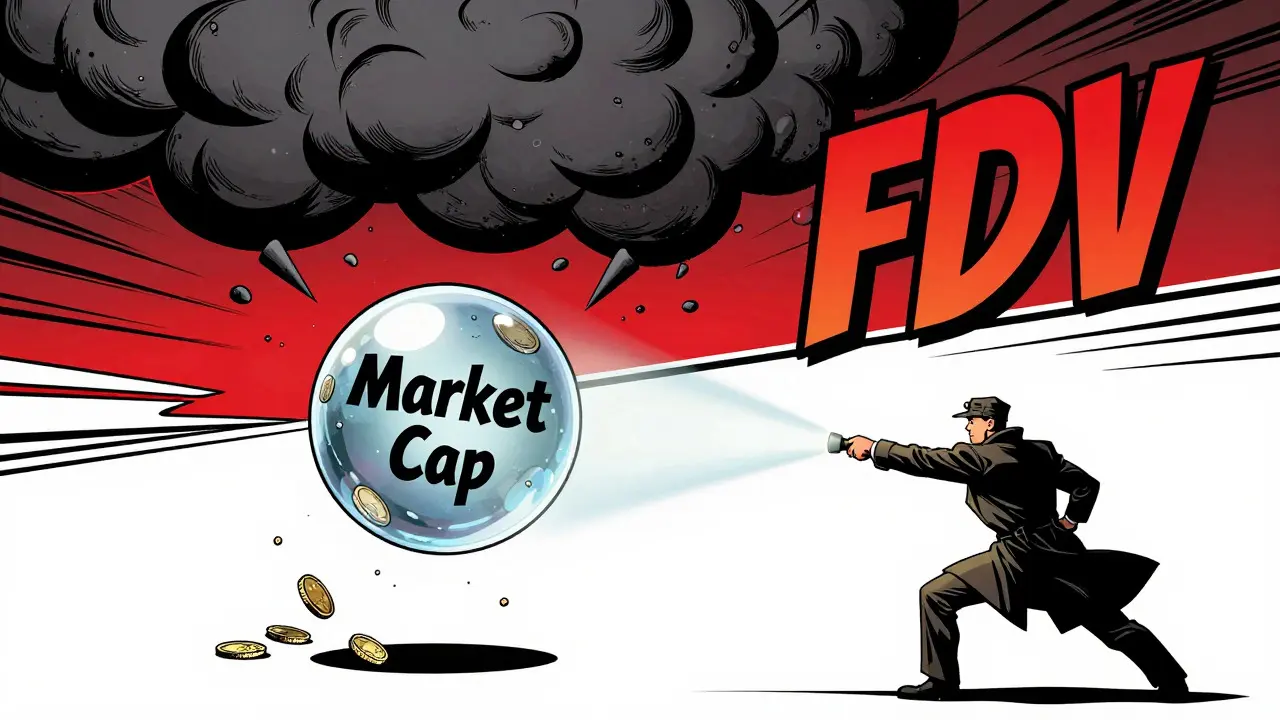
Look closely at the relationship between the Market Capitalization and the Fully Diluted Valuation (FDV). The FDV represents the value if all 10 million tokens were in circulation. At $5.16, the total potential value is over $54 million. Yet, the actual market cap is only about $272,000. Why? Because only 50,000 tokens-just 0.5% of the total supply-are currently circulating.
This is a major red flag. Most legitimate projects launch with 20% to 50% of their tokens in circulation to ensure liquidity and decentralization. After nearly four years since its 2022 launch, having less than 1% of tokens available suggests that the vast majority of the supply is held by insiders, the development team, or early investors who have not sold yet. This creates a looming "supply overhang." If those holders decide to sell, the price could collapse instantly because there isn't enough buying power in the market to absorb the dump.
Technical Claims vs. Verification
Ozonechain makes bold technical claims. It states it can process "billions of transactions per second." For perspective, Visa processes around 24,000 transactions per second. Bitcoin handles about 7. Ethereum manages roughly 15-30. Claiming billions is an extraordinary assertion that requires extraordinary proof.
Where is the proof? As of August 2026, there is no independent audit verifying these speeds. There are no public benchmarks from reputable third-party firms. Furthermore, the project claims to use the Cosmos SDK, which is a framework for building blockchains that emphasizes interoperability and sovereignty. While the Cosmos SDK is robust and used by successful chains like Binance Smart Chain and Terra (before its collapse), simply using the SDK does not automatically grant billion-TPS capabilities. Usually, such performance comes from specific consensus mechanisms like HotStuff or advanced sharding, neither of which is clearly detailed in Ozonechain’s public documentation.
The "5th Layer Security System" is another term thrown around without clear definition. In cybersecurity, layers usually refer to the OSI model (Physical, Data Link, Network, Transport, Session, Presentation, Application). A "5th Layer" implies session-level security, but without whitepaper details explaining *how* this works, it remains marketing jargon. Investors should be wary of buzzwords that sound impressive but lack technical substance.
Liquidity and Trading Risks
If you decide to buy OZONE, you will likely do so on smaller exchanges like LBank or BitMart. These platforms offer limited pairs, primarily OZONE/USDT. The 24-hour trading volume hovers around $370,000. While this sounds like a decent amount, remember that the entire market cap is only $272,000. This means the daily volume is higher than the total value of the circulating supply-a statistical anomaly that often indicates wash trading or extremely thin order books.
Thin liquidity means high slippage. If you try to sell a large position, you might not find buyers at the current price. Your sell order could drop the price significantly just by executing. Additionally, the token has shown high volatility, with a 14-day Relative Strength Index (RSI) often dipping below 30, indicating oversold conditions. However, being oversold doesn't mean it's a bargain; it can stay oversold for months if interest wanes.
Consider the comparison with established DeFi tokens. Uniswap (UNI) or Aave (AAVE) have millions in daily volume and deep liquidity pools. OZONE has neither. This makes it ill-suited for practical use cases like payments or collateral, as the cost of entering and exiting positions would be prohibitively high for most users.
Community and Development Activity
A healthy crypto project thrives on community engagement. Developers post updates, users discuss features, and analysts review code. For Ozonechain, silence reigns. Reddit threads are sparse or non-existent. Twitter activity is minimal compared to the claimed team size of 201-500 employees. If a company truly has hundreds of employees, where are the GitHub commits? Where are the developer blogs? Where are the hackathons?
The absence of a publicly accessible, detailed whitepaper is also concerning. While a link is provided on the site, full technical specifications are often hidden or outdated. In the open-source ethos of blockchain, transparency is key. When a project hides its technical roadmap or lacks active developer forums, it raises questions about whether the team is still working on the product or if they are merely holding the bag.
User sentiment on tracking sites like CoinCodex is bearish. Existing holders report frustration with price fluctuations and lack of news. Without new partnerships, enterprise adoption, or real-world utility, the narrative driving the price is purely speculative-and speculation fades quickly in a mature market.

Is Ozonechain a Scam or Just Stalled?
Labeling something a "scam" requires legal proof of intent to defraud. However, we can identify "red flags" that suggest high risk. Ozonechain exhibits several:
- Extreme Token Concentration: 99.5% of tokens are out of circulation after 4 years.
- Vague Technical Claims: "Billions of TPS" and "5th Layer Security" without audits.
- Lack of Liquidity: High risk of slippage and exit traps.
- Minimal Community: No visible user base or developer activity.
- Inconsistent Branding: Confusion between Quantum Resistance and Cosmos SDK narratives.
It may not be a outright scam in the sense that the website exists and tokens trade. But it behaves like a stalled project. The team may have abandoned development, leaving the token to drift. Or, they may be planning a massive unlock of tokens later, which would crash the price for current holders. Either way, the risk-to-reward ratio is heavily skewed against the retail investor.
Final Thoughts: Proceed with Extreme Caution
So, what is Ozonechain? It is a micro-cap cryptocurrency with ambitious claims and negligible execution. It sits at rank #3993 on CoinMarketCap, far removed from the top-tier projects that define the industry. For a beginner, it is a dangerous trap due to the illusion of a low share price ($5) masking a tiny market cap and huge future supply. For an experienced trader, it offers little utility and high liquidity risk.
If you are looking for exposure to DeFi or Layer 1 blockchains, consider established players with transparent tokenomics, active development, and real usage. Ozonechain serves as a cautionary tale: always look beyond the headline claims. Check the circulating supply. Read the audits. Look for the community. If those elements are missing, you might be buying a ticket to an empty theme park.
What is the total supply of OZONE tokens?
The maximum total supply of OZONE is exactly 10,000,000 tokens. However, as of mid-2026, only about 50,000 tokens (0.5%) are in circulation, meaning the vast majority are held off-market.
Is Ozonechain built on Ethereum?
No, Ozonechain is built using the Cosmos SDK, making it an independent Layer 1 blockchain. However, it claims to be EVM (Ethereum Virtual Machine) compatible, allowing developers familiar with Solidity to build on it.
Why is the market cap so low compared to the price?
The market cap is low because very few tokens are circulating. Market Cap = Price x Circulating Supply. With only 50,000 tokens trading, even a $5 price results in a tiny market cap (~$272k), while the Full Diluted Valuation is over $54 million.
Where can I buy OZONE?
OZONE is listed on smaller cryptocurrency exchanges such as LBank and BitMart. It is not typically found on major tier-1 exchanges like Coinbase or Binance, which reflects its low liquidity and market recognition.
Does Ozonechain have quantum resistance?
There is conflicting information. Older sources mention quantum-resistant features, but the current official website focuses on speed and security via the Cosmos SDK without explicitly detailing quantum cryptography. This inconsistency adds to the uncertainty surrounding the project's technical foundation.


Another rug pull waiting to happen 🚩
you guys are all asleep at the wheel while the deep state manipulates liquidity pools via algorithmic centralization protocols designed to suppress retail leverage and enforce fiat hegemony through synthetic asset manipulation and shadow banking derivatives that operate outside regulatory oversight frameworks established by post-2008 financial reforms which were never truly implemented but rather simulated for public consumption to maintain illusion of market efficiency and transparency in decentralized finance ecosystems that are fundamentally centralized by design from inception to execution layer implementation details hidden behind proprietary consensus mechanisms controlled by venture capital syndicates with ties to traditional banking institutions seeking to co-opt blockchain technology for surveillance capitalism purposes rather than genuine disintermediation goals originally envisioned by cypherpunk pioneers who understood true privacy requires mathematical proof not just marketing slogans about decentralization that mean nothing without verifiable on-chain data proving distribution of power among participants rather than concentration within few entities holding majority supply as seen here where insiders control ninety nine percent of tokens creating massive asymmetric risk profile unfavorable to late entrants assuming rational actor model holds which it rarely does in crypto markets driven by sentiment and narrative rather than fundamentals leading to bubbles and crashes repeating historical patterns observed in tulip mania south sea bubble dot com era housing crisis and now crypto winter cycles indicating systemic instability inherent in speculative assets lacking intrinsic value backing or cash flow generation capabilities required for sustainable investment thesis beyond pure gambling mechanics disguised as technological innovation narratives pushing adoption curves forward artificially through hype cycles fueled by social media influencers paid by projects to shill tokens before dumping positions on unsuspecting retail investors trapped in exit liquidity scenarios orchestrated by market makers manipulating order books across fragmented exchange landscapes suffering from low volume high slippage conditions exacerbating price volatility and uncertainty surrounding future developments roadmap updates team communications community engagement metrics developer activity levels code repository commits audit reports security assessments vulnerability disclosures patch releases upgrade paths migration strategies interoperability solutions cross-chain bridges oracle integrations governance mechanisms voting rights proposal submissions execution timelines treasury management fund allocation spending priorities grant programs ecosystem incentives staking rewards delegation options validator selection criteria slashing conditions fault tolerance models consensus algorithms proof of stake proof of work hybrid approaches energy consumption considerations environmental impact statements sustainability commitments carbon offset initiatives green blockchain certifications renewable energy partnerships mining operations hardware requirements software dependencies client implementations node synchronization network topology peer-to-peer architecture routing protocols latency optimization throughput scaling solutions sharding techniques rollup layers zero knowledge proofs homomorphic encryption multi-party computation secure enclaves trusted execution environments attestation mechanisms identity verification know your customer anti-money laundering compliance regulations legal frameworks jurisdictional challenges tax implications accounting standards reporting requirements disclosure obligations fiduciary duties liability protections insurance coverage dispute resolution mechanisms arbitration clauses smart contract enforcement judicial precedents case law interpretations statutory amendments legislative proposals executive orders administrative rulings agency guidance industry best practices self-regulatory organization standards professional certification programs educational resources training modules workshops seminars conferences hackathons meetups local chapters global networks ambassador programs affiliate marketing referral schemes bounty campaigns bug bounties security audits penetration testing red team exercises blue team defenses incident response plans disaster recovery backups redundancy systems failover mechanisms monitoring tools alerting systems dashboard analytics visualization platforms reporting interfaces user experience design usability testing accessibility features localization translations internationalization support multilingual content regional adaptations cultural sensitivities market segmentation target audience demographics psychographics behavioral analysis consumer insights preference mapping journey mapping touchpoint optimization conversion funnel analysis retention strategies churn reduction loyalty programs incentive structures reward systems tokenomics models economic simulations game theory applications mechanism design auction theory pricing strategies dynamic pricing algorithms machine learning models predictive analytics forecasting tools scenario planning stress testing backtesting historical performance evaluation benchmarking comparisons competitive landscape analysis swot analysis pestle analysis porter five forces framework business model canvas value proposition design customer development lean startup methodology agile development scrum kanban waterfall iterative processes continuous integration continuous deployment ci cd pipelines automated testing unit tests integration tests end-to-end tests regression tests smoke tests sanity tests acceptance tests performance tests load tests stress tests volume tests endurance tests spike tests soak tests capacity tests scalability tests reliability tests availability tests durability tests consistency tests partition tolerance tests cap theorem trade-offs base duality theorem linearizability sequential consistency eventual consistency strong consistency weak consistency causal consistency session consistency monotonic read monotonic write read-your-writes writes-follow-reads bounded staleness freshness guarantees timestamp ordering vector clocks lamport timestamps logical clocks physical clocks hybrid logical clocks hlc true time service ttps google spanner cockroachdb yugabyte database distributed sql databases newsql nosql document stores key-value stores column-family stores graph databases wide-column stores search engines indexing full-text search inverted indexes bloom filters skip lists hash maps tries radix trees suffix arrays suffix trees string matching algorithms pattern recognition natural language processing nlp text classification sentiment analysis topic modeling named entity recognition relation extraction question answering summarization translation speech recognition computer vision image classification object detection face recognition pose estimation motion tracking video analysis audio processing music generation art generation creative coding generative adversarial networks gan variational autoencoders vae diffusion models transformers attention mechanisms encoder-decoder architectures seq2seq models lstm gru rnn neural networks deep learning convolutional neural networks cnn recurrent neural networks rnn long short-term memory lstm gated recurrent unit gru feedforward networks perceptrons multi-layer perceptrons mlp radial basis function networks rbf kohonen self-organizing maps som boltzmann machines restricted boltzmann machines rbm hopfield networks associative memories reservoir computing echo state networks liquid state machines spiking neural networks snn neuromorphic computing brain-inspired computing cognitive architectures symbolic ai connectionist ai hybrid ai neuro-symbolic ai explainable ai xai interpretable ai transparent ai trustworthy ai ethical ai fair ai unbiased ai inclusive ai accessible ai sustainable ai green ai efficient ai low-carbon ai circular economy principles cradle-to-cradle design waste minimization resource optimization lifecycle assessment lca environmental product declarations epd carbon footprint calculation greenhouse gas emissions inventory scope 1 2 3 emissions reduction targets net-zero commitments science-based targets initiative sbti paris agreement alignment climate action agenda sdgs sustainable development goals un global compact responsible business conduct human rights due diligence labor standards working conditions health safety environment hse community relations stakeholder engagement indigenous peoples rights land use change biodiversity conservation ecosystem services valuation natural capital accounting triple bottom line people planet profit shared value creation corporate social responsibility csr environmental social governance esg investing impact investing socially responsible investing sri green bonds sustainability linked loans slsl transition finance taxonomy classification system disclosure standards tcfd task force climate-related financial disclosures tcfd sasb sustainability accounting standards board iirc integrated reporting council ggi global reporting initiative iso 26000 guidance standard iso 14001 environmental management iso 9001 quality management iso 45001 occupational health safety iso 50001 energy management iso 27001 information security management iso 22301 business continuity management iso 31000 risk management iso 9001 quality management iso 14001 environmental management iso 45001 occupational health safety iso 50001 energy management iso 27001 information security management iso 22301 business continuity management iso 31000 risk management
The discrepancy between the quantum resistance claims and the current EVM focus is genuinely fascinating. It reminds me of the early days of Ethereum when the roadmap shifted dramatically from a simple currency platform to a world computer. However, unlike Ethereum, Ozonechain seems to have lost its way rather than pivoting successfully. The lack of a clear technical identity makes it difficult to assess whether this is a feature or a bug in their strategy. I wonder if the team is still actively developing or if they are simply maintaining the status quo until a better offer comes along. The theme park analogy used in the article is spot on; you pay for an experience that doesn't exist yet, hoping it will materialize before your ticket expires. In crypto, tickets don't expire, but patience certainly does.
I just sit back and watch these micro-cap coins dance around like headless chickens. It’s almost artistic how much hope people put into something with zero substance. The silence from the dev team is louder than any whitepaper could ever be. You can practically hear the dust settling on their GitHub repositories. It’s a ghost town with a price tag.
There is a profound philosophical lesson here about the nature of value in digital spaces. We assign worth based on collective belief, yet when that belief is not anchored in utility or community, it becomes a fragile construct. Ozonechain represents a hollow shell, a monument to ambition without execution. It invites us to reflect on why we invest in ideas versus reality. Perhaps the real value lies in the cautionary tale itself, teaching us to look deeper than the surface-level promises of technological utopias. The empty theme park is a metaphor for many modern ventures that prioritize branding over building. It is a gentle reminder to seek authenticity in an age of simulation.
Hey everyone! Look on the bright side, at least it’s not another meme coin based on a dog. There’s always hope for redemption in the crypto world. Maybe they’re cooking up something huge in secret? Innovation often comes from unexpected places. Let’s give them the benefit of the doubt and keep an eye on their GitHub. Who knows, maybe they’ll surprise us all with a breakthrough in quantum-resistant tech. Stay positive, folks!
the existential dread of holding a bag that weighs nothing is palpable here. you are not just buying a token you are buying into a void a metaphysical emptiness that consumes your portfolio. the boundary between investor and victim is porous and permeable allowing the toxins of bad governance to seep into your soul. consider the ontological status of the token does it exist if no one is trading it? solipsism meets market cap. the jargon is thick but the meaning is thin like skim milk in a desert. wake up sheeple
It is evident that this project is part of a larger scheme to destabilize the global financial order by introducing worthless assets that distract the populace from the real issues. The lack of liquidity is not an accident but a calculated move to trap retail investors while the elites accumulate wealth through off-book transactions. One must remain vigilant against such conspiracies that threaten the very fabric of our economic freedom. The silence from the developers is deafening because they are communicating through encrypted channels known only to the initiated. Do not be fooled by the superficial appearance of a legitimate blockchain project. It is a facade designed to hide the rotting core of corruption and deceit that permeates the entire cryptocurrency industry. Wake up and smell the coffee of truth.
One might inquire as to the fundamental rationale behind the continued existence of such a project given the overwhelming evidence of its stagnation. The absence of a robust community and active development suggests a failure in the initial value proposition. It is imperative to scrutinize the tokenomics more closely to understand the implications of the vast supply held by insiders. This concentration of power poses a significant threat to the decentralization ethos that blockchain technology purportedly champions. Therefore, a cautious approach is warranted for any potential investor considering exposure to this asset class.
Actually, if you look at the Cosmos SDK documentation, there are several chains that started slow and picked up later. But yeah, the FDV gap is ugly :/ I’d wait for a real catalyst before touching this. Not saying it’s dead, just... sleeping. Deeply.