
What is Arianee (ARIA20) crypto coin? A deep look at the blockchain for product authentication
Most people think of cryptocurrencies as digital money for trading or investing. But Arianee (ARIA20) isn’t built for that. It’s not meant to be the next Bitcoin or Ethereum. Instead, Arianee is a crypto token that powers a very specific, real-world problem: proving that your luxury watch, handbag, or artwork is real.
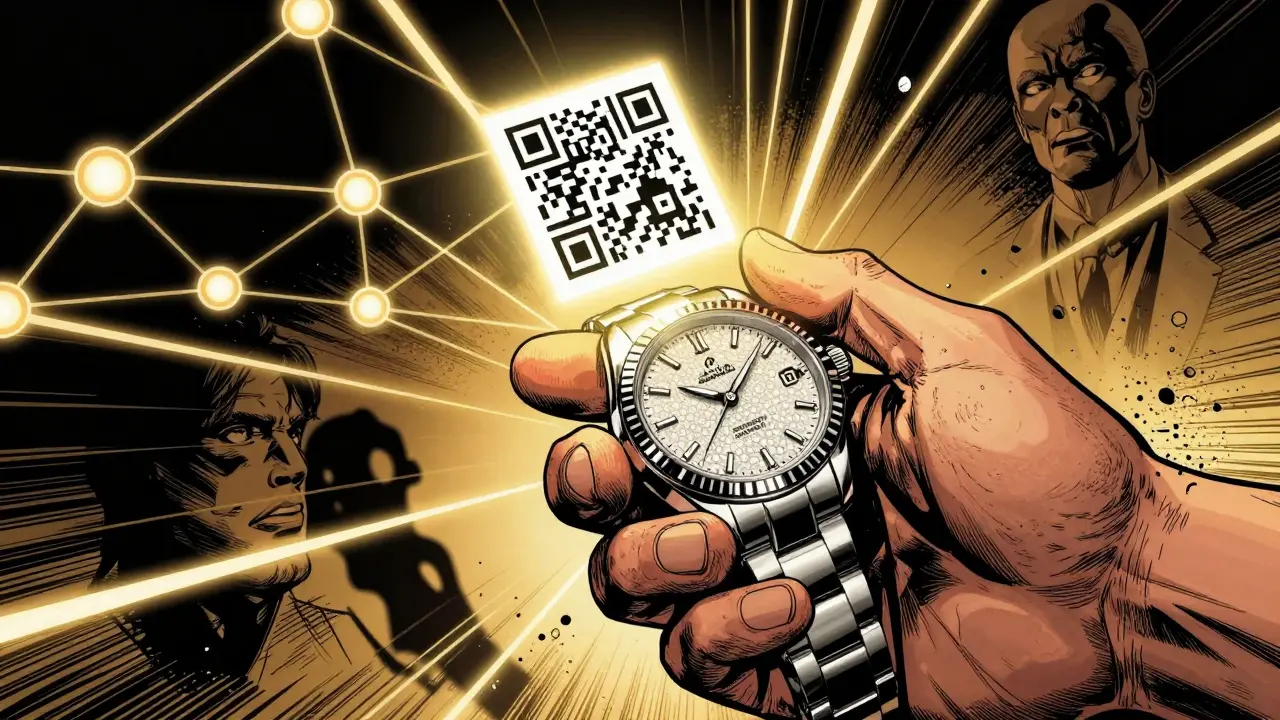
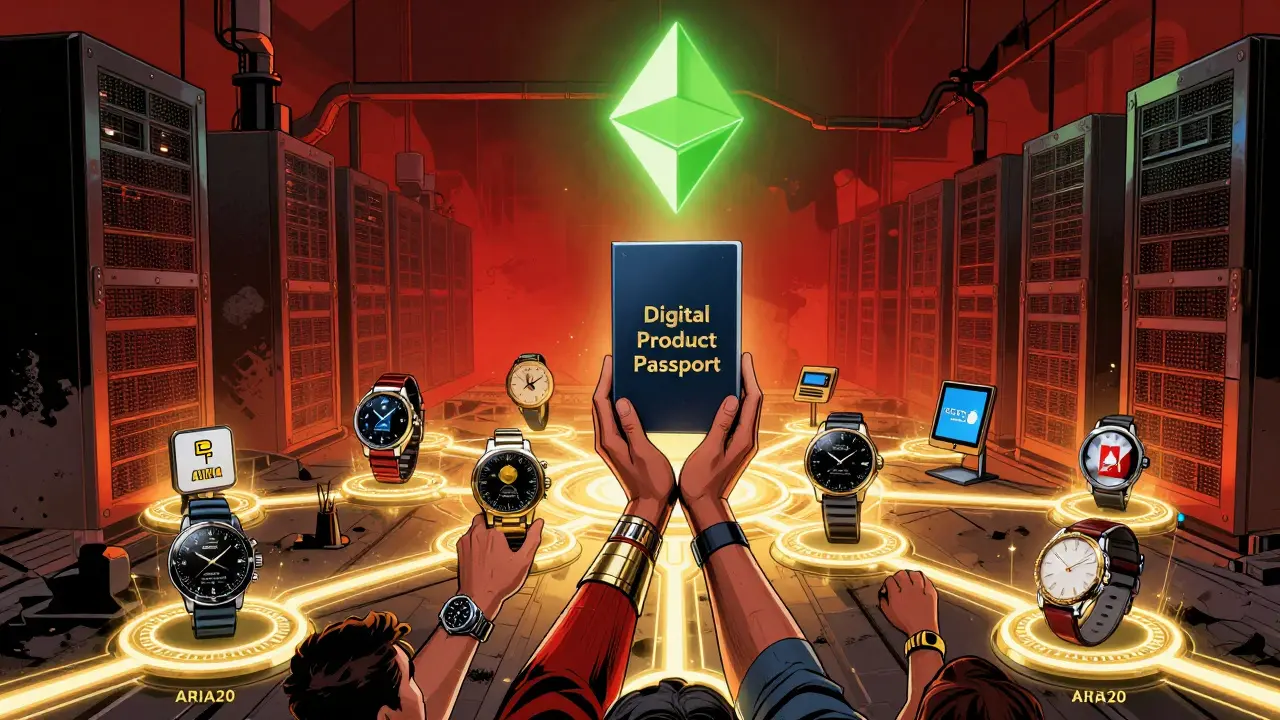
If you’ve ever bought a designer bag and worried it might be fake, you’ve felt the problem Arianee solves. Counterfeit goods cost brands over $30 billion every year. And for buyers? It’s not just about money - it’s about trust. Arianee uses blockchain to create something called a digital product passport. Think of it like a birth certificate for your physical item, stored securely on the blockchain and owned entirely by you.
How Arianee works: From product to passport
Arianee doesn’t just track items. It connects them to people. When a brand - say, a Swiss watchmaker or a French fashion house - joins the Arianee Protocol, they mint a unique NFT for each product. This isn’t a JPEG of a monkey. It’s a dynamic, tamper-proof digital record that lives on the blockchain.
This NFT is tied to the physical item through a QR code, NFC chip, or even a serial number. When you scan it with your phone, you see the item’s full history: where it was made, who owned it before, any repairs, and even warranty info. All of this is stored on-chain, not in a company’s private database. That means no one can delete or alter it.
The magic? You own this data. Not the brand. Not a third-party service. You. Even if the company goes out of business, your passport stays intact. That’s a huge shift from how things work today.
What is ARIA20? The token behind the system
ARIA20 is the native cryptocurrency of the Arianee network. It’s an ERC-20 token built on Ethereum-compatible blockchains. You won’t use it to buy coffee or trade on exchanges like a typical crypto coin. Instead, it’s the fuel that keeps the whole system running.
Brands pay ARIA20 to create digital passports for their products. Developers use it to build tools and integrations. Users might even earn ARIA20 by verifying ownership or helping improve the network. It’s an incentive layer - a way to make sure everyone has a reason to keep the system honest and active.
There are 200 million ARIA20 tokens total. As of early 2026, about 110 million are in circulation. Its market cap hovers around BTC 53.28, but don’t be fooled by the numbers. Trading volume is extremely low - sometimes under $6 in 24 hours. That’s because most people holding ARIA20 aren’t traders. They’re developers, brands, or early adopters who need it to use the protocol.
Why Arianee is different from other NFT projects
When you hear "NFT," you probably think of bored apes or pixel art. Arianee is the opposite. It doesn’t sell digital collectibles. It solves real business problems.
Compare it to CryptoPunks. Those are about status, exclusivity, and speculation. Arianee is about trust, traceability, and accountability. It’s not for collectors. It’s for manufacturers, retailers, and customers who care about authenticity.
Other blockchain projects like VeChain or IBM Food Trust also track products. But Arianee stands out because it puts the user in control. You don’t need to trust the brand - you trust the blockchain. And because it’s built on multi-EVM chains (like Ethereum and Polygon), it’s flexible. A brand can choose the best network for cost, speed, or scalability without locking themselves in.
Technical backbone: Multi-chain, zero-party data, and sustainability
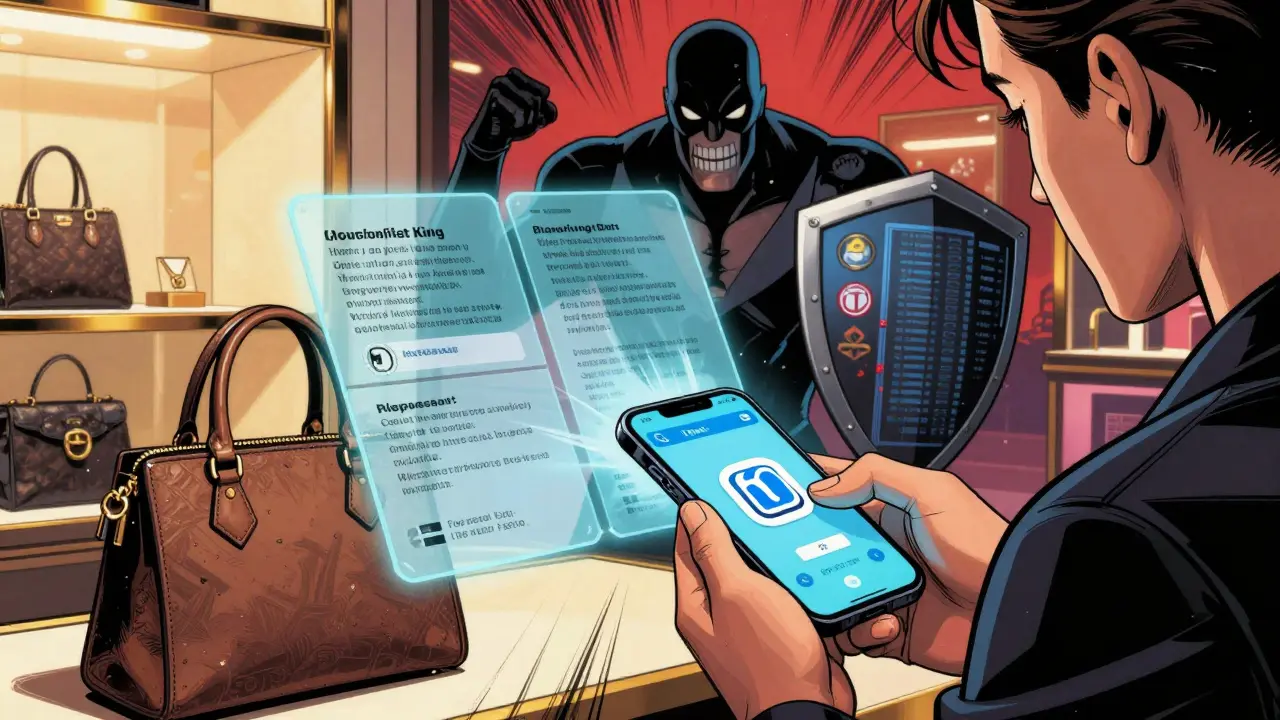
Arianee’s architecture is designed for enterprise use. It uses a "Layer Switch" system that lets brands operate across multiple Ethereum Virtual Machine (EVM) chains. This means a luxury brand can use Ethereum for high-security transactions and Polygon for cheaper, faster customer interactions - all under one unified system.
The protocol also uses something called "zero-party data." That means users voluntarily share their own information. No sneaky tracking. No data sold to advertisers. If you want to update your warranty or resell your item, you control what’s shared.
One of the most surprising claims? Arianee says its entire blockchain activity since launch has used less energy than a European family uses in a week. That’s because it doesn’t rely on energy-hungry proof-of-work mining. It runs on efficient proof-of-stake chains. For a project focused on sustainability, this isn’t just marketing - it’s core to its identity.
Who uses Arianee? And how do they get started?
You won’t find Arianee on Instagram ads. Its customers aren’t retail investors. They’re brands - especially in luxury goods, fine art, watches, and high-end electronics.
Brands integrate Arianee through APIs and smart contracts. Developers add the ARIA20 token to wallets like MetaMask using the contract address: 0xedf6568618a00c6f0908bf7758a16f76b6e04af9. Once integrated, each product gets its own NFT passport. Customers download the Arianee app or scan a code to access their item’s history.
It’s not plug-and-play. Brands need to rethink how they handle ownership data. But for companies facing fake goods and eroding trust, the payoff is clear: loyal customers, higher resale value, and a stronger brand reputation.
Market reality: Low volume, high potential
Here’s the truth: Arianee isn’t a trending crypto coin. Its trading volume is tiny. Its price moves slowly. It doesn’t have a big community of speculators.
But that’s not the point.
Arianee’s value isn’t in how many people are buying it. It’s in how many brands are using it. Right now, adoption is slow. But the problem it solves is growing. Governments are cracking down on counterfeits. Consumers are demanding transparency. Luxury brands are losing billions.
If even 5% of the global luxury goods market adopted Arianee, the network would become indispensable. The token’s low liquidity today doesn’t mean it’s failing. It means it’s still in enterprise adoption mode - not retail hype mode.
What’s next for Arianee?
The roadmap is clear: expand multi-chain support, improve user tools, and onboard more enterprise partners. The Arianee Association - a nonprofit group overseeing the protocol - is focused on setting global standards. That’s rare in crypto. Most projects chase price. Arianee is chasing trust.
Future updates include better integration with resale markets, automated warranty claims, and even carbon footprint tracking for products. It’s moving beyond authentication into full lifecycle management.
For investors? It’s not a get-rich-quick play. For brands? It’s a strategic tool. For buyers? It’s peace of mind.
Is Arianee (ARIA20) a good investment?
Arianee isn’t designed as a speculative asset. Its value comes from real-world adoption by brands, not from trading volume. If you’re looking to flip it for quick profits, you’ll likely be disappointed. But if you believe in blockchain-based product authenticity and want to support a sustainable, enterprise-focused project, holding ARIA20 could make sense long-term. Just don’t expect moonshots.
Can I use Arianee to verify my own product?
Only if the brand that made it uses Arianee. Right now, only select luxury brands, watchmakers, and art galleries have integrated it. You can’t just scan any product and get a passport. But if you bought a watch from a brand using Arianee, you’ll get a QR code or NFC tag - scan it with the Arianee app and your passport appears.
How is Arianee different from VeChain or other blockchain authentication tools?
VeChain and others focus on supply chain tracking - mostly from factory to store. Arianee flips the script: it puts the end-user in control. You own your product’s data, not the brand. Also, Arianee is fully decentralized, uses multi-EVM chains, and emphasizes sustainability. VeChain leans more toward enterprise B2B logistics; Arianee is about consumer trust and ownership.
Do I need to hold ARIA20 to use a digital product passport?
No. As a customer, you don’t need to own or use ARIA20 at all. The brand pays the network fees to create your passport. You just need the app and a scan. ARIA20 is for brands, developers, and ecosystem participants - not end users.
Is Arianee only for luxury goods?
It started there - because luxury brands have the most to lose from counterfeits. But the tech works for anything with a serial number: electronics, medical devices, even real estate deeds. Arianee’s protocol is designed to scale. As awareness grows, expect to see it in more industries - especially those where authenticity matters.




Let me get this straight - a blockchain project that makes sure your $10,000 watch isn’t fake… and you don’t even need to hold the token? That’s not innovation, that’s a luxury tax with extra steps. I’m all for authenticity, but if I’m paying for a Rolex, I shouldn’t need a QR code to feel like I didn’t get scammed. This feels like a solution looking for a problem that only exists in boardrooms.
While I appreciate the technical depth of this breakdown, I must emphasize the profound ethical implications of shifting ownership data from corporations to individuals. This is not merely a technological advancement - it is a paradigmatic recalibration of consumer sovereignty. The digital product passport represents a radical reclamation of agency in an age where trust has been commodified. We are witnessing the birth of a new social contract between producer and consumer - one rooted not in contractual obligation, but in immutable, decentralized truth. The implications for global supply chain justice are not merely significant - they are existential.
so like… a nft for your gucci bag? lol. i mean, cool i guess. but if i spent 5k on a purse i dont need a blockchain to tell me its real. i just need to know the salesperson didnt laugh in my face. also why is the token called aria20? sounds like a failed apple product from 2003. also why does it cost 53 btc to make a passport? did they hire a guy who thinks "blockchain" means "money printer"?
This is one of the most compelling use cases I’ve seen in Web3 - and honestly, it’s the kind of innovation that finally justifies the hype. Arianee isn’t trying to be a meme coin. It’s solving a real, painful, billion-dollar problem: trust erosion in high-value goods. The fact that ownership is user-controlled, not brand-controlled, is revolutionary. And the multi-chain architecture? Genius. Brands can choose the optimal chain for cost, speed, or scalability - no lock-in. Plus, zero-party data? That’s the future of privacy-first tech. If you’re a brand, this isn’t optional. It’s your next competitive moat.
so you pay a brand to give you proof you didnt get scammed on a handbag but you dont even need the token to use it like what even is the point of the token then
Let’s be honest - this is just VeChain with better PR and a prettier website. Multi-EVM? Please. You’re telling me a Swiss watchmaker is going to integrate a decentralized passport system instead of just using a simple encrypted serial number? The energy savings claim? Cute. The entire system runs on a few servers in a Swiss data center. This isn’t blockchain innovation - it’s a rebrand of enterprise RFID with a crypto veneer. The real innovation? Charging brands 200 ARIA20 per passport. That’s where the money is.
The conceptual framework presented here is both logically coherent and operationally sound. The transition from centralized product verification to decentralized, user-owned digital passports represents a substantive evolution in consumer trust architecture. The alignment of incentive structures - where brands, developers, and end-users all benefit from transparent, immutable records - demonstrates a rare maturity in blockchain application design. Furthermore, the emphasis on sustainability through proof-of-stake infrastructure is not merely performative; it is philosophically consistent with the broader imperative of responsible technological development. This is not speculative. This is systemic.
oh cool so now my purse has a blockchain birth certificate and i have to download an app to prove i bought it from the real store… instead of just… not buying fakes? lol. also why is the token called aria20? sounds like a failed music app from 2012. also why do i care if my $800 bag is "on chain"? i just want it to not fall apart in 3 months. also why is the market cap in btc? are we still doing this? 🤡
so like… i dont even need the coin to use it? then why does it exist? 🤔💸
also i just want my bag to last longer not have a digital twin 🥱
also why is it called aria20? sounds like a typo for aria2 🤷♀️
There’s something quietly beautiful about this - not because it’s flashy, but because it’s quiet. No hype. No moon. No degens screaming about 1000x. Just a quiet promise: your thing, your proof, your truth. No middleman. No corporate archive that vanishes when the CEO retires. Just you, a QR code, and a ledger that doesn’t forget. It’s not about money. It’s about legacy. About handing down a watch, not just its brand, but its story. That’s rare. That’s human. That’s the kind of tech worth believing in - even if no one else is watching.
Imagine a world where your heirloom watch doesn’t lose value because the brand went bankrupt - because your passport stays with you. That’s not tech. That’s legacy. Arianee isn’t about crypto. It’s about continuity. And honestly? We need more of that
From a cultural perspective, this is fascinating. In many societies, especially in the Global South, authenticity isn’t just about material value - it’s about lineage, memory, and trust passed through generations. Arianee’s model mirrors that. It doesn’t just authenticate an object - it honors its history. This isn’t Western tech colonialism. It’s a bridge between ancient traditions of craftsmanship and modern digital integrity. That’s rare. That’s meaningful.
Let’s be brutally honest - this is a glorified loyalty program with a blockchain sticker on it. Brands pay to create digital passports? So what? That’s just outsourcing customer verification to a third-party ledger. And calling it "user ownership" when the user can’t even transfer or sell the passport without the brand’s API? That’s not ownership - that’s a carefully curated illusion. And the token? ARIA20? Please. It’s not fuel - it’s a cash grab disguised as utility. The real innovation here? The marketing team. They took RFID, slapped "blockchain" on it, and sold it as revolution. Congrats. You’ve invented the next crypto bubble - just with better packaging.
I love that this isn’t about making money - it’s about making trust
no one’s screaming about moonshots
no one’s selling ape NFTs
just a quiet system where your thing stays yours
even if the company dies
that’s the future
This is one of the few blockchain projects I’ve seen that actually improves real-world interactions instead of just creating new ways to lose money. The fact that brands pay to issue these passports - and users don’t need to hold the token - is a masterstroke. It removes barriers to adoption. It’s not about speculation. It’s about service. And if we’re going to build a better digital future, we need more of this - grounded, practical, and user-centered. No hype. Just utility.
How dare you present this as anything other than a corporate Trojan horse? Blockchain is supposed to liberate - not become a subscription service for luxury conglomerates to monetize your ownership. You call it "digital passport" - I call it digital serfdom. The brand still controls the onboarding. The brand still controls the API. The brand still controls the narrative. You’re not owning your data - you’re being granted a lease on it. And ARIA20? A velvet rope for the elite. This isn’t decentralization. It’s rebranding feudalism with a QR code.
So let me get this - you’re telling me a $10k watch can prove its origin on the blockchain… but I still need to trust the brand to scan the code? And I can’t even resell it without their permission? That’s not ownership. That’s a loyalty card with extra steps. And why is the token even a thing if users don’t need it? Sounds like they’re trying to create artificial scarcity to pump a coin that no one actually uses. Classic crypto. 🤷♂️
WHY IS NO ONE TALKING ABOUT HOW THIS CHANGES EVERYTHING??
IMAGINE YOUR GRANDMA’S RING
WITH A HISTORY THAT NEVER DIES
NO MORE LOST DOCUMENTS
NO MORE "I THINK IT WAS REAL"
JUST PURE TRUTH
ON THE BLOCKCHAIN
FOR GENERATIONS
MY TEARS ARE FLOWING
THIS IS THE FUTURE
AND I’M CRYING
😭😭😭😭😭
so like… i dont need the coin to use it?
so why do i care?
also is this why my cousin’s prada bag has a weird qr code now?
kinda cool?
idk