What Is a Cryptocurrency Exchange? Types, Fees, and Safety Explained
Imagine walking into a stock brokerage to buy shares in Apple. You trust the broker to hold your money, execute the trade, and keep your account safe. Now imagine doing the same thing, but instead of dollars and stocks, you’re dealing with Bitcoin or Ethereum, and the "broker" might be a line of code running on servers halfway across the world. That is essentially what a cryptocurrency exchange is: a digital marketplace platform where users can buy, sell, and trade digital assets like cryptocurrencies and tokens.
If you are new to crypto, this concept can feel overwhelming. There are dozens of platforms, confusing fees, and scary headlines about hacks. But at its core, an exchange is just a middleman. It connects buyers who want to spend their fiat currency (like USD or EUR) for crypto with sellers who want to cash out. Without these platforms, trading would be incredibly slow and difficult for most people.
The Two Main Types of Crypto Exchanges
Not all exchanges work the same way. In fact, they fall into two very different categories that offer distinct experiences. Understanding the difference between these two is the first step toward choosing the right one for your needs.
Centralized Exchanges (CEX)
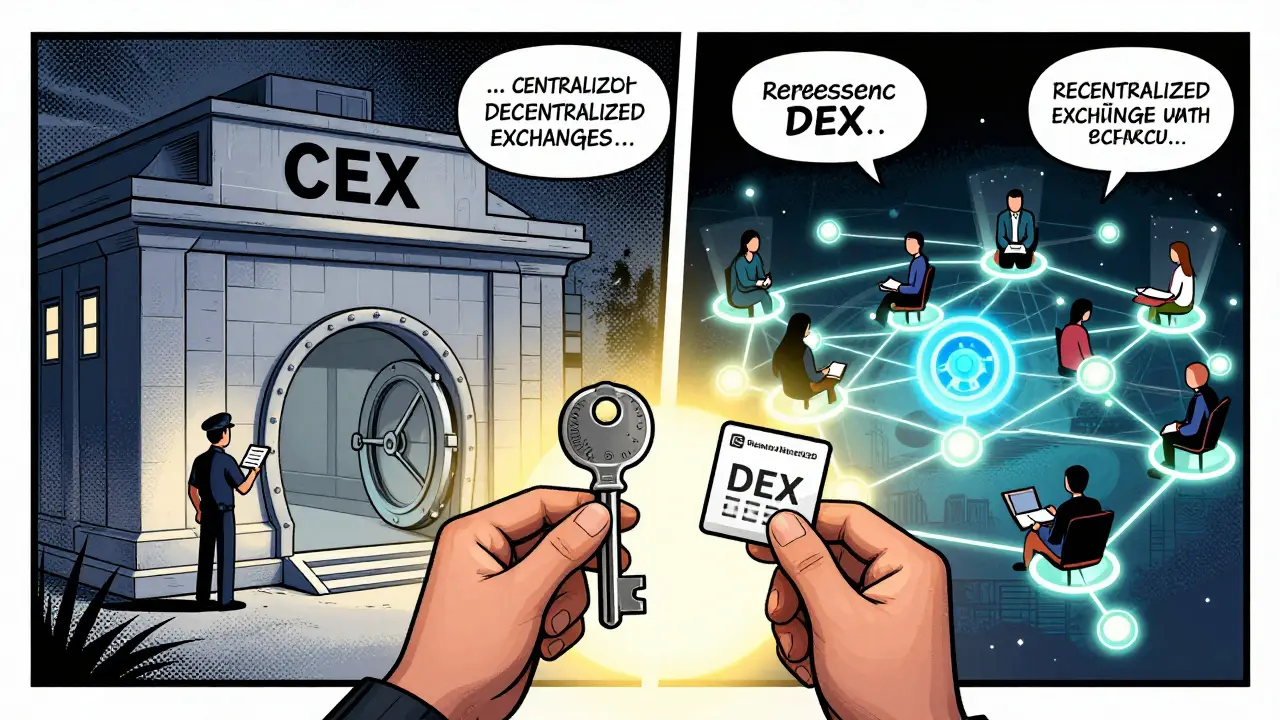
Think of a centralized exchange as a traditional financial institution adapted for digital assets, where a single company controls the platform, user accounts, and funds. Companies like Coinbase, Binance, and Kraken operate this way. When you sign up, you create an account with them. They verify your identity, hold your money in their wallets, and execute trades on their internal books.
This model feels familiar because it mimics how banks and stock brokers have worked for decades. You get customer support if something goes wrong. If you forget your password, there is a help desk to call. Transactions happen instantly because they don’t always wait for blockchain confirmations. However, this convenience comes with a trade-off: you do not control your private keys. The exchange does. This means you are trusting them with your security. If the exchange gets hacked or shuts down, accessing your funds can become a nightmare.
Decentralized Exchanges (DEX)
On the other end of the spectrum sits the decentralized exchange as an autonomous protocol running on smart contracts that allows peer-to-peer trading without a central intermediary. Platforms like Uniswap or SushiSwap fit here. There is no company behind them. No CEO. No customer service team. Instead, the exchange is a set of computer programs deployed on a blockchain network.
When you use a DEX, you connect your personal cryptocurrency wallet directly to the platform. You retain full control of your assets at all times. The trade happens directly on the blockchain between you and another user (or a liquidity pool). This eliminates the risk of a single company stealing your funds. However, it also means there is no safety net. If you send money to the wrong address, it is gone forever. The interfaces can be complex, and you need to understand concepts like gas fees and slippage before you start trading.
How Do Crypto Exchanges Actually Work?
You might wonder how these platforms match buyers with sellers. The mechanism differs significantly depending on whether you are using a centralized or decentralized model.
In a centralized exchange, the company uses an order book. Think of it as a giant list. On one side, you have people wanting to buy Bitcoin at specific prices. On the other, you have people wanting to sell. The exchange’s software matches these orders automatically. If someone wants to buy at $60,000 and someone else wants to sell at $60,000, the trade executes. The exchange takes a small fee from this transaction as profit.
Decentralized exchanges often use a different method called Automated Market Makers (AMMs). Instead of matching individual buyers and sellers, users deposit their crypto into a shared "liquidity pool." When you want to trade, you swap against this pool. A mathematical formula determines the price based on the ratio of assets in the pool. This ensures there is always liquidity available, even if no other human is actively trying to sell at that exact moment.
Safety and Security: Who Holds Your Keys?
This is the most critical question you will face. In the crypto world, there is a famous saying: "Not your keys, not your coins."
When you use a centralized exchange, the exchange holds your keys. They store your Bitcoin in massive digital vaults called cold storage wallets. While major exchanges invest heavily in security-using multi-signature technology, insurance funds, and rigorous audits-they remain attractive targets for hackers. History has shown us numerous cases where centralized exchanges were breached, resulting in millions of dollars lost. To mitigate this risk, many experts recommend moving your crypto to a personal hardware wallet after buying it on an exchange.
With a decentralized exchange, you hold your own keys via your self-custody wallet. This removes the counterparty risk of the exchange going bankrupt or being hacked. However, it shifts the burden of security entirely to you. You must protect your seed phrase (the list of words that gives access to your wallet). If you lose this phrase, no one can help you recover your funds. There is no "forgot password" button in decentralization.
Fees and Costs: What Will Trading Cost You?
No discussion about exchanges is complete without talking about fees. These costs can eat into your profits significantly if you are not careful.
- Trading Fees: Centralized exchanges typically charge a percentage of each trade, ranging from 0.1% to 0.5%. Some offer lower rates if you hold their native token or trade large volumes. Decentralized exchanges usually charge around 0.3%, which goes to the liquidity providers rather than a company.
- Withdrawal Fees: Moving crypto off a centralized exchange often incurs a flat fee to cover blockchain transaction costs. These vary by coin; withdrawing Bitcoin might cost more than withdrawing Ethereum due to network congestion.
- Gas Fees: On decentralized exchanges, you pay "gas" fees to process transactions on the blockchain. During busy periods on networks like Ethereum, these fees can spike dramatically, sometimes costing tens of dollars for a simple swap. Layer 2 solutions and alternative blockchains like Solana or Polygon offer much cheaper alternatives.
- Spread: This is the difference between the buy and sell price. Centralized exchanges often embed a small spread in their quoted prices, which acts as a hidden fee.
| Feature | Centralized Exchange (CEX) | Decentralized Exchange (DEX) |
|---|---|---|
| Custody | Exchange holds your funds | You hold your funds |
| Identity Verification | Required (KYC/AML) | Not required (Anonymous) |
| User Experience | Familiar, easy to use | Complex, technical interface |
| Liquidity | High (Deep order books) | Variable (Depends on pools) |
| Security Risk | Hack of the platform | User error / Smart contract bugs |
| Customer Support | Available 24/7 | Community forums only |
Regulation and Compliance
As cryptocurrency moves from the fringes to the mainstream, governments are paying closer attention. Centralized exchanges are now heavily regulated entities in most developed countries. They must comply with Know Your Customer (KYC) laws, which require you to upload government ID and proof of address. They also follow Anti-Money Laundering (AML) rules to prevent illicit activities.
This regulation provides a layer of consumer protection. If a regulated exchange fails, there may be legal recourse for users. However, it also means your privacy is compromised. Every trade you make is recorded and reported to tax authorities in many jurisdictions.
Decentralized exchanges operate in a gray area. Because there is no central entity to regulate, they are harder to shut down or control. This appeals to privacy advocates, but it also means regulators are developing new ways to target the developers or front-end interfaces of these platforms. Users should be aware that while DEXs offer anonymity, the underlying blockchain transactions are still public and traceable.
Choosing the Right Exchange for You
So, which one should you pick? It depends on your experience level and goals.
If you are a beginner, a centralized exchange is likely the best starting point. The interface is intuitive, you can buy crypto directly with a credit card, and if you run into trouble, there is a support team to guide you. Platforms like Coinbase or Kraken are excellent for getting your foot in the door. Just remember to withdraw your larger holdings to a personal wallet once you are comfortable.
If you are an experienced trader looking for privacy, lower fees, or access to new tokens before they hit major exchanges, a decentralized exchange is the way to go. You will need to learn how to manage a wallet like MetaMask, understand gas fees, and navigate dApps. But the reward is total autonomy over your digital assets.
For those who want a bit of both, hybrid exchanges are emerging. These platforms attempt to combine the speed and ease of centralized matching with the security of decentralized custody. While still a smaller segment of the market, they represent an interesting evolution in how we interact with digital finance.
Is it safe to keep my crypto on an exchange?
It is generally not recommended to keep large amounts of cryptocurrency on a centralized exchange long-term. While reputable exchanges have robust security measures, they are targets for hackers. If the exchange is compromised or goes bankrupt, you could lose your funds. For better security, move your assets to a self-custody hardware wallet after purchasing them.
Do I need to provide my ID to use a crypto exchange?
Yes, if you are using a centralized exchange. Regulatory requirements mandate Identity Verification (KYC) to prevent money laundering and fraud. You will typically need to upload a photo of your passport or driver's license. Decentralized exchanges do not require ID, as you connect directly with your wallet.
Which type of exchange has lower fees?
It depends on the network conditions. Centralized exchanges often have predictable, low trading fees (around 0.1-0.3%). However, decentralized exchanges can be cheaper during low network activity but become expensive when blockchain networks are congested due to high gas fees. Always compare the total cost including withdrawal or gas fees.
Can I buy Bitcoin directly with cash on a decentralized exchange?
No. Decentralized exchanges only allow you to swap one cryptocurrency for another. You cannot deposit fiat currency like USD or EUR directly onto a DEX. You must first buy crypto on a centralized exchange or through a peer-to-peer service, transfer it to your personal wallet, and then use that crypto on the DEX.
What happens if I lose my password on a centralized exchange?
Unlike decentralized platforms, centralized exchanges act like traditional banks. If you forget your password, you can use the "Forgot Password" feature to reset it via email or SMS verification. This is one of the main conveniences of using a centralized platform, though it requires you to trust the company with your account recovery.