Semi-Fungible Tokens with ERC-1155: The Complete Guide to Efficiency and Gaming
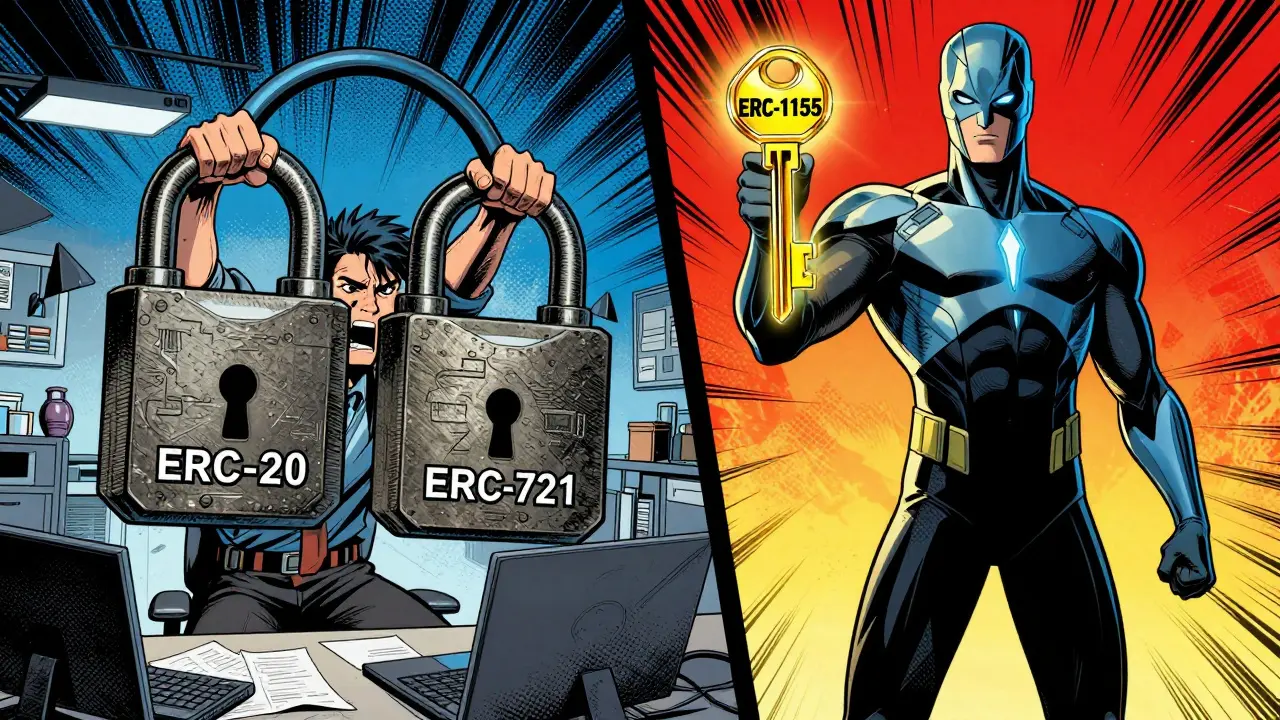
Imagine you are building a video game. You need swords that are all identical (fungible) and legendary armor sets that are one-of-a-kind (non-fungible). In the early days of blockchain, this meant deploying two completely different smart contracts. One for the swords, another for the armor. It was messy, expensive, and slow. Then came ERC-1155, which is a multi-token standard on Ethereum that allows both fungible and non-fungible tokens to exist within a single smart contract. This protocol, introduced by the Enjin team in 2018, changed the rules. It let developers bundle everything into one efficient system. If you are looking to understand why this matters for your project or investment, you have come to the right place.
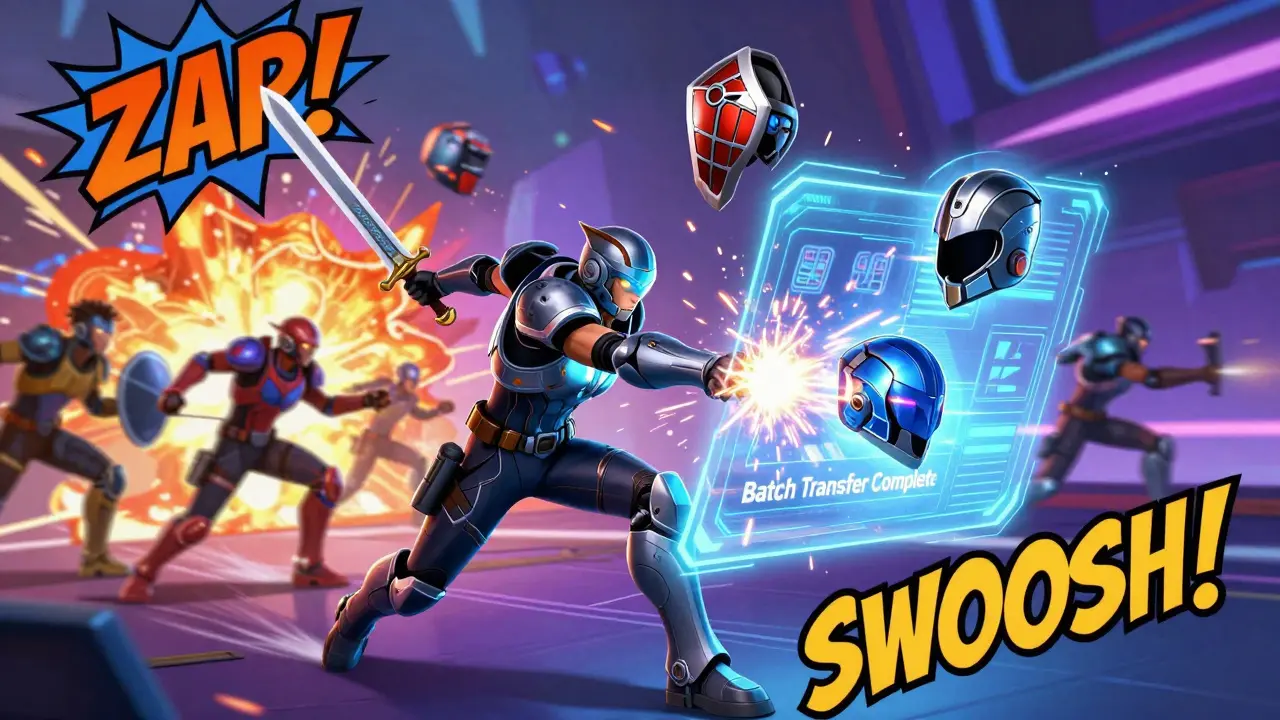
The core problem ERC-1155 solves is efficiency. Before this standard, if you wanted to send five different items to a friend, you had to pay gas fees for each transaction separately. With ERC-1155, you can batch those transfers into one action. This isn't just a minor tweak; it cuts costs significantly. Data from Merkle Science in March 2024 showed that transferring ten NFTs using ERC-1155 cost about 43.7% less in gas than doing the same with the older ERC-721 standard. For a user buying a full set of gear in a metaverse, that difference between paying $5 or $15 in fees is huge.
How Semi-Fungible Tokens Work
To grasp ERC-1155, you first need to understand what "semi-fungible" means. Fungible tokens, like Bitcoin or USDT, are interchangeable. One dollar is equal to another dollar. Non-fungible tokens, like a Bored Ape Yacht Club NFT, are unique. No two are alike. Semi-fungible tokens sit in the middle. Think of concert tickets. Each ticket is unique because it has a specific seat number (non-fungible aspect), but they are also part of a larger pool of identical value (fungible aspect). You can trade a front-row ticket for another front-row ticket, but not for a back-row one.
Technically, ERC-1155 handles this by assigning a unique ID to every token type within a single contract. Unlike ERC-721, where every NFT needs its own contract address, ERC-1155 uses one address for thousands of items. The metadata for these items-like images or descriptions-is stored off-chain, usually on IPFS, while the ownership data stays on the blockchain. This structure allows the network to process bulk updates instantly. When a game server needs to update inventory for 10,000 players simultaneously, ERC-1155 can handle that load without clogging the network.
ERC-1155 vs. ERC-721 and ERC-20
| Feature | ERC-20 | ERC-721 | ERC-1155 |
|---|---|---|---|
| Token Type | Fungible (Interchangeable) | Non-Fungible (Unique) | Semi-Fungible (Both) |
| Contract Structure | One contract per token type | One contract per collection | One contract for multiple types |
| Batch Transfers | No | No | Yes (Up to 10,000 at once) |
| Gas Efficiency | Low | High | Very Low (40-60% savings) |
| Best Use Case | Currencies, Governance | Digital Art, Collectibles | Gaming Items, Metaverse Assets |
The table above highlights why ERC-1155 is gaining traction. ERC-20 is great for money but terrible for unique items. ERC-721 is perfect for art but inefficient for games with thousands of identical swords. ERC-1155 bridges this gap. It allows a developer to mint 10,000 copies of a "Common Sword" and 1 copy of a "Legendary Shield" in the same transaction. This flexibility reduces deployment costs and simplifies wallet integration. Users don't need to manage multiple contract approvals; they approve one contract for all their assets.
Real-World Adoption: Gaming and Metaverses
You might wonder who is actually using this technology. The biggest adopters are in the gaming sector. The Sandbox, a popular metaverse platform, relies heavily on ERC-1155. They use it to manage over 1.2 million in-game items, including wearables, land parcels, and tools. According to Etherscan analytics through May 2024, The Sandbox alone accounts for nearly 32% of all ERC-1155 transactions. This dominance exists because gamers hate waiting. Batch processing means instant inventory updates. When you buy a helmet and boots in The Sandbox, you get them in one click, not two separate transactions that take minutes to confirm.
Other major platforms are following suit. Polygon, Avalanche, and BNB Chain added native support for ERC-1155 in early 2024, recognizing its utility beyond just Ethereum. This cross-chain compatibility is crucial. It means an asset created on Ethereum can be bridged to other networks efficiently. Enterprise adoption is also rising. Gartner reported in May 2024 that 42 Fortune 500 companies are exploring ERC-1155 for loyalty programs. Imagine earning points that are fungible but can be upgraded into unique, non-transferable rewards. That is the power of semi-fungibility.
Security and Technical Considerations
Efficiency comes with complexity. While ERC-1155 is robust, it introduces new security dynamics. The standard includes a built-in safety feature called onERC1155Received. This hook ensures that if you accidentally send tokens to a contract that doesn't support ERC-1155, the transaction reverts. This prevents the common mistake of sending crypto to an incompatible address, which usually results in permanent loss. ChainSafe's analysis confirms this mechanism is effective at preventing accidental burns.
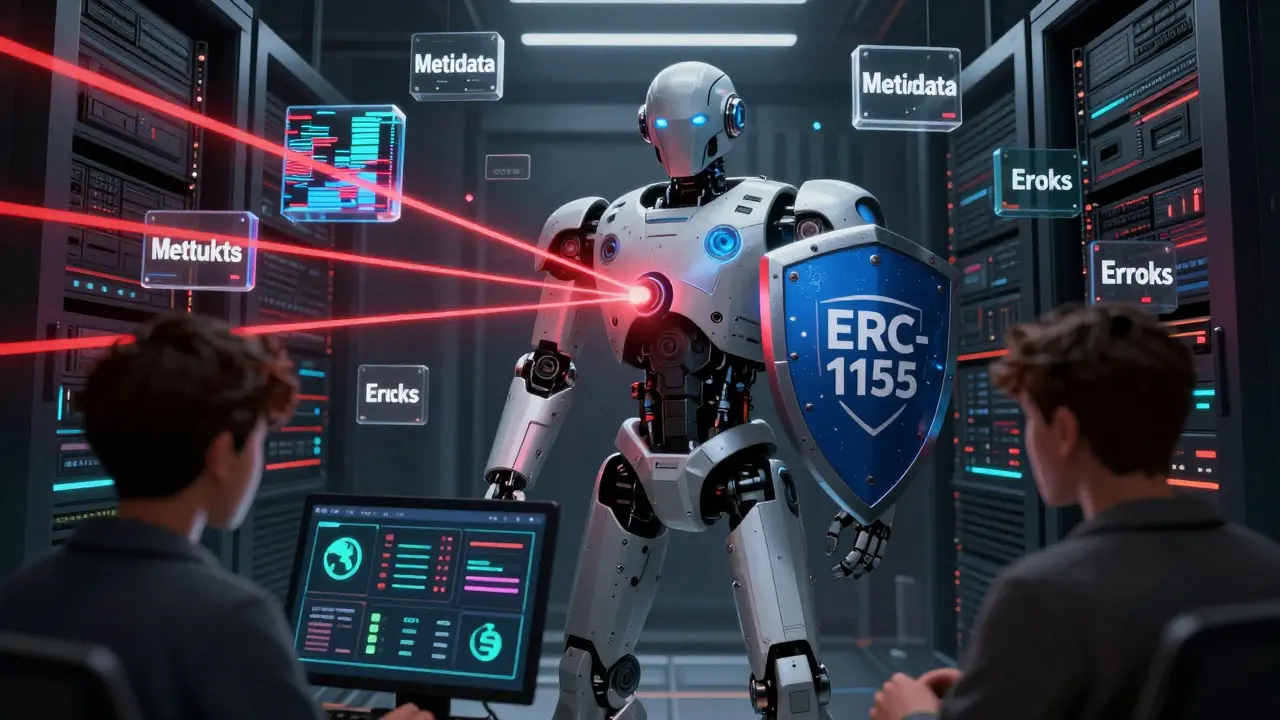
However, there are risks. Dr. Jane Lee from MIT’s Digital Currency Initiative warned in February 2024 that consolidating multiple token types into single contracts creates novel attack vectors. Specifically, metadata manipulation is a concern. Since the visual representation of a token is often stored off-chain, a malicious actor could theoretically change the image linked to a token ID without altering the underlying ownership. Developers must use decentralized storage like IPFS and pinning services to mitigate this. Additionally, debugging ERC-1155 contracts can be harder than ERC-721 due to limited tooling support, as noted by developers on GitHub in early 2024.
Challenges and Market Perception
Not everyone loves ERC-1155. The primary criticism is conceptual complexity. Dieter Shirley, CTO of Dapper Labs, argued in July 2023 that the semi-fungible model is hard for mainstream users to grasp. Regular people understand "money" and "art." They struggle with "items that are sometimes money and sometimes art." This confusion leads to market errors. DappRadar found a 12.3% higher rate of mispriced listings in ERC-1155 markets compared to pure NFT standards. Users often confuse the rarity of a batch item with a unique item, leading to unfair trades.
Wallet support has also been inconsistent. While major wallets like MetaMask now support ERC-1155, some smaller or legacy wallets still display these assets incorrectly. They might show a balance of "1" for a batch of 100 items, confusing the user. As of May 2024, WalletConnect updated its protocol to add native support across 87 wallet applications, which should alleviate this issue soon. Until then, developers must educate their users carefully.
Implementation Guide for Developers
If you are ready to build with ERC-1155, here is what you need to know. First, ensure your development environment supports Solidity and the Ethereum Virtual Machine (EVM) version London or later. The learning curve is moderate. ThirdWeb estimates it takes 2-3 weeks for a Solidity developer to become proficient, compared to 1-2 weeks for ERC-721. The extra time is spent understanding batch logic and URI metadata handling.
- Choose a Framework: Use OpenZeppelin Contracts (v4.9.0+) for audited, secure reference implementations. Alternatively, ThirdWeb offers pre-built templates that simplify deployment.
- Handle Metadata: Store your token images and attributes on IPFS. Never store large files directly on-chain. Use the ERC-1155 Metadata URI extension to link your on-chain IDs to off-chain data.
- Test Batch Transfers: Rigorously test the
safeBatchTransferFromfunction. Ensure your frontend correctly displays balances for both fungible and non-fungible IDs. - Integrate Wallets: Verify compatibility with popular wallets. Use WalletConnect v2 for broadest support.
Community resources are strong. The Enjin Developer Server on Discord averages over 1,200 daily active participants. If you get stuck, help is usually available within hours. Just remember to audit your code thoroughly, especially around approval mechanisms, before mainnet deployment.
Future Outlook and Regulatory Landscape
The future looks bright for ERC-1155. Deloitte forecasts a 23.7% annual growth in adoption through 2027, driven largely by gaming and enterprise supply chain tracking. The upcoming Ethereum Cancun upgrade, expected in late 2024, will further reduce gas costs for batch transactions, making ERC-1155 even more attractive. Cross-chain interoperability is also improving, allowing assets to move seamlessly between Ethereum, Polygon, and other EVM-compatible chains.
Regulation remains the wildcard. The SEC’s March 2024 guidance identified semi-fungible tokens as creating "novel classification challenges." Because these tokens can behave like securities (if they represent shares) or commodities (if they represent goods), regulators may evaluate them case-by-case. Developers must be cautious. Avoid promising financial returns from token appreciation. Focus on utility-access, gameplay, or physical redemption-to stay within safer legal boundaries.
Is ERC-1155 better than ERC-721?
It depends on your use case. If you are creating unique digital art, ERC-721 is simpler and has better market perception. However, if you are building a game with thousands of items, ERC-1155 is vastly superior due to lower gas fees and batch transfer capabilities.
What are semi-fungible tokens?
Semi-fungible tokens are assets that share characteristics of both fungible and non-fungible tokens. For example, a concert ticket is unique (seat 1A) but interchangeable with other tickets of the same price tier. ERC-1155 enables this duality on the blockchain.
How much does ERC-1155 save in gas fees?
Studies show ERC-1155 can reduce gas costs by 40-60% compared to ERC-721 when transferring multiple assets. For batch transfers of 10 items, savings average around 43.7%, making it ideal for high-volume applications like gaming.
Can I use ERC-1155 on networks other than Ethereum?
Yes. ERC-1155 is an EVM-compatible standard. Networks like Polygon, Avalanche, BNB Chain, and Arbitrum support it natively. This allows for cheaper transactions and faster processing while maintaining compatibility with Ethereum tools.
Are there security risks with ERC-1155?
Like any smart contract, ERC-1155 has risks. Key concerns include metadata manipulation (changing the image of a token) and complex approval logic. Always use audited libraries like OpenZeppelin and store metadata on decentralized systems like IPFS to mitigate these risks.