

How Blockchain Anti-Piracy Solutions Protect Digital Rights in 2026
Imagine spending months creating a film or recording an album, only to watch it get ripped and shared across torrent sites within hours. For years, the standard fix was Digital Rights Management (DRM)-software that locks files down so tightly that even paying customers often struggle to play them. But DRM has a fatal flaw: once someone cracks the code, everyone gets the key. That is where blockchain anti-piracy solutions are changing the game. Instead of just locking the door, these systems create an unbreakable chain of evidence that tracks exactly who leaked your content and rewards the public for helping you catch them.
We are no longer talking about theoretical concepts from the early days of crypto. By 2026, this technology has matured into a robust ecosystem used by major studios and independent creators alike. It combines immutable ledgers, cryptographic identifiers, and forensic watermarking to detect unauthorized redistribution almost instantly. If you are looking to protect your intellectual property without frustrating your legitimate audience, understanding how these tools work is essential.
Why Traditional DRM Fails Where Blockchain Succeeds
To understand why blockchain is gaining traction, we have to look at what went wrong with traditional methods. Standard DRM relies on secrecy. It encrypts media files and requires specific software keys to decrypt them. The problem? Security through obscurity never lasts. Once a hacker finds one vulnerability, they share the exploit globally. Suddenly, the lock is broken for everyone.
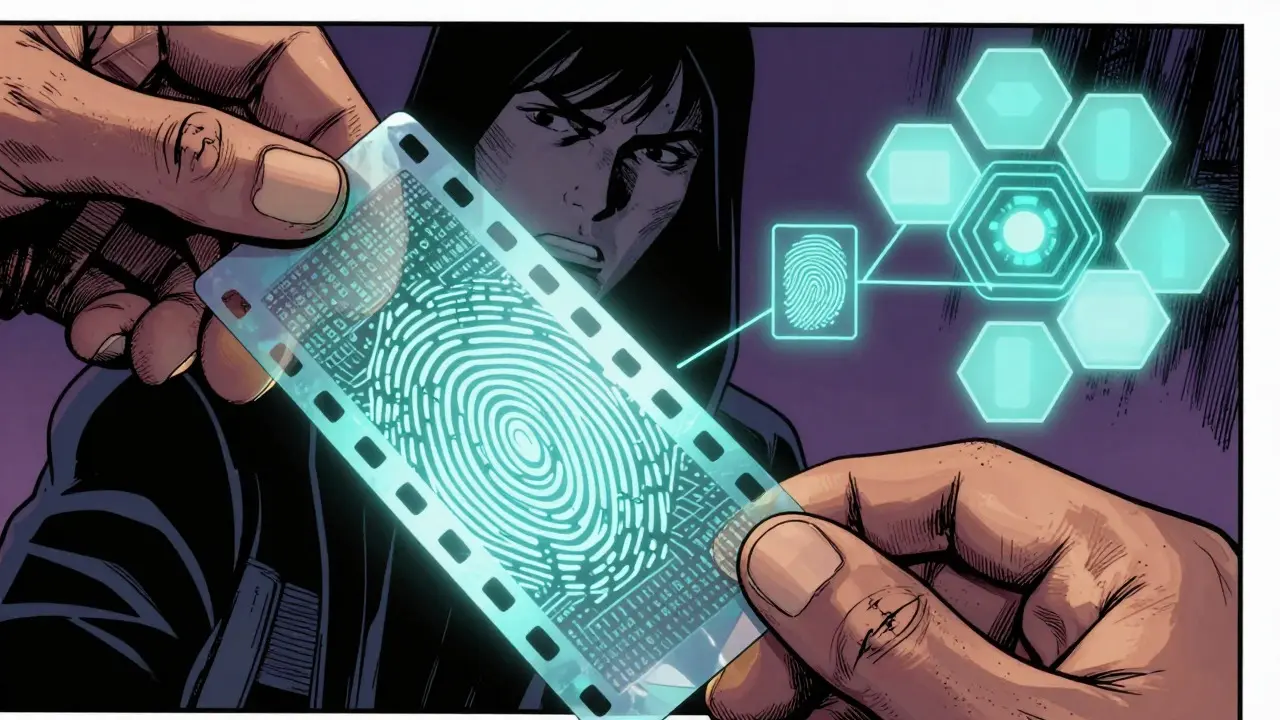
Blockchain flips this model on its head. Instead of trying to hide the file's origin, it embeds a unique, invisible fingerprint into every single copy distributed. This process is called forensic watermarking. Each recipient-whether it is a critic, a festival programmer, or a test viewer-gets a version of the file with a distinct mark tied to their identity. If that specific file appears online, you know exactly who leaked it.
The magic happens when you combine this watermarking with a distributed ledger. In traditional systems, logs can be altered or deleted. On a blockchain, once a record of ownership or a leak detection event is written, it cannot be changed. This immutability provides legally defensible proof of ownership and piracy events, which is crucial for takedown notices and lawsuits.
How the Technology Actually Works
You might be wondering how a decentralized database stops a pirate from uploading a video. It doesn't stop the upload directly; rather, it makes the act of pirating incredibly risky and easy to trace. Here is the typical workflow used by leading platforms:
- Cryptographic Hashing: When you create content, the system generates a unique digital fingerprint (hash) of the file. This hash is stored on the blockchain as proof that you owned this specific file at this specific time.
- Unique Watermarking: Before distributing screeners or preview copies, the system embeds a hidden watermark into each file. This watermark contains metadata linking back to the recipient.
- Bounty Integration: Some advanced systems, like those pioneered by Custos Media Technologies, encode a Bitcoin private key or cryptocurrency bounty directly into the watermark. This incentivizes anyone who finds the pirated file to claim the reward, which triggers an alert on the blockchain.
- Smart Contract Automation: Smart contracts automatically execute actions based on predefined rules. For example, if a leak is detected, the contract might immediately issue a Content ID claim to streaming platforms or notify legal teams.
This architecture minimizes the need for manual monitoring. Instead of hiring a team to scour the web for leaks, the network does the heavy lifting. The latency from a bounty claim to a confirmed piracy event can be measured in seconds, allowing rights holders to react while the file is still fresh.
Key Players in the Ecosystem
The landscape of blockchain-based protection is diverse. There isn't one single app that does everything; instead, there is a stack of specialized tools. Here is how the major players compare:
| Platform / Tool | Primary Function | Target Audience | Key Feature |
|---|---|---|---|
| Custos Media | Leak Traceability & Detection | Film Studios, Distributors | Bitcoin-anchored forensic watermarks with bounties |
| Argus | Community Reporting | General Content Owners | Smart contracts incentivizing public reporting of piracy |
| MediaChain | Immutable Registration | Artists, Photographers | Timestamped proof of creation and ownership |
| Audius | Smart Licensing | Music Creators | Automatic royalty distribution via smart contracts |
| DRPChain | Image Protection | Stock Photo Agencies | Perceptual hashing combined with blockchain logging |
Custos stands out for its aggressive approach to film piracy. By mid-2019, they had protected over 500,000 movies using their blockchain-anchored system. Their model turns downloaders against uploaders: if you find a leaked file with a Custos watermark, you can claim a small crypto reward. Doing so exposes the uploader's identity to the rights holder. It’s a clever way to outsource enforcement to the global population.
On the other hand, platforms like Po.et and MediaChain focus less on catching pirates and more on establishing indisputable authorship. For visual artists and writers, proving you created something before someone else stole it is half the battle. These platforms provide a timestamped, tamper-proof record that serves as powerful evidence in copyright disputes.
Benefits Beyond Just Stopping Leaks
While catching pirates is the headline feature, the real value lies in the operational efficiency these systems bring. Consider the administrative nightmare of managing licenses. Traditionally, tracking who has the right to show your content in which territory involves spreadsheets, emails, and paper contracts. Blockchain automates this through smart contracts.
When a license expires or a new territory is added, the smart contract updates automatically. This reduces errors and disputes. Furthermore, the transparency of the ledger builds trust between creators and distributors. Everyone sees the same data, eliminating "he said, she said" arguments over payments or usage rights.
For large enterprises, the scalability is impressive. Systems like the scalable blockchain DRM prototypes discussed in recent academic literature demonstrate that these networks can handle millions of concurrent transactions. This means a studio releasing hundreds of films simultaneously can track each one individually without slowing down their infrastructure.
Limitations and Realistic Expectations
It is important to keep our feet on the ground. Blockchain is not a silver bullet. As fintech expert Viktor Prokopenya noted, blockchain is essentially a ledger-it tracks ownership but doesn't physically prevent copying. A determined pirate can still screen-record a movie or photograph a digital artwork.
The solution here is layered defense. Blockchain works best when combined with other technologies. Forensic watermarking helps identify the source of the leak, but it doesn't stop the initial capture. Therefore, most successful implementations use blockchain alongside traditional encryption for high-value assets and community reporting mechanisms for widespread infringement.
Another challenge is usability. For non-technical creators, interacting with wallets, managing private keys, and understanding gas fees can be intimidating. However, newer platforms are abstracting this complexity away. Users simply upload their content and pay a subscription fee, while the platform handles the backend blockchain interactions.

Implementing Your Own Strategy
If you are ready to adopt these tools, start by defining your threat model. Are you worried about internal leaks from trusted partners? Then a forensic watermarking solution like Custos is ideal. Are you concerned about unauthorized reuse of your images on social media? Look into perceptual hashing systems like DRPChain. Do you want to automate royalty payments? Explore smart licensing platforms like Audius or Revelator.
Integration usually involves API connections. Most modern providers offer SDKs that allow you to embed protection features directly into your existing CMS or distribution platform. You don't need to build a blockchain node from scratch. The goal is to make the protection seamless for your legitimate users while creating a minefield for infringers.
Finally, prepare your legal team. While blockchain provides strong evidence, you still need to enforce it. Ensure your terms of service clearly state that using protected content grants permission for watermarking and that claiming bounties constitutes consent to reveal the leaker's identity. This legal groundwork ensures that when the technology flags a pirate, you have the standing to take action.
The Future of Content Protection
As we move further into 2026, the line between distribution and protection is blurring. We are seeing the rise of integrated platforms that handle streaming, licensing, and anti-piracy in one package. Projects like Vanguard aim to provide all-round protection by combining active internet scanning with decentralized storage.
We also expect to see greater interoperability between different blockchain networks. Currently, many solutions are siloed. In the future, a creator might register a work on Po.et, distribute it via a Cinezen-like VOD platform, and monitor it with Argus, all seamlessly connected. This unified approach will make piracy increasingly difficult and costly, shifting the balance of power back to the creators.
Can blockchain completely stop piracy?
No technology can completely stop piracy, especially physical acts like screen recording. However, blockchain significantly raises the cost and risk for pirates by enabling instant detection, precise attribution of leaks, and automated takedowns. It shifts the dynamic from reactive cleanup to proactive deterrence.
Is blockchain anti-piracy expensive for small creators?
Costs vary widely. Enterprise solutions like Custos may require significant investment due to custom integration. However, registration platforms like Po.et or MediaChain often have low or free tiers for basic timestamping. As competition increases, prices are expected to drop, making these tools accessible to indie filmmakers and musicians.
How does forensic watermarking differ from visible watermarks?
Visible watermarks are obvious logos overlaid on content, which can be cropped out. Forensic watermarking embeds data invisibly into the pixels or audio waves. It survives compression, cropping, and format conversion, making it much harder for pirates to remove without degrading the quality of the stolen file.
What is a "bounty" in the context of Custos?
A bounty is a small cryptocurrency reward encoded into the watermark of a protected file. When someone downloads a pirated copy and uses a tool to claim this reward, the transaction is recorded on the blockchain. This alerts the content owner to the leak and identifies the specific recipient who originally received that marked copy.
Do I need to know coding to use these solutions?
Not necessarily. Many platforms offer user-friendly dashboards where you can upload files and manage rights without writing code. However, for deep integration into existing workflows, some technical knowledge or developer support may be required to connect APIs and configure smart contracts.






Hey folks, just wanted to chime in on this because I've been testing some of these watermarking tools for my indie band and it's actually pretty slick. The idea that you can trace a leak back to the specific person who got the screener is huge. No more guessing games with lawyers. (Y) Just upload, tag, and let the blockchain do the heavy lifting. It saves so much headache compared to old-school DRM that just annoyed paying customers.
Oh, how delightfully naive we are to believe that a digital ledger can tame the chaotic beast of human desire! We build these intricate castles of code, thinking they will hold back the tide of entropy, but really, we are just rearranging deck chairs on the Titanic of intellectual property. The 'unbreakable chain' is merely a metaphor for our own fragile ego; we crave ownership in a world that fundamentally resists possession. Is it not poetic that we use technology meant to liberate information to shackle it again? The irony is thick enough to cut with a knife. One must wonder if the creators themselves understand the philosophical weight of what they are attempting to enforce upon the collective unconscious.
Wake up sheeple! 🐑 This is just another way for the elites to track every single one of your moves. They want to know who you are, what you watch, and where you live. The 'bounty' system is a trap designed to turn neighbor against neighbor. Once they have your identity linked to that blockchain entry, good luck getting it removed. It’s total surveillance capitalism disguised as 'protection'. Don’t let them feed you this crypto-nonsense. They’re watching 👁️👄👁️
Look at this!! Isn't it amazing!!! The future is here and it is bright!!! I love how this empowers creators from all over the globe!!! Especially those of us in developing nations who struggle with piracy!!! It gives us a voice!!! A powerful voice!!! Let's embrace this change!!! Together we can win!!! 💪💪💪
One must consider the epistemological implications of such a system. The assertion that blockchain provides 'immutable proof' is technically accurate yet practically reductive when applied to the fluid nature of digital media consumption. Furthermore, the reliance on forensic watermarking presupposes a level of technical literacy among the general populace that simply does not exist. It is a solution in search of a problem, or perhaps, a problem manufactured by the very entities profiting from its implementation. The jargon-heavy discourse surrounding 'smart contracts' often obscures the mundane reality of legal enforcement, which remains stubbornly analog and inefficient. Therefore, one should approach this with extreme skepticism.
Ive been using Audius for a bit now and while it isnt perfect, its a game changer for royalty splits. No more waiting months for checks from distributors. The smart contracts handle it automatically. Sure, there's a learning curve with wallets, but once you get it, its smooth sailing. Highly recommend giving it a shot if you're an artist tired of the middleman taking their cut. Its empowering af!
Incorrect assumptions. Blockchain is not a magic wand. It is a distributed ledger technology (DLT). You need to understand the consensus mechanism. Proof of Work vs Proof of Stake matters. Gas fees will kill small creators. Scalability issues remain. Do your due diligence before investing time. Read the whitepapers. Understand the tokenomics. Otherwise, you are just noise in the signal.
i mean it sounds cool but like do we really need all this tech just to stop people from copying files? seems like overkill to me lol. maybe if it was easier to use i'd care more but right now it feels like its just for big studios who have money to burn. hope it gets simpler tho.
Oh wow, another day, another attempt to solve piracy with crypto. How original. 😒 But seriously, has anyone tried just making content so good people WANT to pay for it? Maybe that's too radical an idea. The bounty system is cute though, turning pirates into snitches. Very dystopian. Love it. 🙄
it is interesting to think about trust. traditionally we trusted institutions to protect rights. now we trust math. is that better? maybe. or maybe we just shifted the burden. the transparency is nice though. less room for shady deals behind closed doors. makes sense logically.
thats awesome man!! finally something that works!! ive been trying to figure out how to protect my photos for years and always failed. this looks like the answer. gonna try it out this weekend. thanks for sharing the info!!
why are you all so excited? nothing changes. the rich get richer. the poor stay poor. my life is hard and this doesnt help me. i am tired of reading about tech solutions for social problems. it never works. just leave me alone.
This is American innovation at its finest!!! Why can't other countries catch up??? We lead the world in tech and justice!!! Anyone who says otherwise is hating on progress!!! Support local creators!!! Buy American!!! 🇺🇸🇺🇸🇺🇸
It is a step forward. Slowly but surely. We should be supportive of these efforts. Piracy hurts everyone. Let us encourage these technologies. Peace and love to all creators.