
No Loss Offset Rule in India: Impact on Crypto Traders
Imagine making a ₹100,000 profit on one Bitcoin trade and losing ₹80,000 on an Ethereum trade the same week. In most traditional investment markets, you’d pay tax only on your net gain of ₹20,000. But if you are a crypto trader operating under India's strict Virtual Digital Asset (VDA) tax regime, that logic doesn't apply. You will owe 30% tax on the full ₹100,000 gain-₹30,000-while the ₹80,000 loss vanishes into thin air, offering zero relief. This is the reality of the no loss offset rule in India, a regulation that has fundamentally reshaped how traders approach the market.
This rule isn't just a minor footnote; it is a structural pillar of the country's approach to digital assets. Implemented since 2022 and reinforced by the Budget 2025 updates, this framework creates what experts call an "asymmetric tax burden." You get taxed on every win, but the government takes no interest in your losses. For anyone serious about trading cryptocurrencies like Bitcoin or Ethereum, understanding this mechanism is not optional-it is survival.
The Mechanics of the No Loss Offset Rule
To grasp why this rule hurts so much, we need to look at where it lives in the law. The provision is codified under Section 115BBH(2)(b) of the Income Tax Act. It explicitly prohibits cryptocurrency losses from being used to offset gains from other crypto transactions. Unlike equity markets, where you can set off short-term losses against short-term gains, the crypto bucket is entirely isolated.
Here is how the math works in practice:
- No Cross-Asset Offsetting: If you lose money on Solana, you cannot use that loss to reduce the taxable gain from a profitable Bitcoin trade.
- No Carry Forward: In traditional business or equity trading, unused losses can often be carried forward for up to eight years. With VDAs, once the financial year ends, your losses expire. They are gone forever.
- No Offset Against Other Income: You cannot claim crypto losses against your salary, rental income, or profits from a private limited company. The crypto tax universe is a closed loop.
This isolation means that volatility, which is inherent to crypto markets, becomes a direct tax liability driver. High volatility usually leads to both big wins and big losses. Under normal tax laws, these balance out. Under Section 115BBH, the losses become dead weight, while the wins trigger immediate tax obligations.
The Compounding Effect: 30% Tax + 1% TDS
The no loss offset rule rarely acts alone. It sits inside a broader tax structure that amplifies its impact. When you sell crypto for INR, swap BTC for ETH, or even spend crypto on goods, a flat 30% tax rate applies to the capital gains. This rate is uniform, meaning it doesn't matter if you are in the lowest or highest income slab; the crypto tax remains 30%. On top of this, surcharge and health cess apply, pushing the effective rate higher for larger gains.
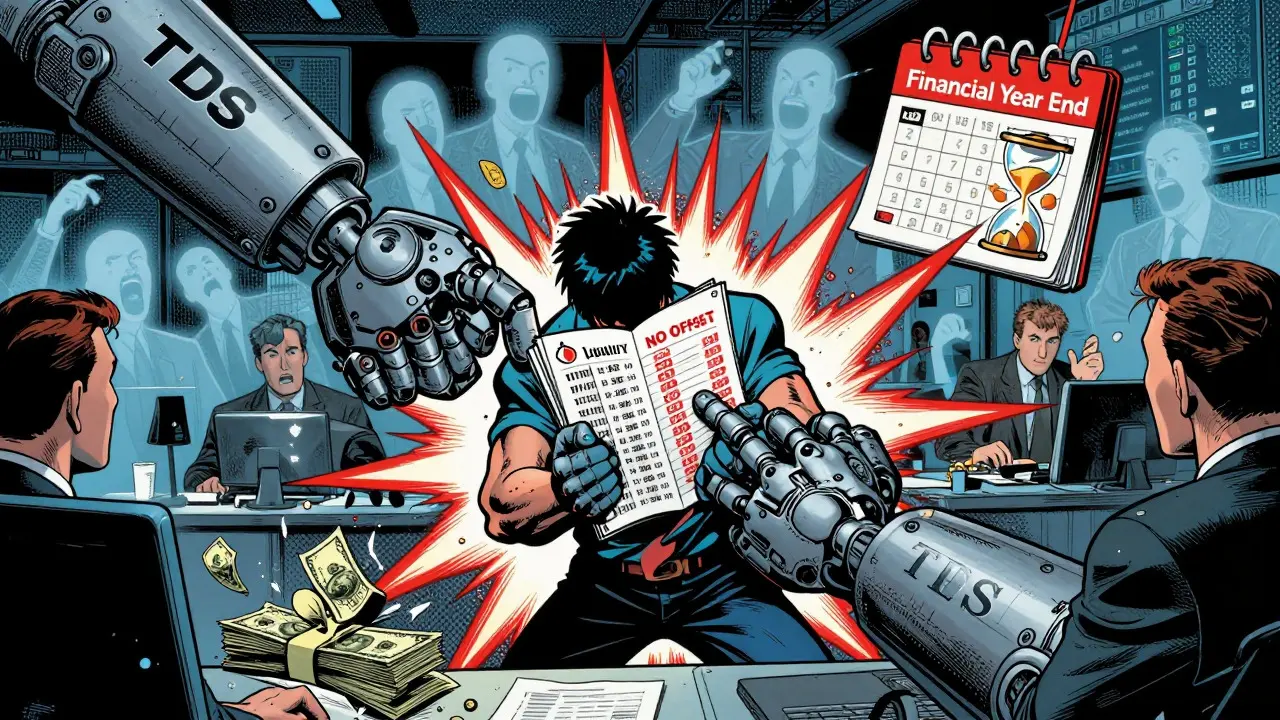
Then there is the cash flow killer: Tax Deducted at Source (TDS). Since July 2022, Indian exchanges must deduct 1% TDS on the full value of all crypto transfers exceeding ₹10,000 annually (or ₹50,000 for Hindu Undivided Families). This is deducted regardless of whether the transaction resulted in a profit or a loss.
Consider this scenario: A trader buys ETH for ₹50,000 and sells it for ₹49,000. That’s a ₹1,000 loss. However, the exchange still deducts 1% TDS on the ₹49,000 sale value (₹490). The trader now has less cash in hand, a realized loss that offers no tax benefit, and a TDS receipt they must reconcile during filing. This creates a liquidity crunch, especially for active day traders who see significant volume but minimal net profit.
| Feature | Equity Investments | Virtual Digital Assets (Crypto) |
|---|---|---|
| Tax Rate on Gains | 10% (LTCG > ₹1L) / 15% (STCG) | Flat 30% + Cess |
| Loss Offset Allowed? | Yes (within category) | No (Section 115BBH) |
| Carry Forward Losses? | Up to 8 years | No |
| Deduction of Expenses | Brokerage, STT, GST allowed | Only acquisition cost (FIFO/LIFO) |
| TDS/TCS | Varies by transaction type | 1% TDS on transfers > ₹50k/₹10k |
Note the column on deductions. For crypto, you can only deduct the acquisition cost. You cannot claim gas fees, network transaction costs, or exchange trading fees as expenses. This further inflates the taxable base, making the no loss offset rule even more painful because your reported gains are artificially higher than your actual economic gains.
Impact on Trader Psychology and Strategy
Rules shape behavior. The no loss offset rule has forced Indian traders to rethink their entire approach to risk management. According to data from major platforms like CoinSwitch, many frequent traders have reduced their activity levels. Why take the risk of a volatile trade if the downside carries a permanent tax penalty?
We are seeing a shift toward two distinct strategies:
- Long-Term Holding (HODLing): By reducing transaction frequency, traders minimize the number of taxable events. Fewer trades mean fewer instances where the no loss offset rule bites. While the 30% tax still applies upon exit, avoiding the 1% TDS on every intermediate swap helps preserve capital.
- Migrating to Derivatives: Some sophisticated traders are moving to crypto futures. Futures contracts are derivatives and do not fall under the VDA definition. Consequently, they are not subject to the 1% TDS on transfer. However, this comes with its own risks, including leverage exposure and different tax treatments under business income heads.
There is also a growing trend of users exploring international platforms. While this might seem like a loophole, it triggers the Liberalised Remittance Scheme (LRS) rules. Sending money abroad to buy crypto attracts a 20% Tax Collected at Source (TCS) on amounts exceeding ₹7 lakh per financial year. So, escaping the domestic no loss offset rule often leads to hitting a massive TCS wall instead.
Compliance Nightmares and Record Keeping
If the tax rates weren’t enough, the compliance burden is staggering. Because losses don’t offset gains, every single transaction matters. You cannot simply look at your portfolio’s total P&L at the end of the year. You must track the cost basis of every individual coin bought and sold.
Traders must file ITR-2 or ITR-3 forms, specifically using Schedule VDA. The simpler ITR-1 form does not accommodate crypto disclosures. This requires maintaining detailed records of:
- Date of acquisition and disposal
- Cost of acquisition (including the specific wallet address if necessary)
- Fair market value at the time of transfer
For someone holding dozens of altcoins across multiple wallets, this is manual labor. Many traders report spending hours reconciling exchange statements with bank records. The complexity increases when dealing with peer-to-peer (P2P) transactions, where the buyer is legally responsible for deducting and depositing TDS. Failure to comply here can lead to penalties, interest, and even prosecution for willful evasion.
Budget 2025: Stricter Penalties, Not Relief
Hoping for a change? The Budget 2025 dashed those hopes. Instead of introducing loss offsetting or lowering rates, the government introduced harsher penalties for non-compliance. Under Section 158B, authorities can now tax undisclosed crypto holdings at a steep 60% rate. This provision was applied retrospectively from February 1, 2025.
This move signals that the government views crypto not as a speculative asset class needing nurturing, but as a source of untapped revenue requiring aggressive extraction. Tax advisory firms like Dinesh Aarjav & Associates warn that the focus is shifting toward enforcement. The Income Tax Department is leveraging data analytics to match exchange reports with taxpayer filings. If your declared gains don’t match the TDS deposited by exchanges, you will likely face a notice.
The retrospective nature of the 60% tax rate adds a layer of anxiety. Traders who may have missed reporting small gains in early 2025 now face the prospect of being taxed at double the standard rate. This environment discourages transparency rather than encouraging it, potentially driving more activity underground.

Global Context: How India Compares
India’s stance is an outlier in the global landscape. Let’s compare it briefly to other major jurisdictions:
- United States: Crypto losses can offset crypto gains. If losses exceed gains, up to $3,000 can offset ordinary income, with the rest carried forward indefinitely.
- Germany: Crypto gains are tax-free if held for more than one year. Even if taxed, losses can be offset against gains.
- Singapore: Generally no capital gains tax on crypto for individuals, provided they are not trading as a business.
In contrast, India offers no holding period exemption (the 30% tax applies whether you hold for a day or ten years), no loss offsetting, and no expense deductions. This makes India one of the least attractive jurisdictions for active crypto trading globally. Industry associations argue that this stifles innovation and pushes talent and capital offshore, ultimately harming the local blockchain ecosystem.
Practical Steps for Traders in 2026
Given the current landscape, what should you do? Here is a realistic checklist for navigating the no loss offset rule:
- Track Everything: Use dedicated crypto tax software or spreadsheets. Do not rely on memory. Every swap, airdrop, and stake reward is a taxable event.
- Minimize Swaps: Try to buy and sell directly in INR pairs where possible to avoid triggering TDS on intermediate swaps between cryptocurrencies.
- Reconcile TDS Regularly: Don’t wait until March. Check your Form 26AS quarterly to ensure exchanges are depositing the TDS they deduct. Discrepancies here cause filing errors.
- Consult a Specialist: General CA advice may not suffice. Find a professional familiar with Schedule VDA and Section 115BBH. The cost of consultation is far lower than the cost of a penalty under Section 158B.
- Plan Exits Carefully: Since losses vanish, try to realize gains when you have sufficient liquid cash to pay the 30% tax without disrupting your lifestyle or trading capital.
The no loss offset rule is not going away anytime soon. Until legislative changes occur, it remains a fixed cost of doing business in Indian crypto markets. Adaptation, meticulous record-keeping, and strategic patience are your best defenses.
Can I carry forward crypto losses to the next financial year in India?
No. Under Section 115BBH of the Income Tax Act, losses incurred from Virtual Digital Assets (VDAs) cannot be carried forward to subsequent years. Once the financial year ends, any unrealized or realized losses expire and provide no future tax benefit.
Does the no loss offset rule apply to NFTs?
Yes. Non-Fungible Tokens (NFTs) are classified as Virtual Digital Assets (VDAs) under Indian law. Therefore, the same 30% tax rate and no loss offset rule apply to buying, selling, or swapping NFTs.
Can I deduct gas fees or exchange charges from my crypto gains?
No. The law allows deduction of only the cost of acquisition. Operational expenses such as network gas fees, mining electricity costs, or exchange trading commissions cannot be claimed as deductions against capital gains.
What happens if I fail to report crypto gains?
Failure to report can lead to severe penalties. As per Budget 2025 updates, undisclosed crypto holdings can be taxed at 60% under Section 158B. Additionally, you may face interest on delayed payments and potential prosecution for tax evasion.
Is there a difference in tax treatment for long-term vs short-term crypto holdings?
No. Unlike equities, there is no distinction between long-term and short-term capital gains for crypto in India. All gains are taxed at a flat 30% plus applicable surcharge and cess, regardless of how long you held the asset.
How does TDS affect my cash flow?
TDS is deducted at the source (by the exchange) on every transfer above the threshold. This reduces your immediate available cash. While TDS is credited against your final tax liability, it creates a liquidity gap that must be managed, especially if you have net losses that offer no tax refund.