
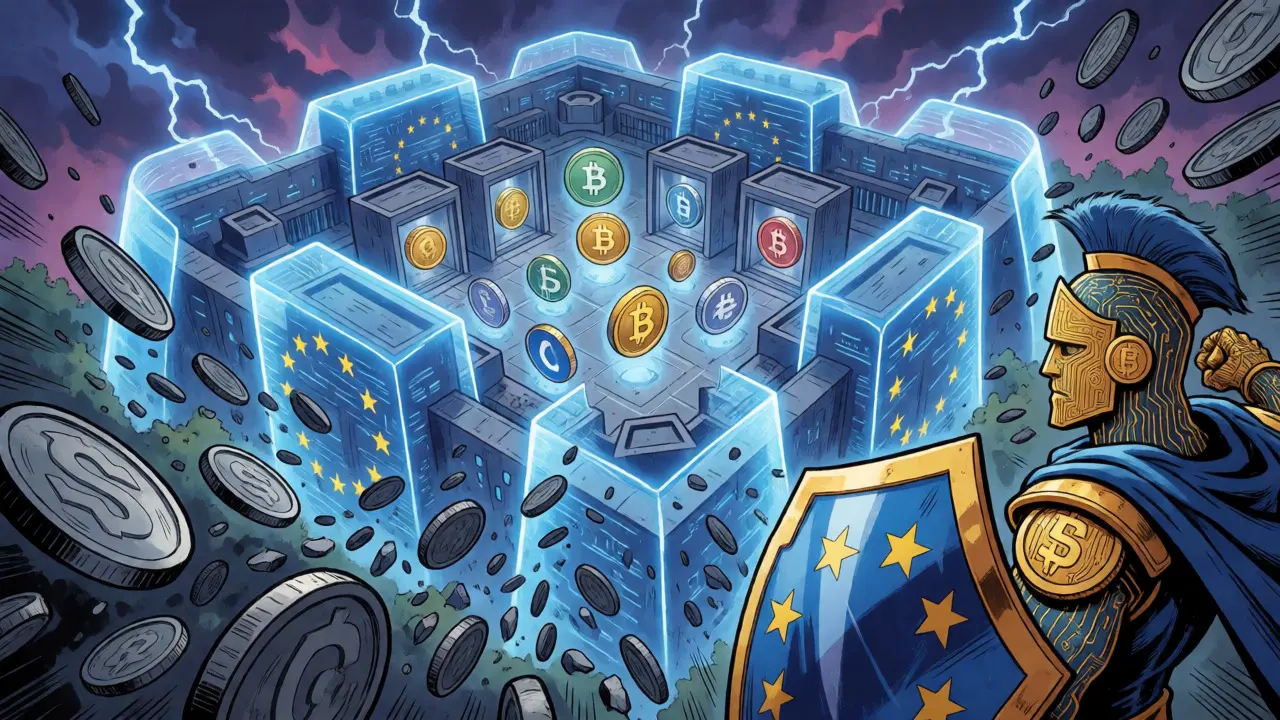
EU Stablecoin Restrictions: MiCA Rules for USDT and Others
If you held USDT or another popular stablecoin in Europe recently, you might have noticed your trading options shrinking. This isn't a glitch; it's the result of the Markets in Crypto-Assets (MiCA) regulation, which fundamentally changed how digital dollars work across the 27 member states. The core issue? Most existing stablecoins didn't meet the strict new standards for reserves and transparency. As of early 2025, major exchanges had to delist non-compliant tokens to stay legal. This article breaks down exactly what happened, why USDT faced these hurdles, and what compliant alternatives are emerging.
The Core Problem: Why Stablecoins Faced a Crackdown
Before MiCA, the stablecoin market was a wild west. Tokens promised a 1:1 peg with the euro or dollar, but few proved they actually held the cash to back it up. When TerraUSD collapsed in 2022, regulators woke up. They realized that if a stablecoin worth billions lost its peg overnight, it could crash traditional financial markets too. So, the EU introduced Regulation (EU) 2023/1114, known as MiCA, to force stability through transparency. The goal wasn't to kill crypto, but to ensure that when you hold a digital token, there is actual money sitting in a bank account backing it. For issuers like Tether (the company behind USDT), this meant opening their books and restructuring their reserve holdings to meet specific legal definitions. If they couldn't prove their reserves were safe and liquid, their tokens became illegal to trade on regulated platforms.
How MiCA Classifies Your Digital Money
MiCA doesn't just say "stablecoins are good" or "bad." It splits them into two distinct categories, each with different rules. Understanding this distinction is key to knowing which coins survived the purge.
| Feature | E-Money Tokens (EMTs) | Asset-Referenced Tokens (ARTs) |
|---|---|---|
| Definition | Aims to maintain value equal to one official currency unit (e.g., 1 EUR). | Maintains value by referencing multiple currencies, commodities, or a single non-euro currency. |
| Regulatory Status | Treated like electronic money. Requires an e-money license. | Requires authorization from national authorities and a reserve management body. |
| Redemption Rights | Holders can redeem at par value (face value) at any time. | Redemption rights exist but may be subject to conditions depending on the asset mix. |
| Reserve Requirements | Must hold equivalent fiat currency in bankruptcy-protected accounts. | Must hold high-quality liquid assets that match the reference basket. |
| Example Candidates | EURC (Circle), upcoming Euro Coin from bank consortium. | Some multi-currency tokens (though many rebranded or exited). |
Most popular stablecoins tried to fit into the EMT category because it’s simpler for users who just want digital euros or dollars. However, getting an e-money license is tough. You need significant capital, robust governance, and regular audits. Many issuers failed to secure this authorization in time, leading to their delisting.
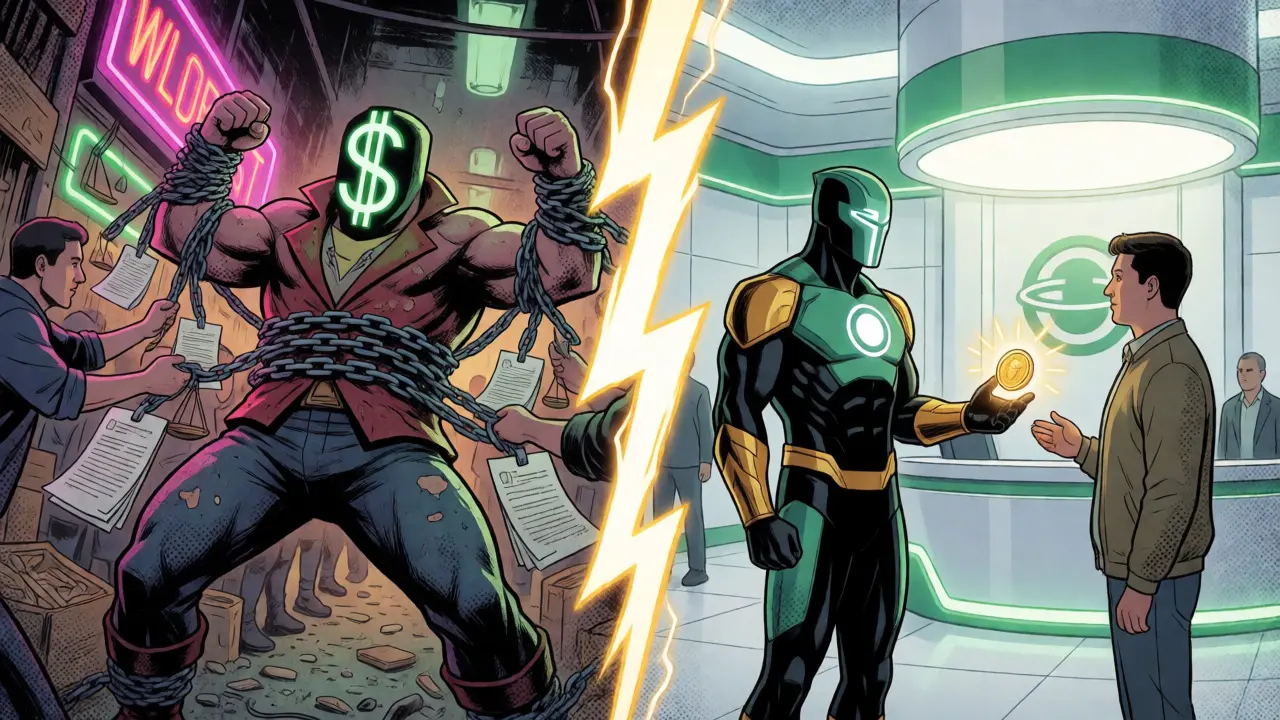
The USDT Situation: Why It Was Delisted
Tether’s USDT is the largest stablecoin globally, but it faced significant headwinds in the EU. The main friction point wasn't necessarily that USDT lacked reserves, but rather the structure and transparency of those reserves under EU law. To comply with MiCA, issuers must provide clear proof that reserves are held in bankruptcy-remote structures. This means if the issuer goes bust, the creditors can’t touch the money backing your tokens. For years, Tether’s audit reports were criticized for being vague. While they improved over time, the transition to full MiCA compliance required more than just better accounting; it required legal restructuring within the EU jurisdiction.
By January 2025, the European Securities and Markets Authority (ESMA) enforced strict timelines. Crypto-Asset Service Providers (CASPs)-think Binance, Kraken, Coinbase-had to stop offering trading pairs for non-compliant stablecoins. For many EU users, this meant seeing USDT/EUR pairs disappear. You could still hold USDT in your wallet, and often transfer it, but you couldn't easily buy or sell it against the euro on regulated exchanges. This created a liquidity gap. Traders had to switch to compliant alternatives like EURC (issued by Circle) or other locally authorized tokens, often paying higher fees or facing lower liquidity in the process.
What Compliant Alternatives Are Available?
With USDT restricted, the market didn't vanish; it shifted. Two main types of solutions emerged:
- Existing E-Money Tokens: Circle’s EURC became a primary beneficiary. Since Circle already operated under strict US regulations and moved quickly to obtain EU e-money licenses, EURC remained tradable. It offers similar utility to USDT but with the regulatory seal of approval.
- The Bank Consortium Initiative: Nine major European banks, including ING, UniCredit, and CaixaBank, formed a consortium to launch their own MiCA-compliant euro stablecoin. Expected to launch fully in late 2026, this initiative aims to create a "European alternative" to US-dominated tokens. It’s backed by traditional banking infrastructure, which appeals to institutional investors worried about counterparty risk.
These alternatives aren't just clones of USDT. They come with enhanced consumer protections. For instance, MiCA mandates that holders can redeem their tokens at face value. If you hold 100 EURC, you can demand €100 from the issuer. This right didn't explicitly exist in the same enforceable way for all pre-MiCA tokens.
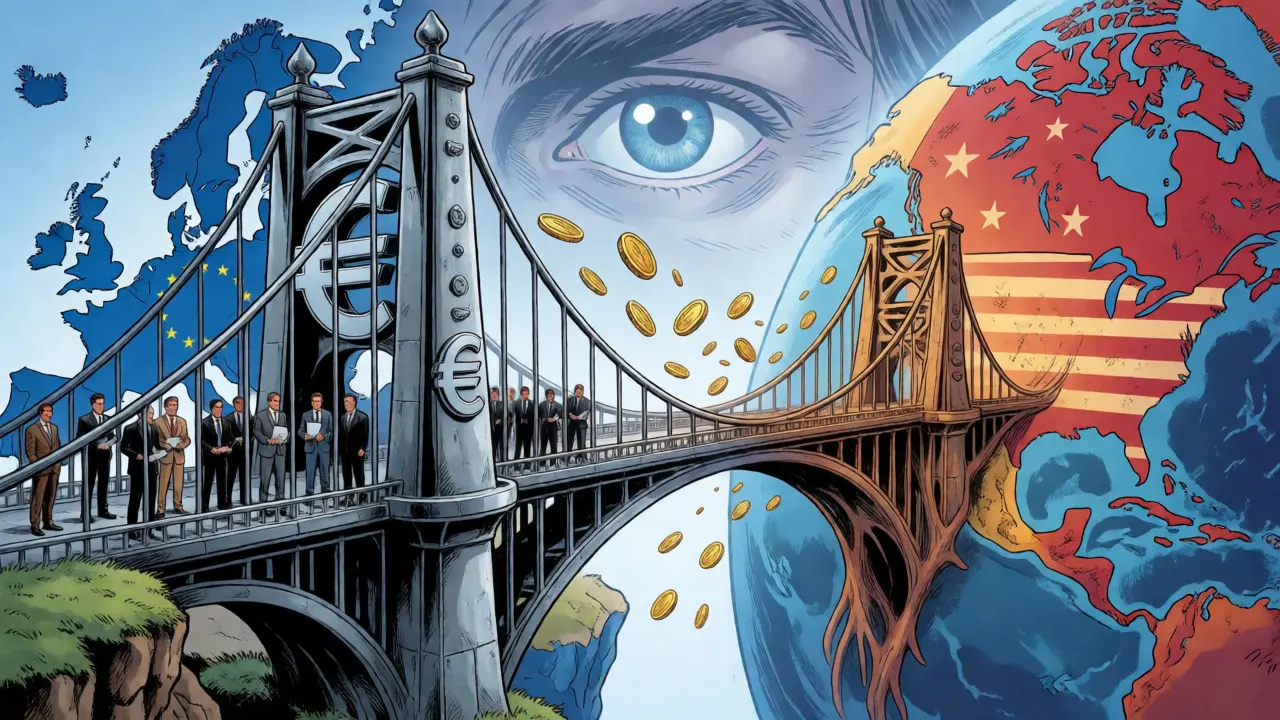
Global Context: EU vs. US Regulations
It’s worth noting that the EU isn't acting in a vacuum. Across the Atlantic, the United States passed the GENIUS Act in July 2025. Like MiCA, it requires 1:1 reserves and bankruptcy protection. However, analysts note that the US framework is slightly more flexible regarding implementation timelines and certain operational details. This divergence creates a competitive tension. Some market participants worry that stricter EU rules could push innovation and trading volume toward the US or other jurisdictions with lighter-touch approaches. Conversely, others argue that the EU’s clarity provides a safer harbor for long-term institutional adoption. The Bank for International Settlements (BIS) has warned that without such rules, stablecoins pose risks to monetary sovereignty, especially in emerging economies where citizens flee local currencies for digital dollars.
Practical Steps for EU Crypto Users
If you’re holding stablecoins in the EU, here’s what you should do right now:
- Check Your Exchange: Log in to your platform. Are your USDT trading pairs active? If not, look for EURC or other MiCA-labeled tokens.
- Review Custody Options: Even if you can’t trade USDT, most CASPs allow you to keep it in custody. Don’t panic-sell unless you need liquidity. Transfers usually remain open.
- Understand Conversion Fees: Moving from USDT to a compliant token might involve swapping costs. Calculate whether the fee outweighs the benefit of holding the non-compliant asset.
- Watch for New Launches: Keep an eye on announcements from the European bank consortium. Their stablecoin could offer better integration with traditional banking apps.
The shift isn't just about compliance; it's about trust. By forcing issuers to prove their reserves, the EU is trying to make stablecoins boring in the best possible way. Boring means predictable. Predictable means safer for your portfolio.
Can I still hold USDT in my personal wallet in the EU?
Yes. MiCA primarily restricts the provision of services related to non-compliant tokens. Holding tokens in a self-custody wallet (like MetaMask or Ledger) is generally permitted. The restrictions focus on buying, selling, and exchanging these tokens through regulated service providers.
Why was USDT delisted if it claims to have enough reserves?
Having reserves isn't enough; the structure matters. MiCA requires reserves to be held in bankruptcy-protected entities and audited according to specific EU standards. Until Tether fully aligned its corporate and reserve structures with these requirements, it was considered non-compliant for trading purposes on EU-regulated platforms.
What is the difference between EMTs and ARTs?
E-Money Tokens (EMTs) are pegged to a single official currency (like the Euro) and require an e-money license. Asset-Referenced Tokens (ARTs) reference a basket of assets or multiple currencies and require a different type of authorization. Most retail stablecoins aim to be EMTs for simplicity and direct redemption rights.
Will the new European bank stablecoin replace USDT?
It aims to be a strong competitor, particularly for institutional use and cross-border payments within Europe. However, replacing USDT entirely is unlikely in the short term due to network effects and global liquidity. The bank stablecoin offers a trusted, regulated alternative but faces challenges in matching USDT's widespread adoption outside the EU.
Do these rules apply to Bitcoin or Ethereum?
No. MiCA distinguishes between stablecoins and other crypto-assets. Bitcoin and Ethereum are not stablecoins because their value fluctuates freely. They fall under different sections of MiCA, focusing on disclosure and marketing rather than reserve backing and redemption rights.







The distinction between EMTs and ARTs is indeed the crux of this regulatory framework. It seems that the EU is attempting to create a tiered system where simplicity for the retail user is prioritized through the E-Money Token structure, which requires a more rigorous licensing process but offers clearer redemption rights.
One must consider the philosophical implications of forcing private entities to adhere to such strict definitions of 'money.' By requiring bankruptcy-remote structures, the regulation is essentially saying that trust in code or corporate promises is insufficient without legal safeguards equivalent to those in traditional banking. This might slow down innovation in the short term, as seen with the delisting of USDT, but it likely establishes a foundation for long-term stability that other jurisdictions may eventually emulate.
Circle's EURC is definitely the winner here! 🏆 They moved so fast. 🚀 If you're in the EU, just switch now. Don't wait. 💸
Oh please, spare me the 'transparency' narrative. 😒 Tether has been printing money out of thin air for years and now they're crying because they can't hide their sloppy accounting anymore? The EU finally grew a spine. 🇪🇺 Most of these 'compliant' alternatives are just rebranded scams waiting to happen. I bet the bank consortium stablecoin will be just as opaque once the initial hype dies down. Typical bureaucratic theater designed to protect legacy banks from competition. 🙄
This is a really positive step forward for the global crypto community! 👏
While the transition period is tough for traders who loved the liquidity of USDT, having clear rules actually helps us all feel safer. It shows that regulators aren't just trying to ban things, but rather trying to integrate crypto into the mainstream financial world responsibly.
I think the emergence of compliant tokens like EURC is great news for everyday users who want peace of mind. We should celebrate this clarity rather than mourning the loss of the 'wild west' days. Keep pushing for better standards!
i still dont get why holding usdt in my ledger wallet is ok but i cant sell it on coinbase... feels arbitrary
like if i hold it its safe right? so why does the exchange need to care about the reserve structure when im just moving it around? feels like they just want to force everyone onto their own tokens or partners
That's a very understandable frustration, Lea. From what I understand, the logic isn't necessarily about the safety of the asset itself in your cold storage, but rather the risk exposure of the *service provider* facilitating the trade.
If an exchange allows trading pairs for non-compliant assets, they are arguably offering a regulated service involving an unregulated product. MiCA places the burden on the CASP (Crypto-Asset Service Provider) to ensure everything they list meets the standard. So, while your personal custody is fine, the platform can't legally act as a marketplace for it without risking their own license. It’s annoying, but it’s about protecting the intermediary ecosystem.
Spot on Duncan. Also worth noting that some exchanges are getting creative with OTC desks to bypass the main order book restrictions, though fees are usually higher. For anyone stuck with USDT, checking if your exchange has a separate 'non-EU' interface or specific conversion routes to EURC might save you some hassle. Just don't leave too much sitting there idle.
Ugh, another regulation nightmare 😩. Why do they always have to make things so complicated??? 🤯. I lost half my portfolio value because I couldn't swap quickly enough 😭. Now I'm stuck holding bags of illiquid tokens 😔. Is it ever going to end??? 😫. I miss the old days when we could just trade freely 😢. This feels like punishment for early adopters 😠. 😡😡😡
Thank you for this detailed breakdown. It provides necessary context regarding the classification of EMTs versus ARTs. For institutional investors, the clarity on redemption rights is paramount. The ability to redeem at par value removes a significant layer of counterparty risk that was previously difficult to quantify. While the market adjustment period is volatile, the resulting framework appears robust enough to support sustained institutional adoption across the Eurozone.
You ignored the tax implications entirely. Changing stablecoins triggers capital gains events in many jurisdictions. Did you account for that?
Indeed, the fiscal consequences are often overlooked in discussions focused purely on regulatory compliance. When converting from USDT to EURC, one must carefully evaluate whether the transaction constitutes a taxable disposal event under local laws. In several European member states, the movement between stablecoins may not trigger immediate taxation if they are considered fungible equivalents, but this varies significantly by jurisdiction. It would be prudent for readers to consult with a tax advisor familiar with digital asset regulations before executing large-scale conversions to avoid unexpected liabilities.
Stop complaining about fees! You're paying for safety! If you wanted zero friction you should've stayed in fiat! Adapt or die! The market is maturing and so should you! Get over it and start using the tools that work! 🚀💥
Hey folks, just a quick tip from someone who navigated this recently! ✅
If you're in the EU, don't panic-sell your USDT. 🛑
Instead, look for P2P platforms that allow direct swaps to EURC or even USD-based compliant tokens if available. 🔄
Also, check if your exchange offers a 'convert' feature rather than a trade pair – sometimes that bypasses the listing restriction technically. 🧐
Stay calm and calculate your fees first! 📉➡️📈
Actually, I think this is terrible for consumers. 🙅♀️ Less choice = worse prices. 📉 Banks are inefficient and expensive. 🏦 We're just swapping one monopoly for another. 🔄 And don't get me started on the 'bankruptcy remote' claim – who audits the auditors? 🤷♀️ It's all smoke and mirrors. 🎭
Man, I feel you. It's so stressful watching your options shrink like that. 😩 I spent hours yesterday just trying to figure out how to move my funds without losing my shirt on fees. 😖 It feels like the rug was pulled out from under us, you know? 😔 But hey, at least we're alive to complain about it, right? 😅 Hang in there, buddy. 🤝
This is exactly what we needed! 🌟 Regulation brings legitimacy! ✨ Yes, it hurts now, but imagine five years from now when grandma can buy crypto safely! 👵💰 The shift to compliant tokens is painful but necessary growth pains! 🌱 We are building the future of finance! 🏗️ Don't give up! 💪
From a systemic risk perspective, the bifurcation of the stablecoin market into strictly regulated EMTs and less common ARTs creates a peculiar asymmetry in liquidity provision. The delisting of USDT effectively fragments the euro-denominated stablecoin pool, potentially increasing slippage costs during periods of high volatility as market depth decreases in the remaining compliant venues. Furthermore, the reliance on a single issuer like Circle for EURC introduces concentration risk; should Circle face operational difficulties, the lack of diverse, highly liquid, MiCA-compliant alternatives could exacerbate market stress. The proposed bank consortium token attempts to mitigate this by leveraging existing settlement infrastructure, yet its delayed launch timeline leaves a critical interim period where the market remains vulnerable to idiosyncratic shocks within the limited compliant supply chain. Thus, while the regulatory intent is noble, the transitional friction imposes tangible economic costs on arbitrageurs and retail participants alike, necessitating a nuanced understanding of both microstructure dynamics and macro-prudential objectives.
interesting read. makes sense from a consumer protection angle. hope the transition goes smoothly for everyone affected.
THEY ARE COMING FOR OUR FREEDOM!!! 🔥🔥🔥 First it was KYC then it was taxes now they want to control every single dollar in our wallets!!! 😡😡😡 This is tyranny pure and simple!!! 🚫👮♂️ We fought for decentralization and now we are handing power back to the central bankers!!! 🏦💀 Wake up sheeple!!! 🐑🐑🐑