
Cryptocurrency Legal Status by Country: 2026 Global Guide
Is your cryptocurrency wallet safe? The answer depends entirely on where you are standing. There is no single global rulebook for digital assets. Instead, we have a patchwork of 75+ countries with wildly different approaches. Some nations welcome crypto with open arms and zero taxes. Others ban it completely, treating ownership like a crime. This fragmentation creates a confusing landscape for investors, businesses, and everyday users.
As of early 2026, the regulatory tide is turning. Governments are moving from "wait and see" to strict enforcement or structured adoption. Understanding these local rules isn't just about avoiding fines; it's about knowing where you can legally trade, how much tax you owe, and whether your assets are protected if an exchange fails. Here is the real-world breakdown of the current legal status of cryptocurrency across the globe.
The Four Regulatory Buckets
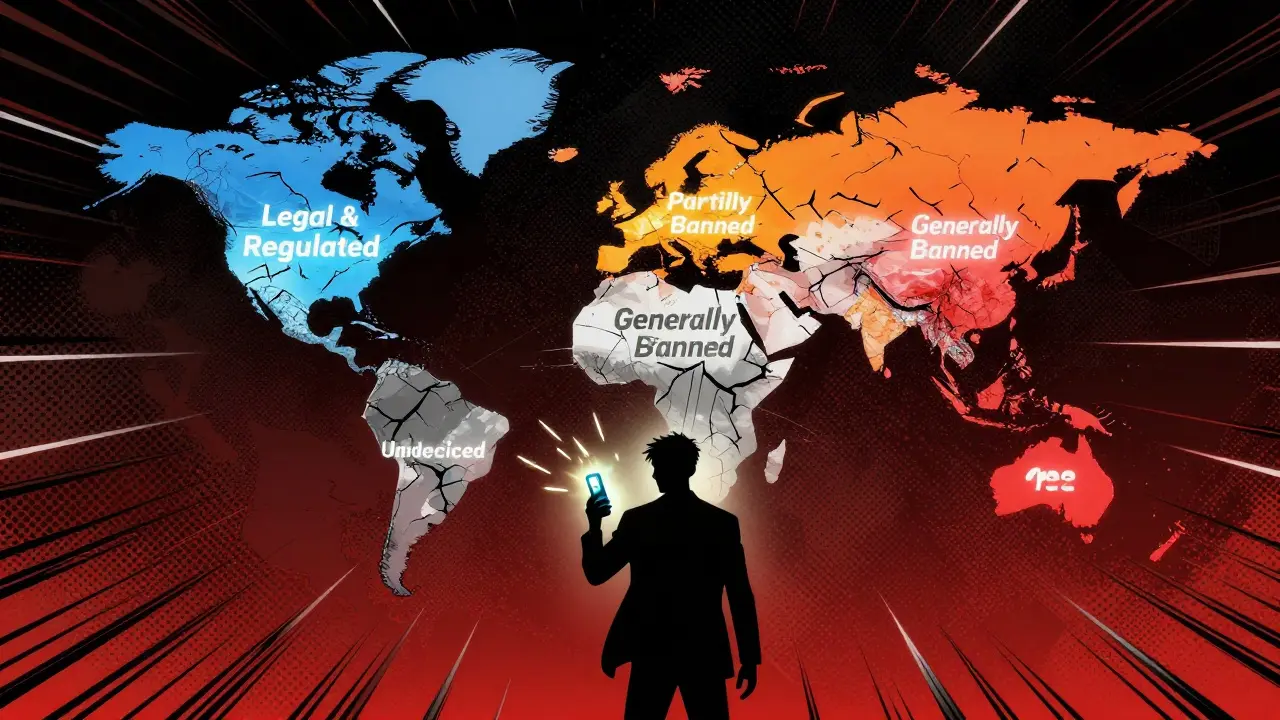
To make sense of the chaos, experts generally group countries into four categories based on their stance toward digital assets. These buckets help you quickly assess risk in any jurisdiction.
- Legal and Regulated: Crypto is legal, but you must follow strict rules regarding licensing, anti-money laundering (AML), and consumer protection. Examples include the United States, Singapore, and most of the European Union.
- Partially Banned: You might own crypto, but you cannot use it for payments, or banks are forbidden from interacting with crypto exchanges. Namibia and Zimbabwe fall here, though enforcement varies.
- Generally Banned: Trading, mining, and holding crypto are illegal. China, Bolivia, and Saudi Arabia enforce total prohibitions to protect monetary sovereignty.
- Undecided/Unregulated: No specific laws exist yet. This creates a gray area where operations aren't explicitly illegal but lack legal protection. Angola and parts of Africa often sit in this zone.
The Atlantic Council’s 2024 tracker noted that 45 countries fall into the "Legal and Regulated" category, while 10 maintain general bans. The majority of economic activity happens in the regulated zones, as businesses demand clarity.
Europe: The MiCA Revolution
If you are in Europe, the game changed significantly in late 2024 with the full implementation of MiCA, which stands for Markets in Crypto-Assets regulation. Before MiCA, every EU member state had slightly different rules. Now, there is a unified framework across all 27 members.
MiCA sets clear standards for stablecoin issuers, crypto asset service providers (CASPs), and transparency. It requires exchanges to hold client funds separately and provides recourse if things go wrong. For medium-sized exchanges, compliance costs around €250,000 initially, plus €75,000 annually. While this sounds expensive, it filters out scams and protects users. Professor Hilary Allen from American University Washington College of Law called MiCA "the world's most comprehensive framework." If you operate in France, Germany, or Italy, you are now under this single roof.
Portugal remains a standout within the EU. Despite MiCA’s operational rules, Portugal maintains its reputation as a tax haven for individuals, charging 0% tax on income derived from Bitcoin transactions for private persons. This makes Lisbon a popular hub for remote crypto workers.
The United States: A Fragmented Maze
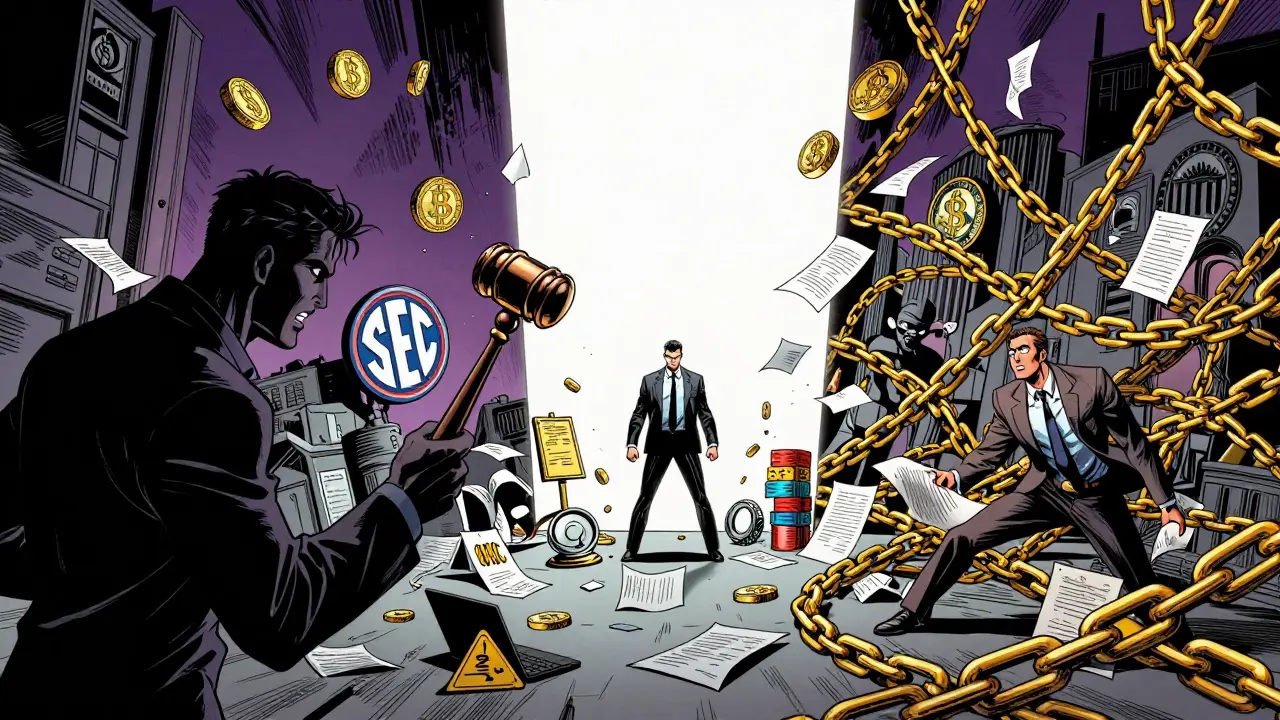
In the US, crypto is legal, but navigating the bureaucracy is a nightmare. There is no single federal agency in charge. Instead, you deal with three powerful bodies:
- SEC (Securities and Exchange Commission): Treats many tokens as securities, requiring registration unless they qualify for exemptions. They aggressively pursue projects they deem unregistered investment contracts.
- CFTC (Commodity Futures Trading Commission): Classifies Bitcoin and Ethereum as commodities. They regulate derivatives and futures markets.
- IRS (Internal Revenue Service): Treats crypto as property. Every swap, sale, or payment triggers a taxable event. You must track cost basis meticulously.
Starting a business here means registering as a Money Services Business (MSB) with FinCEN ($3,000-$10,000 fee) and then obtaining money transmitter licenses in each state where you operate. Each state license costs an average of $5,000 and takes 3-6 months. In March 2025, the House Financial Services Committee approved the Clarity for Payment Stablecoins Act, aiming to create a federal framework for stablecoins. Until that becomes law, the fragmented approach remains.

Asia-Pacific: From Bans to Hubs
Asia shows the widest divergence. On one end, China banned all cryptocurrency transactions, trading, and mining in September 2021. They are instead pushing their own Central Bank Digital Currency (CBDC), the Digital Yuan. Attempting to trade crypto in China carries significant legal risks.
On the other end, Singapore and Japan are leading the way in regulation. Japan was the first G7 nation to legalize Bitcoin as legal tender for payments back in 2017. It requires strict licensing for exchanges. Singapore follows a similar model with robust Anti-Money Laundering (AML) checks. Both countries rank high in user trust; a Deloitte survey found 69% approval for Singapore and 72% for Switzerland among professional traders.
Vietnam presents a unique case. While regulations are tightening, Vietnam leads the Chainalysis 2025 Global Crypto Adoption Index. High peer-to-peer (P2P) transaction volumes drive this adoption, largely due to inflation hedging and remittances. The government has blocked some exchange websites but hasn't criminalized personal holding, creating a complex gray market.
Latin America: Innovation Amidst Volatility
Latin America has become a hotspot for crypto adoption, driven by currency instability. El Salvador made history in June 2021 by adopting Bitcoin as legal tender alongside the US dollar. The Central African Republic followed suit in April 2022, though El Salvador remains the more prominent example. Citizens can pay taxes and buy coffee with Bitcoin.
Brazil offers a more traditional regulatory path. Crypto gains are taxed at 15% for transactions exceeding BRL 35,000 per month. While proposed legislation for a comprehensive framework stalled in recent years, Brazilians operate under general financial regulations. The absence of specific crypto laws creates uncertainty, but the market continues to grow rapidly.
Argentina faces hyperinflation, driving massive P2P usage. While not legal tender, crypto is widely used to preserve value. The government has attempted to restrict capital flows through crypto, but enforcement is difficult given the sheer volume of informal economy activity.
Africa and the Middle East: Mixed Signals
In Africa, central banks are cautious. Nigeria previously banned banks from servicing crypto firms, but the reality on the ground is different. Nigeria ranks among the top countries for crypto ownership (>20% of the population). The Central Bank recently issued guidelines allowing licensed banks to serve virtual asset service providers, signaling a shift toward regulation rather than prohibition.
Saudi Arabia and Bolivia maintain strict bans. Saudi Arabia prohibits crypto trading but is actively developing its own CBDC, the "Riyal," to modernize payments without ceding control to decentralized networks. Botswana has taken a progressive step, introducing a digital asset bill to regulate issuance and trading, aiming to attract fintech investment.
| Country/Region | Legal Status | Tax Treatment | Key Regulation |
|---|---|---|---|
| European Union | Legal & Regulated | Varies by member state | MiCA (Unified Framework) |
| United States | Legal & Regulated | Property (Capital Gains) | SEC/CFTC/IRS Multi-Agency |
| El Salvador | Legal Tender | No Capital Gains Tax | Bitcoin Law (2021) |
| China | Banned | N/A | Total Prohibition (2021) |
| Portugal | Legal & Regulated | 0% for Individuals | MiCA + Local Tax Laws |
| Singapore | Legal & Regulated | No Capital Gains Tax | PAS (Payment Services Act) |
Tax Implications: What Do You Owe?
Taxation is often the biggest headache for crypto holders. Rules vary drastically:
- Australia: No capital gains tax on personal holdings (if held long-term and not traded frequently), but business income from trading is fully taxable.
- Estonia: Eliminated cryptocurrency taxation entirely in 2024 after pressure from the European Commission regarding state aid rules. This makes it highly attractive for Web3 companies.
- Germany: If you hold crypto for more than one year, profits are tax-free. Short-term trades are taxed as regular income.
- India: Imposes a flat 30% tax on crypto gains plus a 1% TDS (Tax Deducted at Source) on transactions, making it one of the most punitive regimes globally.
Always consult a local tax professional. Misclassifying a token as a gift rather than a trade can lead to severe penalties during an audit.
Future Outlook: Convergence and CBDCs
The future points toward greater regulation, not less. The International Organization of Securities Commissions (IOSCO) projects that by 2027, 75% of countries will have dedicated cryptocurrency regulations, up from 37% in 2024. Simultaneously, 92% of central banks are exploring CBDCs. The World Economic Forum predicts 90% of central banks will issue digital currencies by 2030.
This dual trend suggests a hybrid future. Private cryptocurrencies will likely coexist with state-backed digital currencies, linked by interoperable frameworks. For users, this means clearer rules but potentially less anonymity. The FATF’s updated "Travel Rule" requires sharing originator and beneficiary info for transactions over $1,000, reducing privacy for large transfers.
Is Bitcoin legal everywhere?
No. Bitcoin is banned in countries like China, Bolivia, and Saudi Arabia. It is legal tender only in El Salvador and the Central African Republic. In most other places, it is legal to own but subject to varying degrees of regulation and taxation.
What is MiCA and how does it affect me?
MiCA (Markets in Crypto-Assets) is a comprehensive EU regulation implemented in late 2024. It standardizes rules for crypto exchanges and stablecoins across all 27 EU member states. For users, it means stronger consumer protections and clearer rights if an exchange fails.
Do I need to pay taxes on crypto gifts?
It depends on your country. In the US, gifting crypto is not a taxable event for the giver, but the recipient inherits the cost basis. However, if you sell gifted crypto later, you may owe capital gains tax. Always check local gift tax thresholds.
Which countries have the best crypto tax laws?
Portugal (0% tax for individuals), Estonia (no crypto tax since 2024), and Singapore (no capital gains tax) are currently considered favorable. Germany also offers tax-free status if assets are held for over one year.
Can I use crypto to pay for goods in my country?
In El Salvador and the Central African Republic, yes, it is legal tender. In most regulated countries like the US and EU, merchants can accept it voluntarily, but they must report it for tax purposes. In banned countries like China, using crypto for payments is illegal.







so you think the government knows what they are doing with all this regulation nonsense they dont they just want control and money its always about control why do we need to report every single transaction like criminals anyway i have my own wallet and no one can touch it but the feds keep trying so be careful out there because they are watching everything you do online even if you think you are hidden
It is truly disheartening to see how many people ignore the legal implications of their digital holdings. The article clearly states that the US operates under a fragmented maze of agencies, yet individuals continue to treat crypto as an unregulated free-for-all. One must understand that ignorance of the law is not a valid defense when the IRS comes knocking for unpaid capital gains taxes. The complexity of MiCA in Europe versus the SEC's aggressive stance in America highlights the necessity of professional guidance rather than relying on internet forums for financial advice.
I really appreciate this breakdown because it helps us feel more empowered to make informed decisions. It can be scary to navigate these rules but knowing that places like Portugal offer tax benefits gives us hope for remote workers everywhere. Let’s support each other by sharing accurate information and helping newcomers understand the basics without fear. We are all learning together and that community spirit is what makes this space valuable despite the regulatory hurdles.
thats soo true about portugal being great for taxes i moved there last year and it was such a relief not having to worry about the 30% tax like in india or whatever it is now. the mi ca stuff seems complicated tho but at least its unified right? i still get confused sometimes with all the acronyms but hey better than nothing i guess lol
The philosophical implication of state-controlled CBDCs versus decentralized assets is profound :). If the state issues currency, does it not become a tool of surveillance capitalism rather than a medium of exchange? The freedom to transact anonymously is the bedrock of individual liberty in the digital age. We must question whether convenience outweighs the loss of privacy in this hybrid future predicted by the WEF. What is the cost of our comfort?
hey madhu i totally agree with you about the privacy aspect it is very important. in india the 30% tax plus tds is really harsh and feels like punishment for using new tech. i hope things improve soon because right now it is hard for small traders to survive. let us stay positive and help each other navigate these tough times ok
here is a tip for everyone dealing with the us tax situation 📉 track your cost basis from day one 📈 most people mess this up and end up owing way more than they should 💸 use automated software instead of spreadsheets because errors are costly 😬 the irs treats crypto as property so every swap is a taxable event 🔥 don't let them catch you off guard 👮♂️
Jevon makes an excellent point about cost basis tracking which is often overlooked by casual investors. I have seen too many clients face severe penalties during audits simply because they failed to document their transactions meticulously. It is crucial to consult with a local tax professional who specializes in cryptocurrency to ensure compliance. Misclassifying a token as a gift rather than a trade can lead to significant legal and financial repercussions that could have been avoided with proper planning.
This entire concept of global crypto regulation is a joke designed to weaken American sovereignty. Why should we listen to European frameworks like MiCA when our own system works fine? The SEC is doing exactly what it needs to do to protect American investors from foreign scams. Anyone complaining about regulations is either a criminal or ignorant of the risks involved. We need strict enforcement here in the USA to maintain our economic dominance and prevent capital flight to weak jurisdictions.
Oh sure, Matthew, because nothing says 'economic dominance' like confusing your citizens with three different federal agencies and fifty different state licenses. The sarcasm is thick enough to cut with a knife. Maybe if the US actually passed coherent legislation instead of letting the SEC play judge, jury, and executioner, businesses wouldn't be fleeing to Singapore or Dubai. But sure, let's keep pretending the current chaos is a feature, not a bug.
The author fails to mention the sheer incompetence required to manage such a fragmented landscape. It is absurd that one must register as an MSB and then obtain individual state licenses. This bureaucratic nightmare stifles innovation and rewards only those with deep pockets. The Clarity for Payment Stablecoins Act is a band-aid on a gunshot wound. Until there is a unified federal approach, the US will remain a second-tier player in the global crypto arena. Pathetic.
You people are delusional if you think crypto is safe anywhere. The elites are coming for your bags regardless of where you live. China banned it to control the masses, the US regulates it to tax the masses, and Europe standardized it to surveil the masses. There is no escape. Your 'decentralized' dreams are a fantasy sold by grifters. Wake up and realize that fiat is the only real power left because the state holds the gun.
oh please dan stop with the doom and gloom narrative it is so exhausting 😒 yes there are risks but saying there is no escape is just lazy thinking. look at el salvador or portugal people are finding ways to thrive despite the systems. maybe instead of preaching fear you could try understanding how technology empowers individuals. but i guess that would require you to open your mind which you seem reluctant to do
The trajectory toward convergence is inevitable and we must adapt accordingly. While the rise of CBDCs presents challenges to privacy, the interoperability frameworks mentioned suggest a structured evolution rather than a collapse. Investors should focus on jurisdictions with clear regulatory paths like Singapore or Estonia to mitigate risk. Embrace the change, prepare your compliance structures, and position yourself for the next phase of digital asset integration. The future belongs to those who are prepared.