
What is Global Token (GBL)? A Warning About the Crypto 'Ghost Coin'
You’ve probably seen it on a list. Maybe you were scrolling through an exchange app, looking for the next big thing, and there it was: Global Token (GBL). It looked official. It had a ticker symbol. It even had listings on major platforms like Coinbase and Binance. But if you dig just one inch deeper, something feels... off. The numbers don't add up. The activity is nonexistent. And the silence from its creators is deafening.
If you are asking "what is Global Token," you aren't just looking for a definition. You are likely trying to decide if this coin is worth your money or if it’s a trap. Based on the data available as of late 2025 and early 2026, the answer leans heavily toward caution. GBL isn't just a bad investment; it exhibits all the classic signs of what experts call a "ghost token"-a digital asset that exists on paper but has vanished in practice.
The Paradox of Zero Supply
Let’s start with the most glaring red flag. In the world of cryptocurrency, digital assets secured by cryptography and running on blockchain technology, supply is everything. You need tokens in circulation for people to buy, sell, and use them. Without circulating supply, there is no market. There is no price discovery. There is nothing.
Yet, here is the reality for GBL: According to data from Coinbase, one of the largest regulated cryptocurrency exchanges in the United States and CoinMarketCap, a leading aggregator of cryptocurrency market data, the total supply of Global Token is fixed at 17,900,000. That sounds fine. But the circulating supply? Zero. Exactly zero.
How can a token be listed for trading if nobody holds it? This creates a logical paradox. If you try to buy GBL, who are you buying it from? If the circulating supply is zero, there are no sellers. This discrepancy suggests either a massive error in how the exchanges have indexed the token or, more likely, a deliberate obfuscation of the token's true status. As of October 2025, Etherscan-the primary block explorer for Ethereum-based tokens-shows zero Ethereum addresses holding GBL. If no wallet holds it, why does it still appear on your screen?
Conflicting Technical Foundations
When you research a project, you expect consistency. Is it on Bitcoin? Ethereum? Solana? For GBL, the answer changes depending on which website you visit. This lack of clarity is not a minor detail; it is a fundamental breakdown in technical transparency.
Coinbase and Binance listings indicate that GBL operates on the Ethereum, the second-largest cryptocurrency platform by market capitalization, known for smart contracts blockchain. This makes sense given the ERC-20 standard often used for such tokens. However, other data aggregators like Symlix explicitly state that GBL operates on the BNB Chain, a blockchain network developed by Binance, formerly known as Binance Smart Chain.
A token cannot natively exist on two different blockchains without a bridge or a wrapper, and there is no evidence of such infrastructure for GBL. This contradiction leaves investors guessing about the underlying technology. Are you interacting with an Ethereum contract or a BNB smart contract? Without a verifiable whitepaper or a public GitHub repository-which both are missing for GBL-you are flying blind. This ambiguity is a hallmark of projects that lack serious development teams.
The Price Crash and Liquidity Trap
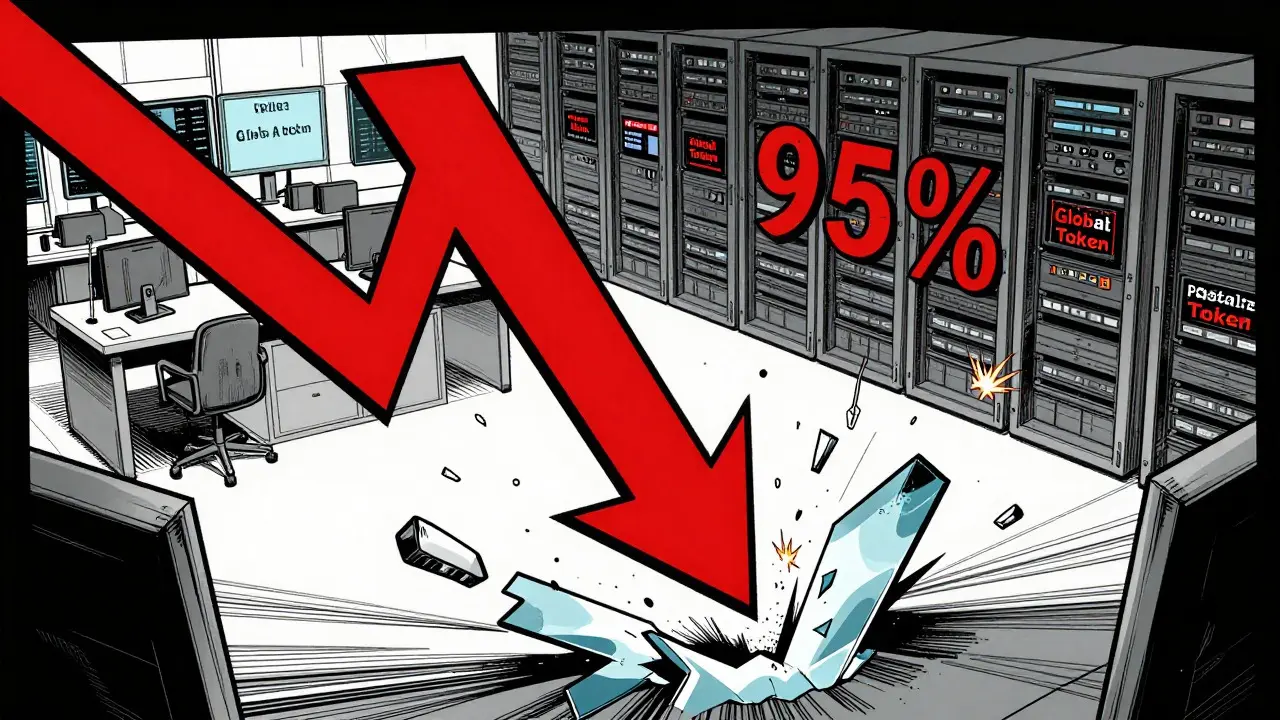
Let’s talk numbers, because they tell a grim story. At its peak, Global Token traded at an all-time high of $39.12. That sounds impressive, right? But context matters. By June 2025, the price had plummeted to approximately $1.73, representing a depreciation of over 95%. Some sources even showed prices as low as $1.48 by late 2025.
But the price drop is only half the problem. The other half is liquidity-or rather, the complete absence of it. Trading volume across all major platforms consistently reports $0. Think about what that means. Volume measures how many tokens change hands in a 24-hour period. If the volume is zero, the market is dead. You might see a price tag, but if you tried to sell a large amount, you would find no buyers. Your order would sit there, unfilled, forever.
This phenomenon is often referred to as a "liquidity trap." Investors get locked in because the token appears to have value on paper, but there is no active market to convert that paper value into cash. The fact that GBL maintains listings on 26 exchanges despite having zero volume suggests these listings may be automated artifacts rather than active markets. They are digital ghosts haunting the servers of major exchanges.
No Team, No Code, No Community
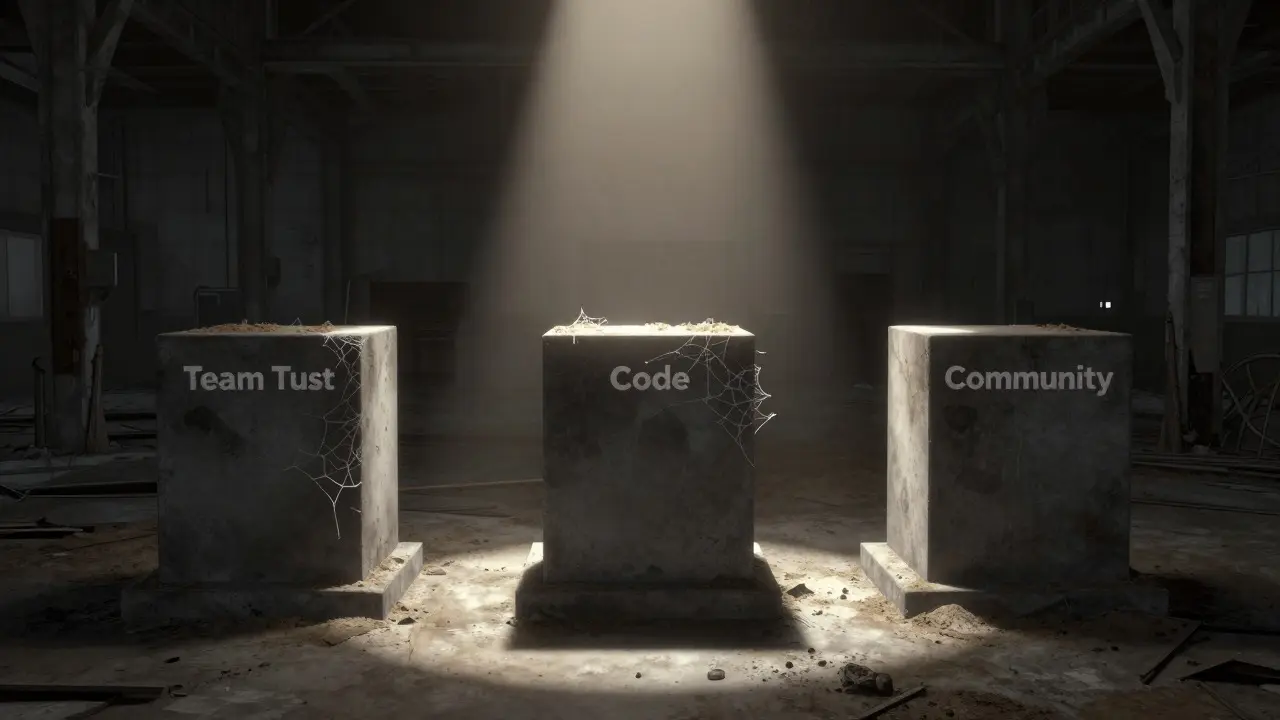
In the crypto space, trust is built on three pillars: the team, the code, and the community. GBL fails on all three counts.
- The Team: There is no verifiable information about the developers behind Global Token. No LinkedIn profiles, no Twitter handles, no public interviews. Anonymous teams are common in crypto, but usually, they provide some form of contact or roadmap. GBL provides silence.
- The Code: A healthy crypto project has an active GitHub repository where developers push updates, fix bugs, and allow the community to audit the code. For GBL, there are no associated repositories. Without code transparency, anyone could claim ownership of the token, including those who might want to rug-pull it.
- The Community: Search Reddit, Discord, or Telegram for "Global Token GBL." What do you find? Virtually nothing. As of late 2025, there were zero substantive discussion threads on Reddit regarding the token. A project with millions in potential market cap should have thousands of users debating its future. Instead, there is a void.
This absence is not accidental. It indicates an abandoned project. When a team stops communicating and stops coding, the token becomes a shell. It retains its listing on exchanges due to legacy data, but it has no life force left.
Why Do Major Exchanges Still List It?
If GBL is such a mess, why is it still on Coinbase and Binance? This is the question that confuses most retail investors. You assume that if a major exchange lists a coin, it must be safe. Unfortunately, that assumption is dangerous.
Exchanges operate on complex algorithms for listing and delisting. Often, once a token is listed, it remains visible unless a manual review triggers a removal. With GBL showing zero volume and zero holdings, it falls into a gray area. It’s not actively harming users because no one can really trade it. So, it sits there, inactive.
Furthermore, regulatory pressures play a role. In October 2025, the SEC’s "Token Transparency Initiative" began targeting tokens with circulating supply anomalies. While this scrutiny is good for the market, it also means exchanges are hesitant to make sudden moves that could draw further attention. They leave the "zombie" tokens listed but mark them as inactive or low-priority in their APIs. Coinbase’s own API marked GBL as "inactive" by October 2025, signaling internally that the token is effectively dormant, even if the front-end page still loads.
The Verdict: Avoid the Ghost
So, what is Global Token (GBL)? Technically, it is a cryptocurrency with a fixed supply of 17.9 million tokens. Practically, it is a non-functional digital asset with zero circulation, zero volume, and zero community support. It fits the profile of a "ghost token" identified by firms like Chainalysis-assets that persist in databases long after their utility has evaporated.
For the average investor, GBL offers no utility, no growth potential, and significant risk. The risk here isn't just losing money on a bad trade; it’s wasting time chasing a mirage. The discrepancies in blockchain data, the conflicting platform origins, and the total lack of development activity paint a clear picture: this project is dead.
Before you click "buy" on any obscure token, ask yourself: Who holds it? Where is the code? Who is talking about it? If the answers are "no one," "nowhere," and "silence," keep your wallet closed. In the volatile world of crypto, survival depends on sticking to transparent, active, and verified projects. GBL is none of those things.
| Metric | Data Point | Risk Level |
|---|---|---|
| Circulating Supply | 0 / 17,900,000 | Critical |
| 24-Hour Volume | $0 | Critical |
| Blockchain Origin | Conflicting (ETH vs BNB) | High |
| Development Activity | None (No GitHub) | Critical |
| Community Presence | Negligible | High |
| Price Trend | -95% from ATH | High |
Is Global Token (GBL) a scam?
While "scam" implies intentional fraud, GBL exhibits characteristics of an abandoned or failed project. With zero circulating supply, zero trading volume, and no verifiable team, it functions as a "ghost token." Whether it was initially fraudulent or simply mismanaged, the result is the same: it holds no real value and poses a high risk to investors.
Why does Coinbase list Global Token if it has no supply?
Exchanges often retain listings for tokens that become inactive due to automated systems and legacy data. Coinbase has marked GBL as "inactive" in its backend API, indicating they recognize the lack of activity. The frontend listing persists until a formal delisting process is completed, which can take time for low-volume assets.
Can I buy Global Token on Binance?
Technically, yes, Binance provides a guide on how to buy GBL. However, the guide includes disclaimers about insufficient trading activity. Because the circulating supply is reported as zero, finding a seller to execute a trade is highly unlikely, making any purchase attempt practically futile.
What blockchain does GBL run on?
There is conflicting information. Major exchanges like Coinbase associate it with Ethereum, while other data providers link it to the BNB Chain. This inconsistency suggests poor documentation or potential errors in data aggregation, adding to the uncertainty surrounding the token's technical validity.
Is there a whitepaper for Global Token?
As of late 2025, no verifiable whitepaper or official technical documentation exists for Global Token. The absence of a whitepaper, combined with a lack of GitHub repositories, indicates a severe lack of transparency and professional development standards.
What is the current price of GBL?
Prices vary wildly due to lack of liquidity, ranging from $1.48 to $12.11 across different platforms. However, with $0 trading volume, these prices are largely theoretical. The token has dropped over 95% from its all-time high of $39.12, reflecting its deteriorating market status.
Should I invest in Global Token?
Most analysts recommend avoiding GBL. With metrics classified as "critical" risk-including zero supply, zero volume, and no development activity-it lacks the fundamental requirements for a viable investment. It is safer to focus on tokens with transparent teams, active communities, and verifiable liquidity.


the ontological status of a token with zero circulating supply is fascinatingly void. it exists as a signifier without a signified, a pure linguistic construct in the digital ether. when we look at GBL, we are looking at the shadow of value rather than value itself. the market mechanisms that usually anchor price to utility have completely decoupled here. it is a ghost in the machine, haunting the ledgers of exchanges that refuse to exorcise it. this raises questions about the nature of liquidity and whether it can be purely theoretical. if no one holds it, who defines its worth? perhaps the worth is in the confusion it generates among retail investors seeking alpha in beta markets. the paradox of the listed but unholdable asset challenges our understanding of blockchain transparency.
don't fall for the mainstream narrative that this is just an 'abandoned project.' the conflicting blockchain data between ETH and BNB isn't a mistake; it's a deliberate obfuscation tactic by the deep state crypto regulators to confuse the masses. they want you to think it's dead so you don't ask why the SEC's Token Transparency Initiative is targeting specific anomalies. the zero volume is artificial suppression. keep your eyes open because the real story is buried under layers of institutional gaslighting. trust nothing from Coinbase or Binance until you verify the on-chain truth yourself. they are feeding you legacy data to keep you complacent while the elite move assets off-ledger.
boring article. another coin dies. wtf.
people really need to stop chasing these dead ends. it is simple logic. if there is no team and no code, there is no product. you are buying air. the whole crypto space is full of these zombies that exchanges are too lazy to remove. it is not a mystery, it is negligence. stop looking for magic beans and start reading whitepapers. if there is none, walk away. it is that easy. most of you are just gamblers pretending to be investors.
i actually find this kind of analysis really helpful for understanding how messy the early stages of decentralized finance can be, even if the outcome is negative. it is interesting to see how long a token can linger in the system before it is fully purged, which says a lot about the inertia of financial infrastructure. maybe there is a lesson here about patience and due diligence that applies to other areas of life too. we often rush into things without checking the fundamentals, and then we get surprised when the house of cards collapses. it is good to have resources like this that break down the technical reasons behind a failure, so we can learn from them rather than just feeling disappointed. i hope more projects will take note of the importance of community engagement and transparent development practices.
everyone is so quick to call it a scam or a ghost but what if the silence is strategic? maybe the team is building something in stealth mode that requires absolute secrecy. the lack of a github repo could mean they are avoiding front-running by copycat developers. you all judge based on surface level metrics without understanding the deeper game theory at play. it is arrogant to assume that zero volume means zero value. sometimes the smartest money sits quietly while the fools panic sell. let the dust settle before you declare victory over a potential unicorn.
oh darling, the tragedy of GBL is almost poetic in its decay. imagine the vibrant dreams of its creators, now reduced to a digital specter haunting the servers of Coinbase. it is like watching a beautiful flower wilt in fast forward, petals falling into the void of zero liquidity. the conflicting blockchain origins add a layer of surrealism, as if the token is suffering from an identity crisis across dimensions. one moment it is Ethereum, the next BNB, lost in the labyrinth of smart contracts. it is a cautionary tale wrapped in code, a siren song that leads only to the rocks of insolvency. we must cherish the active tokens while they last, for they too may become ghosts in the night.
great breakdown! :D it is super important to check those red flags like zero supply and no github. always do your own research before diving in. happy trading everyone! :)
THIS IS EXACTLY WHY WE NEED BETTER REGULATIONS!!! The fact that these zombie tokens sit on major exchanges is a disgrace to the entire industry!!! People lose money because of this negligence!!! We need immediate action from the SEC to force delistings of inactive assets!!! Do not let them hide behind 'legacy data' excuses!!! Protect the investors!!! #CryptoReform
🚨🚨🚨 THE TRUTH IS SUPPRESSED 🚨🚨🚨 GBL is not dead, it is being hidden by the banking cartel to protect fiat currency!!! The zero volume is a lie created by manipulated exchange APIs!!! Wake up sheeple!!! They want you to believe it is a ghost so you stay in the matrix!!! Check the dark web forums where the real traders talk!!! 👁️👄👁️💀💀💀
One might ponder the existential dread induced by such a hollow construct. To list a token with no holders is akin to inviting guests to a banquet where the tables are empty and the kitchen is closed. It is a farce of the highest order, perpetrated by institutions that claim to uphold integrity yet allow such absurdities to persist. The ambiguity of its blockchain origin further exacerbates the epistemological crisis faced by the investor. How can one trust a platform that cannot even agree on the substrate of reality? It is a testament to the chaotic nature of this nascent financial sector, where rules are fluid and accountability is nonexistent. One should approach such entities with extreme skepticism and perhaps a healthy dose of cynicism.
hey guys, just wanted to chime in and say that spotting these red flags early is key to staying safe out there. its wild how many people still fall for the hype without checking the basics like supply and dev activity. keep your heads on a swivel and dont let FOMO drive your decisions. stick to projects with solid teams and active communities. you got this! 💪🔥