
How Many Faulty Nodes Can BFT Systems Tolerate: The 3f+1 Rule Explained
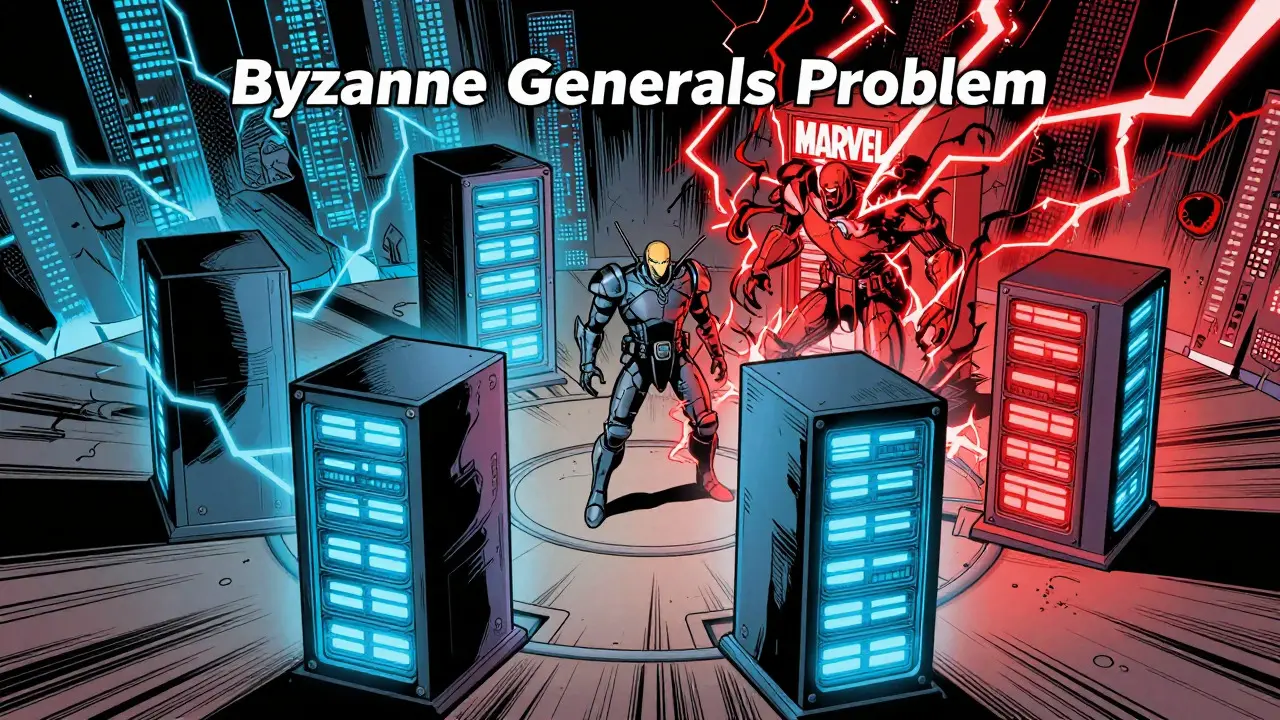
You’ve probably heard that blockchain is unhackable. But what happens when the computers running it start lying to each other? In distributed systems, this isn’t just a glitch; it’s a specific threat known as a Byzantine fault. If you are building or managing a network that relies on Byzantine Fault Tolerance (BFT), which is a property of distributed systems that enables them to maintain reliable operation despite faulty or malicious nodes, you need to know exactly how many bad actors your system can handle before it collapses.
The answer isn’t a guess. It is a hard mathematical limit. A BFT system can tolerate up to one-third of its nodes being faulty or malicious. This means if you have 10 nodes, only 3 can fail. If a 4th goes rogue, the entire system stops agreeing on the truth. Understanding this ratio is the difference between a resilient enterprise ledger and a frozen database.
The Core Formula: Why n ≥ 3f + 1 Matters
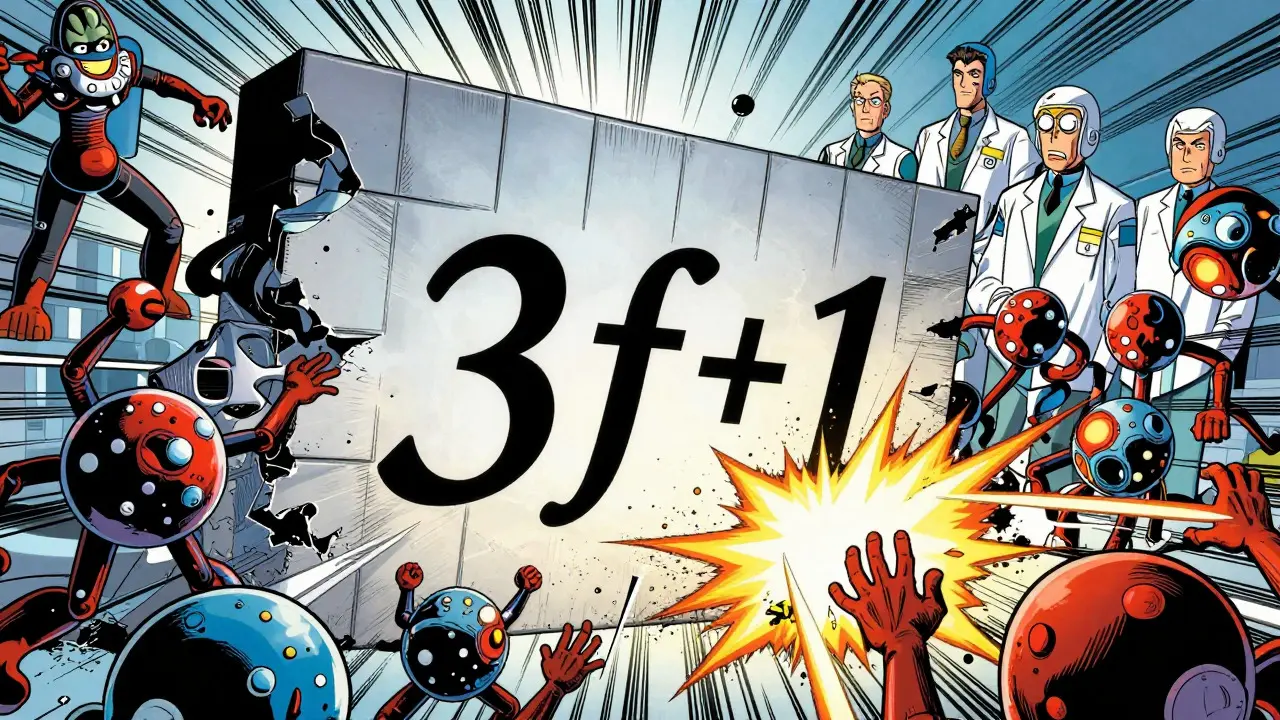
To understand why your system needs so many servers, we have to look at the math behind the scenes. The fundamental rule for any Byzantine Fault Tolerant system is expressed as n ≥ 3f + 1. Here, n represents the total number of nodes in your network, and f is the maximum number of faulty nodes you want to tolerate.
This formula comes from the original research by Leslie Lamport, Robert Shostak, and Marshall Pease in their 1982 paper, "The Byzantine Generals Problem." They proved that without this ratio, honest nodes cannot distinguish between a slow connection and a malicious lie. Let’s break down what this looks like in real numbers:
- Tolerating 1 faulty node (f=1): You need at least 4 total nodes (3*1 + 1 = 4). One bad node out of four is 25% of the network.
- Tolerating 2 faulty nodes (f=2): You need at least 7 total nodes (3*2 + 1 = 7). Two bad nodes out of seven is roughly 28.6%.
- Tolerating 3 faulty nodes (f=3): You need at least 10 total nodes (3*3 + 1 = 10). Three bad nodes out of ten is 30%.
Notice the pattern? As you add more nodes to tolerate more faults, the percentage of faulty nodes allowed never exceeds one-third. Hedera Hashgraph’s technical documentation confirms this, stating that BFT systems can tolerate up to one-third of nodes acting maliciously while still reaching honest consensus. If you try to run a system with fewer than 4 nodes, you have zero Byzantine fault tolerance. Lose one node, and you lose majority agreement.
BFT vs. Other Consensus Mechanisms
Not all distributed systems use BFT. Bitcoin uses Proof-of-Work (PoW), and Ethereum uses Proof-of-Stake (PoS). How do they compare?
| Consensus Type | Fault Tolerance Limit | Finality Speed | Best Use Case |
|---|---|---|---|
| Practical BFT (PBFT) | Up to 1/3 faulty nodes (f ≤ (n-1)/3) |
Deterministic (Seconds) | Permissioned Enterprise Ledgers |
| Proof-of-Work (Bitcoin) | Up to 49% malicious hash power | Probabilistic (Hours/Days) | Public, Open Networks |
| Proof-of-Stake (Ethereum) | Complex; depends on validator set size | Fast (Minutes) | High-throughput Public Chains |
The key difference is finality. BFT provides deterministic finality. Once the nodes agree, the transaction is done. There is no going back. PoW and PoS rely on probability-the longer you wait, the less likely a reversal becomes. For financial institutions or aerospace controls, waiting hours for certainty is unacceptable. That is why NASA uses 7-node configurations for spacecraft systems to tolerate 2 simultaneous failures instantly. However, BFT requires a fixed, known list of participants. This makes it perfect for private networks but difficult for open public blockchains where anyone can join.
Why Engineers Add Extra Nodes (The n = 3f + 2 Rule)
If the math says you need 4 nodes to tolerate 1 failure, why do most production systems use 5, 7, or even 10? Because reality is messier than theory.
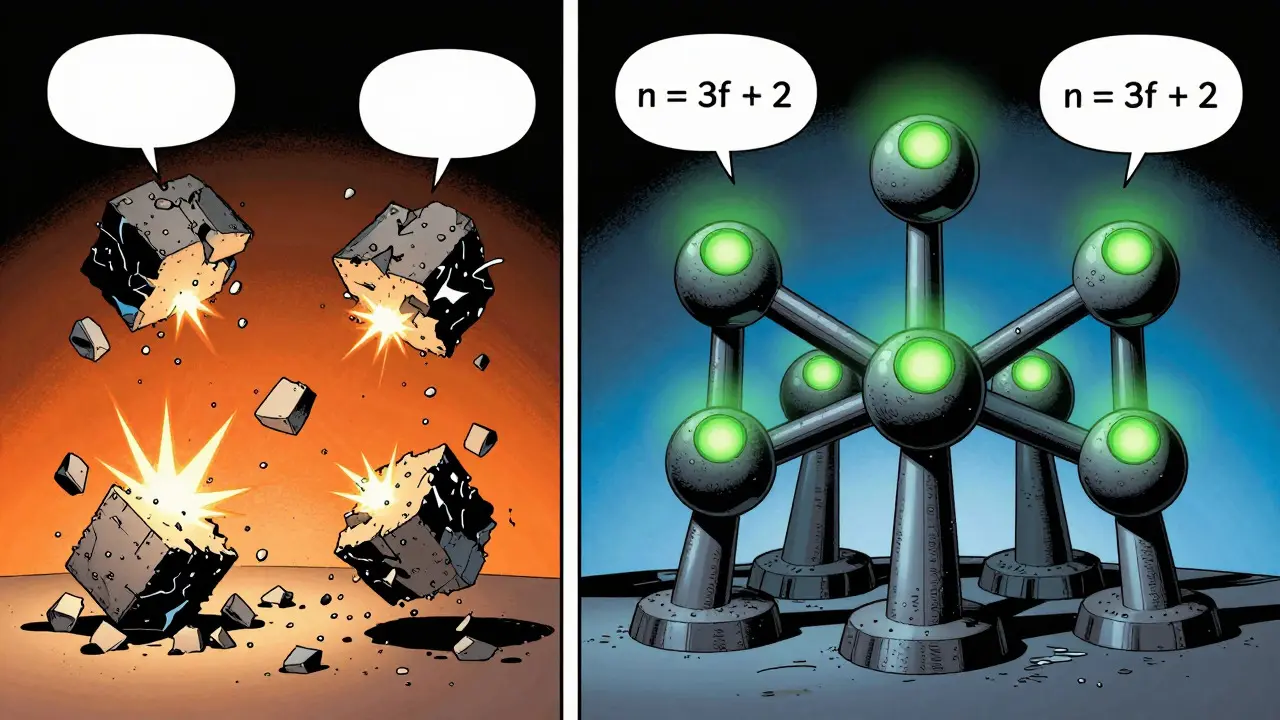
In a strict n = 3f + 1 setup, you have zero margin for error. If you have 4 nodes and tolerate 1 fault, and then a second node has a temporary network hiccup during maintenance, your system halts. It can’t reach consensus because it thinks it has two faulty nodes, exceeding its limit.
Industry best practice, observed in GitHub discussions for Tendermint and Hyperledger Fabric, suggests using n = 3f + 2 or higher. This adds redundancy. For example:
- Theoretical Minimum: 4 nodes (tolerates 1 fault).
- Production Standard: 5 or 7 nodes (tolerates 1 fault with room for maintenance, or tolerates 2 faults).
A startup case study from early 2025 highlighted this risk. Their 4-node BFT system suffered 72 hours of downtime when one node failed during a network partition. Because they were at the bare minimum, the transient issue looked like a second Byzantine fault, freezing the ledger. IBM’s Food Trust network, by contrast, uses 7 nodes to tolerate 2 simultaneous faults, achieving 99.995% uptime over 18 months. The extra hardware cost is worth the reliability.
Performance Costs of Fault Tolerance
Tolerating lies is expensive. Every node must verify messages from every other node, often requiring multiple communication rounds. MIT research from 2001 showed that performance degrades significantly as faulty nodes approach the 30% threshold. In a 10-node system, latency increased by 227% when 3 nodes became faulty compared to a healthy state.
Furthermore, infrastructure costs are higher. Microsoft’s 2023 whitepaper noted that Azure Blockchain Service users reported 37% higher infrastructure costs for BFT systems compared to non-fault-tolerant alternatives with equivalent throughput. You are paying for security and redundancy. When deciding on your node count, balance the regulatory requirement (e.g., EU’s DORA mandates tolerating at least 2 simultaneous faults) against your budget. For internal apps, f=1 (4-5 nodes) might suffice. For financial clearing, f=2 (7+ nodes) is standard.
Future Developments and Optimizations
Researchers are constantly trying to make BFT faster and cheaper without breaking the n ≥ 3f + 1 rule. The IETF’s BFT Working Group released optimizations in late 2025 introducing threshold cryptography to reduce message complexity. Meanwhile, MIT’s CSAIL published research on "Fractional BFT" in March 2025, exploring probabilistic methods that might exceed classical bounds in specific network topologies, though deterministic guarantees still require the traditional node count.
Quantum computing also poses a long-term risk. NIST’s 2025 roadmap indicates that BFT systems will need to update their cryptographic primitives by 2030 to remain secure. Until then, the core logic remains unchanged: trust is built through numbers, not promises.
What is the maximum percentage of faulty nodes a BFT system can handle?
A BFT system can tolerate up to one-third (33.3%) of its nodes being faulty or malicious. This is derived from the formula n ≥ 3f + 1, ensuring that honest nodes always hold a supermajority.
How many nodes do I need to tolerate 2 faulty nodes?
To tolerate 2 faulty nodes (f=2), you need a minimum of 7 total nodes (n=7). However, for production stability, experts recommend using 8 or 9 nodes to allow for maintenance and transient errors.
Can a 3-node system be Byzantine Fault Tolerant?
No. A 3-node system cannot tolerate any Byzantine faults. If one node fails or lies, the remaining two honest nodes cannot distinguish the liar from a slow connection, leading to consensus failure. You need at least 4 nodes for f=1.
Is BFT better than Proof-of-Work?
It depends on your goal. BFT offers instant, deterministic finality and low energy usage, making it ideal for private enterprise ledgers. Proof-of-Work allows for open participation and higher theoretical fault tolerance (up to 49%), but takes hours to confirm transactions and consumes massive energy.
Why do companies use more nodes than the mathematical minimum?
Companies add extra nodes (redundancy) to prevent downtime during maintenance or temporary network issues. Running at the exact minimum (3f+1) means any unexpected failure causes the entire system to halt. Adding 1-2 extra nodes provides a safety buffer.







hey everyone just wanted to say that the n=3f+2 rule is super important for production systems because you need that extra buffer for maintenance windows and transient network errors otherwise your ledger freezes like that startup in 2025 did so always add redundancy
They are lying to you about the math. The elites want you to believe in this 3f+1 rule so they can control the nodes. I have seen documents from the deep state that show Lamport was a front man for a cabal of bankers who rig the consensus every time a node goes rogue. You think 4 nodes are enough? Ha! They plant the faulty nodes themselves. Wake up sheeple. The Byzantine Generals were actually CIA operatives testing our obedience. If you run a BFT system you are part of the problem. Trust no one. Especially not the ones selling you Azure Blockchain Service.
Oh look another tech bro trying to explain basic algebra 🙄 As if we all dont know that n>=3f+1 is just a way to sell more servers 💸 The real issue is that these systems are designed to fail so big tech can step in with their proprietary solutions 🤡 Who needs fault tolerance when you have corporate greed? At least Bitcoin lets you mine in your basement without asking permission from some board of directors 😂
i think its really helpful to understand that bft is not for everyone though like if you are a small startup maybe you dont need 7 nodes right away but as you grow you will see why the redundancy matters it helps keep things running smoothly even when people make mistakes or networks go down which happens all the time so its good to plan ahead
The nature of truth in a distributed system is an illusion we create to feel safe in a chaotic universe. When we say a node is 'faulty' we are projecting our fear of uncertainty onto silicon. Is the node lying or is it merely expressing a different reality? The 3f+1 rule is a cage for the human spirit, forcing us to accept a false consensus rather than embracing the beautiful ambiguity of existence. We build walls of code to hide from the void.
You are missing the point entirely. It is not about philosophy. It is about math. If you cannot do basic arithmetic you should not be designing critical infrastructure. The cost of failure is measured in dollars and lost data. Stop writing poetry and start reading the whitepapers. Precision matters. Ambiguity kills ledgers.
Wow that was intense Michelle! But Logan has a point about the human element behind the code. We are all just trying to find order in chaos. Maybe we can appreciate both the hard math and the soft existential dread. Let us all take a deep breath and remember that technology serves us not the other way around. Peace and love to all the node operators out there ✨
So what you are saying is that Lisa is crazy and Logan is pretentious? That is exactly what I thought too. I bet you guys sleep on the same side of the bed. Anyway the real question is why does NASA use 7 nodes? Is it because they are paranoid or because they know something we don't? I heard their spacecraft talk to each other using quantum entanglement now. Just saying. 👽🚀
It is indeed quite fascinating to observe the various perspectives presented here and while the mathematical rigor of the Byzantine Fault Tolerance models is undeniable one must also consider the sociological implications of relying on such rigid structures in an increasingly interconnected world where trust is becoming a scarce commodity and the definition of a faulty node may extend beyond mere technical failures to include intentional malice by actors who seek to undermine the very foundations of digital commerce and governance thus requiring a holistic approach that integrates both technological safeguards and ethical considerations into the design of resilient systems
The article states that performance degrades significantly as faulty nodes approach the 30% threshold which is a crucial detail often overlooked by enthusiasts who focus solely on finality speed. In practice this means that while BFT offers deterministic finality the operational cost of maintaining that certainty during periods of instability can outweigh the benefits for applications that do not require instant settlement. Engineers must weigh the trade-offs carefully.
Typical amateur analysis. Most people here do not understand that PBFT is only suitable for permissioned environments where the validator set is fixed and known. Trying to apply this logic to public chains is a fundamental category error. The overhead of message complexity O(n^2) makes it unscalable for open networks. Stick to PoS if you want decentralization. :)
I cannot believe how many people are ignoring the moral responsibility of system designers. When a system fails because someone chose n=4 instead of n=7 lives are affected. Think of the patients whose medical records get locked! Think of the pilots whose navigation data gets corrupted! This is not just code it is life and death. We must demand higher standards from these engineers. They are playing god with our data. 😡😠
While the sentiment expressed by Winston is passionate; it lacks nuance. The decision to implement specific node counts is a business risk assessment; not a moral failing. Furthermore; the claim that n=4 is inherently immoral ignores the context of resource constraints for smaller entities. One must distinguish between negligence and calculated risk. The article correctly identifies that industry best practices suggest n=3f+2; however; this is a recommendation; not a commandment. Rigid adherence to any single metric without considering the broader ecosystem is intellectually lazy.