
How Peer Discovery Works in Cryptocurrency Networks: Bitcoin vs Ethereum
Imagine walking into a crowded room where everyone speaks different languages, nobody knows your name, and you have no phone to call a friend. How do you find people to talk to? In the physical world, you might look for familiar faces or ask someone nearby. In the digital world of cryptocurrency, this problem is solved through Peer Discovery, which is the fundamental process by which nodes in decentralized blockchain networks locate and connect to other participating nodes. Without this mechanism, blockchains would be isolated islands of data, unable to share transactions or agree on the state of the ledger.
When you run a node on a network like Bitcoin or Ethereum, it doesn't just magically know who else is online. It has to actively search for peers to connect with. This process is the backbone of the peer-to-peer (P2P) infrastructure that makes cryptocurrencies truly decentralized. If peer discovery fails, the network fragments. If it's manipulated, the network becomes vulnerable to attacks. Understanding how this works reveals why some blockchains are more resilient than others.
The Bootstrap Problem: Finding the First Friend
Every new node faces the "bootstrap problem." When a computer first joins the network, its list of known peers is empty. It needs at least one connection to start downloading blocks and validating transactions. But how does it find that first peer without relying on a central server?
Bitcoin solves this with a multi-tiered approach designed for maximum resilience. The primary method involves DNS Seeds, which are hardcoded Domain Name System names maintained by community members that return IP addresses of active full nodes. These aren't single points of failure because there are many independent DNS seed operators. When a Bitcoin node starts, it queries these DNS records. The response is a list of IP addresses of publicly available nodes.
If the DNS seeds fail-perhaps due to internet censorship or technical issues-the node falls back to hardcoded seed nodes. These are specific IP addresses embedded directly into the Bitcoin software code as a last resort. As a final option, users can manually configure trusted peers from community sources. This layered approach ensures that even if one discovery method is blocked, the node can still join the network.
Cascading Connections: How Nodes Expand Their Network
Once a node establishes its first connection, the real work begins. It doesn't stop at one peer. Instead, it initiates a cascading discovery effect. The newly connected node sends a getaddr message, asking its peer for a list of other nodes it knows about. The peer responds with an addr message containing IP addresses of its own connections.
This creates a ripple effect. Node A connects to Node B. Node B shares addresses of Nodes C, D, and E. Node A then attempts to connect to C, D, and E. Each of those nodes shares their own lists, rapidly expanding the new node's view of the network topology. To prevent overwhelming the network, nodes limit the number of outbound connections they maintain simultaneously, typically keeping around eight active peers.
Nodes also track the quality of these connections. They monitor metrics like latency, reliability, and misbehavior scores. If a peer consistently disconnects or sends invalid data, the node marks it as unreliable and prioritizes healthier connections. This self-optimizing behavior reduces reliance on the initial DNS seeds over time, distributing the load across the entire network.
The Handshake Protocol: Establishing Trust
Finding a peer is only half the battle. The nodes must also agree to communicate. This happens through a strict handshake protocol. When a connection is established, both nodes exchange version messages. These messages contain critical information:
- The software version of the node
- The current block height (how up-to-date the node is)
- A timestamp to synchronize clocks
- Services the node supports (e.g., whether it stores the full blockchain)
If the receiving node accepts the connection parameters, it replies with its own version message. Both sides then send verack messages to confirm the link is open. Only after this handshake is complete do they begin exchanging blocks and transactions. To keep the connection alive, nodes send ping messages periodically. If no response is received within 90 minutes, the node assumes the peer has gone offline and removes it from its active list.
Ethereum’s Dynamic Approach: discv5 and ENRs
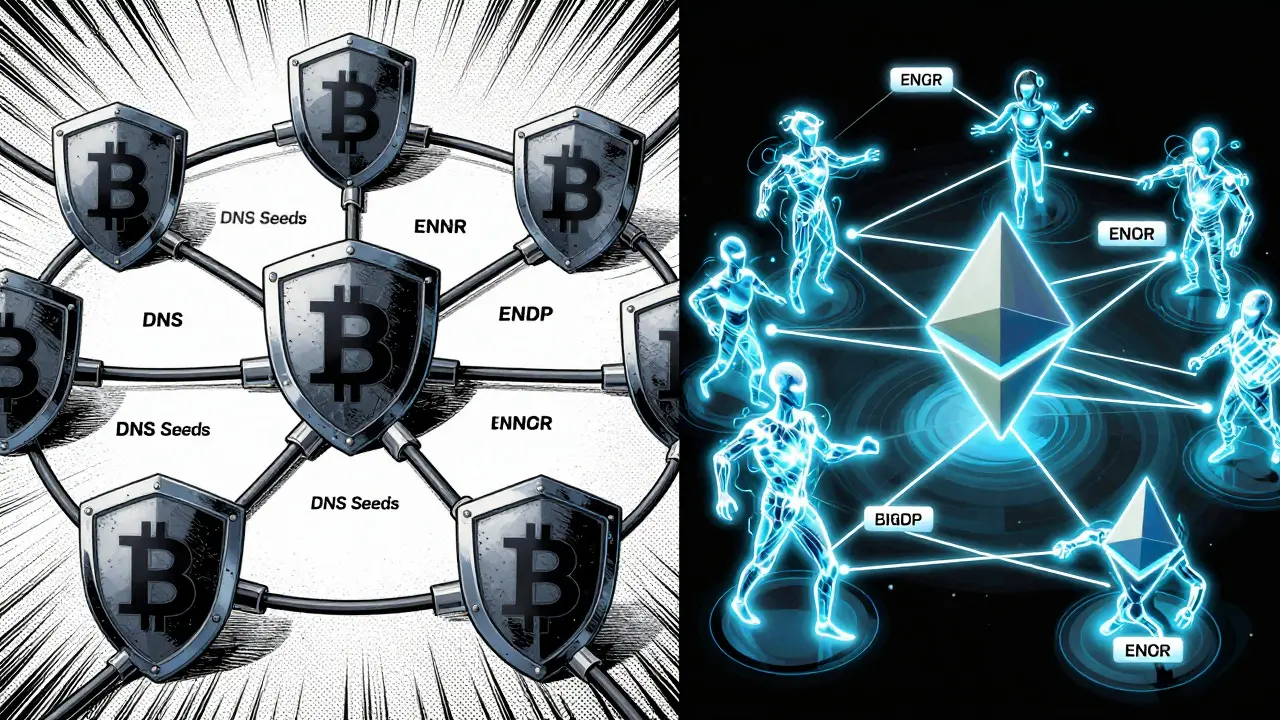
While Bitcoin relies on static DNS seeds and gradual peer sharing, Ethereum uses a more dynamic system called discv5, which is Node Discovery Protocol version 5.1, a UDP-based protocol that enables nodes to discover each other using cryptographic proofs. This shift became necessary with Ethereum’s transition to Proof-of-Stake (PoS) and the introduction of the Beacon Chain.
In Ethereum 2.0, nodes don't just share IP addresses. They share Ethereum Node Records (ENRs), which are cryptographically signed records that contain node identity, network address, and metadata such as subnet membership. ENRs allow nodes to verify that the peer they are connecting to is legitimate and hasn't been spoofed. This is crucial for preventing eclipse attacks, where malicious actors try to isolate a node by surrounding it with fake peers.
The discv5 protocol organizes nodes into a distributed hash table (Kademlia-style). Nodes frequently update their ENRs to reflect changes in their status, such as joining or leaving specific subnets for attestation aggregation. This allows the network to scale efficiently, as nodes can quickly find peers that are relevant to their specific role in consensus, rather than just any random peer.
Security Risks: Eclipse Attacks and Censorship
Peer discovery is not just about connectivity; it's a security frontier. The most significant threat is the Eclipse Attack, which is a scenario where an attacker controls all or most of a victim node's peer connections, isolating it from the rest of the network. If a validator node is eclipsed, it might see a different version of the blockchain than the majority, leading to missed attestations or even double-spending opportunities.
Bitcoin mitigates this by encouraging nodes to maintain diverse connections and by using NAT traversal techniques to expose nodes behind firewalls. However, smaller networks with fewer participants remain vulnerable. Another risk is censorship. If governments or ISPs block access to specific DNS seeds, nodes might struggle to join. This is why community-run DNS seeds are vital-they provide redundancy against centralized blocking.
| Feature | Bitcoin (DNS Seeds) | Ethereum 2.0 (discv5) |
|---|---|---|
| Discovery Method | DNS Queries + Peer Sharing | UDP-based Kademlia DHT |
| Identity Verification | IP Address based | Cryptographic ENRs |
| Primary Use Case | General transaction propagation | Validator coordination & subnet sync |
| Resistance to Spoofing | Low (relies on trust/reputation) | High (signed records) |
| Scalability Focus | Stable, slow growth | Dynamic, high churn adaptation |

Why Decentralization Matters in Discovery
The goal of peer discovery is to ensure that no single entity controls who joins the network. If a company owned all the DNS seeds, they could de-list certain nodes, effectively censoring them. By distributing seed maintenance across volunteers and using protocols like discv5 that rely on cryptographic proof rather than central authority, blockchains maintain their censorship-resistant nature.
This decentralization also enhances fault tolerance. In traditional client-server models, if the server goes down, the service stops. In P2P networks, if half the nodes vanish, the remaining nodes simply reconnect to each other. The network heals itself. This Byzantine fault tolerance is what allows cryptocurrencies to operate 24/7 without downtime, even during global internet disruptions.
Future Challenges and Innovations
As networks grow, peer discovery faces new challenges. High churn rates-where nodes frequently join and leave-can overwhelm discovery protocols. Future developments focus on integrating privacy-enhancing technologies like onion routing to hide node locations from network observers. Additionally, researchers are exploring machine learning algorithms to predict reliable peers, reducing the time it takes for new nodes to bootstrap securely.
For developers and users, understanding peer discovery means making better choices. Running a full node isn't just about storage; it's about maintaining healthy network connections. Choosing reputable DNS seeds, ensuring proper firewall configuration, and keeping software updated are practical steps to stay connected and secure in the evolving landscape of cryptocurrency networks.
What happens if a Bitcoin node cannot reach any DNS seeds?
If DNS seeds are unreachable, the Bitcoin node falls back to hardcoded seed nodes embedded in the software. If those also fail, the user must manually configure a trusted peer IP address. This multi-layered fallback ensures the node can still join the network even under heavy censorship or technical failure.
How does discv5 differ from traditional peer discovery?
Discv5 uses a distributed hash table and cryptographically signed Ethereum Node Records (ENRs) to verify peer identity. Unlike Bitcoin's IP-based discovery, discv5 prevents spoofing and allows nodes to dynamically organize into subnets, which is essential for Ethereum's Proof-of-Stake consensus mechanism.
What is an Eclipse Attack in peer discovery?
An Eclipse Attack occurs when an attacker manipulates peer discovery to control all of a victim node's connections. This isolates the node from the rest of the network, allowing the attacker to feed it false data or delay transactions, potentially compromising consensus or enabling double-spends.
Why do nodes need to exchange version messages?
Version messages establish a common ground for communication. They tell nodes what software version is running, how up-to-date the blockchain is, and what services are supported. This prevents incompatible nodes from wasting resources trying to sync with peers that can't understand their data format.
Can peer discovery be censored by governments?
Yes, governments can block access to specific DNS seeds or IP ranges. However, because peer discovery is decentralized with multiple redundant seeds and manual configuration options, total censorship is difficult. Users can switch to alternative seeds or use Tor to bypass blocks.