
Crypto Licensing Requirements in Philippines by SEC: What You Need to Know in 2026
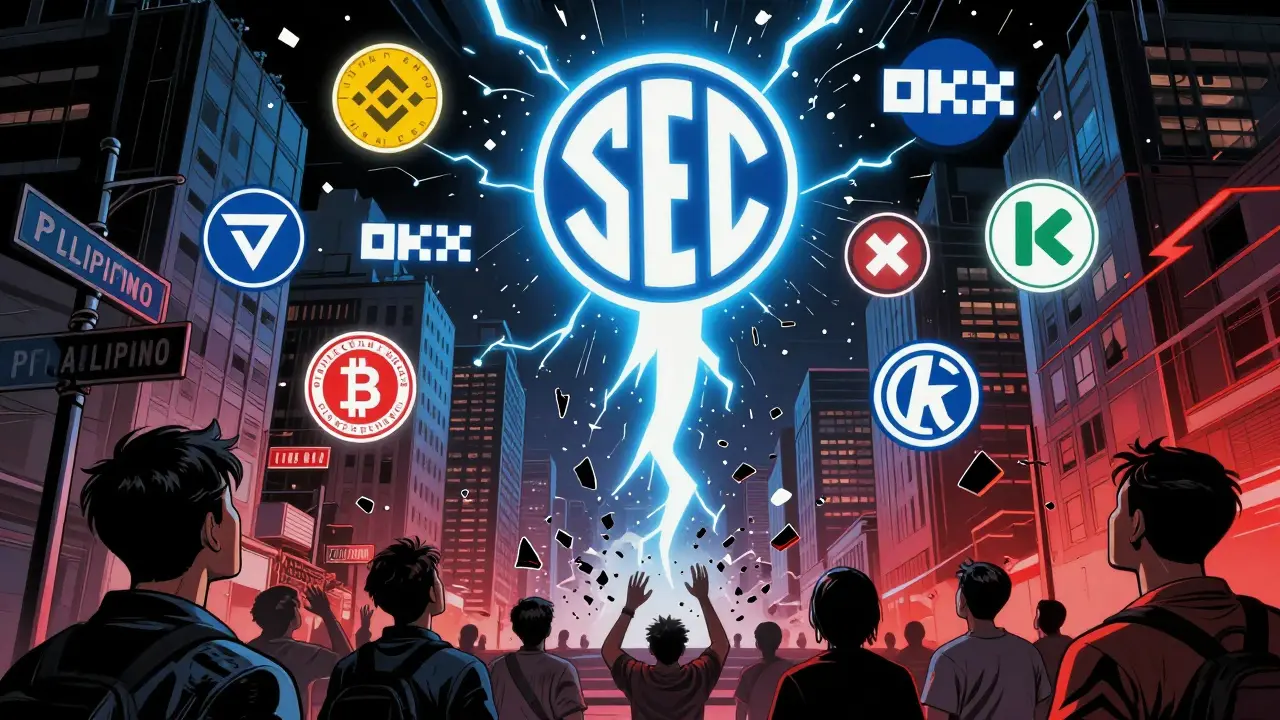
Before July 2025, anyone in the Philippines could use any crypto exchange - Binance, OKX, KuCoin, you name it. No licenses, no oversight, no consequences. That changed overnight. The Securities and Exchange Commission (SEC) of the Philippines dropped its most serious regulatory move yet: Crypto Asset Service Providers (CASPs) must now be licensed to operate here - or face being blocked, fined, and shut down. This isn’t a suggestion. It’s the law.
Who Needs a License?
If your business does anything involving crypto in the Philippines, you need a license. That includes exchanges that let people buy, sell, or trade digital assets. It includes wallets that hold crypto for users. It includes platforms that offer staking, lending, or yield farming. Even if you’re based in another country - say, Singapore or the U.S. - but you’re marketing to Filipinos or letting them trade on your platform, you’re subject to this rule. The SEC doesn’t care where you’re headquartered. If you serve Filipino users, you need to register.The list of banned platforms isn’t small. On August 1, 2025, the SEC publicly named ten major exchanges operating illegally in the country: OKX, Bybit, KuCoin, Kraken, Gate.io, MEXC, Bitget, CoinEx, Binance, and Huobi. Binance was already blocked in 2024. The others followed. Their websites were taken down from local ISPs. Users got 30 days to withdraw funds. After that? No more deposits. No more trading. No more access.
The Licensing Checklist
Getting licensed isn’t easy. The SEC doesn’t just ask for paperwork. They demand proof you can handle real money, real risk, and real people. Here’s what you need:- Register as a domestic corporation - You must incorporate in the Philippines. Foreign companies can’t just file from abroad.
- Minimum paid-up capital of PHP 100 million (about $1.8 million USD) - This money must be in Philippine pesos or USD, held in a local bank. Crypto assets don’t count. You need cold, hard cash on hand.
- Physical office in the Philippines - You can’t use a virtual address. You need a real building, with staff, phone lines, and a local contact point.
- Full AML and KYC systems - You must verify every user’s identity, track transaction patterns, and report suspicious activity to both the SEC and the Anti-Money Laundering Council. No exceptions.
- Separate customer funds - Your users’ crypto and fiat must be stored in completely separate accounts from your company’s money. No commingling. No using customer funds to cover losses.
- 30-day pre-disclosure rule - Before you market any crypto asset (even a new token or staking product), you must file a disclosure document with the SEC and publish it on your website and social media. You can’t say things like “this coin will 10x.” You can only give facts - no promises.
- Monthly financial reporting - Every 30 days, you submit detailed reports on transactions, user growth, revenue, and reserves. The SEC watches everything.
There are also fees. They’re not flat. They’re based on your gross revenue in the Philippines. The more you make, the more you pay. This isn’t just a tax - it’s a way to fund ongoing supervision.
What Happens If You Don’t Comply?
The SEC isn’t bluffing. Violations carry real teeth:- Fines from ₱50,000 to ₱10 million per violation - One unlicensed transaction? That’s a fine. Ten thousand? That’s a fine. Every day you keep operating without a license? Another ₱10,000 per day on top.
- Website blocking - ISPs are ordered to cut off access. No more redirects. No more workarounds.
- Legal action against executives - Company owners and officers can be personally held liable if fraud or money laundering is found.
- Public blacklisting - The SEC publishes names of non-compliant platforms. Your reputation is destroyed.
By October 2025, over 200,000 Filipino users had already moved their assets off unlicensed platforms. The SEC didn’t need to shut them down with force - the threat alone pushed users to safer, compliant alternatives.

Who’s Already Licensed?
Some platforms moved fast. Youholder, Bitget, Cex.io, Bybit, and Bigone all submitted full applications before the July 5, 2025 deadline. They hired local legal teams, opened offices in Makati or Bonifacio Global City, and set up local bank accounts. They now display their SEC license numbers on their websites - a badge users can click to verify.These platforms also changed their marketing. No more “earn 15% APY!” banners. Instead, they now show clear risk disclosures: “Crypto assets are volatile. Past performance does not guarantee future results.” They even added Filipino-language versions of their terms.
Why This Matters for Users
If you’re just a regular person trading crypto in the Philippines, this might feel like bureaucracy. But here’s the truth: before this law, there was no safety net. When a platform collapsed - and they did - users lost everything. No refunds. No recourse. No government help.Now, if you’re using a licensed CASP:
- Your funds are segregated - if the exchange goes bankrupt, your crypto isn’t used to pay their bills.
- You’re protected by AML rules - you won’t be unknowingly used to launder money.
- You have a legal channel to complain - if something goes wrong, you can file a formal complaint with the SEC.
- You get clear disclosures - no hidden fees, no fake promises.
The SEC didn’t ban crypto. They just made it safer. And that’s the point.
Market Impact and Future Outlook
Despite the strict rules, the crypto market in the Philippines is still growing. Adoption is projected to hit 10.86% of the population by 2026 - that’s over 12.7 million users. Crypto revenue is expected to hit ₱1.1 billion this year.Why? Because the rules created trust. Users now know which platforms are safe. Investors are stepping in. Local fintech startups are launching compliant crypto products. Even banks are starting to explore custody services for licensed CASPs.
But the cost of compliance is high. Smaller exchanges - especially those from countries with looser regulations - can’t afford the PHP 100 million capital requirement or the overhead of a local office. That means the market is becoming dominated by a few big players. Some see this as good: fewer scams, more stability. Others worry it’s anti-competitive.
The SEC says they’ll review the rules in 2027. But for now, the message is clear: if you want to operate here, you play by our rules. No exceptions.
What’s Next?
The SEC has signaled that future updates may include:- More detailed rules for DeFi protocols and NFT platforms
- Guidelines for crypto ATMs and peer-to-peer trading apps
- Integration with the Bangko Sentral ng Pilipinas (BSP) for fiat-crypto on-ramps
- Potential tax reporting requirements for users above certain transaction thresholds
For now, the focus remains on exchanges. But if you’re building anything crypto-related in the Philippines - even a simple wallet app - you should assume you’ll need a license soon.
Do I need a license if I only trade crypto personally?
No. The rules apply only to businesses that offer crypto services to others - like exchanges, wallets, or staking platforms. If you’re buying and selling crypto for yourself on a licensed platform, you don’t need a license. But if you start offering trading services to friends, running a crypto ATM, or operating a wallet for others - then yes, you need to register.
Can I use Binance or OKX in the Philippines now?
No. Both Binance and OKX are on the SEC’s official list of unlicensed platforms. Their websites are blocked by local internet providers. Any attempt to access them via VPN is risky - your account may be frozen, and you lose legal recourse if funds are lost. Use only SEC-licensed CASPs.
How long does it take to get a crypto license in the Philippines?
The process takes between 4 to 8 months, depending on how complete your application is. The SEC’s PhiliFintech Innovation Office reviews documents, conducts interviews, and may require additional filings. Many applicants are rejected on the first try for missing AML documentation or failing to prove physical office presence.
What happens to my crypto if a licensed exchange goes bankrupt?
Your assets should remain safe. Licensed CASPs are required to keep customer funds completely separate from company funds, using segregated accounts and third-party custodians. If the exchange fails, your crypto should be returned to you, not used to pay the company’s debts. This is one of the biggest protections the new rules provide.
Are stablecoins regulated under these rules?
Yes. Stablecoins like USDT and USDC are classified as crypto-assets under the CASP Rules. Any platform offering them for trading, staking, or lending must be licensed. Issuers of stablecoins must also file disclosure documents and prove they hold 1:1 reserves in regulated financial institutions.



The SEC’s move is nothing short of a masterstroke in financial sovereignty. For too long, the Philippines has been a lawless frontier for foreign crypto firms peddling snake oil to unsuspecting citizens. Now, with capital requirements, physical presence mandates, and segregated custody, we’re not just regulating-we’re building a financial cathedral. This isn’t bureaucracy; it’s civilization taking root in a digital jungle.
Those crying ‘anti-competitive’ are the same people who think unregulated markets are ‘free.’ Freedom without accountability is anarchy. And anarchy, my friends, is just capitalism with the safety nets cut.
Let the small players fail. The market doesn’t need 500 sketchy exchanges. It needs three or four titan institutions, audited, transparent, and accountable to Filipino law. This is how nations protect their people-not by catering to offshore shell corporations, but by demanding they earn the right to operate here.
And yes, the PHP 100 million capital requirement? That’s not a barrier-it’s a filter. It ensures only those with real commitment, real capital, and real skin in the game can play. The rest? They were never here to serve. They were here to siphon.
I applaud the SEC. This is what leadership looks like.
Okay but like… have y’all read the ontological implications of this? 🤯
We’re not just regulating exchanges-we’re redefining the metaphysics of trust in decentralized systems. The SEC is essentially saying: ‘Your blockchain is not sacred. Your code is not law. Only the state’s paper stamp is sovereign.’
This is the death of crypto’s original sin: decentralization. Now, every node must bow to Makati. The ‘trustless’ system is now the most trust-dependent system ever created-because you have to trust the government to not be corrupt… which is a hilariously ironic pivot.
Also, ‘segregated funds’? Lol. Tell that to the 2008 Lehman Bros. victims. History doesn’t repeat-it just changes the font. 💸🤯
Also, can we talk about how ‘licensed’ means ‘bribed’? I’m not saying anything… but I’m also saying everything. 🤫
Look, I’m not a crypto bro, but I’ve read the SEC guidelines like 17 times and I still think this is a joke. First off, ‘physical office’? You mean like a desk in a co-working space with a fake sign? That’s not a real office. That’s a prop. And ‘minimum capital’? Who’s auditing the auditors? The same people who let the Binance CEO run around like a billionaire fugitive?
And don’t get me started on ‘segregated funds.’ If the exchange goes bankrupt, your crypto is ‘safe’? Sure, until the court decides to seize it under ‘general creditor claims.’ That’s literally happened in 3 countries already. The SEC is just putting lipstick on a pig and calling it a unicorn.
Also, why is it that every time a government says ‘we’re protecting you,’ it’s because they want to tax you, control you, and monitor you? This isn’t safety. It’s surveillance with a smiley face.
And yes, I know I’m being dramatic. But if you’re not being dramatic about crypto regulation, you’re not paying attention. 🤷♂️
They’re lying. All of them. The SEC? A front for the IMF. The licensed exchanges? Shell companies owned by the same offshore entities that run the unlicensed ones. You think Binance was really blocked? Please. They just moved their servers to a new domain and paid off the ISP. The ‘blacklist’? A distraction. The real players are still in the shadows-just with better lawyers and a new logo.
And don’t tell me about ‘segregated funds.’ That’s a fairy tale for people who still believe in tooth fairies. Every single time a government says ‘your money is safe,’ it’s because they’re about to freeze it. Look at Cyprus. Look at Argentina. Look at Venezuela.
The real goal? To force everyone into the centralized banking system. Once you’re on a licensed platform, they track every transaction. They know who you are. They know what you bought. They know when you sold. And then? Tax. Fine. Confiscation. It’s all coming. Mark my words.
Use a hardware wallet. Don’t touch any platform. Ever.
You know what’s funny? People are treating this like some kind of heroic regulatory win. But let’s be real-the SEC didn’t do this to protect Filipinos. They did it because they realized they couldn’t tax unlicensed platforms. That’s it. Pure and simple. Revenue. That’s the only language governments speak.
And now? The big players-Bybit, Cex.io-they’re not ‘licensed’ because they’re ethical. They’re licensed because they could afford the $1.8 million upfront. The little guys? Out. The innovators? Crushed. The market? Monopolized. And the consumers? Now they have fewer choices, higher fees, and a government badge they’re supposed to trust.
It’s capitalism with a velvet glove. It looks nice. But it’s still a fist.
Also, ‘monthly reporting’? Who’s gonna audit those reports? The same guys who approved the last 10 fraudulent fintech startups? Please.
I miss the wild west. At least then you knew who the villains were.
I think there’s something beautiful here. A country choosing to build something real, even if it’s hard. Not every regulation is oppression. Sometimes, it’s care.
Before this, people lost everything. No warnings. No recourse. Just silence. Now, if something goes wrong, there’s a number to call. A form to fill. A paper trail. That matters.
Yes, the rules are strict. Yes, it’s expensive. But isn’t that better than a graveyard of broken wallets and broken dreams?
I’m not saying it’s perfect. But I’m saying it’s a step toward dignity. And dignity, even if slow, is worth fighting for.
Just wanted to say-this is actually one of the most thoughtful regulatory frameworks I’ve seen in crypto. Not perfect, but thoughtful.
The segregation of funds? Yes. The physical office? Makes sense if you want accountability. The disclosure rules? Long overdue.
I know it’s frustrating for small players, but if you’re building something real, you can adapt. The market will reward those who do.
Also, the fact that they’re including Filipino-language disclosures? That’s huge. It shows they’re not just trying to control-they’re trying to include.
Let’s not forget: this is a developing economy. They’re not copying the U.S. or EU. They’re building their own path. And that deserves respect.
There’s a deeper epistemological rupture here. The SEC’s framework presupposes a Hobbesian state as the sole legitimate arbiter of value-a radical departure from the Satoshi paradigm, which was predicated on algorithmic trust, not institutional authority.
By mandating physical presence and capital reserves, they’ve effectively re-entrenched centralized power under the guise of consumer protection. The blockchain’s immutable ledger is now subordinate to the ledger of bureaucratic compliance.
This is not innovation. It is domestication. And while it may yield short-term stability, it extinguishes the very anarchic spark that made crypto revolutionary in the first place.
Ironically, the SEC has succeeded in making crypto less decentralized than the Philippine peso.
Let me get this straight. You’re telling me I can’t use KuCoin anymore? But it’s the only one that gives me 15% APY on DOGE. Now I have to use some boring licensed thing that says ‘past performance doesn’t guarantee future results’? That’s not safety. That’s boredom.
And why do I need a physical office? I live in Cebu. I don’t even have a job. How am I supposed to afford that?
Also, why are they banning Binance? They have the best app. The SEC is just jealous they can’t tax it.
And don’t even get me started on ‘disclosure documents.’ Who reads those? No one. They’re just there to make the government feel important.
My money. My choice. That’s the whole point. Why does everyone think they know better than me?
You’re all delusional. This isn’t regulation. It’s a power grab. The SEC doesn’t care about safety. They care about control. And they’re using ‘consumer protection’ as a cover to crush innovation and funnel money into their cronies’ pockets.
Let me tell you something: the Philippines is not Switzerland. It’s not Singapore. It’s a country where corruption is baked into the system. And now? The ‘licensed’ platforms? They’re all connected to politicians. You think Bybit got licensed because they’re ethical? No. They paid. Just like the others.
And the ‘PHP 100 million capital’? That’s not a barrier to entry. It’s a bribe requirement. You can’t afford it? Too bad. You’re not part of the club.
This isn’t about protecting users. It’s about protecting the elite. And if you’re still believing this is about ‘safety,’ you’re the one who needs to be protected-from yourself.
Bro. I lost $12k on an unlicensed platform last year. No recourse. No refund. Just silence.
So yeah. I’m all for this. I don’t care if it’s ‘bureaucratic.’ I don’t care if it’s ‘expensive.’ I just want to know that if I put my money somewhere, it’s not gonna vanish into thin air because some guy in a basement in Singapore decided to rug pull.
Yes, the rules are strict. But so was my last hospital bill. And I’d rather pay a fee than lose everything again.
Also-can we just appreciate that they’re finally doing something right? For once? In a country that’s been getting screwed for decades?
Thank you, SEC. I don’t know you. But I’m grateful.
I love this. Really. As someone who’s lived in the Philippines for 10 years, I’ve seen so many people get burned. One friend lost his life savings on a fake staking platform. Another got scammed by a Telegram group promising ‘double your money in 7 days.’
This isn’t about control. It’s about dignity. It’s about saying: ‘You deserve better.’
Yes, it’s hard. Yes, it’s slow. But it’s real. And real change doesn’t come from shouting online. It comes from paperwork, offices, audits, and rules that actually mean something.
Let’s not hate the system because it’s imperfect. Let’s fix it. Together.
And yes, I’m using a licensed exchange now. And I sleep better at night.