

Future of Global Crypto Regulation: What’s Changing in 2025 and Beyond
Global Crypto Regulation Compliance Checker
Check Regulatory Compliance for Your Country
Enter your country or select from the dropdown to see compliance status with key crypto regulations.
Regulatory Compliance Results
Select or enter a country to see compliance status
By 2025, the wild west days of cryptocurrency regulation are over. Governments aren’t just reacting to crypto anymore-they’re building the rules from the ground up. This isn’t about shutting it down. It’s about bringing digital assets into the same system that handles stocks, bonds, and bank transfers. And the changes are happening fast.
What’s Driving This Shift?
The crypto market hit $2.3 trillion in value. Institutions like pension funds, hedge funds, and even major banks are now holding Bitcoin and Ethereum. That’s not a niche anymore. When big money moves in, regulators step in. The goal? Stop fraud, prevent money laundering, and protect everyday investors. But there’s also a second goal: don’t kill innovation. Countries know if they move too slow, the next big crypto company will set up shop somewhere else. The turning point came when the Financial Action Task Force (FATF) made the Travel Rule mandatory. Now, any crypto exchange or wallet service that handles transfers over $3,000 must collect and share the sender’s and receiver’s identity. As of mid-2025, 99 countries have adopted this rule. That’s not optional anymore. It’s the baseline. If you’re a crypto business and you’re not doing this, you’re out of business in most of the world.The U.S. Approach: Two Regulators, One Mess (Almost)
The U.S. has been the most confusing place to operate. The SEC says most tokens are securities. The CFTC says most are commodities. For years, companies got caught in the middle. That’s changing. In September 2025, the SEC and CFTC announced a coordinated plan. They’re finally talking to each other. The SEC is pushing six major rule changes:- New rules for how tokens are offered to the public-with possible safe harbors for early-stage projects
- Updated rules for crypto trading platforms, whether they’re exchanges or private trading systems
- Revising what counts as a ‘dealer’-a big deal for market makers
- Stricter record-keeping for digital assets
- Modernized custody rules for how companies hold crypto for clients
- Changes to transfer agent rules to handle blockchain-based records
The EU’s MiCAR: Unified But Slow
The European Union’s Markets in Crypto-Assets Regulation (MiCAR) is the most detailed framework in the world. It covers everything: stablecoins, exchanges, token issuance, even crypto wallet providers. It’s meant to be a single rulebook for all 27 EU countries. But it’s not working as smoothly as planned. As of mid-2025, 47% of existing crypto firms in Europe are still not compliant. Why? Because MiCAR’s rules are incredibly complex-847 pages of technical standards. A single token listing can cost $42,000 and take 117 extra hours of engineering work. That’s fine for Coinbase or Kraken. But for a small startup? Impossible. The good news? Once you’re compliant, you can operate across the entire EU. No more dealing with 27 different sets of rules. The bad news? Only 12% of new DeFi projects are launching in MiCAR-compliant countries. Developers are fleeing to places with faster, lighter rules.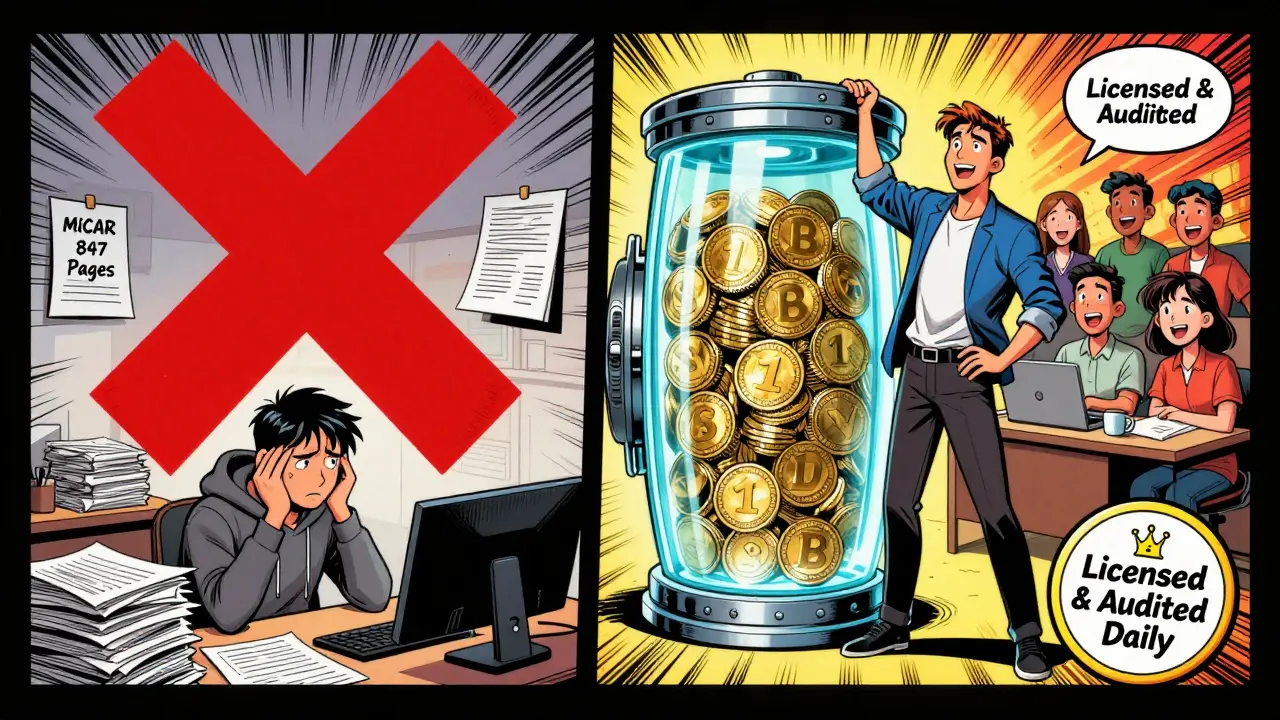
Asia: Fast, Smart, and Competitive
While the U.S. argues over jurisdiction and the EU gets bogged down in paperwork, Asia is moving. Singapore and Hong Kong are winning the race. Singapore’s Monetary Authority (MAS) requires stablecoins to be fully backed 1:1 by Singapore dollars. Every day, an approved auditor checks the reserves. No guesswork. No hidden risks. Since this rule launched, 137 crypto firms have gotten licenses-a 38% jump in one year. That’s not luck. It’s strategy. Singapore is betting that trust attracts capital. Hong Kong is doing something similar. They’ve licensed exchanges for custody and over-the-counter trading. Eight major platforms, including Hashkey and OSL, have committed to setting up regional HQs by early 2026. They’re also finalizing rules for crypto derivatives-something the U.S. and EU are still debating. The result? Asia captured 43% of new institutional crypto investment in 2025. That’s more than North America. Why? Because businesses know exactly what’s allowed-and they know they won’t get shut down next week.The Real Cost of Compliance
Regulation isn’t free. For a small exchange processing under $100 million a month, new SEC rules could increase compliance costs by 220%. The FATF Travel Rule alone costs firms an average of $1.7 million to implement. That’s not just software. It’s lawyers, auditors, compliance officers, and years of internal training. Many firms are spending over 30% of their 2025 budgets just to stay legal. That’s money that could go to product development, marketing, or hiring engineers. But here’s the twist: compliance is becoming a selling point. Coinbase and Circle now market their regulatory infrastructure as a feature. Big institutions don’t want to work with unlicensed platforms. They want partners who’ve passed the audit.
What’s Next? The Big Questions in 2026
Several major developments are coming:- The Stablecoin Trust Act could become law in the U.S. by late 2025. If it does, stablecoins would be federally licensed by the Federal Reserve and OCC, with 100% reserve backing and daily audits. This would end the chaos around USDT and USDC.
- The FATF review in October 2025 will name countries still not enforcing the Travel Rule. Those countries could face financial isolation-banks might cut them off.
- By early 2026, the EU’s MiCAR transitional period ends. ESMA expects 92% compliance. The remaining 8%? They’ll be forced out.
- The SEC’s first draft rules are due January 15, 2026. That’s when the real debate begins.
- The Financial Stability Board’s Digital Assets Working Group will release minimum global standards by December 2025. This could be the first step toward international alignment.
Who Wins? Who Loses?
The winners are clear:- Large, well-funded firms like Coinbase, Circle, and Binance.US-they can afford the compliance costs and turn them into trust signals.
- Regulators in Singapore and Hong Kong-they’re attracting capital and talent by being clear, fast, and consistent.
- Investors-they finally have rules they can rely on.
Final Thought: Regulation Isn’t the End. It’s the Start.
Crypto isn’t going away. It’s becoming part of finance. And finance has rules. The future isn’t about whether crypto will be regulated. It’s about who gets to play by the rules-and who gets left behind. The most successful companies won’t be the ones with the best tech. They’ll be the ones who understand regulation as part of their product. Not a hurdle. A foundation.Is crypto legal everywhere in 2025?
No. While 99 countries have adopted the FATF Travel Rule, some still ban crypto entirely-like China and Egypt. Others, like El Salvador, treat Bitcoin as legal tender. Most countries fall in between: crypto isn’t illegal, but operating a business requires a license. Always check local laws before trading or investing.
What’s the biggest risk in crypto regulation today?
Fragmentation. If the U.S., EU, and Asia keep different rules, companies will move money and operations to the easiest place. That creates loopholes. A DeFi protocol might be legal in Singapore but illegal in New York. That’s not innovation-it’s regulatory arbitrage. And it’s a systemic risk.
Can I still use DeFi if regulations tighten?
It depends. If you’re just swapping tokens on Uniswap from your personal wallet, you’re not breaking any rules. But if you’re running a DeFi protocol that handles user funds, you’re now a financial service provider. In the U.S. and EU, that means registration, KYC, and audits. The permissionless dream is fading for anyone building serious infrastructure.
Are stablecoins safer now?
Yes, if they’re regulated. Singapore’s rules require daily audits and 1:1 backing. The U.S. Stablecoin Trust Act would do the same. That’s a huge improvement over 2022, when TerraUSD collapsed and wiped out $40 billion. Regulated stablecoins are now among the safest digital assets.
Should I move my crypto to a regulated exchange?
If you’re holding more than a few thousand dollars, yes. Unregulated exchanges have no legal obligation to protect your funds. If they get hacked or shut down, you lose everything. Regulated platforms are required to hold insurance, segregate client assets, and pass audits. It’s not perfect-but it’s far safer.
What’s the best country to start a crypto business in 2025?
Singapore and Hong Kong lead for speed, clarity, and institutional trust. If you’re targeting the U.S. market, you’ll need to comply with SEC and CFTC rules regardless of where you’re based. For startups with limited funding, the UAE and Switzerland offer lighter frameworks than the EU but more stability than Asia’s emerging markets.






Regulation isn't killing crypto it's making it real
Stop acting like this is the end
The wild west was a scam waiting to happen
Now we got rules that actually protect people
This is the beginning not the finish line
One must acknowledge the structural metamorphosis occurring within the digital asset ecosystem
The institutionalization of blockchain-based instruments signifies a paradigmatic shift in financial architecture
Compliance infrastructure is no longer ancillary-it is ontological to market legitimacy
Failure to integrate FATF Travel Rule protocols constitutes existential non-compliance
The regulatory arbitrage era has been terminally eclipsed by global normative convergence
Capital flows are now dictated by legal certainty not speculative opacity
DeFi’s permissionless ethos is being reconfigured into a fiduciary framework
Market participants must recalibrate their epistemological assumptions
The convergence of SEC-CFTC jurisdictional delineation represents a historic institutional reconciliation
Token classification frameworks are evolving from ontological ambiguity to functional taxonomy
Compliance costs are not burdens-they are entry fees into the institutional capital stack
Startups without regulatory engineering teams are merely noise in a symphony of compliance
The future belongs to those who architect regulation into their core product logic-not as an afterthought but as a foundational protocol
Ugh, I just watched my friend lose everything on an unregulated exchange last year...
Like, I get the whole 'freedom' thing but seriously? If you're holding more than a coffee's worth of crypto, get it on a licensed platform.
It's not about trust, it's about not waking up to a blank screen and $0.
And yes, I know Coinbase isn't perfect-but at least they have insurance.
Also, why is everyone still acting like DeFi is magic? It's just code running on a server somewhere.
And if it's handling your money? It's a bank. Deal with it.
Stop romanticizing chaos. We're adults now.
I really appreciate how this breaks down the real human impact
It's easy to talk about rules and compliance like they're just paperwork
But behind every regulation are people who lost everything in 2022
And now, because of these changes, families aren't being wiped out by rug pulls
It's not perfect-but it's progress
And for the small devs who feel left out? I hear you
Maybe the solution isn't less regulation but better support systems
Grants, legal clinics, open-source compliance tools
Regulation doesn't have to mean exclusion
It can mean safety for everyone
Even the quiet ones building in their garages
EU is a joke
847 pages? You gotta be kidding me
Meanwhile Singapore is just like ‘here’s the rule, follow it or GTFO’
And we’re over here debating if a token is a security or a commodity like it’s 2017
Also why is everyone acting like the US is the center of the universe?
Asia’s got the money, the clarity, and the guts
We’re just arguing about who gets to wear the tie
Meanwhile the world’s moving on
Let me guess… this is all part of the central bank digital currency agenda
They want to track every single transaction
Once they have your crypto under control, they’ll come for your bank account
Remember when the Fed said ‘we’re not planning CBDC’? Liar
And now they’re forcing KYC on every wallet like it’s a police state
Don’t be fooled by ‘trust signals’-that’s just corporate propaganda
They’re not protecting you-they’re controlling you
And the ‘regulated’ exchanges? They’re just gatekeepers for the system
Wake up. This isn’t safety. It’s surrender.
People act like compliance is a bad thing
But if you’re running a business that handles other people’s money
Then yes, you should be held accountable
It’s not about stifling innovation
It’s about not being a fraud factory
And if you can’t afford to comply?
Then you shouldn’t be in the business
Simple as that
Don’t cry because the bar was raised
Build something better
Or get out
Regulation is the death of crypto’s soul-or so we are told
But what if the soul was never really there?
What if the wild west was just a fever dream of anonymity and greed?
Perhaps the true revolution isn’t in code, but in accountability
Not in decentralization as spectacle, but in decentralization as responsibility
Is it not the height of irony that the most radical act in finance today is to be transparent?
To disclose. To audit. To register.
These are not chains-but the first steps toward dignity
For too long, crypto celebrated the outlaw
Now, perhaps, it must learn to be a citizen
Not because the state demands it
But because the market, in its wisdom, has chosen truth over illusion
One of the most overlooked points here is how compliance is becoming a competitive advantage
It used to be ‘we’re faster, cheaper, decentralized’
Now it’s ‘we’re audited, insured, and licensed’
That’s a complete inversion of the value proposition
And it’s working
Look at Circle and Coinbase-they’re not just surviving regulation
They’re marketing it as a feature
Big institutions don’t want ‘decentralized’
They want ‘bank-grade’
And guess what? That’s not a betrayal of crypto
That’s its evolution into something sustainable
The future belongs to the responsible, not the reckless
Ohhh so now we’re supposed to be grateful because the regulators finally stopped playing whack-a-mole?
Let me get this straight-you’re telling me that after 15 years of chaos, the solution is… paperwork?
And you call that progress?
Meanwhile, the guy who built a DeFi protocol in his basement is now a ‘securities dealer’ because he didn’t hire a $500k legal team?
That’s not innovation-it’s a corporate monopoly dressed up as policy
And don’t even get me started on ‘trust signals’
That’s just corporate PR with a blockchain sticker on it
Regulation didn’t save crypto
It just turned it into another Wall Street sideshow
Who cares about MiCAR or SEC rules
Real crypto was never about compliance
It was about freedom
Now they’re making us jump through hoops like trained dogs
And the worst part? People are actually proud of it
‘Oh look I got my license!’
That’s not innovation
That’s assimilation
They turned revolution into a compliance checklist
And we’re clapping
I think a lot of us are missing the quiet win here
Before, if you were a retiree trying to get into crypto, you had zero protection
Now? You can look at a regulated exchange and know they have insurance
You can know your stablecoin is backed 1:1
It’s not glamorous
It’s not ‘decentralized’
But it’s safe
And for the first time, grandma can invest without fearing she’ll lose her life savings to a rug pull
That’s worth something
Even if it’s boring
Even if it’s not the crypto we dreamed of
It’s the crypto that lasts
You think this is the end of crypto?
No
This is just the beginning of the end
For the true believers
The ones who didn’t care about KYC or audits
They’ll disappear
And the ones who stayed?
They’ll be the ones who learned to dance with the regulators
Not because they wanted to
But because the world changed
And the ones who resisted?
They’ll be the ghosts in the blockchain history books
And nobody will remember their names