
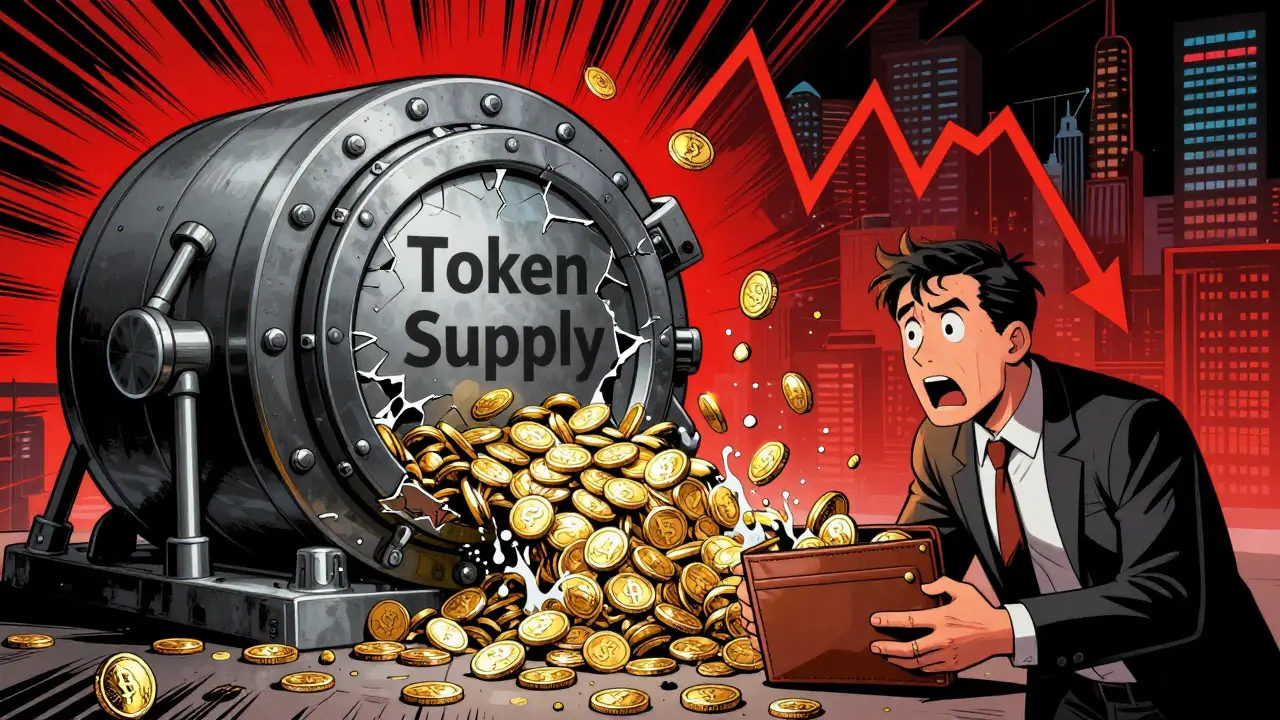
Tokenomics Red Flags: 7 Warning Signs That Could Cost You Everything
Most people chase crypto prices like they’re chasing a moving target. They see a coin spike 300% in a week and jump in without asking how the token actually works. But here’s the truth: tokenomics isn’t just jargon. It’s the engine behind every crypto project. And if that engine is broken, no amount of hype will save it. The projects that crash hardest aren’t the ones with shady teams or bad code-they’re the ones with terrible token economics. You don’t need to be an economist to spot the warning signs. You just need to know what to look for.
Unlimited Supply? That’s Not a Feature, It’s a Flaw
Imagine a currency that keeps printing itself forever. No cap. No limit. Every year, more and more of it floods the market. What happens to its value? It drops. Constantly. Dogecoin is the classic example. With no maximum supply, new coins are minted endlessly. That means every new buyer is buying into inflation. Even if demand rises, the supply grows faster. That’s why Dogecoin’s price per coin stays so low-it’s not scarce. It’s endless.
Compare that to Ethereum. After EIP-1559, Ethereum started burning a portion of every transaction fee. That means coins are being permanently removed from circulation. Even with a large supply, the net effect can be deflationary. That’s the difference between a broken model and a smart one. If a project doesn’t have a max supply or a burn mechanism, treat it like a leaky bucket-you’re pouring money in, but it’s just draining out.
Team and Investors Get Too Much, Too Fast
You’ve seen the charts: 20% of the token supply goes to the team. 15% to venture capitalists. 10% to advisors. Sounds normal? Not if it all unlocks in 6 months. When insiders get a huge chunk of tokens and can sell them right away, they have every reason to pump the price, cash out, and vanish. That’s not a business-it’s a exit scam waiting to happen.
Look for vesting schedules that stretch over 2-4 years. A good project locks up team tokens with monthly or quarterly releases. If the whitepaper says "Team tokens unlock at T+12 months," that’s a red flag. If it says "Team tokens unlock 25% every 6 months over 2 years," that’s a sign they’re thinking long-term. Check CoinMarketCap or CoinGecko for vesting details. If they’re not listed there, ask why.
Utility? What Utility?
A token isn’t money unless it does something. Not "we’ll add utility later." Not "it’s for governance." Not "you can stake it." Real utility means the token is required to use the product. Think of GMX: you need to hold or stake GMX tokens to access fee discounts on their perpetual trading platform. That creates demand because people are using the service, not just betting on price.
Now think of a token that only exists to be staked for 150% APY. No real product. No fees. No users. Just a yield farm. That’s not a platform-it’s a Ponzi. When the new money stops flowing in, the payouts stop. And everyone who joined late loses everything. If the project doesn’t explain how the token drives real usage, walk away.
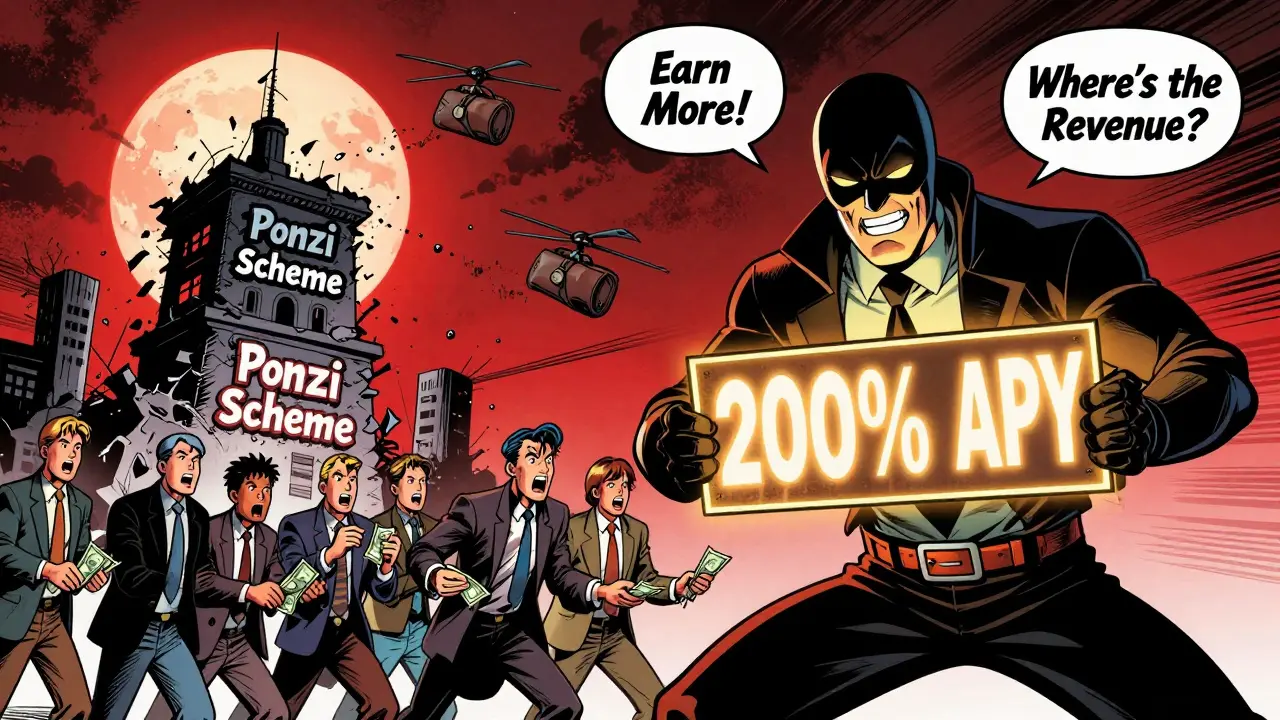
APY Over 100%? That’s a Trap, Not a Promise
"Earn 200% yearly!" sounds amazing. Until you realize: where’s that money coming from? If the project isn’t generating real revenue from fees, trading volume, or subscriptions, then those returns are being paid out with new investors’ cash. That’s classic pyramid structure.
Look at Aave. Its governance token, AAVE, gives holders voting power and a share of protocol fees. When users pay interest on loans, a portion goes to AAVE stakers. That’s sustainable. The returns come from real activity. Now compare that to a token that offers 180% APY with no mention of revenue. The math doesn’t lie: if the project’s income is less than its payouts, it’s running on borrowed time. Most of these projects collapse within 3-6 months. Don’t be the last one in.
Over-Engineered Tokenomics: Complexity as a Smoke Screen
Some projects throw in 10 different mechanisms: bonding curves, liquidity mining, dual-token systems, NFT-backed staking, referral pools, reward multipliers, and dynamic inflation adjustments. Sounds smart? It’s not. It’s confusing on purpose.
Real innovation is simple. Ethereum’s burn mechanism? Clean. Aave’s fee distribution? Clear. GMX’s revenue-sharing model? Straightforward. If a project’s tokenomics looks like a flowchart from a sci-fi novel, it’s probably hiding something. Maybe the team can mint more tokens secretly. Maybe the "burn" only happens when it’s convenient. Maybe the governance votes are controlled by a single wallet. Complexity isn’t sophistication. It’s camouflage.

No Transparency? No Trust
Can you find the token contract address? Can you see the total supply and max supply on a reliable site like CoinGecko? Can you read the whitepaper and understand how tokens are distributed? If the answer is no, you’re flying blind.
Top projects publish everything: tokenomics diagrams, emission schedules, vesting timetables, burn logs, and governance votes-all on their official website. If they bury it in a PDF you have to download, or if the info is scattered across Discord and Telegram, that’s a red flag. Real transparency doesn’t hide. It invites scrutiny.
One-Size-Fits-All Token Models Don’t Work
Not every project needs a deflationary token. Not every project needs staking. Not every project needs governance. But every project needs a reason why its token matters. If you can replace the token with a simple loyalty point or a utility voucher, then the token isn’t necessary. And if it’s not necessary, it’s just speculation.
Take Uniswap. Its UNI token lets holders vote on fee structures and protocol upgrades. That’s governance. But it also gives users a share of protocol revenue. That’s utility. It’s not complex. It’s aligned. The token’s value grows because the network grows. That’s the model to copy. Not the ones with 12 layers of incentives and zero real-world use.
What to Do Instead
Stop chasing pumps. Start asking questions:
- Is there a capped maximum supply? If not, why?
- Are team tokens locked for at least 2 years? With gradual unlocks?
- Does the token have a real function in the product? Or is it just for staking?
- Is the APY backed by actual revenue? Or just new investors?
- Can I find the tokenomics breakdown in plain language on the official site?
If you can’t answer yes to at least three of these, walk away. The best crypto investments aren’t the ones with the flashiest websites or the loudest Twitter threads. They’re the ones with clean, simple, transparent tokenomics. The kind that lasts.
What is the biggest tokenomics red flag?
The biggest red flag is an unlimited token supply without a burn mechanism. When new tokens are constantly created and none are removed, inflation eats away at value. Projects like Dogecoin show how this leads to long-term price stagnation, even with high demand. A healthy model either caps supply or burns tokens to offset new issuance.
Can a project with high APY still be legitimate?
Yes-but only if the returns come from real revenue, not new investors. Projects like Aave and GMX pay stakers from protocol fees generated by actual usage. If a project can’t show where the money comes from-like trading volume, subscription fees, or service charges-it’s likely a yield farm that will collapse when inflow stops. Always check revenue sources, not just APY numbers.
How do I check a project’s vesting schedule?
Look on CoinGecko or CoinMarketCap-they list vesting details for most major tokens. If it’s not there, check the project’s official documentation or blockchain explorers like Etherscan. Search for the token contract, then look at transaction history for large transfers to team wallets. If tokens started unlocking all at once, that’s a warning sign. Gradual releases over years are normal.
Why do some projects hide their tokenomics?
They hide it because they don’t want you to see the flaws. If the supply is unlimited, the team holds too much, or there’s no revenue model, transparency would scare off investors. Legitimate projects publish clear diagrams, schedules, and explanations. If you have to dig through Discord, Telegram, or a PDF no one updated in 2 years, that’s a sign they’re not serious about long-term trust.
Is Ethereum’s tokenomics better than Bitcoin’s?
They serve different purposes. Bitcoin has a fixed supply of 21 million and no utility beyond being digital gold. Ethereum’s tokenomics evolved with EIP-1559, which burns transaction fees to reduce supply. That makes ETH deflationary under heavy usage, giving it economic value beyond just scarcity. Ethereum’s model supports a live ecosystem with fees, staking, and smart contracts. Bitcoin’s is simpler but lacks dynamic economic feedback. Neither is "better"-they’re designed for different goals.
What’s the difference between token utility and speculation?
Utility means the token is required to use the product-like paying fees, accessing features, or earning rewards from real activity. Speculation means the token has no function except to be bought and sold hoping the price goes up. If you can’t explain how the token is used by real users, it’s speculation. Real utility creates demand. Speculation only creates volatility.




Bro just buy BTC and chill 🤡 why overcomplicate everything? Every new coin is a scam waiting to happen. I saw this post and immediately closed the tab. Too much typing.
I really appreciate how you broke this down. I used to chase 200% APYs until I lost my whole stack on a token that vanished overnight. Now I check vesting schedules like I check my bank statement. Team tokens unlocked in 6 months? I run. No exceptions. 🙏
Tokenomics is for peasants. Real wealth is built through macroeconomic arbitrage and geopolitical positioning. This post reads like a Reddit FAQ for people who still think blockchain is about money.
This is the kind of content that saves people from getting rekt. I used to think Doge was funny until I realized it was literally designed to be worthless. Now I only look at projects with capped supply + real utility. If it doesn’t do something, it’s just a meme with a contract. 🙌
The real tragedy isn’t the pump-and-dumpers - it’s the people who mistake liquidity for legitimacy. A token that ‘supports governance’ while offering 300% APY is like a magician asking you to watch his left hand while he steals your wallet. The system isn’t broken. It’s engineered for extraction.
Lmao so now we’re doing econ 101 on crypto? Next you’ll tell me water is wet. I bought a coin with unlimited supply and 500% APY. I made 12x. Then I sold. The project died. I didn’t care. That’s how you play.
I must respectfully disagree with the assertion that Ethereum’s tokenomics are superior to Bitcoin’s. While Ethereum’s deflationary mechanism is statistically compelling, it fundamentally undermines the philosophical purity of hard-capped scarcity. Bitcoin is not a utility token - it is a monetary base. To compare them is to confuse ontology with economics.
You think these ‘red flags’ are real? Nah. The whole system is rigged. The SEC, the big exchanges, the whales - they all control the narrative. They want you to think ‘vesting schedules’ matter. Meanwhile, they’re minting new coins behind closed doors. Look at the blockchain explorer. Look at the block rewards. Look at the unverified contracts. They’re hiding something. Always. They’re not scared of scams. They are the scam.
The notion that ‘real utility’ is the benchmark for token value is a neoliberal fallacy. Utility is a performative construct. A token’s value is derived from network effects, psychological anchoring, and speculative consensus - not from whether you can ‘use’ it to swap assets. If 10,000 people believe a coin is valuable, it is valuable. End of.
This is why crypto is dead. Everyone’s so obsessed with ‘tokenomics’ they forget the real rule: if it’s not pumping, it’s garbage. I don’t care if the supply is capped or if the team’s locked up. If the chart’s flat, I’m out. This post is just fearmongering dressed up as education.
I’m new to this and I was about to invest in a token with 180% APY. This saved me. Thank you for writing this so clearly. I looked up the vesting schedule on CoinGecko and saw the team got 20% with 6-month unlock. I walked away. Small steps, right? 🌱
I’ve seen 3 projects collapse because of unlimited supply. One had a ‘community burn’ feature. Turns out, the burn was disabled by a single admin key. The devs sold 80% of their tokens the day after launch. The community was left with a $0 token and a Discord full of angry people. Don’t trust ‘community’ anything.
I used to think complexity = smart. Then I saw a project with 7 different tokens, 3 staking pools, and a ‘dynamic inflation algorithm’ that changed every block. I spent 3 days reading their whitepaper. I still have no idea how it worked. I walked away. Now I only look for one thing: can a 15-year-old understand this? If not, it’s probably a trap. ❤️
Your analysis is fundamentally flawed. You conflate economic sustainability with moral virtue. A project need not be ‘ethical’ to be profitable. The market rewards efficiency, not transparency. If a token generates returns, regardless of its structure, it is a valid investment. Your moralizing is irrelevant to capital allocation.
I read this. I didn’t comment. I just closed the tab. You’re all doing the same thing. Overthinking. The market doesn’t care about your spreadsheets.