
What is ZKsync (ZK)? A Guide to the Ethereum Layer 2 Powerhouse
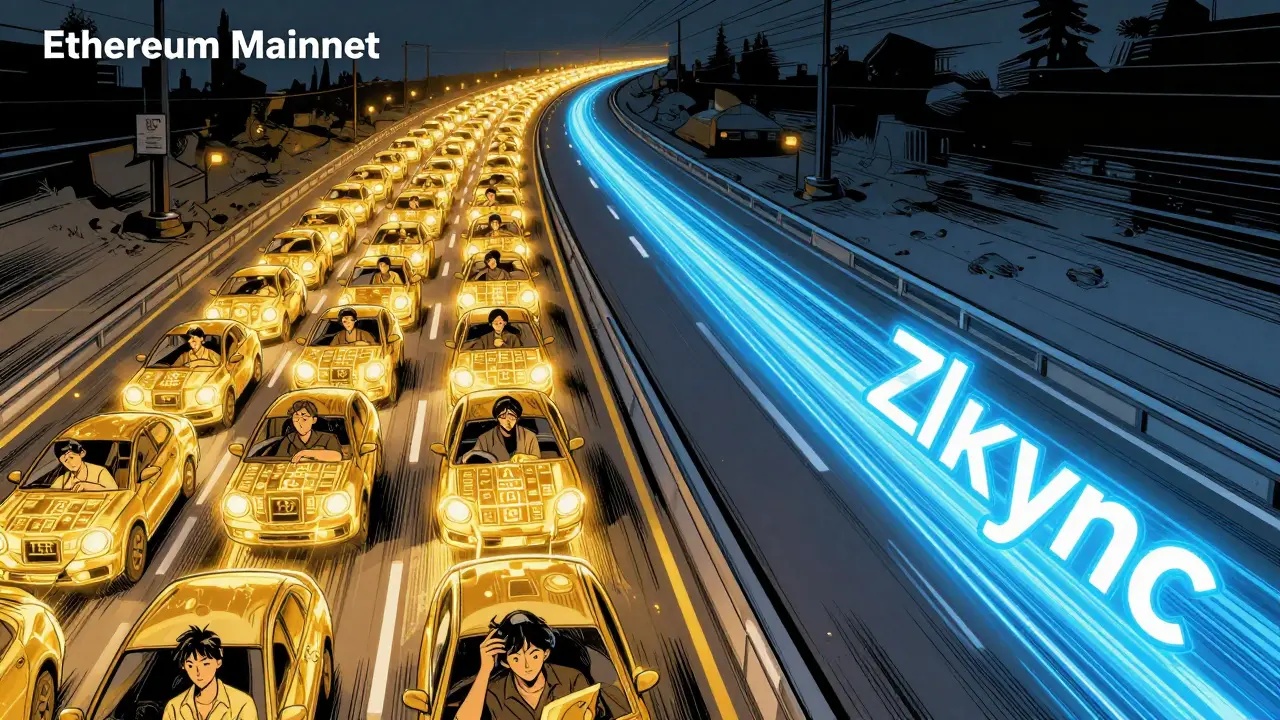
Ever tried sending a transaction on Ethereum during a busy market surge and felt like you were paying for a small luxury vacation just in gas fees? That's the exact problem ZKsync is designed to fix. Instead of forcing every single transaction to compete for space on the main Ethereum highway, ZKsync moves the heavy lifting off-site, processes it in bulk, and then sends a single, mathematically proven "receipt" back to the main chain. This makes your transactions lightning-fast and significantly cheaper without sacrificing the security of the world's most famous smart contract platform.
The Quick Rundown: What You Need to Know
- What it is: A Layer 2 (L2) scaling solution for Ethereum.
- The Secret Sauce: Uses Zero-Knowledge Proofs (ZKPs) to verify transactions.
- The Token: The ZKsync (ZK) token powers the ecosystem and governance.
- Key Benefit: Massive throughput (10,000+ TPS) and near-instant finality.
How ZKsync Actually Works
To understand ZKsync, imagine a post office. Normally, if every person in a city sent one letter at a time to a central hub, the system would jam. ZKsync acts like a local sorting center. It collects thousands of letters, bundles them into a single large crate, and sends that crate to the main hub. The hub doesn't need to read every single letter; it just needs a mathematical proof that every letter in the crate is valid. This is the essence of zk-rollups.
The platform was developed by Matter Labs and focuses on a trustless architecture. Unlike some other scaling methods, ZKsync doesn't ask you to trust a group of validators. Instead, it relies on cryptography. If the math adds up, the transaction is valid. This is why it's often seen as more secure than "Optimistic Rollups," which assume transactions are honest unless someone proves otherwise (often requiring a long waiting period to withdraw funds).
Breaking Down ZKsync Era and the ZK Stack
You'll often hear about ZKsync Era. This is the platform's flagship protocol. It is fully EVM-compatible, meaning developers who write code for Ethereum can port their apps over to ZKsync without having to learn a whole new language. This is a huge deal because it allows DeFi protocols and NFT marketplaces to migrate quickly, bringing a wealth of tools to the L2 environment.
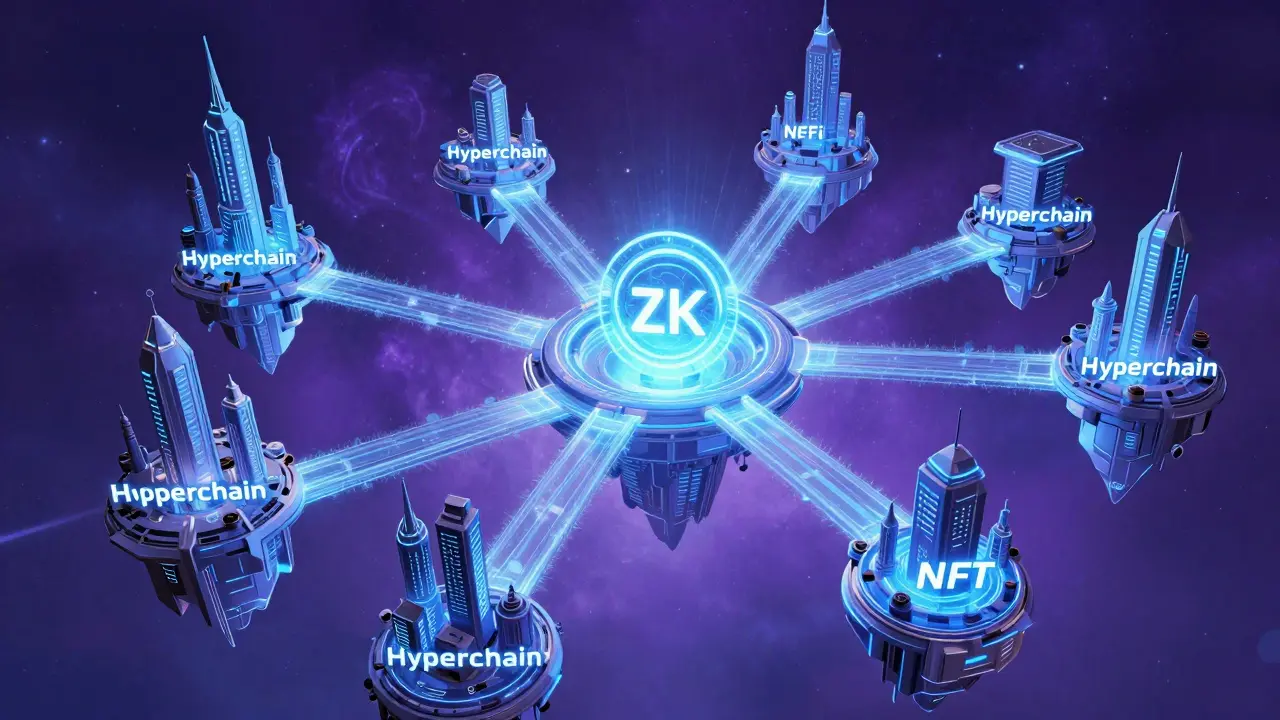
Then there is the ZK Stack. Think of this as a modular toolkit. It allows other people to launch their own "hyperchains"-customized ZK-chains that all plug into the same ecosystem. One of the coolest parts of the ZK Stack is that it allows chains to use tokens other than ETH for gas fees. For example, a gaming chain could let users pay for transactions using a specific in-game currency or a stablecoin like USDC, making the user experience much smoother for non-crypto natives.
| Feature | ZKsync (ZK-Rollup) | Optimistic Rollups |
|---|---|---|
| Confirmation Speed | Near-instant (via Validity Proofs) | Slower (requires challenge period) |
| Security Model | Mathematical/Cryptographic | Game-theoretic (fraud proofs) |
| Withdrawal Time | Fast | Often 7 days |
| Computational Cost | High (generating proofs is hard) | Low |

The ZK Token: More Than Just a Coin
The ZK token officially hit the markets on June 17, 2024. But it isn't just something to trade on an exchange. The token is designed to facilitate the governance of the network. Instead of a central company making all the decisions, token holders can participate in shaping the future of the protocol.
The distribution of the ZK token was handled with a focus on genuine participation. Matter Labs didn't just give coins to whoever showed up; they used a value scaling formula to reward users who actually provided liquidity to DeFi protocols or developed infrastructure. A significant chunk-17.5% of the total supply-was allocated to contributors and users through an airdrop to ensure the network was seeded with active, invested participants.
Performance and Scalability Metrics
If you're wondering if ZKsync actually delivers on its promises, the numbers are pretty striking. The network is optimized for massive throughput, capable of handling 10,000+ transactions per second (TPS). For perspective, the Ethereum mainnet typically handles around 15-30 TPS. By offloading this volume, ZKsync prevents the main chain from clogging while keeping the fees low enough that you can actually afford to mint an NFT or swap a few tokens without spending $50 on gas.
Because all ZKsync chains use a standardized ZK-engine, the security is consistent across the board. You aren't jumping into a "wild west" chain with unknown security standards; the trust is derived directly from Ethereum's Layer 1. This makes the Elastic Network-the web of interoperable ZK-chains-much more attractive for institutional players who can't afford to take unnecessary risks with their capital.
Potential Pitfalls and Things to Watch
No technology is perfect. The biggest challenge for ZKsync is the computational intensity of generating zero-knowledge proofs. While the end-user experiences fast transactions, the provers (the systems calculating the proofs) require immense computing power. This is a technical hurdle the team is constantly working to optimize.
Additionally, because the ZK ecosystem is growing so fast, users should always be careful about which "hyperchains" they interact with. While the core ZK-engine is secure, the individual applications running on those chains are only as safe as their own smart contract audits. Always double-check the project's credibility before bridging your funds.
Is ZKsync safe to use?
Yes, ZKsync is generally considered very safe because it relies on cryptographic validity proofs. Unlike other L2s that rely on "trusting" a set of validators, ZKsync's security is anchored in the Ethereum mainnet. If the math proves the transaction is valid, it's settled. However, always remember that individual dApps on the network can still have bugs or vulnerabilities.
How is ZK different from ETH?
ETH is the native currency of the Ethereum main blockchain (Layer 1). ZK is the governance and utility token for the ZKsync scaling network (Layer 2). Think of Ethereum as the foundation and ZKsync as a high-speed express lane built on top of that foundation to make it usable for millions more people.
What are the benefits of zk-rollups over optimistic rollups?
The main advantage is the speed of withdrawals and finality. Optimistic rollups usually have a 7-day waiting period for withdrawals to ensure no one cheated. ZK-rollups use mathematical proofs to verify transactions instantly, meaning you don't have to wait a week to get your money back to the main Ethereum chain.
Can I use tokens other than ETH for gas on ZKsync?
Yes, thanks to the ZK Stack. While the main Era chain typically uses ETH, other chains built using the ZK Stack can customize their base token for fees. This means you could potentially pay for transactions using stablecoins like USDC or other community-specific tokens.
How do I get ZK tokens?
ZK tokens are traded on major cryptocurrency exchanges. They were initially distributed via an airdrop to active contributors and users of the ZKsync ecosystem, but they are now available for purchase through standard trading pairs on most supported platforms.
What to Do Next
If you're new to the ecosystem, the best way to start is by bridging a small amount of ETH from the mainnet to ZKsync Era. This will let you experience the speed and low cost firsthand. From there, explore the decentralized exchanges (DEXs) and lending protocols built on the network.
For developers, the move is clear: check out the ZKsync SDKs. Whether you're experienced with Solidity or looking to build something entirely new with the ZK Stack, the ability to create a custom, scalable chain that inherits Ethereum's security is a massive opportunity for the next wave of Web3 apps.




The implementation of ZK-rollups is a total game changer for scalability! Getting that throughput up to 10k TPS while maintaining L1 security is a massive win for the whole ecosystem. If you guys are looking to dive in, I highly recommend checking out the ZK Stack for custom hyperchains-the flexibility to use USDC for gas is just chef's kiss for onboarding new users into DeFi without the ETH headache!
This is such a great breakdown! 😊 I love how it simplifies the complex math behind ZKPs. Definitely makes the transition to Layer 2 feel way less intimidating for everyone! 🚀✨
Absolute rubbish. The computational overhead for generating these proofs is a massive bottleneck that the industry keeps ignoring. It's just another layer of obfuscation for a system that's fundamentally over-engineered. We're trading off decentralization for the illusion of speed while the provers become centralized points of failure. Typical L2 nonsense.
I hear you on the prover centralization risk, but that's exactly why the modularity of the ZK Stack is key! We're moving toward decentralized prover networks to mitigate that exact bottleneck. It's an iterative process, not a finished product!
Hahaha please... you think this basic guide is 'enlightening'?? The real intellects already knew this. Most of these western users are just chasing airdrops without understanding the deeper metafisics of zero-knowledge. It's honestly pathetic how people worship these tools without seeing the granderer design of digital sovereignty that we in India are actually pioneering in spirit.
Just a heads up for anyone bridging: make sure you're using the official bridge or a well-known provider like Orbiter. It's easy to get phished with fake 'bridge' sites that look exactly like the real thing. Also, keep a little bit of ETH on your L2 for gas, even if the fees are low, because you can't move funds back if you're totally drained!
Omg why is everyone so obsessed with these tokens anyway? It's literally just a bunch of numbers on a screen while the world is falling apart. And don't get me started on the 'governance' part-we all know a few whales just make all the decisions while the rest of us pretend we have a say. It's honestly a joke.
The centralization of prover nodes is a calculated move by the global elite to maintain control over the flow of information. Do not trust the 'mathematical proof' blindly. These systems are designed to monitor every single move under the guise of efficiency. The American dream is being replaced by a digital ledger of surveillance and we are just cheering for it
the real issue here is that people keep treating l2s as a magic bullet when in reality the liquidity fragmentation is becoming a nightmare and the only way this actually works is if the abstraction layer becomes completely invisible to the user which is still miles away given the current state of the zksync era implementation and the way they handle the sequencing
I've been playing around with some of the dApps on Era and the speed is legit insane. It's kind of a philosphical shift too, right? Moving from a model of 'trust but verify' (Optimistic) to 'math says it is' (ZK). I did make a few typos in my first smart contract deployment but the dev tools are pretty forgiving once you get the hang of them.
Wait, so the 7-day wait is gone?? That's actually huge!!!
Basically yeah. Since the validity proof is submitted with the batch, the L1 knows the state is correct immediately. No need for a challenge window. It's just standard ZK-rollup architecture.
Oh wow, a 7-day waiting period for my own money! What a fantastic feature of the old system. I'm so glad we're finally moving away from that wonderful experience. Truly a miracle of modern science.
just keep pushing forward everyone!! you got this!! crypto is a wild ride but we can all learn together and grow our portfolios while supporting each other throughout the journey!! keep it real and stay hungry!!
There is something almost poetic about the way Zero Knowledge Proofs work. It's the ultimate paradox: proving you know a secret without ever revealing the secret itself. It reflects the human condition in a way-we all have internal truths that we can validate to the world without ever fully exposing our souls. It's not just tech; it's a mirror of our own boundaries and the sacred spaces we keep within ourselves while interacting with a vast, digital society.
I concur with the technical assessment provided in the post... the efficiency gains are quite notable...