
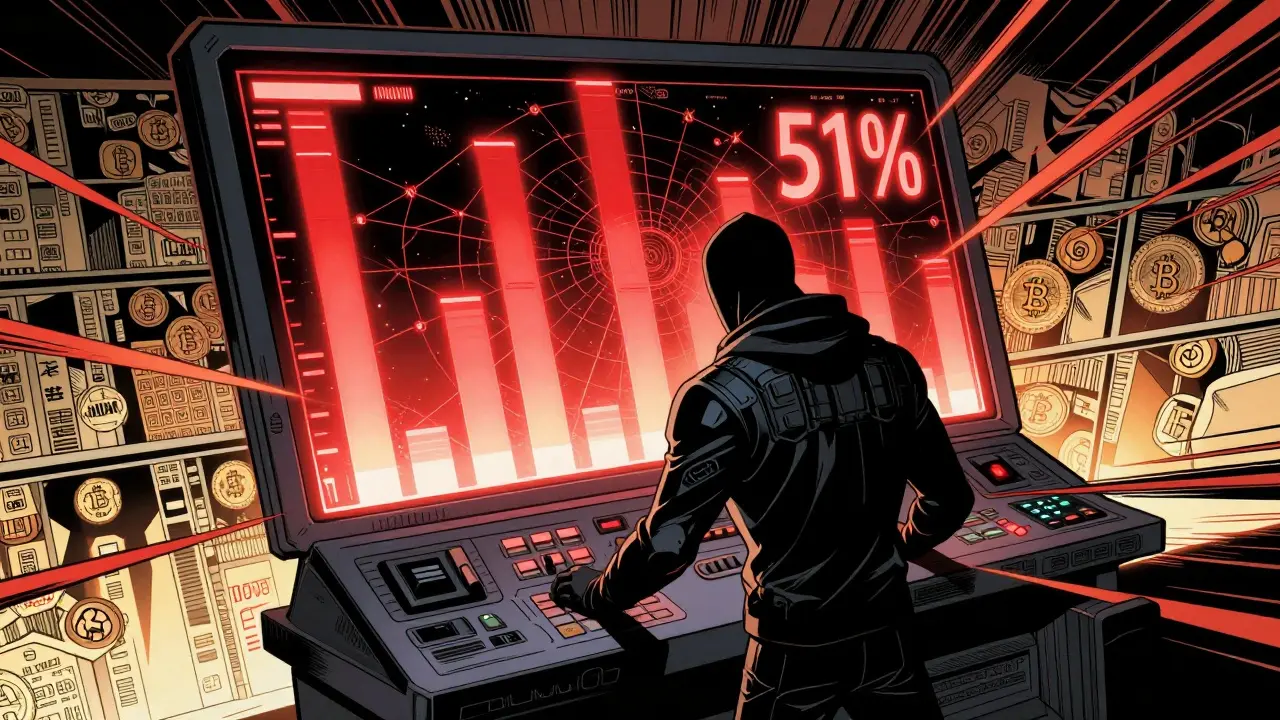
How to Prevent 51% Attacks on Blockchains: Real-World Strategies That Work
51% Attack Vulnerability Calculator
Blockchain Security Assessment
Calculate the vulnerability of a blockchain to 51% attacks based on real-world data from the article.
What a 51% attack really does to your crypto
Imagine you wake up and find out someone erased your last ten Bitcoin transactions - including the one where you bought that new laptop. Not just reversed. Erased. And then they spent the same coins again. That’s what a 51% attack does. It doesn’t break encryption. It doesn’t hack wallets. It just takes over the rules of the game.
When one person or group controls more than half of a blockchain’s computing power (in PoW) or staked tokens (in PoS), they can decide which transactions get confirmed. They can delay new blocks. They can undo old ones. And worst of all - they can double-spend. This isn’t theoretical. Between 2018 and 2022, Bitcoin Gold, Verge, and Litecoin Cash were hit multiple times. In 2020, Verge lost $1.7 million in a single attack. These aren’t sci-fi scenarios. They’re real losses happening right now.
Why small blockchains are sitting ducks
Not all blockchains are created equal. Bitcoin, with its 400 exahashes per second of mining power, would cost over $12 billion in hardware and nearly $50 million a day in electricity to attack. That’s not just expensive - it’s practically impossible for any single entity to pull off.
But look at a coin with a $20 million market cap and only 0.6 exahashes of hash rate. Attackers don’t need to buy thousands of ASIC miners. They can rent the power for under $1,500 on platforms like NiceHash. In 2022, Chainalysis found that 87% of all 51% attacks targeted blockchains worth less than $50 million. The math is simple: low security = low cost to break.
That’s why exchanges like Binance often pause deposits for small-cap coins after unusual activity. It’s not paranoia. It’s damage control. If your coin can be attacked for less than the price of a used car, it’s not secure by design - it’s just lucky so far.
Proof-of-Work: The hash rate arms race
Bitcoin uses Proof-of-Work (PoW). Miners compete to solve complex puzzles. The more computing power you have, the more blocks you mine. The network trusts the longest chain - the one with the most cumulative work.
Preventing a 51% attack here means making sure no single miner or pool controls too much of that power. Bitcoin Core has had monitoring tools since 2016 that alert the network if any mining pool hits 40% of total hash rate. That’s not a hard rule - it’s a warning siren. If one pool gets too big, miners elsewhere start switching to other pools. The market self-corrects.
Some networks go further. The MIT-developed ChainLocks protocol, used in some forks, requires 60% of miners to digitally sign each block. Even if you control 51% of hash power, you still can’t forge a block without the signatures. That raises the attack cost from renting hardware to also hacking dozens of independent mining operations - a whole different level of difficulty.

Proof-of-Stake: Betting your money on honesty
Ethereum switched from PoW to Proof-of-Stake (PoS) in September 2022. Instead of buying expensive machines, validators lock up 32 ETH - around $51,200 at 2023 prices - to participate. If they act maliciously, they lose part or all of that stake. It’s called slashing.
Here’s the genius part: attacking a PoS chain isn’t just expensive - it’s self-sabotage. To control 51% of Ethereum’s staked ETH, you’d need to buy up over $25 billion worth of tokens. And once you start reversing transactions, the network detects it. Validators slash your stake. The price of ETH crashes. You’ve just destroyed the value of your own investment.
That’s why Ethereum survived multiple attempts in late 2022 where attackers controlled 35% of validators. The slashing mechanism kicked in. The attackers lost millions. The network kept running. PoS doesn’t make 51% attacks impossible - it makes them financially suicidal.
Hybrid and alternative models that work
Some blockchains mix ideas. Decred uses 60% PoW and 40% PoS. In a 2021 test, researchers tried to control 65% of the network. They failed - because even if they owned all the mining power, they still needed to control a large chunk of staked tokens too. Two systems blocking each other = harder to break.
Other chains like EOS use Delegated Proof-of-Stake (DPoS). Instead of thousands of validators, only 21 elected block producers confirm transactions. Users vote them in or out. If one gets shady, the community votes them off within minutes. It’s fast, efficient, and works well for smaller networks where full decentralization isn’t practical.
Enterprise chains like Hyperledger Fabric use Practical Byzantine Fault Tolerance (PBFT). These aren’t public blockchains - they’re permissioned. Only approved nodes can validate. PBFT can handle up to 33% malicious actors without breaking. That’s why 72% of Fortune 500 companies use this model. It’s not for crypto traders - but it’s bulletproof for banks and supply chains.
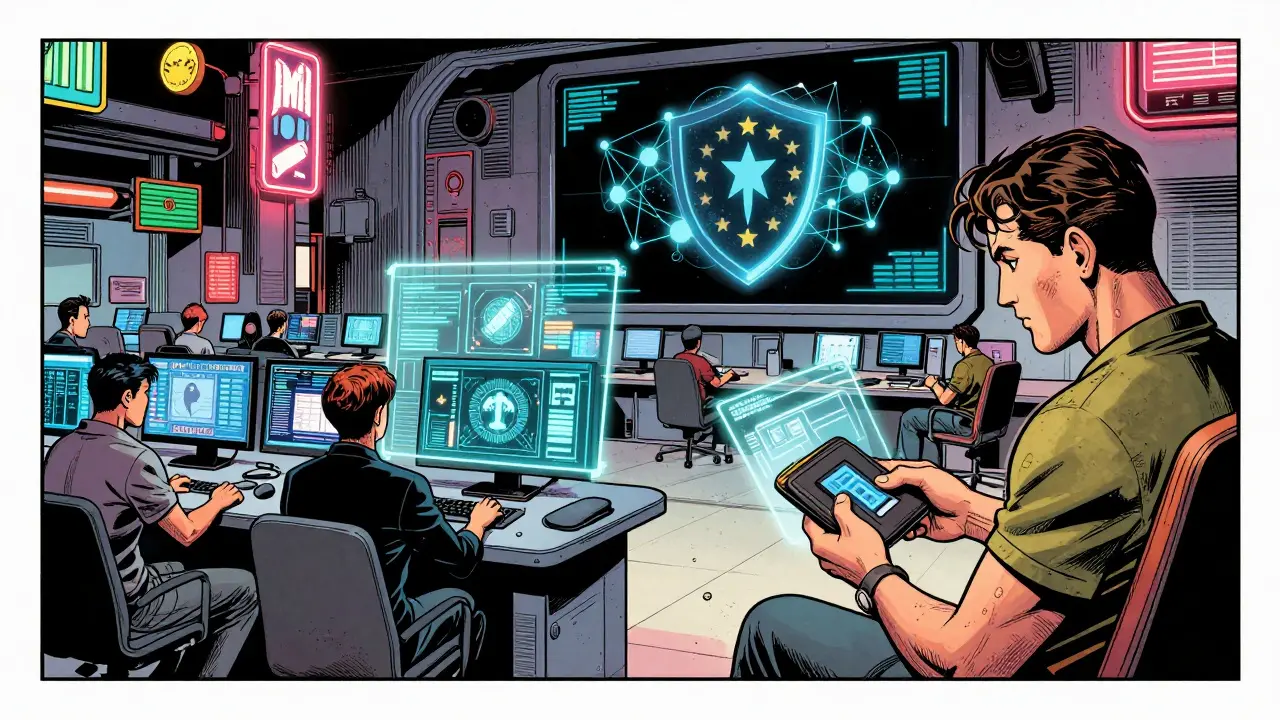
What you can do as a user or investor
You don’t need to be a developer to stay safe. Here’s what works in real life:
- Avoid small-cap coins - If a coin’s market cap is under $100 million, assume it’s vulnerable. The data doesn’t lie.
- Wait for 6+ confirmations - On Bitcoin, one confirmation takes 10 minutes. Six means an hour. On smaller chains, wait longer. If an exchange says “instant deposit,” be skeptical.
- Use trusted exchanges - Binance, Coinbase, Kraken monitor for 51% attacks. They freeze deposits when something looks off. That’s a feature, not a bug.
- Watch the network stats - Sites like Blockchain.com and Crypto51 show real-time hash rate distribution. If one pool is at 45%, it’s a red flag.
- Don’t trust “unhackable” claims - No blockchain is 100% safe. But some are safe enough. Look for networks with high hash rates, strong staking requirements, and active community governance.
The future: AI, regulation, and better design
Things are getting better. MIT’s Blockchain Security Monitor now uses AI to predict attacks before they happen. In beta tests, it spotted suspicious hash rate buildup with 89% accuracy - often 30 minutes before an attack started.
Regulations are catching up too. The EU’s MiCA law, effective June 2024, forces crypto platforms to implement “robust mechanisms to prevent majority attacks.” That means exchanges will soon be legally required to block deposits on vulnerable chains.
And Ethereum’s upcoming Dencun upgrade in early 2024 will separate block creators from block builders. This stops powerful miners from manipulating transaction order to profit at users’ expense - a hidden form of centralization that could lead to 51% risks down the line.
By 2027, experts predict attacks on blockchains with market caps over $1 billion will drop to less than half a per year. That’s not zero - but it’s a massive improvement from the 2.3 attacks per year we see now.
Bottom line: Security is a numbers game
A 51% attack isn’t about clever hacking. It’s about economics. The bigger, more decentralized, and more costly to attack a network is, the safer it becomes. Bitcoin stays secure because it’s expensive to break. Ethereum stays secure because attacking it costs more than you’d ever make.
For users, the lesson is simple: don’t gamble on tiny blockchains. Stick to the big ones. Wait for confirmations. Trust the systems that make attacks too expensive to bother with. The technology isn’t perfect - but the best defenses aren’t magic. They’re just smart math, strong incentives, and a little bit of common sense.







So let me get this straight... we're trusting math and electricity to keep our money safe? Cool. I'll just keep mine under my mattress. At least the cat can't reverse my transactions. 😐
This was actually really helpful. I’ve been nervous about putting any money into smaller coins after hearing about the attacks. Knowing what to look for-like confirmations and hash rates-makes me feel a lot more confident. Thanks for breaking it down clearly.
You people are clueless. The real problem isn’t the blockchain-it’s the Fed. They’re scared of decentralized money because it cuts out their printing press. 51% attacks? That’s just the government’s way of testing if you’re loyal enough to the system. Wake up.
You’re not alone if you’re scared of crypto! But this post? It’s like a flashlight in a dark room. You don’t have to be a tech genius to stay safe-just follow the five tips. You got this 💪
Wait… so you’re telling me the government didn’t create all these ‘attacks’ to scare people away from crypto? 🤔 They’re using this to push MiCA so they can track every single transaction. I’m not buying it. #DeepStateCrypto
If you're still holding anything under $100M market cap, you're not an investor-you're a donation to someone's exit scam. Just sayin.
The assertion that PoS renders 51% attacks financially suicidal is empirically sound. The economic disincentive structure is elegantly robust.
DPoS is the future. 21 validators = efficiency. PBFT for enterprises = compliance. PoW is obsolete. You’re clinging to 2009 tech.
Nah, Bitcoin’s secure because it’s the only one that matters. Everything else is just noise. You think Ethereum’s safe? LOL. They’re still running on someone else’s code. 🤡
Man this post just saved me from putting my rent money into some random altcoin. I was about to go all in on DogeMoon2.0 until I read the part about $1500 attacks. Yikes. Thanks bro 😅
The part about ChainLocks is fascinating. Requiring digital signatures from 60% of miners adds a layer that’s not just technical-it’s institutional. Smart design.
Wait, wait, wait-so if I wait for 6 confirmations, I’m basically saying ‘I trust the network more than the guy who just sent me this cash’? That’s wild. I never thought about it like that. Thanks for the reminder 🙏🙏🙏
It is imperative to recognize that the fundamental architecture of blockchain security is not predicated upon cryptographic perfection, but rather upon the alignment of economic incentives with network integrity. The transition from Proof-of-Work to Proof-of-Stake represents a paradigmatic evolution in the governance of distributed consensus, wherein the cost of malfeasance is internalized by the actor, thereby rendering adversarial behavior economically irrational. This is not merely a technical advancement-it is a sociotechnical innovation.
If you’re using a chain with less than 10 exahashes of hash rate, you’re already compromised. It’s not a question of ‘if’-it’s ‘when’. Use Bitcoin or Ethereum. Period.
I used to think crypto was all about getting rich quick. Then I lost a little on a sketchy coin and realized-this isn’t gambling. It’s about protecting your value. This post helped me see that. Thanks for the clarity.
It’s funny how we call it a 51% attack like it’s a villain. But really, it’s just the system being honest. If you put all your trust in one thing, someone will try to take it. Maybe the real question is: why do we trust anything at all?