

Liquidity Pool Impermanent Loss Calculator: How to Avoid Costly Mistakes in DeFi
When you add ETH and USDC to a liquidity pool on Uniswap, you're not just earning trading fees-you're also risking a hidden loss called impermanent loss. It doesn't show up as a negative balance. Your tokens don’t disappear. But if the price of ETH jumps 50% while you're locked in, you could end up with less value than if you'd just held those tokens in your wallet. That’s impermanent loss. And if you don’t use a calculator to measure it, you’re flying blind.
Most new liquidity providers think they’re getting a free lunch: earn fees, no risk. But the math doesn’t lie. In early 2023, over 60% of users who added volatile pairs like ETH/SHIB to pools lost money after fees were factored in. Why? Because they didn’t check the calculator first.
What Actually Causes Impermanent Loss?
Impermanent loss happens because of how automated market makers (AMMs) work. Most DeFi exchanges like Uniswap use a simple rule: x * y = k. That means the product of the two tokens in a pool must stay constant. If one token’s price changes, the pool automatically rebalances by selling more of the rising asset and buying more of the falling one.
Imagine you put in 1 ETH and 2,000 USDC when ETH is $2,000. The pool has $4,000 total. Now ETH spikes to $3,000. The pool rebalances to keep x * y = k, so it sells some ETH and buys USDC. You end up with less ETH and more USDC than you started with. If you’d just held your 1 ETH, you’d have $3,000. But in the pool? Maybe only $2,850. That $150 gap? That’s impermanent loss.
It’s called “impermanent” because if ETH drops back to $2,000, the loss disappears. But if it keeps rising? The loss becomes real. And that’s where calculators come in.
How a Liquidity Pool Impermanent Loss Calculator Works
A good calculator doesn’t guess. It runs the math for you. You plug in three things:
- Your initial price ratio (e.g., 1 ETH = $2,000)
- The current price ratio (e.g., 1 ETH = $3,000)
- The amount of each token you deposited
The tool then calculates:
- What your tokens are worth now inside the pool
- What they’d be worth if you hadn’t deposited them
- The percentage difference - your impermanent loss
Advanced calculators go further. They add real-time data: trading volume, pool fees, volatility trends. For example, SushiSwap’s built-in tool pulls 24-hour volume from its own pool to estimate how much fee income you’ve earned. Then it subtracts the loss. You don’t just see risk-you see net profit or loss.
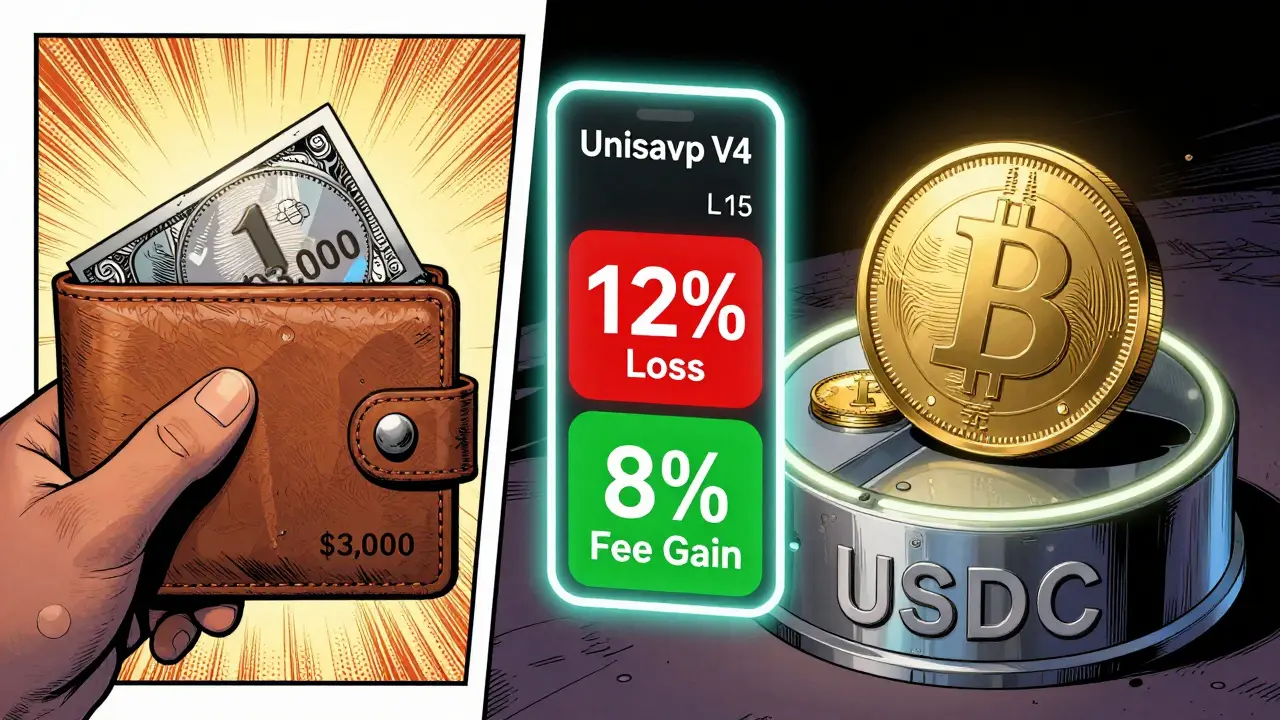
One user on Reddit added 5 ETH and 10,000 USDC to a pool in January 2024. The calculator showed a 12% impermanent loss after a week. But fees earned were 8%. Net loss? Only 4%. Without the tool, they might’ve pulled out thinking they lost money. They stayed-and ended up with a 2.1% net gain by month-end.
Types of Calculators You Can Use
Not all calculators are created equal. There are three main types:
Basic Web Tools (e.g., impermanentloss.com)
These are free, simple, and fast. You enter two prices and two amounts. It gives you a percentage. Easy. But they ignore fees. That’s a big flaw. In stablecoin pools (like USDC/DAI), fees often outweigh loss. In volatile pairs (ETH/SOL), fees barely cover it. A basic tool can’t tell the difference. According to CoinDesk’s 2023 review, these tools are 23% less accurate than ones that include fee data.
Exchange-Native Tools (e.g., Uniswap V3, SushiSwap, Balancer)
These are better. They pull live data from the pool you’re using. Uniswap’s V3 calculator (updated March 2024) now shows how concentrated liquidity positions affect loss. If you only provide liquidity between $2,800 and $3,200 for ETH, the tool adjusts your risk profile. It also adds real-time fee estimates. These are the most trusted by experienced LPs. 68% of users now use these over third-party tools, according to a Chainalysis and Messari report from February 2024.
Institutional Platforms (e.g., Amberdata, Kaiko)
These are for professionals. They cost money-$1,500/month minimum. But they offer backtesting, volatility forecasting, and AI-driven predictions. Amberdata’s 2024 update uses machine learning trained on 3 years of pool data. It can predict 7-day loss with 92% accuracy. Hedge funds use these. Most retail users don’t need them. But if you’re staking $50k or more? It’s worth the cost.
What Most Calculators Get Wrong
Even good calculators have blind spots. Here are the three biggest mistakes people make:
- Ignoring fee compounding - Some tools assume fees are paid out weekly. But in reality, they’re reinvested automatically. That boosts your position over time. Tools that don’t account for this overstate loss.
- Using today’s price as the only input - A sudden 30% jump might look scary. But if volatility is high, the price might swing back. Tools that use 30-day historical volatility give better context. Amberdata’s method uses this and cuts error rates by 40%.
- Not comparing pools - A calculator shouldn’t just show loss. It should let you compare ETH/USDC vs. ETH/DAI vs. WBTC/USDC. SushiSwap’s tool lets you do this. Most don’t.
One user followed a popular YouTube guide and used a basic calculator to add SOL/ETH liquidity. It showed 5% loss. They thought it was safe. But SOL’s 30-day volatility was 140%. The fee revenue? Only 1.8% APR. They lost 18% net over 3 weeks. A better tool would’ve flagged it.
When to Use a Calculator - And When to Walk Away
You should always run a calculator before adding liquidity. But here’s the rule: if the projected loss is over 8% and fee yield is under 5%, avoid it. Most stablecoin pairs (USDC/DAI, FRAX/USDC) show less than 1% loss and 6-10% APR. Those are safe. ETH/USDC? 3-5% loss, 4-7% APR. Acceptable if you’re holding long-term. But ETH/SHIB? 15%+ loss, 2% APR? Don’t touch it. Unless you’re speculating on price, not earning fees.
During the March 2023 banking crisis, users who used calculators avoided high-volatility pairs. Those who didn’t lost an average of 22.7% net, according to the DeFi Safety Council. The difference? One group checked the numbers. The other didn’t.

How to Get Started
Here’s how to use a calculator in 5 steps:
- Choose a pool you want to join (e.g., ETH/USDC on Uniswap V3)
- Go to Uniswap’s built-in calculator (or SushiSwap’s)
- Enter your deposit amount for each token
- Input the current market price (it auto-fills if you’re on the exchange)
- Check the net result: loss vs. fee estimate
If the net result is negative? Wait. If it’s positive? Go ahead. You can also simulate future scenarios. What if ETH goes to $4,000? What if it drops to $1,800? Most tools let you adjust the price slider. That’s how pros manage risk.
It takes 15 minutes to learn. That’s all. No coding. No wallet connect. Just a browser. Coinbase’s 2024 study found users who used calculators were 3x less likely to pull out in panic during market swings.
What Experts Say
Dr. Guillermo Angeris from Stanford, who co-wrote the paper on Uniswap markets, says: “Impermanent loss calculators provide essential risk visibility but must be used alongside fee revenue projections to determine net profitability.”
Vitalik Buterin called them “fundamentally important for rational liquidity provision.”
But don’t treat them like crystal balls. They predict opportunity cost, not future prices. As Dr. Georgios Konstantopoulos of Paradigm warned: “Most free calculators fail to account for the convexity of fee revenue, creating false risk perceptions.”
That’s why you need to use one that includes fees. Not just loss.
Final Advice
Impermanent loss isn’t magic. It’s math. And math doesn’t lie. If you’re putting money into a liquidity pool, you owe it to yourself to run the numbers. Free tools work. But the best ones? They’re built into the exchanges you already use. Uniswap, SushiSwap, Balancer - they all have them. Use them. Every time.
Don’t wait for a loss to happen. Check before you click “Approve.”
Is impermanent loss real, or does it go away?
Impermanent loss is real only if the price of your assets doesn’t return to the level when you deposited them. If ETH rises from $2,000 to $3,000 and stays there, you lose value compared to holding. But if it drops back to $2,000, the loss disappears. That’s why it’s called “impermanent.” The key is net profit: if your earned fees are higher than the loss, you’re ahead.
Do all liquidity pools have impermanent loss?
Yes - but not equally. Pools with two stablecoins (like USDC/DAI) have almost zero impermanent loss because their prices rarely move. Pools with one stablecoin and one volatile asset (like ETH/USDC) have moderate loss. Pools with two volatile assets (like ETH/SOL) have the highest loss. Always check the calculator before depositing.
Can I avoid impermanent loss entirely?
Not if you’re providing liquidity to an AMM. But you can minimize it. Use stablecoin pairs, avoid high-volatility tokens, and only join pools where fee yield exceeds projected loss. Tools like Uniswap V3’s concentrated liquidity let you set price ranges, reducing exposure to extreme swings.
Why do some calculators show 0% loss even when prices changed?
That usually means the tool isn’t including fees. If a pool has high trading volume, fees can offset loss entirely - even if the price moved. A good calculator shows both: loss percentage and net profit after fees. If it only shows loss, it’s incomplete.
Should I use a calculator if I’m only depositing a small amount?
Yes. Even small amounts can add up. If you deposit $500 into a high-volatility pair and lose 15%, that’s $75 gone. A calculator takes 30 seconds. The cost of skipping it? Real money. Always check.







Just added 2 ETH and 5k USDC to Uniswap V3 yesterday and used the built-in calculator. Showed 3.2% impermanent loss but 5.1% fee yield. Net gain? 1.9%. I stayed in. Been a week. ETH went to $3800. Still positive. Math wins. Always check before you click approve.
LOL. You think a calculator tells you the truth? 😏 The real impermanent loss is your trust in DeFi math. Every time you use one of these tools, you’re just feeding the AMM. They don’t care if you lose. They care if you trade. You’re not earning fees-you’re liquidity fertilizer.
YOU’RE ALL MISSING THE POINT. This entire post is a marketing pamphlet disguised as education. The ‘calculators’? Built by the same teams that profit from your liquidity. They show you ‘net gain’ because they WANT you to stay locked in. The real impermanent loss? Your freedom. Your capital. Your soul. They’re not tools-they’re traps wrapped in Excel sheets.
And don’t get me started on ‘concentrated liquidity.’ That’s just high-risk gambling with a fancy UI. I’ve seen 150% losses in 48 hours. And guess who’s still telling you to ‘use the calculator’? The same people who made the damn thing.
Don’t be a lamb. Be a wolf. Or at least don’t click ‘approve’ without reading the whitepaper. And no-I won’t link it. Figure it out yourself.
Calculators are useless. Just hold ETH. Done.
Interesting breakdown. The key insight for me was fee compounding. Most retail tools don’t model reinvestment. I built a simple script in Python that pulls Uniswap V3 fee data via The Graph and auto-calculates net APY. It’s not perfect but better than web tools. Happy to share the logic if anyone wants it.
Really glad you shared this. I was about to throw my USDC/DAI pool into the mix without checking-thanks for the nudge. I’m new to LPing and honestly didn’t realize how much the fee math matters. I used Sushi’s tool and saw a tiny loss but solid fees. Decided to go for it. Feels good to make an informed move instead of just hoping.
So you’re telling me I need to run numbers before I risk my crypto? Wow. That’s so… responsible. I thought DeFi was about freedom. Not spreadsheets. But hey, if you like doing math, go ahead. I’ll be over here, holding my ETH and laughing at the people who think a calculator can predict the future. 🤡
Let’s be real. 90% of these ‘calculators’ are built by devs who don’t even understand convexity. The numbers they show are based on historical averages. But volatility isn’t normal. It’s fat-tailed. And no calculator accounts for black swans. You think 12% loss is bad? Wait till you’re in an ETH/SOL pool during a memecoin pump. Your ‘net gain’ becomes a 40% wipe. And no one warned you. Because they’re all using the same broken tools.
This was super helpful for me as someone just starting out. I was scared of impermanent loss but didn’t know how to measure it. Tried the Uniswap calculator and realized my ETH/USDC pool was actually profitable after fees. I feel way more confident now. Thank you for breaking it down simply. Keep sharing this kind of stuff!
Bro, I just want to say-you’re doing an amazing job educating people! I’m from India and I’ve been trying to get my friends into DeFi, but they’re scared of losses. This post, especially the part about stablecoin pairs being low-risk, gave me the perfect example to share. I showed them the calculator, they tried it with 100 USDC/DAI, and now two of them are in! Small steps, big impact. Keep going!
While the post is technically accurate, it fundamentally misrepresents the incentive structure of AMMs. The ‘net profit’ narrative is a dangerous oversimplification. Fee revenue is not guaranteed-it is path-dependent and subject to front-running, MEV extraction, and liquidity mining decay. A calculator that shows a ‘positive’ outcome assumes static conditions. In reality, the system is adversarial. You are not an LP. You are a liquidity provider to a game where the house always wins. And you’re being sold a fantasy.
Here’s the truth no one will admit: the whole ‘impermanent loss calculator’ is a distraction. It’s designed to make you feel in control so you keep your money in the pool. Meanwhile, the protocol is minting new tokens, diluting your share, and the devs are cashing out their early allocations. The ‘loss’ you see? That’s just the tip. The real loss is the opportunity cost of not being in the presale. Or not shorting the token. Or not rug-pulling your own liquidity. Every time you use one of these tools, you’re validating the system. You’re not calculating risk-you’re legitimizing the scam. And if you think a calculator can predict volatility? Honey, the market’s not a math problem. It’s a psychological one. And the only thing that matters is who’s holding the bag when the lights go out. Spoiler: it’s you. And the calculator? It’s the last thing you’ll see before the rug.