
What is SynVision (TWS) Crypto Coin? A Clear Breakdown of the AI Entertainment Token
When you hear about SynVision (TWS), it’s easy to get confused. Is it the next big thing in entertainment? Or just another crypto project with flashy promises and no real users? Let’s cut through the noise. SynVision (TWS) is a cryptocurrency token built on the Solana blockchain, designed to power a platform that lets creators make and monetize short drama content using AI and blockchain incentives. It’s not TikTok. It’s not YouTube Shorts. It’s an attempt to build a new kind of entertainment system - one where viewers, creators, and investors all have a stake in what gets made and how it earns money.
What Does SynVision Actually Do?
SynVision isn’t just a coin. It’s meant to be the engine behind a platform focused on "micro-short drama" - stories under 90 seconds, designed for mobile viewing, with serialized plots that hook viewers quickly. Think of it like Netflix’s "Shorts" but with a twist: every time someone watches, likes, or shares a drama, the creators earn TWS tokens. And not just creators - viewers who engage deeply can also earn tokens based on their activity.
The platform uses AI to help writers and producers. It analyzes what kinds of storylines, characters, and endings are trending in real time. If viewers keep rewatching a scene where a character turns out to be a villain, the AI suggests doubling down on that twist in future episodes. It’s not magic, but it’s meant to reduce the guesswork behind content creation.
Unlike YouTube, where ad revenue is split with the platform, SynVision cuts out the middleman. Creators get paid directly in TWS tokens. Viewers who comment, share, or even just stick around for the full 60 seconds earn tokens too. The idea is simple: reward attention. And because it’s on Solana, transactions are fast and cheap - no $5 fees to send a few cents in rewards.
Tokenomics: The Numbers Behind TWS
The total supply of TWS is listed as 1.96 billion tokens. But here’s where things get messy. Different websites say different things. CoinMarketCap says 1.96 billion. Other sources claim 200 billion. One even says 200 quadrillion. That’s not a typo. It’s a red flag. When even the basic math around supply is inconsistent, you’re dealing with a project that lacks transparency.
As of March 24, 2026, TWS trades between $0.02192 and $0.043987, depending on the platform. That’s down from its all-time high of $0.099817 in August 2025. In just seven months, it lost over 76% of that peak value. But it also jumped 5,942% from its low of $0.0003823 in May 2025. That kind of swing is normal for tiny crypto projects - but terrifying for anyone trying to plan ahead.
The market cap? Around $1.41 million, according to CoinMarketCap. But some trackers show $0. That’s because there’s almost no trading. The 24-hour volume hovers between $0 and $3,667. That’s less than what a single influencer might make from one sponsored post. Low volume means low liquidity. If you buy TWS, you might not be able to sell it easily - or at all.
Where Can You Buy TWS?
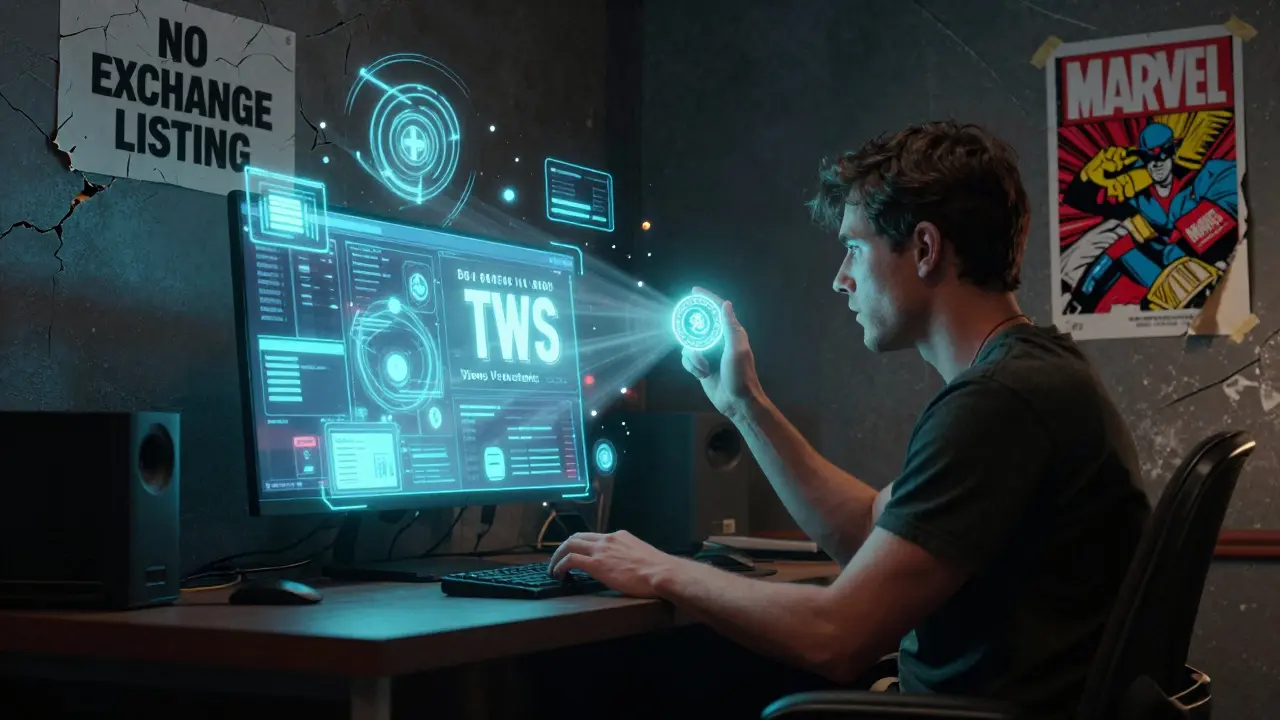
This is the biggest hurdle. SynVision (TWS) is not listed on Binance, Coinbase, or any major exchange. You won’t find it on Uniswap or PancakeSwap either. According to CoinCarp, the token "has yet to be listed on any cryptocurrency exchanges (CEX or DEX)." That means you can’t just open your app and buy it.
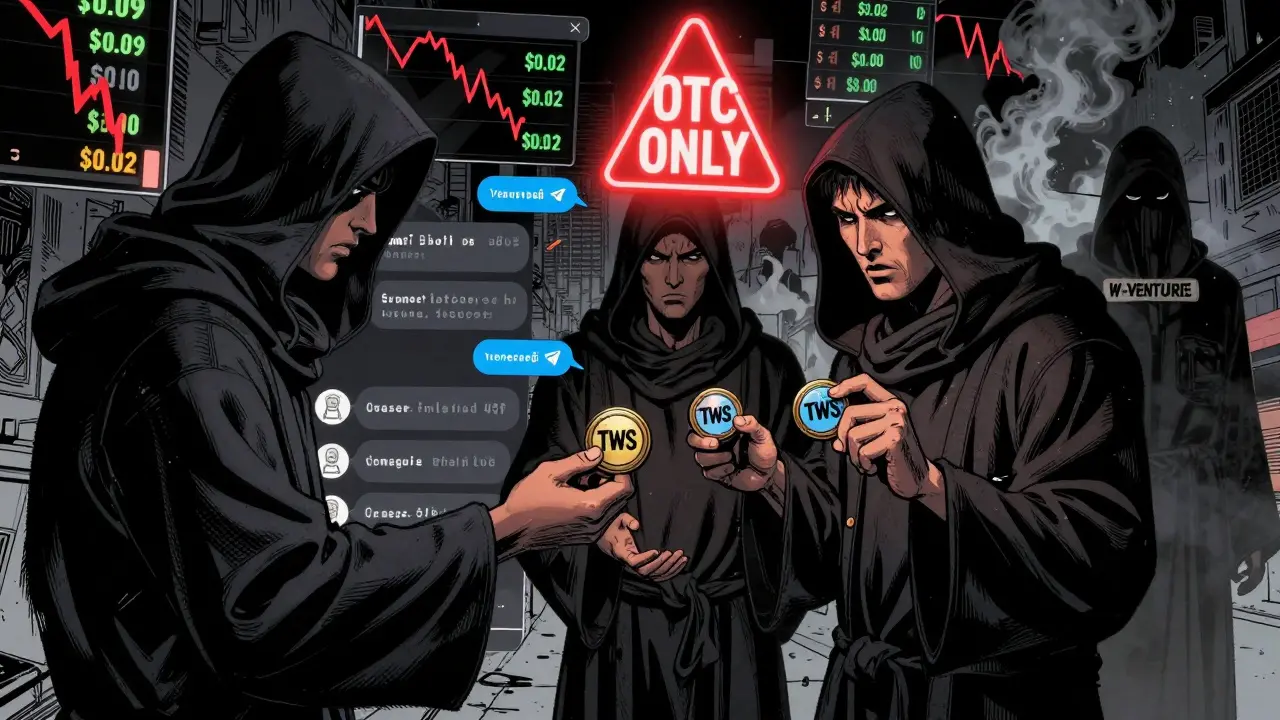
Right now, trading happens through Over-the-Counter (OTC) channels - private deals between individuals or small groups. These aren’t regulated. There’s no price transparency. No order books. No protection. If you want TWS, you’re likely dealing with someone on Telegram or a private Discord server. That’s not investing. That’s gambling.
Some search results mention Binance. That’s misleading. It might have been listed briefly in 2025, but as of now, there’s no active trading. No official listing. No public market. If someone tells you they can sell you TWS on Binance, they’re either mistaken or lying.
Who’s Behind SynVision?
The project is created by W-VENTURE Group, a company that doesn’t have a public website, LinkedIn profile, or verifiable track record. Their team is anonymous. No names. No photos. No past projects. That’s not uncommon in crypto - but it’s risky when you’re asking people to invest in a platform that depends on long-term trust.
They communicate through Twitter (@SYN_VISION_W), a Medium blog, and two Telegram channels. The content is mostly announcements, roadmap updates, and promotional posts. There’s no technical documentation, no code repository on GitHub, and no audit reports from a third-party security firm. That’s a problem. If you can’t see the code, you can’t trust it.
Is SynVision Worth Anything?
Here’s the hard truth: SynVision (TWS) is a high-risk, early-stage experiment. It’s not a stock. It’s not a utility token with real usage. It’s a bet on a future that hasn’t happened yet.
There are no real users. No data on daily active viewers. No creator payouts tracked publicly. No integration with actual drama studios or production houses. The whole thing feels like a pitch deck with a token attached.
It’s trying to compete with TikTok and YouTube Shorts - platforms with billions of users and billions in revenue. SynVision has no brand recognition, no marketing budget, and no way to attract mainstream creators. It’s asking people to switch from free, easy-to-use platforms to a crypto-based system that’s hard to access and hard to understand.
That doesn’t mean it’s a scam. But it does mean it’s speculative. If you’re thinking of buying TWS, you’re not investing in a product. You’re betting that someone else will pay more for it later. That’s the definition of a pump-and-dump asset.
What Should You Do?
If you’re curious about SynVision:
- Read their whitepaper - if you can find it.
- Check if they’ve had their smart contracts audited.
- Look for real creator testimonials, not just marketing posts.
- Ask: Can I actually use this today? Or is it all future promise?
Most people who buy TWS now are chasing a quick gain. But with trading volume this low and no exchange listings, the odds of selling at a profit are slim. If you do buy, treat it like a lottery ticket - not an investment.
For now, SynVision remains a quiet experiment in a crowded field. It has a clever idea - blockchain-powered short drama. But without real adoption, real users, and real access, it’s just another token with a story.

SynVision's model is actually a fascinating convergence of AI-driven content optimization and tokenized engagement loops. The micro-short drama format taps into the dopamine-driven consumption patterns we've seen explode on TikTok, but the real innovation is in aligning incentives across the entire ecosystem-creators, viewers, and even lurkers. The Solana backbone makes microtransactions viable, which is huge. No more ad revenue arbitrage. If the platform can onboard even 10k active creators with consistent output, the network effect could be brutal. The supply inconsistencies? Yeah, sketchy-but that’s par for the course in early-stage DeFi-adjacent projects. What matters is utility, not whitepaper math.
Oh wow, another 'blockchain for content' fantasy. Let me guess-next they’ll tokenize your tears when you cry at the drama. This isn’t innovation, it’s vaporware with a Solana sticker. You don’t build a new entertainment platform by slapping a token on top of a concept that already has Netflix, YouTube, and TikTok eating its lunch. The fact that it’s not listed anywhere? That’s not a bug, it’s the whole damn feature. It’s a Ponzi dressed as a startup.
Let’s be real. This isn’t a platform. It’s a Telegram group with a smart contract and a Midjourney logo. 😂 The 'AI analyzes trending twists'? Bro, that’s just a bot counting how many times people rewatch the villain reveal. And the team? Anonymous. No LinkedIn. No GitHub. Not even a decent Discord. If your 'revolutionary' project can’t even show you a team photo, you’re not building the future-you’re trying to cash out before the Feds show up.
There’s a real opportunity here if they can solve the trust deficit. The idea of rewarding attention with tokenized incentives isn’t new-but the execution needs transparency. Audits. Public code. Real creator case studies. Right now, the lack of verifiable data makes it impossible to evaluate. I’ve seen dozens of projects like this. Most die quietly. A few pivot into something useful. But you can’t build a community on hype and Discord DMs. You need documentation, accountability, and a roadmap that doesn’t sound like a pitch deck written in a fever dream. If they release a public beta with verifiable payout logs, I’ll give it another look. Until then, it’s a speculative gamble.
so like… uhhhh… you’re saying people can earn crypto by watching 60 sec drama clips?? 🤔 i’m in. also can i get tokens for just scrolling?? like… just vibin?? 🫶
Don’t sleep on this. The future of content isn’t ads-it’s alignment. If viewers get rewarded for watching, creators get paid directly, and the AI helps refine the narrative? That’s not just smart. It’s inevitable. Yeah, the supply numbers are messy. But look at early Ethereum-no one knew the exact token count either. The real question is: are you betting on the tech, or the hype? I’m betting on the tech. 🚀
No exchange listings. Zero volume. Anonymous team. That’s not a startup. That’s a trap.
People are gonna lose money on this, but honestly? I kinda respect the ambition. The AI-driven story tuning is legit. Imagine a drama series where the plot evolves based on real-time viewer feedback-like a choose-your-own-adventure with blockchain backing. The OTC thing is wild, yeah, but maybe that’s how early Web3 stuff rolls. Think of it like Bitcoin in 2010-no exchange, just weird dudes on forums trading with paypal. Could be the next big thing. Or a ghost town. Either way, I’m watching.
Wow. Another 'blockchain solves everything' project. Did they forget that content thrives on *accessibility*, not tokenomics? You can’t compete with TikTok by making users navigate a wallet, gas fees, and OTC scams. This isn’t innovation. It’s arrogance wrapped in a whitepaper.
I’ve seen this movie before. It’s called 'Crypto: The Prequel'. They had a whitepaper. They had a logo. They had a 'revolutionary' AI. And then? Poof. Gone. The team vanished. The Discord died. The token? Worthless. This feels like deja vu. Don’t be the sucker who buys the last ticket before the theater burns down. 🎭🔥
It’s easy to dismiss this, but ask yourself: why do people keep trying? Because the current models are broken. YouTube takes 45%. TikTok owns your data. Creators are disposable. SynVision’s model flips that. Yes, it’s early. Yes, the supply numbers are a mess. But if they can prove they can pay creators *consistently*-even just $50 to 500 people-that’s a win. I’m not investing. But I’m following. Maybe in 6 months, we’ll see real data. Until then, stay curious.
ok so i read this whole thing and i’m like… if i watch a 60 sec drama and get paid in tws… and i can use those tokens to make my own drama… and the ai helps me write it… is this… a game?? 🤯 i’m so confused but also kinda excited??
Let me get this straight: You’re asking people to abandon YouTube for a platform that doesn’t exist yet, with a token no one can buy, from a team that doesn’t exist? That’s not visionary. That’s just… sad. This isn’t a crypto project. It’s a cry for help.
This is exactly why crypto is a cancer. It preys on the naive, the desperate, the gullible. People think they’re 'investing' when they’re just feeding a gambling den disguised as innovation. No audits. No transparency. No legal recourse. Just a bunch of anonymous grifters siphoning hope from people who think 'blockchain' means 'trust'. Shameful.
While the project presents intriguing possibilities, the lack of formal documentation, third-party audits, and regulatory compliance raises significant red flags. In the context of blockchain-based ecosystems, verifiable transparency is not optional-it is foundational. Until these elements are addressed, any valuation is purely speculative and ethically questionable. I urge all potential stakeholders to prioritize due diligence over FOMO.
Bro this is wild. AI writing drama? Like… imagine a twist where the villain turns out to be your ex… and the AI just knows because 80% of viewers rewatched that scene. That’s not tech. That’s psychic. And the fact that you can’t even buy it? Perfect. Means the insiders are holding. I’m buying. 🤑
If you're thinking of getting into this, treat it like a side project. Not an investment. Maybe try creating a short if they ever launch a beta. See how the AI works. See if creators actually get paid. Don't buy tokens. Just observe. That's the smart play.
USA built the internet. China’s building AI. This? This is some dude in a basement with a Discord and a dream. And we’re supposed to give him money? Nah. I’m out.