
Understanding Blockchain Network Topology: How Nodes Connect
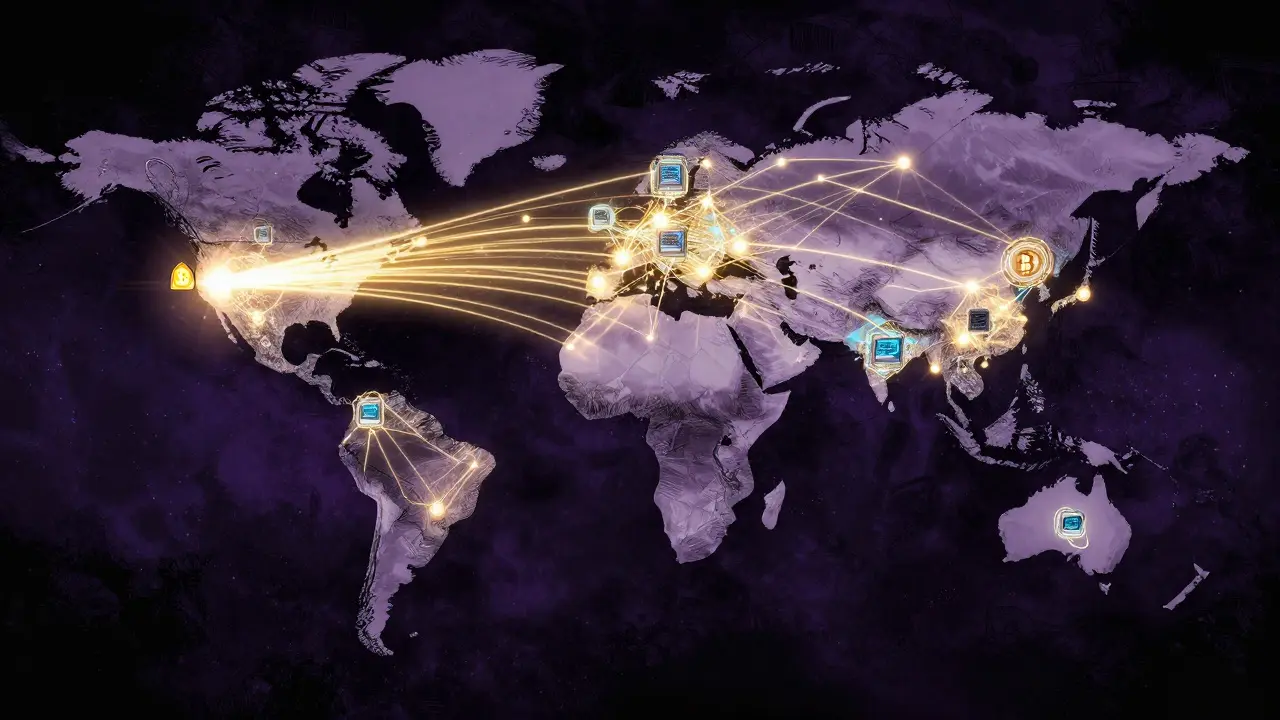
Imagine you're sending a small amount of Bitcoin-maybe 1,000 sats-to a friend. You hit send, and within seconds, thousands of computers across the globe know about it. How does that happen without a central office or a single 'master' server directing traffic? The answer lies in the network topology. Essentially, topology is the map of how nodes (the computers in the network) are wired together. If the map is wrong, the whole system slows down or, worse, becomes easy to hack.When we talk about blockchain network topology is the physical and logical arrangement of nodes in a blockchain network, determining how data flows and how the distributed ledger is maintained. It is the foundational blueprint that decides whether a network is truly decentralized or just a fancy version of a traditional bank.
The Peer-to-Peer Gold Standard
Most blockchains you've heard of use a peer-to-peer (P2P) model. In a P2P setup, there is no boss. Every node is equal. When a new transaction happens, the originating node doesn't send it to a central hub; it tells its immediate neighbors. Those neighbors tell their neighbors, creating a ripple effect. This is often called a mesh topology.
Why does this matter? Because it kills the "single point of failure." In a traditional banking system, if the main server goes down, nobody gets paid. In a mesh network like Bitcoin, you could wipe out half the nodes in North America, and the network would still hum along perfectly because the data just finds another route through nodes in Europe or Asia.
Comparing Different Topology Models
While P2P is the goal for decentralization, not every network is built the same. Some use structures that look more like traditional computing to gain speed, though they sacrifice some security. Let's look at the most common architectural models found in research and practice.
| Topology Type | Structure | Main Advantage | Biggest Risk |
|---|---|---|---|
| Mesh (P2P) | Interconnected nodes | High resilience | Higher data redundancy |
| Router (Star) | Central hub node | Faster routing | Single point of failure |
| Ring | Circular path | Balanced load | Slow if one node fails |
| Hierarchical (Tree) | Layered branches | Organized flow | Bottlenecks at root nodes |
The Trade-off: Speed vs. Decentralization
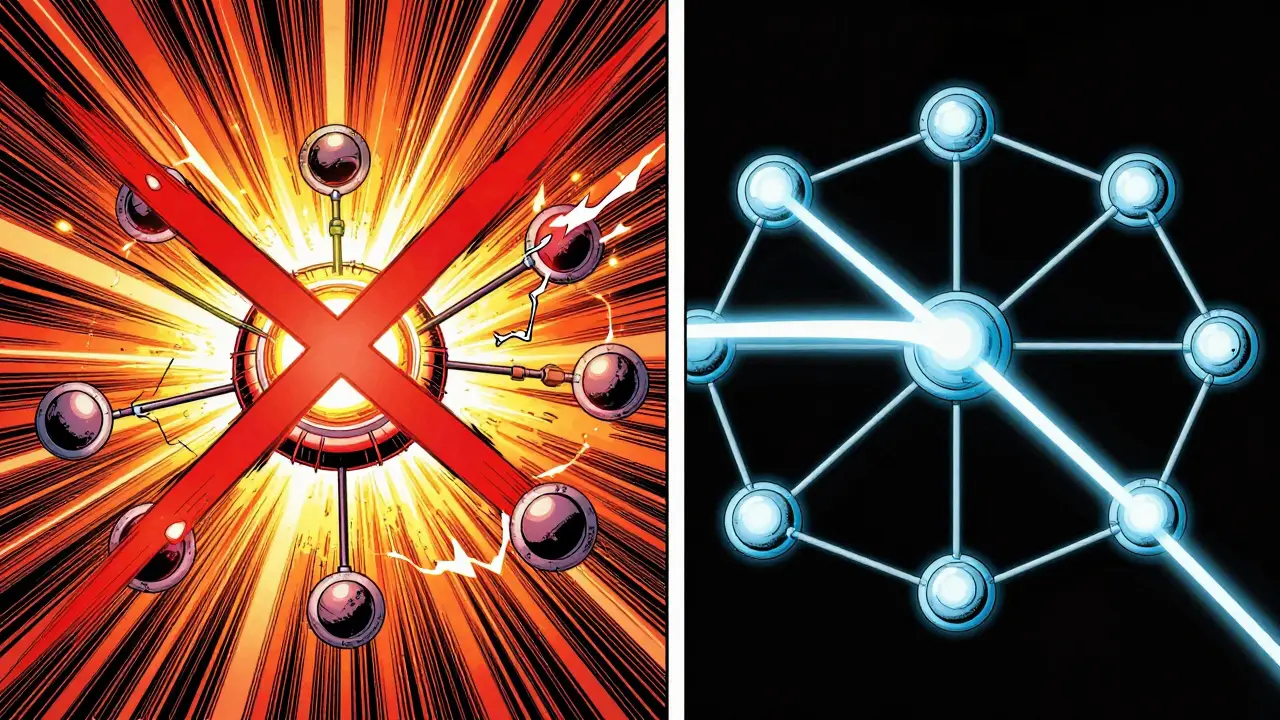
You might wonder why anyone would use a Router or Star topology if it's riskier. It comes down to efficiency. In a Router topology, all data flows through a central point. This is incredibly fast-similar to how a company's internal server works. But for a blockchain, this is a nightmare. A central hub becomes a massive target for Denial of Service (DoS) attacks. If the hub is knocked offline, the entire network freezes.
Then there's the Ring topology. Here, each node only talks to its direct neighbor. It's a tidy way to distribute the network load, but it's fragile. If the chain breaks at one point, the data can't complete the circle. This is why true decentralized systems lean heavily toward the mesh approach, even if it means sending the same piece of data to multiple nodes unnecessarily.
How Topology Interacts with Network Layers
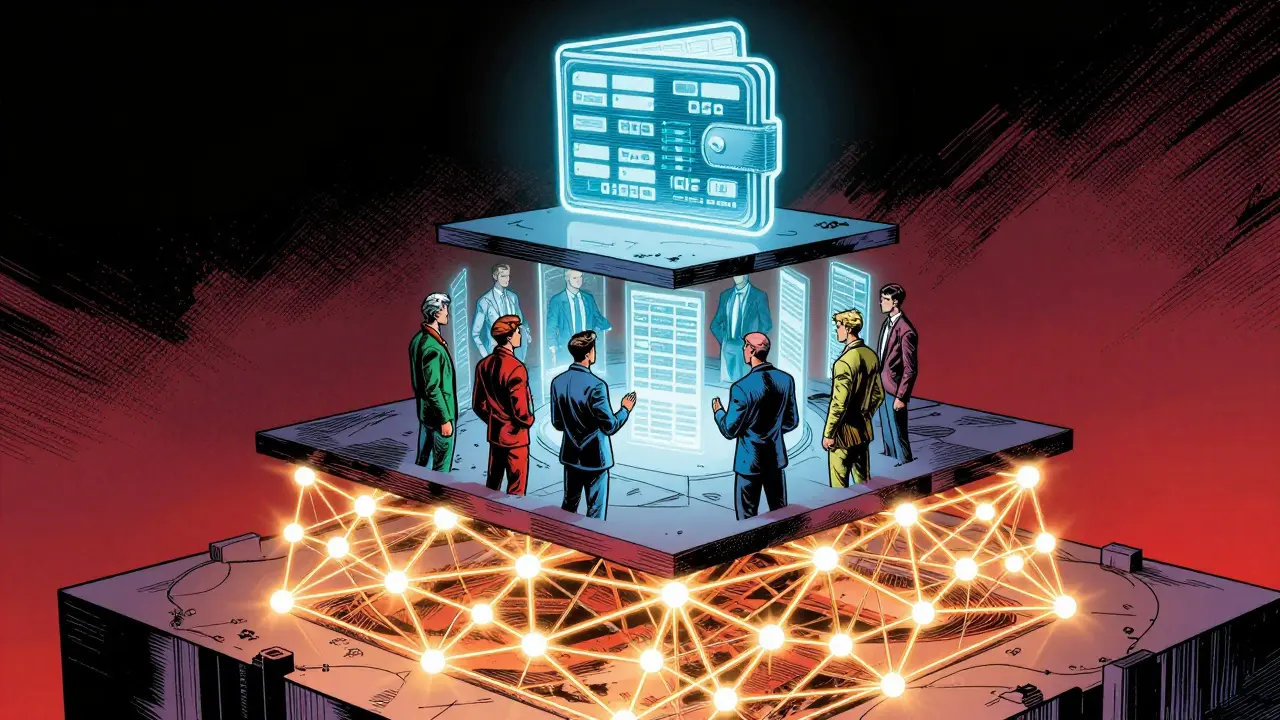
Topology doesn't exist in a vacuum; it's the floor that the rest of the blockchain stands on. To understand how a transaction actually moves, we have to look at the layers.
First, there is the Network Layer. This is where the topology lives. It manages the communication protocols that allow nodes to find each other. Without this layer, a node is just an isolated computer with no way to sync the ledger.
On top of that sits the Consensus Layer. This is where the network agrees on which transactions are real. Whether the network uses Proof-of-Work (like Bitcoin) or Proof-of-Stake (like the modern version of Ethereum), the topology affects how fast the "vote" spreads. If the topology is fragmented, the consensus takes longer to reach, leading to slower confirmation times.
Finally, we have the Application Layer. This is what you actually see-your wallet, a lending platform, or a smart contract. These apps don't care how the nodes are wired; they just rely on the layers below to ensure that when they move funds, the network is secure and consistent.
Enterprise vs. Public Blockchains
Not all blockchains are meant for the general public. Take Hyperledger Fabric. Unlike Bitcoin, which is an open-for-all mesh, Hyperledger is often used by businesses. In this environment, they use "peer nodes" that host copies of the ledger and communicate through specific channels. This is a more controlled topology because it prioritizes privacy and permission over total openness.
In a public network, anyone can join and become a node, which creates a chaotic but robust mesh. In a private enterprise network, the topology is often more hierarchical. They might have designated gateway nodes that manage traffic, which increases speed but moves the network closer to the centralized models used by traditional banks.
Common Pitfalls in Topology Design
When developers design new chains, they often fall into the trap of prioritizing scalability too early. They might implement a "hub-and-spoke" model to make transactions feel instant. However, this creates a hidden vulnerability. If the "spokes" rely on a few powerful nodes (super-nodes), the network isn't actually decentralized-it's just a distributed database with a few bosses.
Another issue is network latency. In a global mesh, a node in Wellington might take longer to hear about a transaction from a node in London than a node in New York does. If the topology doesn't account for this, you get "forks," where different parts of the network think different versions of the ledger are the truth.
What is the most secure blockchain topology?
The mesh (or peer-to-peer) topology is generally the most secure because it lacks a single point of failure. Because every node can connect to many others, the network remains operational even if large numbers of nodes are taken offline by attacks or technical failures.
Does network topology affect transaction speed?
Yes, significantly. Centralized or hierarchical topologies are typically faster because data has a shorter, more direct path to a validator. In contrast, decentralized mesh networks require data to "hop" through multiple peers, which can introduce latency.
What happens if a central node in a star topology fails?
In a star or router topology, the central node is the only way for other nodes to communicate. If it fails, the entire network is severed, and transactions cannot be processed or validated until the hub is restored.
How does Ethereum handle its network structure?
Ethereum uses a decentralized P2P structure combined with a consensus mechanism called Gasper. This allows the network to maintain a distributed state across thousands of nodes while using Proof-of-Stake to secure the chain without needing the massive energy of Proof-of-Work.
Is a ring topology ever useful for blockchain?
Ring topologies are mostly used in academic research or very specific private environments to balance network load. They aren't practical for public blockchains because a single node failure can break the entire communication loop.
Moving Forward: What to Watch
If you're a developer or an investor, look at how a project handles its node distribution. If they claim to be decentralized but only have three major server clusters running the show, that's a red flag. The future of the industry is moving toward "strongly connected" models that try to find the sweet spot between the raw speed of a hub and the ironclad security of a mesh.
Keep an eye on Layer 2 solutions as well. They often use their own unique topologies to bundle transactions before sending them back to the main Layer 1 chain, effectively creating a multi-tiered network map that attempts to solve the scalability trilemma.






It is really helpful to see the difference between mesh and star topologies laid out like this. Many people forget that scalability often comes at the cost of security, and the "super-node" issue is a great point to keep in mind when researching new projects.
USA makes the best tech anyway 🇺🇸 🦅 Mesh is the only way to go. Others are just fake!
Uhm, basic stuff really. Like, obviously the trilemma is the only thing that actually matters here and the author just barely scratched the surface of how L2s actually interact with the L1 state transition. I've seen way deeper analyses on whitepapers that actually use real math instead of just simple analogies. It's almost cute that some people find this "educational" when it's basically just a surface-level overview for beginners who can't read a technical spec. Honestly, if you don't understand the gossip protocol implementation details, you're just guessing. Typical pop-science approach to crypto, honestly so tedious to read through the fluff just to get to the point. Most of the industry is just copying and pasting from old GitHub repos anyway. I can't even believe we're still debating star vs mesh in 2024. It's so outdated. Give me a real DAG or something that isn't from a decade ago. Just my two cents, but this is barely an introduction. Total amateur hour.
That is a spicy take!
The mention of Hyperledger Fabric is spot on since the channel-based architecture significantly optimizes the throughput for permissioned ledgers by reducing the blast radius of transaction propagation. Implementing a Byzantine Fault Tolerant (BFT) consensus within a hierarchical topology can actually mitigate some of those root-node bottlenecks if the primary is rotated frequently via a view-change protocol.
Totally agree with the point on L2s! They are the secret sauce for making this actually usable for the average person :)
i tried to run a node once and my computer literally melted... why is this so hard for me 😭
The distinction between the network layer and the consensus layer is an essential observation. It is imperative that individuals recognize how the physical distribution of nodes directly impacts the time required to achieve finality across the distributed system.
I believe the author has correctly identified the inherent risk of a single point of failure in centralized topologies. One might also consider the role of ISP-level filtering, which can occasionally mimic a topology failure by blocking P2P traffic.
I think we can all agree that finding the middle ground is where the real innovation happens, and while some might disagree on the speed of mesh networks, the security they provide is simply unmatched in the long run.
It is interesting to see how different regions manage these connections, especially when considering the cultural approach to privacy and data sovereignty in different parts of the world.