
What is Franklin (FLY) Crypto? A Realistic Look at the Token
Have you ever stumbled upon a cryptocurrency with a tiny market cap and wondered if it’s a hidden gem or a dead end? That’s exactly where Franklin (FLY) sits today. It’s an ERC-20 utility token designed for the FLyECO ecosystem, a platform that promised to remove intermediaries from decentralized finance (DeFi). But does it still deliver on those promises?
When you look at the numbers, the picture gets blurry fast. As of late 2023, data showed Franklin (FLY) hovering around a market cap of roughly $17,700. To put that in perspective, that’s less than what many people spend on a mid-range laptop. With trading volumes sometimes dipping below $10 in a single day, this isn’t just a small project-it’s one of the smallest active tokens you’ll find on major trackers.
The Core Concept: What Is the FLyECO Ecosystem?
To understand why Franklin (FLY) exists, you have to look at its parent structure, the FLyECO ecosystem. The idea was straightforward: create a space for individuals who want financial freedom without traditional banks or middlemen. The platform aimed to support decentralized organizations, non-fungible tokens (NFTs), and gaming applications.
The token itself serves as the fuel for this machine. If you wanted to use services like FLyLaunchpad for initial DEX offerings (IDOs), trade on FLyDEX, or stake your assets via FLyStaking, you needed FLY. The pitch was simple: hold the token, get discounts, and benefit from the ecosystem’s growth. It sounds like a classic DeFi flywheel model, similar to how giants like Uniswap or PancakeSwap operate, but scaled down significantly.
| Component | Function | Status/Observation |
|---|---|---|
| FLyLaunchpad | Hosts IDO projects for new tokens | No verifiable user metrics reported |
| FLyDEX | Decentralized exchange services | Minimal adoption; low liquidity |
| FLyStaking/Farming | Reward mechanisms for holders | Theoretical benefits lack practical evidence |
| FLyNFT | Marketplace for digital collectibles | No significant transaction volume observed |
Technical Specs: Under the Hood
If you’re a developer or a tech-savvy investor, you probably want to know where this token lives. Franklin (FLY) operates primarily on the Ethereum blockchain as an ERC-20 token. Its contract address is 0x85f6eb2bd5a062f5f8560be93fb7147e16c81472. It also has a presence on the Binance Smart Chain (BSC), with the address 0x681fd3e49a6188fc526784ee70aa1c269ee2b887.
The supply dynamics are worth noting. The maximum supply is set at 1.7 billion tokens. However, only about 31% of that-roughly 519 million tokens-was in circulation as of September 2023. This means there’s a lot of room for future dilution if the team decides to release more tokens into the market. For a token with such low current demand, a large unlocked supply can often pressure the price downward.
From a code perspective, reviews on GitHub suggest the contract implements standard ERC-20 functionality. There aren’t any flashy security enhancements or innovative features here. One anonymous reviewer, 'CryptoAuditor42', described it simply as a "basic utility token with no distinguishing technical characteristics." It works, but it doesn’t do anything special.
Market Reality: Price, Volume, and Liquidity
This is where things get tricky for potential investors. Let’s talk numbers. In October 2023, LiveCoinWatch reported a price of $0.000200, while other sources like Holder.io showed even lower figures around $0.000034. These discrepancies highlight a common issue with micro-cap cryptocurrencies: inconsistent data tracking due to low activity.
The all-time high (ATH) is another point of confusion. Some sources claim an ATH near $1.27, which would imply a massive drop. Others cite a peak closer to $0.05. Regardless of which number you trust, the current price represents a decline of over 97% from its highest point. That’s not just a correction; that’s a collapse in value.
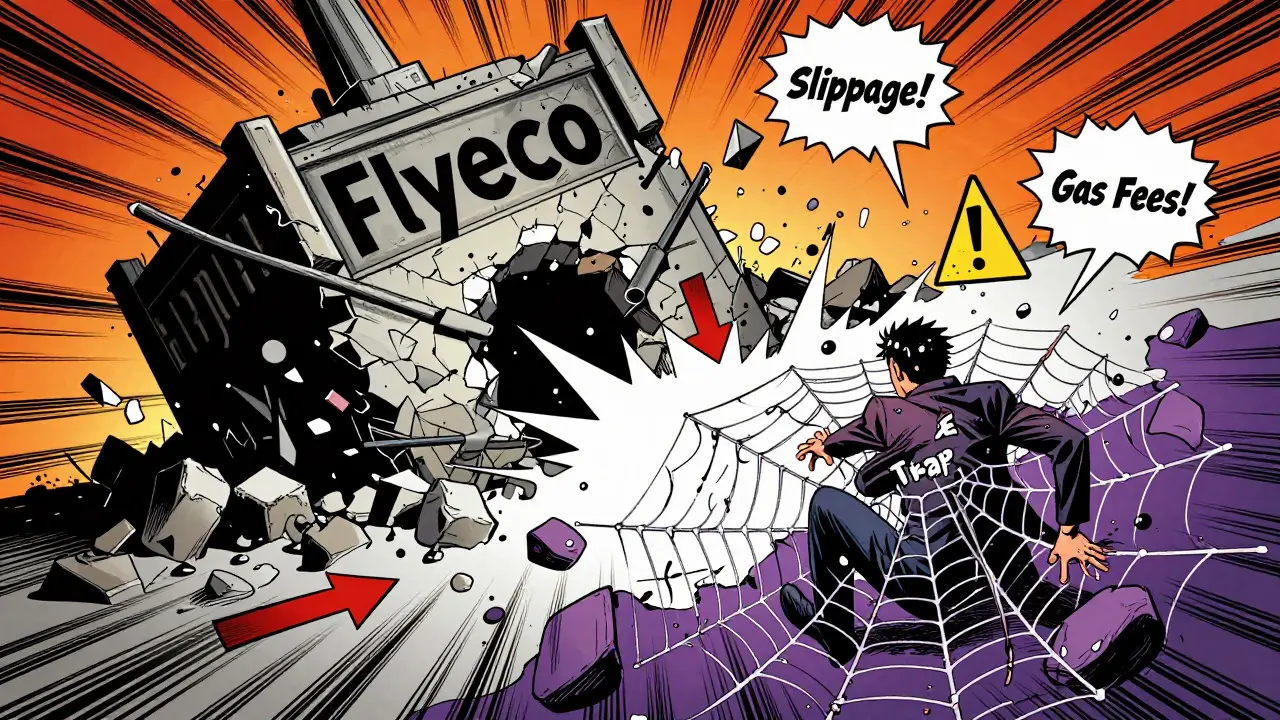
Liquidity is the real killer here. Trading volume is virtually nonexistent. On days when the entire global market trades billions, Franklin (FLY) might see $1 to $10 in total volume across all exchanges. Imagine trying to sell $50 worth of FLY. With such thin order books, you’d likely experience slippage of 30-50%, meaning you’d get far less money back than expected. Plus, you’d have to pay Ethereum gas fees, which could easily exceed the value of your trade.
| Metric | Franklin (FLY) | Uniswap (UNI) | PancakeSwap (CAKE) |
|---|---|---|---|
| Market Cap | ~$17,700 | >$1 Billion | >$1 Billion |
| 24h Volume | $1 - $4,000 | >$100 Million | >$50 Million |
| Exchange Presence | Uniswap V2, ProBit Global | Major CEX & DEXs | Major CEX & DEXs |
| Development Activity | Stagnant (Last commit 2022) | Active Daily | Active Daily |
Community Sentiment: Is Anyone Talking?
In crypto, community is everything. Without users, there’s no network effect. So, what’s the buzz around Franklin (FLY)? Honestly, there isn’t much.
A search through Reddit yields only about 12 mentions of "FranklinYield" or "FLY token" in recent years. Most discussions happen in beginner subreddits, with questions like, "Is this worth $10?" The replies are usually cautious, warning about zero liquidity and high gas fees. Twitter is equally quiet. The official account, @FrankLinYield, has fewer than 1,300 followers and hasn’t posted original content since mid-2023. No responses to inquiries. No updates. Just silence.
User feedback on platforms like ProBit Global paints a grim picture. Comments include phrases like "Impossible to sell even tiny amounts without massive slippage" and "Last trade was 3 days ago - avoid at all costs." When users feel trapped because they can’t exit their positions, sentiment turns negative quickly. There are no success stories, no verified partnerships, and no visible enterprise adoption.
Development Status: Is the Project Dead?
One of the biggest red flags for any crypto project is development activity. For Franklin (FLY), the GitHub repository shows the last commit occurred on April 15, 2022. That’s over a year before the latest market data we’re looking at. No new features, no bug fixes, no roadmap updates.
The official website, tokenfly.co, contains basic information but lacks detailed guides or active announcements. Industry analysts tracking micro-cap tokens have labeled Franklin’s trajectory as "consistent with abandoned projects." When you combine stagnant code, minimal social media presence, and vanishing trading volume, it’s hard to argue that this is an active, growing ecosystem.
DappRadar’s Q3 2023 report noted that tokens with market caps below $100,000 saw a 92% average decline in active users over the past year. Franklin fits squarely into this category. Without fresh capital, new users, or technical innovation, the momentum has completely stalled.

Risks and Considerations for Investors
If you’re considering buying Franklin (FLY), you need to understand the risks. This isn’t an investment; it’s speculation on a dormant asset. Here’s what you should watch out for:
- Extreme Volatility: With so few trades, a single buy or sell order can swing the price wildly.
- Liquidity Traps: You might be able to buy, but selling could be nearly impossible without losing most of your value to slippage.
- Gas Fees: Since it’s on Ethereum, every transaction costs ETH. If your trade is worth $5, but the gas fee is $3, you’re already underwater.
- Dilution Risk: With 69% of tokens still outside circulation, future unlocks could crash the price further.
- Abandonment: Lack of development suggests the team may have moved on, leaving users with a hollow shell of a platform.
Experts specializing in low-cap cryptocurrencies advise extreme caution. Tokens with these metrics are often classified as "highly speculative and unsuitable for all but the most risk-tolerant investors." In reality, they’re suitable for almost no one who values capital preservation.
How to Buy (If You Still Want To)
If you’ve read all this and still want to experiment, here’s how you’d technically go about it. Keep in mind, this requires some knowledge of decentralized finance.
- Set Up a Wallet: You’ll need a Web3 wallet like MetaMask. Make sure it supports both Ethereum and Binance Smart Chain.
- Get ETH or BNB: Buy Ethereum or Binance Coin on a major exchange and transfer it to your wallet. You’ll need this to pay for gas fees.
- Connect to a DEX: Go to Uniswap V2 (for Ethereum) or PancakeSwap (if using BSC version). Connect your wallet.
- Paste the Contract Address: Search for FLY. If it doesn’t show up, paste the correct contract address (
0x85f6...for ETH) to ensure you’re getting the right token. Scams are rampant in this space. - Swap with Caution: Set your slippage tolerance high (maybe 10-20%) because of low liquidity. Confirm the transaction.
Be prepared to wait. Even after buying, finding a buyer later might take days or weeks. And remember, the cost of entering might outweigh the value of the tokens you receive.
The Bottom Line
Franklin (FLY) started with an ambitious vision: a decentralized ecosystem free from intermediaries. But visions don’t pay bills, and without users, liquidity, or development, the dream has faded. Today, it stands as a cautionary tale in the world of DeFi. It’s a micro-cap token with negligible presence, trapped in a cycle of low volume and high fees.
For most investors, the opportunity cost is too high. Your time and capital are better spent on projects with active communities, transparent roadmaps, and real usage. If you’re holding FLY, consider whether the emotional attachment is worth the financial drag. If you’re looking to enter, ask yourself: why bet on a ghost town when there are bustling cities elsewhere in the crypto landscape?
Is Franklin (FLY) a good investment in 2026?
Based on available data, Franklin (FLY) is considered a high-risk, speculative asset rather than a solid investment. With a market cap under $20,000, minimal trading volume, and no recent development activity, it lacks the fundamentals required for sustainable growth. Most experts advise avoiding such micro-cap tokens unless you are fully prepared to lose your entire principal.
Where can I buy Franklin (FLY) token?
You can purchase Franklin (FLY) on decentralized exchanges like Uniswap V2 (on Ethereum) or potentially on smaller centralized exchanges like ProBit Global. However, due to extremely low liquidity, you may face significant slippage and high gas fees. Always verify the contract address to avoid scam tokens.
What is the total supply of FLY tokens?
The maximum supply of Franklin (FLY) is 1.7 billion tokens. As of late 2023, approximately 31% of these tokens were in circulation. The remaining tokens could be released in the future, which might lead to inflationary pressure on the price.
Is the FLyECO ecosystem still active?
There are strong indications that the FLyECO ecosystem is largely inactive. The official GitHub repository has seen no commits since April 2022, and social media channels have been silent for months. User reports suggest that platform features like staking and NFT marketplaces have minimal to no actual usage.
Why is the price of Franklin (FLY) so low?
The price is low due to a combination of factors: extremely low demand, lack of liquidity, minimal marketing, and absence of development updates. Additionally, the token has dropped over 97% from its all-time high, reflecting a loss of confidence among early adopters and traders.