
BitWell Crypto Exchange Review: Why This Platform Is Dead and How to Avoid Similar Scams
BitWell was once promoted as a cutting-edge crypto exchange - but today, it’s a cautionary tale
If you’re searching for a crypto exchange with low fees and advanced trading tools, you might have stumbled across BitWell. Back in 2021, it looked promising: claims of ex-Amazon and Morgan Stanley staff, DeFi options no one else offered, and trading fees below industry averages. But by early 2025, the truth came out. BitWell is no longer a functioning exchange. It’s listed as "dead" by Cryptowisser, flagged as a scam by Cryptolegal UK, and blacklisted by Traders Union. Users who deposited funds report being locked out, asked to pay fake fees to withdraw, or told their accounts were frozen for "suspicious activity." This isn’t a glitch. This is a pattern.
What BitWell claimed - and what it actually delivered
BitWell pitched itself as a derivatives specialist. It said it had the world’s first DeFi option product, letting traders access DeFi markets without holding DeFi tokens. Sounds clever, right? But no one ever verified how it worked. Independent analysts couldn’t find technical documentation, smart contract audits, or even proof that the feature existed. Meanwhile, real DeFi platforms like Deribit - which held 80% of the Bitcoin options market in Q1 2025 - operated with full transparency, regulatory oversight, and years of proven performance.
BitWell’s spot trading fees were low: 0.09% taker, 0.08% maker. That was 59% below the global average at the time. But here’s the catch: no legitimate exchange can sustain ultra-low fees without regulatory compliance, deep liquidity, or institutional backing. BitWell had none of those. Its only real advantage was secrecy.
The red flags were everywhere - if you knew where to look
First, the registration. BitWell was based in Seychelles, a jurisdiction the Financial Action Task Force (FATF) labeled as "high-risk" for crypto scams. Compare that to Binance (licensed in Dubai and Bermuda) or Coinbase (listed on the NYSE and regulated by the SEC). One is transparent. The other hides behind offshore paperwork.
Second, the legal info. Traders Union’s review found BitWell’s website only had a user agreement. No company address. No license number. No regulatory body listed. No CEO name. Just a form you could sign. Legitimate exchanges publish their legal entity details upfront. BitWell buried them - or didn’t have them at all.
Third, the withdrawal fees. Cryptowisser couldn’t find any information on withdrawal fees. That’s not an oversight. It’s a warning. If an exchange won’t tell you how much it costs to get your money out, it’s because they don’t want you to try.
User reports: A flood of complaints about frozen funds
Over 142 verified user complaints collected by Traders Union between 2023 and 2025 showed a clear trend: 78% of users couldn’t withdraw their funds. In 43% of cases, users never got anything back. One Reddit user, u/CryptoLoser2023, reported being asked to pay a $2,400 "verification fee" to unlock a $12,850 account. That’s the textbook definition of a scam.
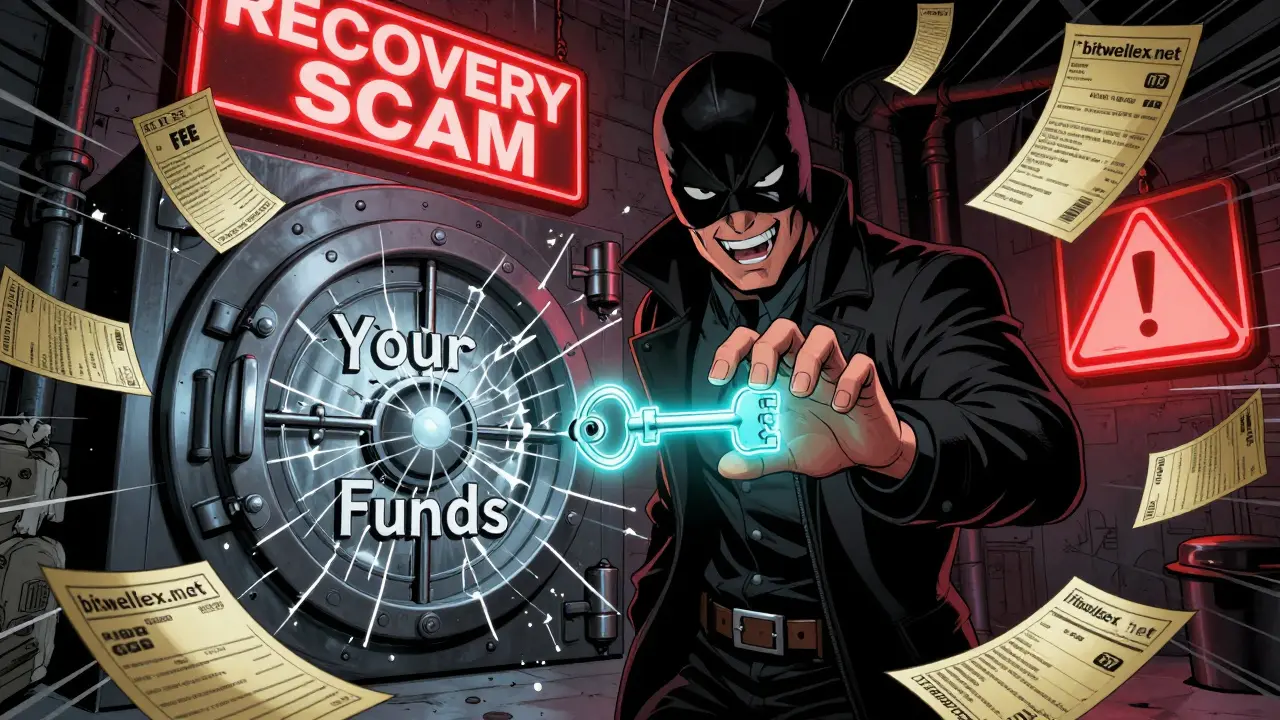
Users also complained about customer support. One Myfxbook reviewer said responses came "minutes after each question" - which sounds like a joke until you realize they meant it took minutes to get a reply from a bot, not a human. Another user said the site "crashed months ago," and only a mirror site, bitwellex.net, was still up. That site? Cryptolegal UK lists it as a "recovery scam" - a fake portal designed to trick former users into paying more money to "get their funds back."
Why BitWell failed - and why it had to
The crypto exchange market grew to $12.4 billion in 2024. By 2025, 87% of major exchanges had some form of regulatory license. BitWell didn’t. It operated in a gray zone that worked until regulators started cracking down. In June 2024, FATF specifically warned about Seychelles-based exchanges. By March 2025, Traders Union blacklisted BitWell. By April, Cryptowisser marked it as dead.
Its business model relied on attracting traders with low fees, then holding their funds indefinitely. Without compliance, it couldn’t partner with banks, payment processors, or institutional investors. Without trust, it couldn’t survive. And when users started demanding withdrawals, the system collapsed.
What to do if you used BitWell
If you still have funds on BitWell or bitwellex.net - stop. Don’t pay any "recovery fees." Don’t download any "account unlock tools." Don’t reply to emails promising to restore your balance. These are all scams targeting people who already lost money.
There is no official recovery process. No government agency is helping. No legal action is underway. The platform is gone. Your best move is to document everything: screenshots of your account, transaction IDs, emails from support, and any messages about fees. Report it to your local financial authority. File a complaint with Traders Union or Cryptolegal UK. It won’t get your money back - but it might help prevent others from falling for the same trap.
Where to trade instead - safe, regulated alternatives
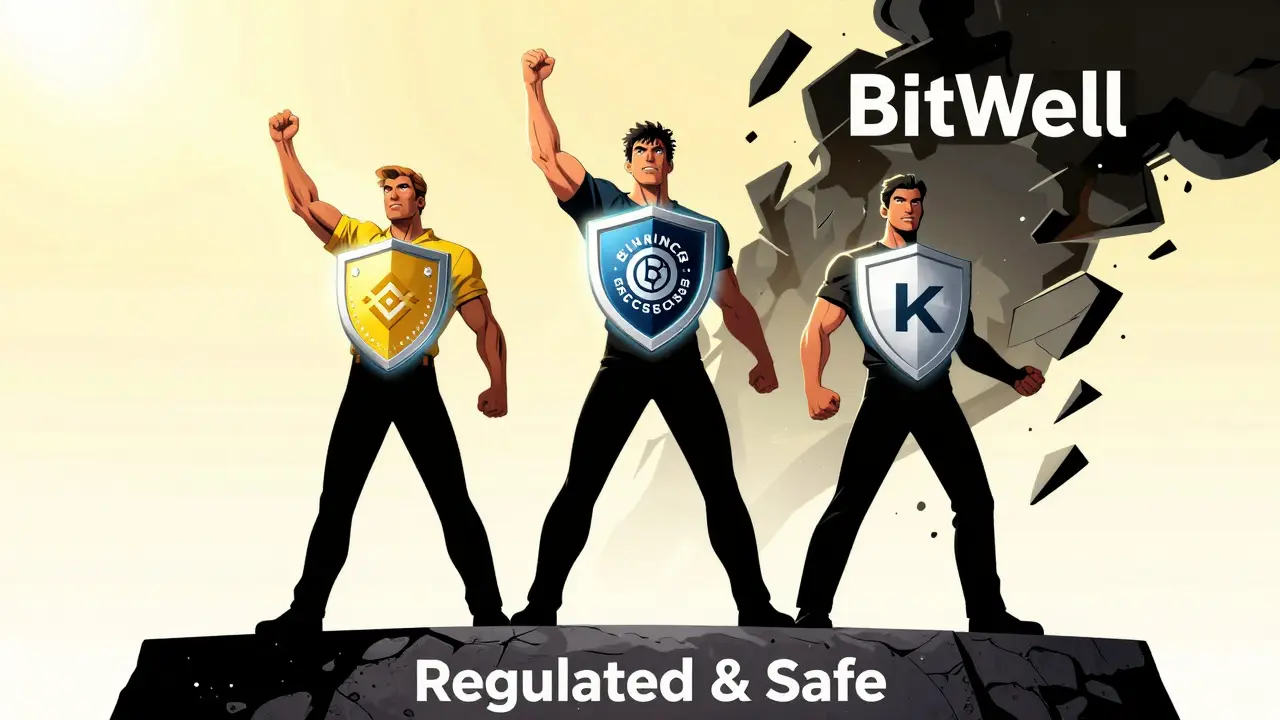
There are dozens of reliable exchanges that actually work. If you’re looking for low fees and strong security, consider:
- Binance - largest global volume, licensed in multiple jurisdictions, offers spot and derivatives trading
- Coinbase - U.S.-based, NYSE-listed, fully regulated, great for beginners
- Kraken - strong security, transparent fees, regulated in the U.S. and EU
- Bybit - focused on derivatives, high liquidity, licensed in Dubai
All of these platforms publish their company details, regulatory licenses, withdrawal fees, and legal terms. They’ve been audited. They’ve been tested. And they’ve been around long enough to survive market crashes.
How to spot a crypto exchange scam before you deposit
Before you sign up for any exchange, ask these five questions:
- Is the company registered with a known financial authority (like the SEC, FCA, or ASIC)?
- Can you find the company’s legal address, registration number, and management team?
- Are withdrawal fees clearly listed - not hidden in fine print?
- Does the website have a working, verifiable SSL certificate and a professional domain (not a weird .net or .xyz)?
- Are there real, recent reviews from multiple independent sources - not just testimonials on the site itself?
If even one answer is "no," walk away. No low fee, no "DeFi option," no ex-Morgan Stanley team is worth losing your crypto.
Final warning: Don’t chase ghosts
BitWell is gone. The website doesn’t work. The team is gone. The funds are gone. The only thing left are scammers pretending to help you recover what you lost. Don’t fall for it. Don’t send more money. Don’t believe promises. This isn’t a technical problem - it’s a criminal one.
If you want to trade crypto, choose a platform that’s open, regulated, and accountable. Not one that hides behind a fake name and a Seychelles mailbox. Your money deserves better than that.


Man, I lost $8k to BitWell back in 2023. Thought I was smart chasing those 0.08% fees. Turned out the only thing low was their ethics. Now I just stick to Coinbase and sleep at night. No more gambling with my crypto.
LOL the "DeFi option" was just a PowerPoint slide with a fancy label. 😂 I saw their "whitepaper" - it was a Google Doc titled "Crypto_2021_ideas_v3_final_FINAL.docx". No audits. No code. Just vibes and a Seychelles PO box.
I used to work in fintech compliance. If a company doesn’t list its legal entity, registration number, or CEO - it’s not a startup. It’s a shell waiting to evaporate. BitWell wasn’t broken. It was designed to fail. And it did.
It’s not just BitWell. It’s the entire myth of the "self-made crypto genius" - the guy with the Rolex and the "ex-Morgan Stanley" LinkedIn badge who vanished after a $50M pump. We keep falling for it because we want to believe the system can be hacked. But the system isn’t broken - it’s just not for you. The real asset isn’t Bitcoin. It’s regulatory clarity. And that’s not for sale on a .net domain.
i lost my btc too. no words. just sad.
You guys are being too soft. This isn't a "scam" - it's a war. These guys are running state-sponsored operations out of offshore zones. They’re not just stealing money. They’re dismantling trust in crypto itself. And we’re just sitting here posting Reddit rants. Wake up.
People who lost money to BitWell are just lazy investors who didn’t "do their own research." If you didn’t check the domain registration or read the TOS, you deserve to lose. This isn’t a tragedy - it’s a lesson in personal responsibility.
Actually, you don’t need to be a genius to spot this. Look at the domain: bitwell.com vs bitwellex.net. One’s legit, one’s a phishing mirror. One has SSL, one doesn’t. One lists a CEO, one doesn’t. The red flags weren’t hidden - they were flashing neon. People just ignored them because they wanted to believe. It’s not ignorance. It’s willful blindness.
I’ve spent the last year helping people recover from exchange scams. Not by chasing fake recovery portals, but by documenting everything - timestamps, screenshots, transaction hashes. It’s not about getting money back. It’s about building a public record. When regulators finally act, they need evidence. Your silence helps the scammers. Your documentation helps the next person. Don’t give up. Just change your strategy.
In accordance with the principles of fiduciary responsibility and due diligence, it is imperative that all participants in the digital asset ecosystem prioritize regulatory compliance, institutional-grade security protocols, and verifiable legal entity disclosure prior to the deployment of capital. The collapse of BitWell is not an anomaly - it is an inevitable consequence of systemic negligence. We must institutionalize education, not just speculation.
India has better exchanges now. No more foreign scams. We got CoinSwitch, ZebPay. Safe. Local. Legal. 💪