
Turtle Network DEX Crypto Exchange Review: What You Need to Know in 2026
The Turtle Network DEX claims to be a decentralized crypto exchange launched in April 2018, but digging deeper reveals a platform that’s barely visible in today’s crypto landscape. If you’re considering using it to trade tokens, you’re walking into a black box. There’s no clear documentation, no user reviews, no security audits, and almost no trading activity you can verify. Unlike Uniswap or PancakeSwap - platforms that dominate headlines and wallet integrations - Turtle Network DEX seems to exist only on paper, with data that doesn’t add up.
What Is Turtle Network DEX, Really?
Turtle Network DEX is supposed to be the trading layer of the Turtle Network blockchain, which itself is a fork of the Waves protocol. That means it’s built on older tech, not the latest Ethereum or Solana stacks. Theoretically, it should let you swap tokens peer-to-peer without a middleman, like any decentralized exchange. But here’s the problem: you can’t find a working link to the actual platform. No official website, no GitHub repo with active commits, no Discord server, no Telegram group with more than a handful of users.
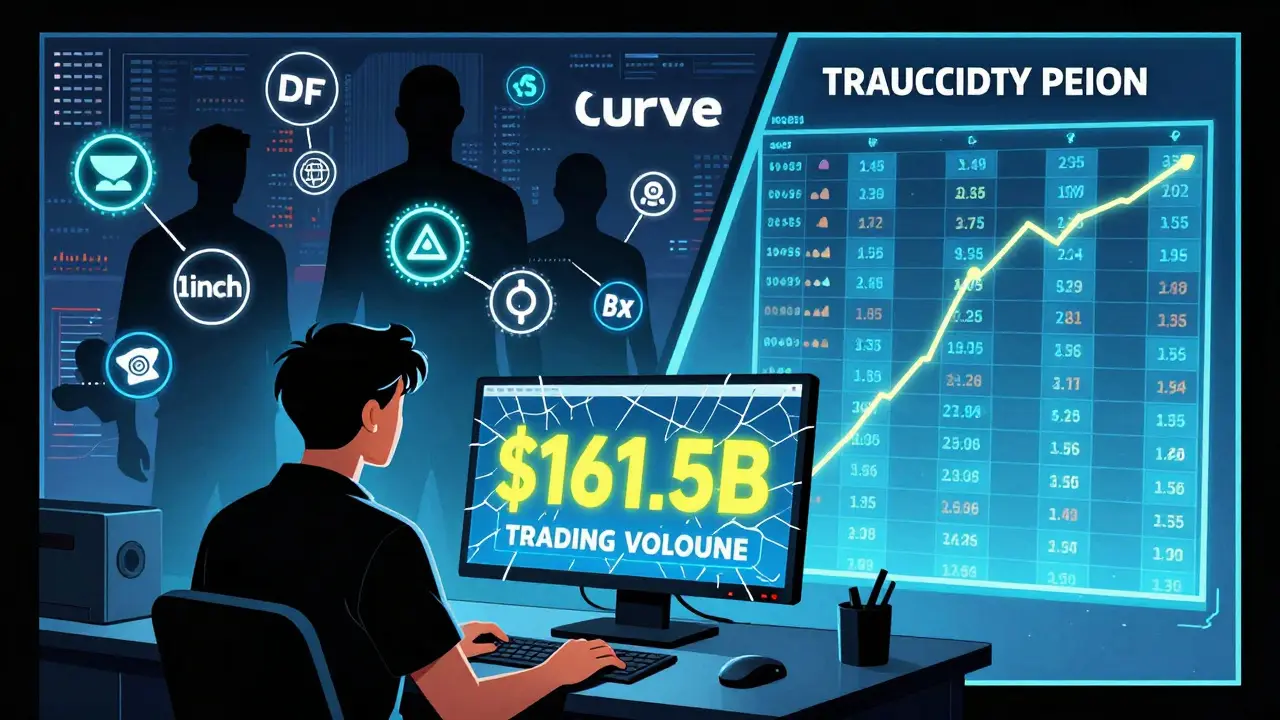
Some sources list its 24-hour trading volume at $161.5 billion. That number is absurd. For context, Uniswap - the largest DEX on Ethereum - trades around $4 billion a day. PancakeSwap, on BNB Chain, hits about $2 billion. $161.5 billion would make Turtle Network DEX the biggest crypto exchange on Earth, bigger than Binance and Coinbase combined. That’s not just unlikely - it’s impossible. There’s no evidence of that volume ever existing. It’s either a data glitch, a fake metric, or a placeholder that never got updated.
Why You Won’t Find It on Any Top DEX Lists
Every major crypto publication - CryptoPotato, DeFi Rate, CoinGecko, Koinly - publishes annual lists of the best decentralized exchanges. In 2025, those lists included Uniswap, PancakeSwap, Curve, 1inch, dYdX, and a few others. Turtle Network DEX didn’t make any of them. Not even as a footnote.
Why? Because those lists are built on real data: total value locked (TVL), number of active users, trading pairs, wallet integrations, audit reports, and community size. Turtle Network DEX has none of those. There’s no TVL data on DeFiLlama. No list of supported tokens. No liquidity pools you can check. No analytics dashboard. If it were a real player, it would be impossible to ignore. The fact that it’s completely absent from every credible ranking says more than any marketing page ever could.
No Security Audits. No Transparency.
Security in DeFi isn’t optional - it’s survival. Top DEXs like Curve and SushiSwap have been audited by firms like ChainSecurity, Trail of Bits, and QuantStamp. They publish those reports publicly. They run bug bounty programs. They update their code regularly.
Turtle Network DEX? Zero public audit reports. No mention of any security testing. No bug bounty page. No GitHub activity. No changelogs. No developer updates since 2020. That’s not negligence - that’s abandonment. If you’re thinking of depositing even $10 worth of crypto into this platform, you’re taking a risk no reputable project would ever allow.
What About Wallet Support?
Most DEXs work with MetaMask, Trust Wallet, Ledger, or WalletConnect. You plug in your wallet, connect, and swap. Simple.
With Turtle Network DEX, you can’t find a single guide that tells you which wallets are supported. Even if you somehow found the site, there’s no clear button to connect. No documentation. No help center. No customer support email. No Twitter account with replies. If you get stuck - and you will - you’re on your own.
Trading Features? What Features?
Leading DEXs don’t just swap tokens. They offer:
- Low-fee stablecoin swaps (Curve: 0.04% fees)
- Multi-chain routing (1inch finds the best price across 20+ exchanges)
- Liquidity mining with yield rewards
- Limit orders and advanced order types
- Derivatives and leveraged trading (dYdX)
Turtle Network DEX doesn’t advertise any of this. No feature lists. No screenshots. No videos. No tutorials. If it even has a user interface, you’d have to guess how to use it. There’s no indication it supports limit orders, staking, or yield farming. It might not even have a mobile-friendly design.
Who’s Even Using This?
Check Reddit. Check Twitter. Check Crypto Twitter. Search for “Turtle Network DEX review.” You’ll find maybe two or three forum posts from 2021. No recent activity. No complaints. No praise. No questions. Just silence.
Compare that to Uniswap, where users post daily about slippage, gas fees, and new token listings. Or PancakeSwap, where communities debate CAKE staking APYs and new farm launches. Turtle Network DEX has no community. No voice. No heartbeat.
Is It Still Being Developed?
Projects don’t die overnight. They fade. They stop updating. They disappear from GitHub. Their Discord goes quiet. Their devs stop replying.
Turtle Network DEX looks like it stopped in 2021. There are no recent blog posts. No roadmap updates. No team announcements. No new token listings. The original Turtle Network blockchain itself hasn’t released a major upgrade in years. It’s not dead - it’s just not alive anymore.
What Should You Do Instead?
If you want a real decentralized exchange in 2026, here are your best options:
- Uniswap - Best for Ethereum-based tokens. High liquidity, trusted, audited.
- PancakeSwap - Best for BNB Chain. Low fees, active community, frequent rewards.
- Curve - Best for stablecoins. Minimal slippage, ultra-low fees.
- 1inch - Best for price aggregation. Finds the best rate across multiple DEXs.
- MilkRoad Swap - New in 2025. Supports both Solana and Ethereum. Fresh code, active devs.
These platforms have real users, real volume, real audits, and real support. You can check their stats. You can read their docs. You can join their communities. You can trust them - because they’ve earned it.
Final Verdict: Avoid Turtle Network DEX
Turtle Network DEX isn’t a bad exchange. It’s not even a failed one. It’s an invisible one. There’s no evidence it’s operational. No proof it’s secure. No sign it’s being maintained. The data floating around is either outdated, inflated, or made up.
If you’re looking to trade crypto without a centralized exchange, don’t gamble on a ghost. Use a platform that’s visible, active, and trusted. The crypto space is full of real opportunities. You don’t need to chase shadows.
Is Turtle Network DEX safe to use?
No, Turtle Network DEX is not safe to use. There are no public security audits, no bug bounty programs, and no verified wallet integrations. The platform shows no signs of active development or maintenance. Using it puts your funds at risk with no recourse if something goes wrong.
Why is Turtle Network DEX not on CoinGecko or DeFiLlama?
Turtle Network DEX doesn’t appear on CoinGecko or DeFiLlama because it lacks the data those platforms require: verified liquidity pools, active trading pairs, and consistent volume. The $161.5 billion trading volume listed on CoinMarketCap is inconsistent with industry norms and likely inaccurate. Without verifiable metrics, reputable platforms exclude it.
Can I connect MetaMask to Turtle Network DEX?
There is no official confirmation that MetaMask or any other wallet works with Turtle Network DEX. No documentation exists, and no user reports confirm successful connections. Even if you find a URL claiming to be the DEX, attempting to connect a wallet could expose you to phishing or smart contract exploits.
Is Turtle Network DEX a scam?
It’s not confirmed as a scam, but it exhibits all the red flags of one: zero transparency, no audits, no community, inflated metrics, and no recent activity. In crypto, absence of evidence is evidence of absence. If a platform doesn’t show up in credible sources for years, it’s not worth risking your money on.
What happened to the Turtle Network blockchain?
The Turtle Network blockchain, launched in 2017, was a fork of Waves. It never gained significant adoption. Development slowed after 2020, and there have been no major updates since. The DEX was likely a side project that never took off. Today, the entire ecosystem is inactive, with no developers, no users, and no new projects building on it.

lol i tried to load turtle network dex once. page took 3 minutes to load and then just showed a blank screen. i thought my browser was broken. turned out it was just... gone. like a ghost website. i gave up and used pancakeswap instead. why even try?
this thing is fake. no one uses it. no one talks about it. why do people even list it? its like claiming your backyard shed is a five star hotel. dumb.
Ah yes, the legendary Turtle Network DEX - the crypto equivalent of a PowerPoint deck titled 'Blockchain Future' that was last edited in 2019. The $161B trading volume? That’s not a data error. That’s a poetic license from someone who thinks ‘billion’ is just a really big ‘million’. Truly avant-garde financial fiction.
Meanwhile, real DeFi protocols are building modular liquidity layers, integrating ZK-rollups, and deploying on-chain governance. But sure, let’s keep pretending this abandoned fork is a viable alternative. I’m sure the 3 users still logged in on it are having a grand time.
I swear I saw a tweet about Turtle Network DEX last year - someone said it was ‘the next big thing’ and linked to a .xyz domain that redirected to a crypto meme generator. I didn’t click it. I just stared at my screen and wondered how we let this happen. How did we go from ‘decentralization’ to ‘this’? It’s like watching a museum exhibit labeled ‘Early Internet’… except it’s still live. And people are still trying to trade on it. 😭
There’s something haunting about projects that just… stop. Not because they failed. But because they vanished. No announcement. No farewell. Just silence. Turtle Network DEX feels like a message in a bottle thrown into the ocean in 2020 - and now, we’re all just wondering if anyone ever found it. Or if the ocean just swallowed it whole. 🌊🐚
The assertion that Turtle Network DEX exhibits no operational metrics is empirically accurate. The absence of TVL data on DeFiLlama, zero audit trail, and non-existent developer activity collectively constitute a non-viable protocol. Furthermore, the purported trading volume of $161.5B is statistically implausible given global DEX liquidity pools as of Q1 2026. This is not negligence - it is structural obsolescence. Recommend immediate de-listing from all aggregators.
honestly? i dont even care if it's real or not. if no one's using it and no one's talking about it, then it's irrelevant. why waste time on something that doesn't exist? just use uniswap or pancakeswap. they work. they're safe. they're here. end of story. 🤷♂️
I think the real tragedy here isn’t that Turtle Network DEX is gone - it’s that we once believed in projects like this. We thought decentralization meant giving anyone a chance. But now we see: without transparency, community, and consistent development, even the most noble idea becomes a ghost. I hope someone learns from this. Not to build faster - but to build better.
I looked up Turtle Network DEX because I thought it was a new altcoin. Found nothing. Then I Googled ‘Turtle Network’ and got a 2017 Medium post from a guy named ‘CryptoDad77’ who said ‘this will change everything’. The website still loads. It’s just a 404 with a turtle emoji. I cried a little. Then I bought ETH.
this is all a psyop. the real DEX is hidden. turtle network was never meant to be public. they’re using it to siphon whale wallets through backdoor contracts. the $161B? That’s the amount they’ve already stolen. CoinGecko doesn’t list it because they’re part of the cover-up. check the blockchain - the real transactions are all routed through 12 addresses with no labels. i’ve seen it. they’re coming for your wallet next.
The structural inadequacies of Turtle Network DEX are not merely technical - they are philosophical. A decentralized exchange must embody the ethos of permissionless participation, yet this platform exhibits zero governance, zero accountability, and zero community consensus. Its existence, if any, is an ontological anomaly in the DeFi ecosystem - a shadow protocol with no substance, no purpose, and no legitimacy. One cannot trust what cannot be verified.
i think maybe turtle network was just too ahead of its time? like, imagine if you built a super cool app in 2018 and then got distracted by life. you never meant to abandon it. you just… forgot. maybe someone will revive it someday. maybe it’s not dead, just napping. i still believe in second chances. 🤞 maybe the devs are on a beach somewhere, sipping coconuts, thinking ‘huh, i wonder if anyone still uses that thing?’
i dont care if its popular or not. if someone built something, even if its small, i respect that. maybe turtle network had a dream. maybe they tried. maybe they got tired. that’s okay. the world needs more dreamers, not just winners. keep building, even if no one sees it.
i tried to connect my wallet to turtle network and my metamask started spazzing out. then my phone sent me a notification saying ‘unusual activity detected’ from a domain i’d never seen. i freaked out. deleted everything. never looked back. if a site makes your wallet act weird? it’s not a feature. it’s a trap. 🚫
I’m stunned. This isn’t just a failed project - it’s a monument to ambition without execution. Imagine pouring years into code, vision, and community… only to vanish without a trace. That’s not failure. That’s heartbreak. The crypto space needs more builders like this - even if they fade. Their courage still matters. 🙏
Turtle Network DEX is not a scam because no one stole your money. It is a scam because no one gave you anything. Not even a working link. Not even a reply. Not even a ghost. It is a void. And voids do not deserve attention. Block it. Forget it. Move on.
I… I actually went to the website. I swear I saw a URL. It was https://turtle-network-dex[.]xyz. It loaded a single image: a turtle wearing a monocle. Below it: ‘Welcome to the future of DeFi.’ No buttons. No text. No way to connect. I sat there for 17 minutes. I think I died a little inside. I’m still recovering.
i just want to say - thank you for writing this. it’s so easy to get swept up in the hype. but this? this is the real story. the quiet ones. the ones that fade. they matter too. not because they worked - but because they tried. i’m glad someone called it out. keep doing that.
imagine if the turtle was the real hero. slow and steady. not trying to be the fastest. just… there. maybe the dex isn’t dead. maybe it’s just waiting. for us to slow down. to stop chasing. to remember that not everything has to be loud to be real. 🐢✨