
Sidechains vs Layer 2: Technical Comparison for 2026
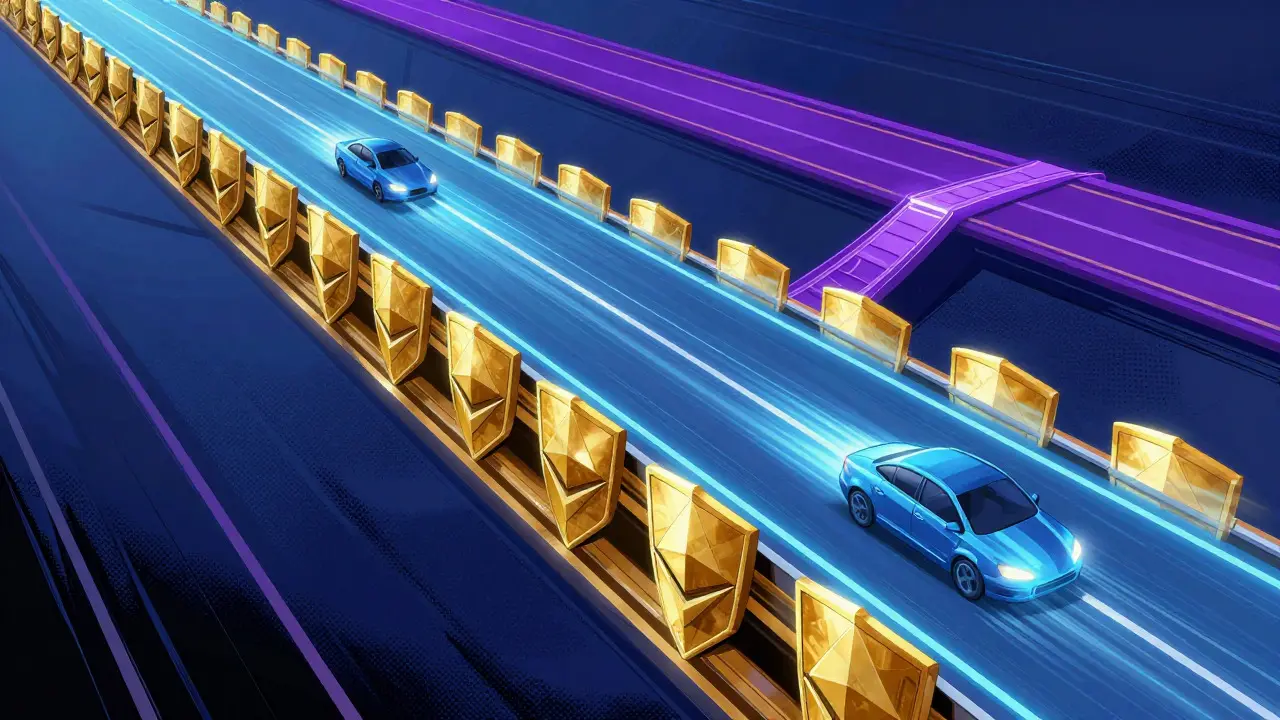
Choosing between sidechains and Layer 2 solutions often feels like picking a car based on whether you want speed or safety. Both aim to fix the same problem: Ethereum's mainnet is too slow and expensive for daily use. But they solve it in fundamentally different ways. One builds a secure highway directly on top of the main road; the other builds a separate, faster road that connects back via ramps.
If you are a developer deciding where to deploy your next dApp, or an investor trying to understand which ecosystem has more staying power, this distinction matters. The choice affects security, cost, user experience, and even regulatory risk. Let’s break down exactly how these two technologies differ under the hood, using real data from the current market landscape.
The Core Architectural Difference
At its heart, a Layer 2 solution is a protocol built directly on top of the Ethereum mainnet. It inherits the security of the base layer while processing transactions off-chain to reduce load. Think of it as adding extra checkout lanes at a supermarket during rush hour. You still use the same store (Ethereum), but you get through faster. Major examples include Optimism, Arbitrum, and Base. These networks publish their transaction data back to Ethereum, meaning if someone tries to cheat, the mainnet can verify and correct it.
A sidechain, on the other hand, is a completely separate blockchain running parallel to Ethereum. It has its own consensus mechanism, its own validators, and its own rules. Polygon PoS and Gnosis Chain are prime examples. They connect to Ethereum via two-way pegs, allowing assets to move between the chains, but they don’t rely on Ethereum’s security model for their day-to-day operations. This independence gives them flexibility but also introduces new trust assumptions. You have to trust the sidechain’s validators, not just Ethereum’s stakers.
| Feature | Layer 2 Solutions | Sidechains |
|---|---|---|
| Security Source | Ethereum Mainnet | Own Validators/Consensus |
| Transaction Cost | $0.05 - $0.50 | $0.005 - $0.02 |
| Finality Time | 10 mins to 7 days | 2-3 seconds |
| Flexibility | Lower (bound by L1 rules) | Higher (customizable rules) |
| Bridge Risk | Lower (data posted to L1) | Higher (trust-based bridges) |
Security: The Critical Trade-off
Security is the biggest point of contention. Layer 2 solutions benefit from the robustness of the Ethereum mainnet. As of late 2024, roughly $40 billion in value was secured across major Layer 2 networks. Because transaction data is posted to Ethereum, any fraud attempt can be challenged and reversed. This provides a high level of confidence for users holding significant assets.
Sidechains, however, depend entirely on their own validator sets. Polygon PoS, for instance, uses around 100 validators. While efficient, this is far fewer than Ethereum’s 800,000+ stakers. Fewer validators mean higher centralization risks. If a majority of sidechain validators collude or fail, the chain could be compromised without Ethereum stepping in to save it. This isn't theoretical. The $600 million Harmony bridge hack in 2022 targeted a sidechain infrastructure, highlighting how vulnerable independent chains can be when their bridges are weak. In contrast, no major Ethereum Layer 2 suffered a comparable total loss during that period because their security anchor remained intact.

Performance and User Experience
Where sidechains shine is speed and cost. They typically achieve 5,000 to 10,000 transactions per second (TPS) with finality in just 2 to 3 seconds. For gaming applications or high-frequency trading, this snappiness is crucial. Users report negligible fees, often under a cent per transaction. This makes micro-transactions viable, something still difficult on most Layer 2s despite their improvements.
Layer 2 solutions are fast compared to Ethereum mainnet, but slower than sidechains. Optimistic Rollups like Optimism and Arbitrum assume transactions are valid until proven otherwise, creating a challenge period. On Optimism, withdrawing funds back to Ethereum can take up to 7 days. ZK-Rollups like zkSync offer faster finality, sometimes near-instant, but historically had higher computational overhead. Transaction costs on Layer 2s generally range from $0.05 to $0.50, a massive reduction from mainnet peaks of $50-$70, but still higher than sidechain rates.
Developer Implementation Challenges
For developers, the choice impacts your workflow significantly. Deploying to a Layer 2 solution usually requires minimal code changes. Most Ethereum smart contracts work out of the box on Arbitrum or Optimism, with less than 5% modification needed. Documentation for major Layer 2 projects is extensive, with completeness scores often exceeding 95%. The learning curve focuses on understanding specific bridge mechanisms and finality windows, taking most developers 2-3 weeks to master.
Sidechains present greater complexity. Because they operate independently, you might need to adapt to modified EVMs or different gas calculation models. Implementing on Polygon PoS can take 4-6 weeks due to validator set management and unique architectural quirks. Documentation quality varies more widely, averaging around 82% completeness. However, if your project requires custom consensus logic or specific performance tuning that Layer 2s restrict, sidechains offer the freedom to experiment. Just be prepared for a steeper integration hill.

Market Adoption and Future Outlook
The market currently favors Layer 2 solutions for institutional and DeFi use cases. With $42.7 billion in Total Value Locked (TVL) across the ecosystem, Layer 2s dominate decentralized finance. Enterprise adoption is strong, with 78% of Fortune 500 blockchain pilots choosing Layer 2 architectures for their security guarantees. Regulatory clarity also leans toward Layer 2s, as they are viewed as extensions of Ethereum rather than separate securities offerings.
Sidechains maintain a strong foothold in gaming and consumer apps, where low latency is non-negotiable. They hold about $7.2 billion in TVL, dominated by Polygon PoS. Looking ahead, Ethereum’s roadmap includes updates like Proto-Danksharding, which will further reduce Layer 2 costs by 80-90%. Meanwhile, sidechains are evolving toward interoperability hubs like Polygon’s AggLayer. The future likely involves a hybrid approach: Layer 2s for security-critical financial applications, and sidechains for specialized, high-throughput use cases where absolute decentralization is less critical than speed.
Frequently Asked Questions
Are sidechains safer than Layer 2 solutions?
Generally, no. Layer 2 solutions inherit security from the Ethereum mainnet, making them more resistant to attacks. Sidechains rely on their own validator sets, which are smaller and more centralized, increasing the risk of collusion or failure. However, sidechains can be designed with very strong security measures, so it depends on the specific implementation.
Which is cheaper for everyday transactions?
Sidechains are typically cheaper, with fees ranging from $0.005 to $0.02 per transaction. Layer 2 solutions are more expensive, usually between $0.05 and $0.50. If you are making frequent small payments, sidechains offer better economics. For larger transfers where security is paramount, the slightly higher Layer 2 fee may be worth the peace of mind.
Can I use both sidechains and Layer 2 solutions together?
Yes, many users and projects utilize both. A common strategy is to keep large reserves on a secure Layer 2 like Arbitrum and move funds to a fast sidechain like Polygon for active trading or gaming. Bridges exist to facilitate these transfers, though you should always account for bridge fees and potential delays when moving assets between these environments.
What is the main disadvantage of Layer 2 solutions?
The primary disadvantage is the withdrawal delay. Optimistic Rollups require a challenge period, often 7 days, before funds can be safely withdrawn to the Ethereum mainnet. This can be inconvenient for users who need quick liquidity. Additionally, while cheaper than mainnet, Layer 2 fees are still higher than those on optimized sidechains.
Will sidechains become obsolete?
Unlikely. While Layer 2s dominate the narrative, sidechains serve specific niches requiring extreme customization or throughput that Layer 2s cannot yet match efficiently. Industries like gaming, IoT, and enterprise internal ledgers often prefer sidechains for their flexibility. They will likely coexist with Layer 2s, each serving different parts of the blockchain ecosystem.



Oh, you think this is just about tech? 🤡 It’s all a setup. The Layer 2s are the new centralization in disguise. You trust Ethereum, but really you’re trusting the sequencers who are basically private banks with better PR. 📉
Omg, Dave, you’re always so dramatic! I actually love how they break down the security trade-offs because it makes me feel like I’m finally getting it, and honestly, if we can get gaming on these faster chains without losing our funds to some shady bridge hack, that would be amazing for everyone involved!! 🚀✨
Let’s not pretend the 'security' of L2s is ironclad when one bad sequencer or a buggy upgrade can freeze your funds for weeks. I’ve seen devs lose their minds over a simple withdrawal delay on Optimism; it’s like being locked in a safe that only opens on a whim. The sidechain crowd gets roasted for 'trust,' but at least they don’t have a 7-day hostage situation for your own money. It’s a messy, chaotic landscape where the loudest voice wins, not the safest code. And don’t get me started on the gas wars-fees spike whenever a whale sneezes, making the whole 'cheap transaction' narrative a fleeting mirage. We’re dancing on a knife edge here, folks. 🎭
How quaint. Still arguing about 'trust' as if it’s a moral failing rather than an economic necessity. The market has already spoken: TVL doesn’t lie. 📈
One must observe that the distinction between 'Layer 2' and 'Sidechain' is becoming increasingly academic as the boundaries blur. 🧐 The so-called 'AggLayer' initiatives suggest a convergence where the security model of one feeds into the other, rendering the traditional dichotomy obsolete. To cling to the old definitions is to ignore the evolutionary trajectory of decentralized infrastructure. The data points to a hybrid future, not a binary choice. 📊
OMG this post is SO helpful i was totally confused before reading it!! thank you for explaining the bridge risk part bc that scared me the most when i tried moving my tokens last month 😩🙏
It is important to remember that efficiency should not come at the cost of transparency. If we prioritize speed over auditability, we risk creating black boxes where errors go unnoticed until it is too late. A balanced approach is necessary.
Ah yes, the eternal debate. Let’s hope the next generation of devs figures out how to make ZK-rollups cheap enough to matter, otherwise we’re just swapping one headache for another. 🙄
I find myself watching from the sidelines, sipping tea, while you all argue. 🍵 The truth is, most users don't care about the architecture; they just want their coffee to be bought without paying $5 in fees. Whether it's a sidechain or an L2 is irrelevant to them. They just want it to work. The complexity is for us, the builders. The simplicity is for them, the users. 🌿
This is such a nuanced topic and I appreciate how the article laid out the developer experience differences. It’s easy to forget that for a small team, the 4-6 week integration time on a sidechain could literally kill a project before launch. The 'flexibility' mentioned is a double-edged sword; it offers freedom but demands a level of expertise that many startups simply don't have. We need more tools that abstract away this complexity so that innovation isn't gated by technical debt. It’s about empowering creators, not just optimizing blockchains. 💡🛠️
(•_•) > ⌐■_■
you guys are missing the point entirely its about control right? the big players want to keep the power close to their chest and call it 'security' while the rest of us are stuck dealing with the scraps of their centralized systems. its always been this way and it never changes. people just get tired of fighting the system so they give up and accept whatever they're handed. 🙃
Concise summary: L2s for DeFi, Sidechains for Gaming. Done.
The illusion of choice. Pick your poison. Both are flawed. Both are expensive. Both are broken. Wake up. ☕