

Upbit Crypto Exchange Review 2025: Is It Right for You?
Upbit Trading Fee Calculator
Fee Calculator
Calculate your trading fees on Upbit based on your trade amount and currency pair. Note: Upbit charges 0.25% for KRW/SGD pairs and 0.2% for USDT/BTC pairs. Minimum trade size is 0.0001 BTC.
- English support is email-only
- Verification takes 24-72 hours
- Only KRW and SGD are supported as fiat currencies
- Spot trading only (no leverage or futures)
Upbit Crypto Exchange Review 2025: Is It Right for You?
If you’re looking for a crypto exchange that’s rock-solid on security and deeply tied to the Korean market, Upbit is one of the few platforms that actually delivers. But if you’re outside South Korea and want to trade Bitcoin with USD, or use leverage, or get fast customer support in English-you’ll hit walls fast. Upbit isn’t trying to be Binance. It’s built for one thing: serving Korean investors under strict government rules. And for that, it does an excellent job.
Launched in October 2017 by Dunamu & Company (a Kakao subsidiary), Upbit quickly became South Korea’s biggest crypto exchange. By 2025, it still controls about 85% of the local market. That’s not luck. It’s regulation, liquidity, and security working together. But global users? They’re an afterthought.
Security: Built Like a Vault
Upbit doesn’t just talk about security-it lives it. Over 98% of user funds are stored in cold wallets, offline and physically isolated from the internet. That’s higher than most exchanges, including some big names. Every withdrawal requires two-factor authentication (2FA), and the system uses AI to flag unusual behavior in real time. No guesswork. No delays. Just automated alerts.
The platform holds ISO 27001, ISO 27017, and ISO 27018 certifications-standards most banks wouldn’t dare skip. Third-party audits by Kudelski Security happen every quarter, and Upbit publishes the results. In 2024, they even passed a proof-of-reserves audit, proving they hold enough crypto to cover all user balances. That’s rare. Most exchanges don’t do this.
CertiK gave Upbit an A-grade security score of 83.52, one of the highest in the industry. But not all tools agree. CER.live rated them lower, citing weaker user security practices and no public penetration testing. Still, for a regulated exchange in a country that cracked down hard on crypto fraud, Upbit’s security is among the best you’ll find.
Trading: Spot Only, No Leverage, No Futures
Here’s where Upbit falls short for most international traders: it doesn’t offer margin trading, futures, or leverage. Not even 2x. If you’re used to Binance or Bybit, this will feel like using a flip phone in 2025.
Upbit supports spot trading only. That means you buy and sell crypto directly-no borrowing, no shorting, no complex options. It’s simple, safe, and boring. For Korean retail investors who just want to buy Bitcoin or Ethereum without risking their life savings, that’s perfect. For anyone else? It’s a dealbreaker.
They list over 180 cryptocurrencies, including major coins like Bitcoin, Ethereum, Solana, and Cardano. But here’s the catch: popular memecoins like Dogecoin, Shiba Inu, and Pepe are missing. So are newer Layer 1s like Avalanche and Polygon. That’s not an oversight-it’s intentional. Upbit’s listing process is strict. They avoid anything they deem too speculative. That’s why their token list feels smaller than competitors, even if the number sounds high.
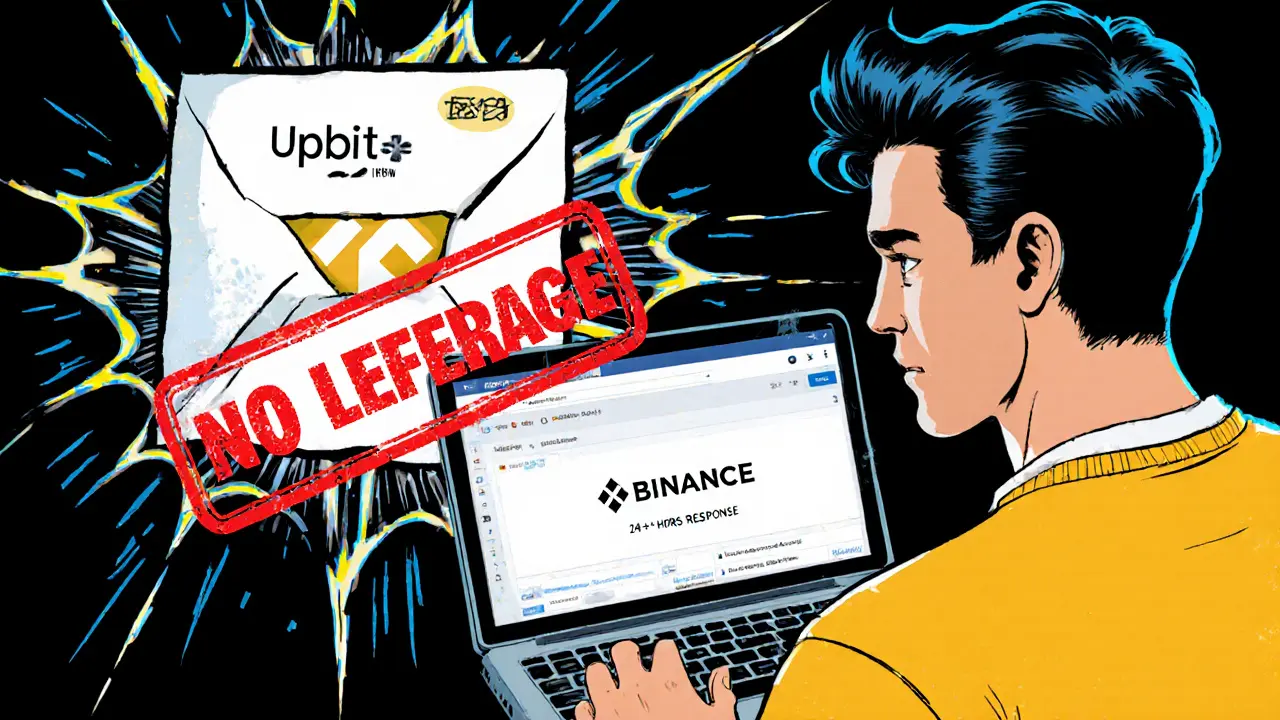
Fees: High for International Users
Trading fees vary depending on the market:
- 0.25% for KRW and SGD pairs
- 0.2% for USDT and BTC pairs
That’s higher than Bybit (0.1%) and way above Binance’s 0.1% for spot trades. If you’re trading small amounts, those percentages add up fast. There’s no tiered fee structure based on volume, no VIP discounts, and no fee discounts for holding their native token-because they don’t have one.
Minimum trade sizes are also strict: you need at least 0.0001 BTC to trade Bitcoin. That’s about $6-$7 at current prices. Not a huge barrier, but it’s still higher than some exchanges that let you buy fractions of a cent worth of crypto.
On the plus side, internal transfers between Upbit accounts are free. So if you’re trading with friends or family who also use Upbit, you won’t pay a cent to move funds between wallets.
Support & KYC: Slow, But Transparent
Upbit’s KYC process is a four-tier system. Each level unlocks higher withdrawal limits:
- Level 1: Email only → 500,000 KRW daily limit
- Level 2: ID upload → 5 million KRW
- Level 3: Video call → 50 million KRW
- Level 4: In-person verification → 500 million KRW (about $370,000 USD)
The verification process takes 24 to 72 hours on average. Some users report waiting over a week, especially during market spikes. That’s frustrating, but it’s the price of compliance. South Korea requires strict identity checks, and Upbit follows them to the letter.
Customer support? Don’t expect live chat in English. The platform offers 24/7 Korean-language chat, but English support is email-only. Response times are 18 hours for Korean users, 48+ hours for everyone else. Reddit users complain about this constantly. If you need help at 2 a.m. and your English isn’t perfect, you’re on your own.
Documentation is another issue. The Korean version of Upbit’s help center is detailed and well-rated (4.7/5). The English version? 2.3/5. Many guides are outdated or incomplete. You’ll often find yourself translating Korean pages using Google Translate.
App & Platform: Clean, But Limited
Upbit’s mobile app is polished. Available on iOS and Android, it supports all core trading functions: placing limit and market orders, checking order history, viewing wallet balances, and enabling 2FA. The interface is clean, responsive, and fast-even on older phones.
They also offer API access for developers, which is great if you’re building bots or automated strategies. But again, this is geared toward Korean traders. Most API documentation is in Korean. English guides are sparse.
There’s no web-based trading terminal with advanced charting tools. No TradingView integration. No custom indicators. You get basic candlestick charts and order books. If you’re a technical trader, you’ll miss the depth of platforms like Kraken or Binance.

Who Is Upbit For?
Upbit is not for everyone. It’s not designed to be. It’s built for one group: Korean citizens who want to buy and hold crypto under a trusted, government-approved system.
If you’re in South Korea, Upbit is the easiest, safest, and most liquid option. Deposits in KRW clear in under 3 minutes. Withdrawals are reliable. You know your money is protected by strict laws.
If you’re outside Korea, Upbit only makes sense if:
- You’re a Korean expat living abroad and want to send money back home
- You’re trading USDT-KRW pairs through Upbit Singapore
- You prioritize security over features and don’t mind slow support
For everyone else-especially those who want USD pairs, leverage, fast support, or meme coins-Upbit is a poor fit. You’ll waste time on verification, pay higher fees, and get stuck with outdated documentation.
What’s Changing in 2025?
Upbit isn’t standing still. In January 2025, they launched USDT-KRW trading pairs through Upbit Singapore, targeting Korean expats. In March, they integrated Ripple’s On-Demand Liquidity (ODL) system. This means international KRW withdrawals could drop from 3-5 days to under 2 hours.
They’re also expanding into Indonesia and Thailand with local entities. But don’t expect them to enter the U.S. or Europe. Regulatory hurdles are too high. Their focus remains Asia.
Analysts agree: Upbit will keep its 80-85% share of the Korean market through 2026. But globally, it’s stuck in second-tier status. It won’t overtake Binance or Coinbase. And it doesn’t need to.
Final Verdict
Upbit is the most secure, regulated crypto exchange in Asia. If you’re in South Korea, it’s your best option. Period.
If you’re not in Korea? Only use it if you have a specific reason-like trading KRW or sending money to family there. Otherwise, look elsewhere. The fees are high, the support is slow, and the features are basic. You’re paying for safety, not flexibility.
It’s not the best exchange overall. But for its target audience? It’s unbeatable.
Is Upbit safe to use?
Yes, Upbit is one of the safest crypto exchanges globally. It stores over 98% of user funds in cold storage, requires mandatory two-factor authentication for withdrawals, and undergoes quarterly third-party security audits by firms like Kudelski Security. It holds ISO 27001, ISO 27017, and ISO 27018 certifications and publishes quarterly proof-of-reserves reports-something few exchanges do.
Can I trade USD on Upbit?
No, Upbit does not support direct USD deposits or trading pairs. The only fiat currencies available are Korean won (KRW) and Singapore dollar (SGD). International users can trade USDT-KRW pairs through Upbit Singapore, but you still need to deposit KRW or SGD. There’s no USD wallet or direct USD-to-crypto trading.
Does Upbit have margin or futures trading?
No, Upbit does not offer margin trading, leverage, or futures contracts. It’s a spot-only exchange. This makes it safer for beginners and conservative investors, but a major drawback for active traders who rely on leverage or short-selling strategies. If you need these features, you’ll need to use Binance, Bybit, or Kraken instead.
How long does Upbit verification take?
Verification typically takes 24 to 72 hours. Level 1 (email) is instant. Level 2 (ID upload) takes 1-2 days. Level 3 (video call) and Level 4 (in-person) can take up to 5 days, especially during high-volume periods. Many users report delays during market rallies or holidays in South Korea.
Is Upbit good for beginners?
For Korean beginners, yes. The app is simple, fees are transparent, and the platform is regulated. For non-Korean beginners, no. The lack of USD support, slow English customer service, outdated documentation, and missing features like staking or crypto cards make it unnecessarily difficult. Beginners outside Korea should start with Coinbase or Kraken instead.
What cryptocurrencies does Upbit support?
Upbit supports over 180 cryptocurrencies, including Bitcoin, Ethereum, Solana, Cardano, and Polkadot. However, it excludes many popular memecoins like Dogecoin, Shiba Inu, and Pepe. It also doesn’t list newer Layer 1 chains like Avalanche or Polygon. The selection is conservative, focused on established, high-liquidity assets.
Can I use Upbit in the United States?
No, Upbit does not operate in the United States. It is not licensed to serve U.S. residents, and its website blocks access from U.S. IP addresses. Attempting to use a VPN to access Upbit violates its terms of service and could result in account suspension or fund freezing.
Are there any hidden fees on Upbit?
Upbit doesn’t have hidden fees, but there are costs you might not expect. Deposit fees for KRW are free, but international bank transfers may charge their own fees. Withdrawal fees vary by coin-for example, withdrawing Bitcoin costs 0.0005 BTC. There’s also a 0.1% fee for converting between crypto assets on the platform. Always check the fee schedule before trading.


Upbit is a joke for anyone outside Korea. Why would you pay 0.25% fees and wait 3 days for support when Binance gives you 0.1% and live chat? This isn't security-it's isolation wrapped in a compliance blanket.
I get why Koreans love it. My cousin uses it daily and says it feels safe. But for the rest of us? It's like trying to use a payphone in 2025. Simple doesn't mean better if it's useless to you.
The ontological framing of Upbit as a "regulated vault" reveals a deeper epistemic bias: security as a proxy for legitimacy. In neoliberal crypto ecosystems, compliance becomes performative virtue signaling. The absence of leverage isn't conservatism-it's structural exclusion disguised as protection. We mistake institutional trust for market viability.
Look, I get it. You want to feel safe. But if you're not in Korea, you're just paying extra to be ignored. The app works fine, sure. But when your support ticket sits for 72 hours and the English docs are half-translated garbage? That's not security. That's neglect dressed up as policy.
They removed Dogecoin because it's "too speculative." Funny how the same people who call Bitcoin a bubble are now playing gatekeeper for what counts as "legitimate." This isn't regulation. It's cultural puritanism with a blockchain sticker on it.
i live in india and i tried upbit last year just to see what all the fuss was about. the app is nice but the verif took 6 days and i had to use google translate for half the help pages. my friend in seoul said its easy for him but for us? its like trying to order pizza in a language you dont speak. still, i respect they dont let scam coins in. maybe too strict but better than some exchanges that list anything with a logo
Americans think they deserve everything. Upbit isn't for you. It's for Koreans who live under real financial regulation. You want USD pairs? Go use a US-based exchange that answers to the SEC. Don't cry because a foreign platform doesn't cater to your entitlement.
I appreciate the transparency in their audits and proof-of-reserves. It's rare. And while the lack of leverage is limiting, it also reduces risk for casual users. Maybe the real issue isn't Upbit-it's that we've been trained to expect everything, everywhere, instantly.
Did you know Upbit is owned by Kakao? That's the same company that runs the messaging app Koreans use to plan everything. They're not just an exchange-they're a government-adjacent data hub. Your trading history? Probably linked to your ID, phone, and social credit. You think this is safe? It's surveillance with a crypto coat.
i came here from south africa and i was skeptical but honestly upbit made me feel like my money was actually safe for once. yeah the support is slow but i dont need to talk to someone every day. i just want to buy btc and sleep. if you want drama go to binance
I'm Korean-American and I use Upbit to send money back to my parents. The ODL integration in 2025 changed everything. Used to take 3 days, now it's 90 minutes. That's real innovation. Don't hate the platform because it doesn't serve your needs-it serves mine perfectly.
I'm conflicted. On one hand, the security is insane. On the other, no futures, no USD, no API docs in English. It's like a Ferrari with no steering wheel. Beautiful engineering, useless for the road you're on.
Upbit is just another overhyped korea-only platform pretending to be global. 0.25% fees? No tiered discounts? No native token? No staking? And you call this "best in asia"? Bro. It's a relic with a nice logo.
They're using this to track crypto purchases and feed data to the South Korean government. You think they don't know who's buying what? Every transaction is logged, tagged, and analyzed. This isn't finance-it's behavioral monitoring under the guise of compliance.
The real story here isn't Upbit's features-it's how the global crypto community has become so fragmented. We used to have one market. Now we have silos: Korea has Upbit, US has Coinbase, Europe has Bitstamp, and everyone else is stuck in Binance's shadow. Upbit is just the most extreme example of localization. The future isn't global-it's regional, regulated, and restricted.
i think upbit is good for korea but for others its like trying to use a manual car when everyone else has automatic. the security is nice but the experience is so outdated. still, i like that they dont list every meme coin. keeps things clean
If you're new to crypto and not in Korea, don't start here. Stick with Coinbase or Kraken. Learn the basics first. Upbit is like teaching someone to swim in a locked pool-safe, but not helpful.
I use Upbit Singapore for KRW-USDT trades. The liquidity is insane compared to other regional exchanges. And the fact they added ODL? Big win. Not perfect, but it's the best option for connecting Asia's fiat flows. Respect the focus.