

SEC vs CFTC: Who Really Controls Crypto Regulation?
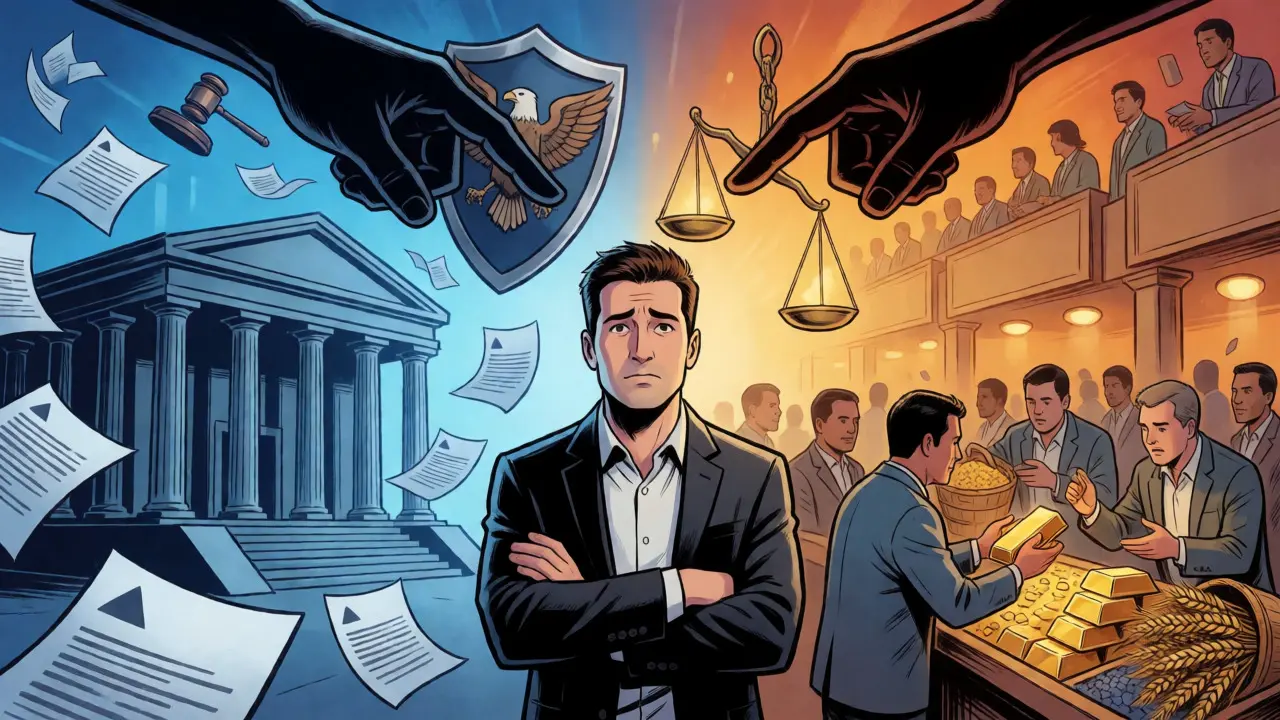
Imagine trying to run a business where two different police departments keep arresting you for the same act. One says your product is a stock; the other says it’s a bushel of wheat. That’s the reality for cryptocurrency companies in the United States today. The tug-of-war between the Securities and Exchange Commission (SEC) and the Commodity Futures Trading Commission (CFTC) isn’t just bureaucratic noise-it’s a $175 billion problem that’s pushing American crypto firms offshore.
If you’ve ever wondered why Bitcoin trades freely while some new tokens get slapped with lawsuits, this guide breaks down exactly who holds the gavel, what laws they’re using, and how the recent legislative moves might finally settle the score. We’ll skip the legal jargon overload and focus on what actually impacts your portfolio and the industry’s future.
The Core Conflict: Security or Commodity?
At the heart of this battle is a simple classification question: Is a digital token a security or a commodity? This distinction determines which agency gets to regulate it, and the stakes are massive.
The SEC relies on the Howey Test, a standard from a 1946 Supreme Court case (SEC v. W.J. Howey Co.). If an asset involves investing money in a common enterprise with an expectation of profits derived from the efforts of others, it’s a security. The SEC argues that most Initial Coin Offerings (ICOs) fit this bill because early buyers rely on the developers’ work to drive up the price.
On the flip side, the CFTC views cryptocurrencies like Bitcoin and Ether as commodities under the Commodity Exchange Act. They argue these assets function like gold or oil-tradable goods without a central company promising returns. In 2015, the CFTC officially declared Bitcoin a commodity, a stance reinforced by courts in cases like CFTC v. McDonnell.
| Feature | SEC Approach | CFTC Approach |
|---|---|---|
| Primary Legal Basis | Securities Act of 1933 & Howey Test | Commodity Exchange Act (CEA) |
| Classification Focus | Investment contracts / Profits from others' efforts | Spot markets / Derivatives / Fraud prevention |
| Key Assets Claimed | Most ICO tokens, DeFi governance tokens | Bitcoin, Ether, Litecoin, Tether |
| Enforcement Style | Registration requirements, disclosure rules | Fraud/manipulation actions, futures registration |
| Recent Stance | Aggressive litigation against exchanges (e.g., Coinbase) | More permissive, focused on derivatives oversight |
Why the Gray Area Hurts Innovation
You might think, "So what if they disagree?" But this ambiguity creates a regulatory Wild West. Companies don’t know which rulebook to follow. Do they register as a securities exchange? Or do they just need to avoid fraud in spot trading?
The cost of this confusion is real. According to a 2024 Deloitte survey, U.S. crypto firms spend an average of $2.7 million annually on compliance. Nearly half of that expense goes toward navigating the SEC-CFTC divide. When Coinbase faced an SEC lawsuit alleging it operated as an unregistered securities exchange, it wasn’t just about one company-it was a signal to the entire industry that any token could be deemed a security overnight.
This uncertainty has driven capital away. The Boston Consulting Group reports that U.S. firms captured only 14% of the global crypto market in 2024, down from 32% in 2020. Meanwhile, the European Union implemented the Markets in Crypto-Assets (MiCA) regulation, offering a unified framework that attracted billions in investment. Investors hate uncertainty more than they hate risk, and right now, the U.S. offers plenty of both.
Key Legal Battles Shaping the Landscape
Court rulings have been the primary referee in this fight, often favoring the CFTC’s view on established coins but leaving newer tokens in limbo.
- CFTC v. McDonnell (2018): A federal court confirmed Bitcoin is a commodity, solidifying CFTC jurisdiction over its spot market.
- SEC v. Ripple Labs: While not directly a CFTC case, this ruling distinguished between programmatic sales of XRP (not securities) and institutional sales (securities), showing how context matters in the Howey Test.
- SEC v. Coinbase (2023-2025): Initially, Judge Katherine Polk Failla allowed the SEC’s case to proceed, suggesting some tokens traded on Coinbase were securities. However, in a dramatic shift, the SEC dismissed the action in February 2025. This move hinted at a softer regulatory stance under new leadership, potentially opening the door for clearer guidelines.
These cases highlight a critical truth: Classification isn’t static. An asset can start as a security (when centralized developers promise growth) and evolve into a commodity (as the network decentralizes). This dynamic nature makes rigid categorization difficult, fueling the ongoing turf war.

The Legislative Fix: The CLARITY Act
Congress hasn’t been idle. The CLARITY Act, passed by the House in April 2024, aims to draw a bright line between the agencies. Here’s how it proposes to split the map:
- Digital Commodities (CFTC Jurisdiction): Tokens linked to a mature blockchain, sufficiently decentralized, and not conferring ownership rights. Think Bitcoin and Ether.
- Digital Asset Securities (SEC Jurisdiction): Tokens that fail the decentralization test or offer profit-sharing rights. Most ICOs fall here.
This framework aligns with what many experts, including former CFTC Chairman Heath Tarbert, have advocated. By defining "maturity" and "decentralization," the Act reduces the guesswork. However, the Senate Banking Committee has introduced competing drafts, creating a potential reconciliation challenge. As of late 2025, the Bipartisan Policy Center predicts a 68% chance of a compromise bill passing before the midterm elections, granting the CFTC primary control over established cryptos while keeping the SEC on newer offerings.
What This Means for Investors and Businesses
If you’re holding crypto or building a project, here’s how to navigate the current landscape:
- Stick to Established Coins: Bitcoin and Ether are widely recognized as commodities. Regulatory risk is lower compared to smaller-cap altcoins.
- Watch the Decentralization Metrics: For new projects, transparency about developer control is key. If a small team controls the supply and roadmap, expect SEC scrutiny.
- Expect Higher Compliance Costs: Until legislation passes, assume dual-compliance costs. Exchanges like Kraken and Gemini already operate under both sets of rules, increasing operational expenses by ~35%.
- Monitor State-Level Actions: With federal clarity delayed, states like Oregon are stepping in. Recent lawsuits against Coinbase by state AGs suggest local regulators may fill the void, adding another layer of complexity.
The resolution of this conflict isn’t just about paperwork. It’s about whether the U.S. remains the hub of financial innovation or cedes ground to jurisdictions with clearer rules. The next 12 months will be pivotal as Congress finalizes the CLARITY Act and the SEC adjusts its enforcement priorities.
Why does the SEC consider some crypto assets securities?
The SEC applies the Howey Test, which defines a security as an investment of money in a common enterprise with an expectation of profits derived primarily from the efforts of others. Many ICOs fit this description because early investors rely on the development team's work to increase the token's value.
Does the CFTC regulate all cryptocurrency transactions?
No. The CFTC has full authority over derivatives (futures, swaps, options) involving digital assets. Its power over spot transactions is limited to preventing fraud and manipulation. It does not regulate the issuance of tokens themselves.
What is the CLARITY Act?
The CLARITY Act is a proposed law that would formally assign the CFTC jurisdiction over 'digital commodities'-assets that are decentralized and linked to mature blockchains-while leaving the SEC in charge of digital asset securities. It aims to resolve the jurisdictional overlap between the two agencies.
Is Bitcoin considered a security or a commodity?
Bitcoin is widely accepted as a commodity. Both the CFTC and federal courts have ruled that Bitcoin functions as a commodity under the Commodity Exchange Act, placing it under CFTC oversight rather than SEC regulation.
How does the SEC vs CFTC conflict affect crypto prices?
Regulatory uncertainty tends to suppress institutional investment, which can dampen price growth. Clearer regulations, such as those expected from the CLARITY Act, could unlock significant capital inflows, potentially boosting prices as investor confidence rises.








The fundamental flaw in the current regulatory landscape isn't just about who gets to claim jurisdiction over a specific token, but rather the sheer philosophical incompatibility between the two agencies' foundational mandates. The SEC operates on a framework of disclosure and investor protection that assumes a centralized entity is pulling the strings, whereas the CFTC understands markets as decentralized ecosystems where price discovery happens organically without a single 'common enterprise' managing the profits. When you try to force a decentralized protocol into the Howey Test, you are essentially trying to measure the wind with a ruler; it simply doesn't fit the metric because the 'efforts of others' component becomes nebulous once the code is deployed and immutable. This mismatch creates a chilling effect on innovation because developers are terrified of creating something that works perfectly technically but fails legally due to an archaic interpretation of what constitutes a security. We need to recognize that code is law in this context, and until our legal frameworks evolve to respect the autonomy of decentralized networks, we will continue to see capital flight to jurisdictions that understand the difference between a commodity and a corporate promise.
Bitcoin is definitely a commodity. 🤷♀️ Everyone knows this already. 🙄
They're both lying to us. It's never been about regulation. It's about control. The SEC wants to tax every transaction like they own your wallet. The CFTC just wants to keep the derivatives market open for their buddies on Wall Street. Neither agency cares about the actual tech. They care about power. Always have. Always will. Wake up.
This whole article is so boring. 🥱 Like, nobody actually reads these long legal breakdowns. Just tell us if we can buy coins or not. Also, why does everyone act like the CLARITY Act is gonna fix everything? It’s probably gonna get watered down by lobbyists anyway. 🙄
Hey folks! 👋 Really insightful post here. I think it's crucial to remember that while the conflict is frustrating, it also highlights how fast crypto has moved compared to traditional finance. For those feeling overwhelmed, don't stress too much! 💪 Focus on projects with clear decentralization metrics-that's your best shield against SEC scrutiny right now. You've got this! Keep building! 🚀📈
The author clearly lacks a deep understanding of securities law if they think the Howey Test is 'simple.' It is a four-prong test that requires rigorous factual analysis, not some gut feeling about whether a token feels like a stock. The assertion that Bitcoin trades freely while others get sued ignores the nuance of secondary market liquidity versus primary issuance. Furthermore, citing Deloitte surveys is lazy journalism when the actual court dockets show a complete mess of contradictory precedents. The CLARITY Act isn't a 'bright line'; it's a political compromise that likely satisfies no one and leaves massive loopholes for enforcement discretion. Until Congress stops treating crypto like a newfangled toy and starts writing precise statutory definitions, this 'tug-of-war' narrative is just sensationalism masking incompetence.
I respectfully disagree with the notion that this is merely bureaucratic noise. Indeed, the distinction between security and commodity is philosophically significant. If we view digital assets through the lens of classical economics, we must ask: do they represent ownership in an enterprise, or are they merely units of exchange? The current ambiguity harms trust, which is the bedrock of any market. Therefore, clarity is not just a legal necessity but a moral imperative for fair trade. Let us hope the legislators find wisdom in their deliberations.
Good breakdown. From my experience working in compliance, the dual-regulation burden is real. Exchanges are basically hiring two separate legal teams. One for the SEC stuff (disclosures, registration) and one for the CFTC stuff (derivatives rules). It doubles overhead costs overnight. The part about EU MiCA attracting billions is spot on. Capital goes where it's treated well. Simple as that.
I appreciate how balanced this perspective is. It really helps to hear that it's not just black and white. I was worried about my portfolio being at risk, but knowing that established coins are safer makes me feel a bit more grounded. Thank you for explaining it gently.
This is such a vibrant tapestry of legal chaos! 🎨 It reminds me of trying to paint with two different color palettes that refuse to mix. The creativity stifled by this uncertainty is heartbreaking. We need a harmonious blend of oversight and freedom, not a clash of titans crushing the little guys. Let's advocate for a future where innovation isn't held hostage by jurisdictional turf wars. 🌟
Oh please. 'Who really controls?' Nobody controls anything, sweetie. That's the joke. 😂 The SEC sues Coinbase, then drops it. The CFTC says Bitcoin is a commodity, then tries to regulate DeFi swaps. It's all theater. And don't get me started on the 'investors hate uncertainty' line. Investors love uncertainty if they can profit from volatility. Grow up. 🙄
its deeper than laws its about the soul of money itself... we are trying to cage lightning with old nets made for fishing whales... the spirit of crypto is freedom and bureaucracy is the antithesis of freedom... we are losing our way...
i wonder if the state level lawsuits mentioned at the end could actually become the main driver for change since federal gov seems stuck in gridlock
While I appreciate the comprehensive overview provided, I remain somewhat skeptical regarding the predictive accuracy of the Bipartisan Policy Center's 68% probability estimate. Historical precedent suggests that legislative compromises often result in diluted regulations that satisfy neither agency fully. Furthermore, the assumption that 'maturity' can be objectively defined in a rapidly evolving technological landscape may be flawed. What criteria determine maturity? Is it node count? Transaction volume? Developer activity? These metrics are subjective and manipulable. Consequently, even if the CLARITY Act passes, the definitional ambiguities may persist, leading to continued litigation rather than resolution.
YES! 🔥 This is exactly the energy we need! Stop letting fear hold you back! Every big movement faces resistance! Keep HODLing! Keep Building! The future is bright! ☀️💪🚀
It's tough watching friends panic sell because of the news. ❤️ I just want everyone to breathe. We'll figure it out together. Stay strong, fam. 🫶