

How to Track Crypto Whale Movements: Tools, Signals & Strategy
Ever wonder why Bitcoin suddenly drops 5% in an hour with no news? It’s usually a whale moving assets. Crypto whales are large holders whose transactions can shift market prices. Because blockchains like Bitcoin and Ethereum are public ledgers, every transaction is visible. This transparency allows you to monitor these big players before the rest of the market reacts. Tracking their moves isn’t about copying trades blindly; it’s about understanding supply and demand shifts in real-time.
Key Takeaways
- Whale tracking monitors large transactions (e.g., 1,000+ BTC or 10,000+ ETH) to predict price movements.
- Tools like Nansen.ai and Whale Alert provide different levels of data depth, from basic alerts to institutional-grade analytics.
- Exchange inflows often signal potential selling pressure, while outflows suggest accumulation and bullish sentiment.
- Stablecoin movements are critical liquidity indicators that frequently precede major crypto purchases by 12-24 hours.
- Always combine on-chain data with technical indicators to filter out false signals and manipulation tactics.
Understanding Whale Thresholds and Definitions
What exactly counts as a whale? The definition varies by asset class due to price differences. For Bitcoin, a transaction exceeding 1,000 BTC (roughly $65 million at current prices) is typically flagged as significant. In the Ethereum ecosystem, the threshold is often set at 10,000 ETH (approximately $30 million). On Binance Smart Chain, movements above 5,000 BNB (around $1.5 million) trigger alerts. These numbers aren't arbitrary; they represent volume large enough to impact order books and market psychology. According to research from Nansen.ai, transactions exceeding these benchmarks often precede price swings of 3-5% within 24 hours. However, context matters. A 1,000 BTC transfer between two cold wallets might mean nothing, while the same amount moving to an exchange could signal an impending sell-off.
Top Tools for Monitoring Large Transactions
The market offers several platforms, each with distinct strengths. If you’re just starting out, Whale Alert is the go-to choice. Founded in 2018, it’s free, easy to use, and has over 1.2 million followers on Twitter. It sends simple notifications when large transactions occur. For deeper insights, Nansen.ai provides labeled wallet intelligence. It tells you *who* is moving the coins-whether it’s a known entity like Coinbase or a specific hedge fund. This comes at a premium price, ranging from $99/month for basic access to $999/month for professional tiers. Another powerful option is Arkham Intelligence, which excels at tracking wallet clusters across multiple blockchains. Its "Intel" platform helps identify groups of addresses acting in unison, a feature crucial for spotting coordinated market moves. For those who want a middle ground, Debank offers multi-chain portfolio tracking with a Pro version available for $19.99/month.
| Platform | Starting Price | Best Feature | Learning Curve |
|---|---|---|---|
| Whale Alert | Free | Real-time Twitter/Telegram alerts | Low (2-3 hours) |
| Nansen.ai | $99/month | Labeled wallet intelligence | Medium-High |
| Arkham Intelligence | $149/month | Wallet cluster analysis | High (40+ hours) |
| Debank | Free / $19.99 Pro | Multi-chain portfolio view | Low-Medium |
Interpreting Exchange Flows: Inflows vs. Outflows
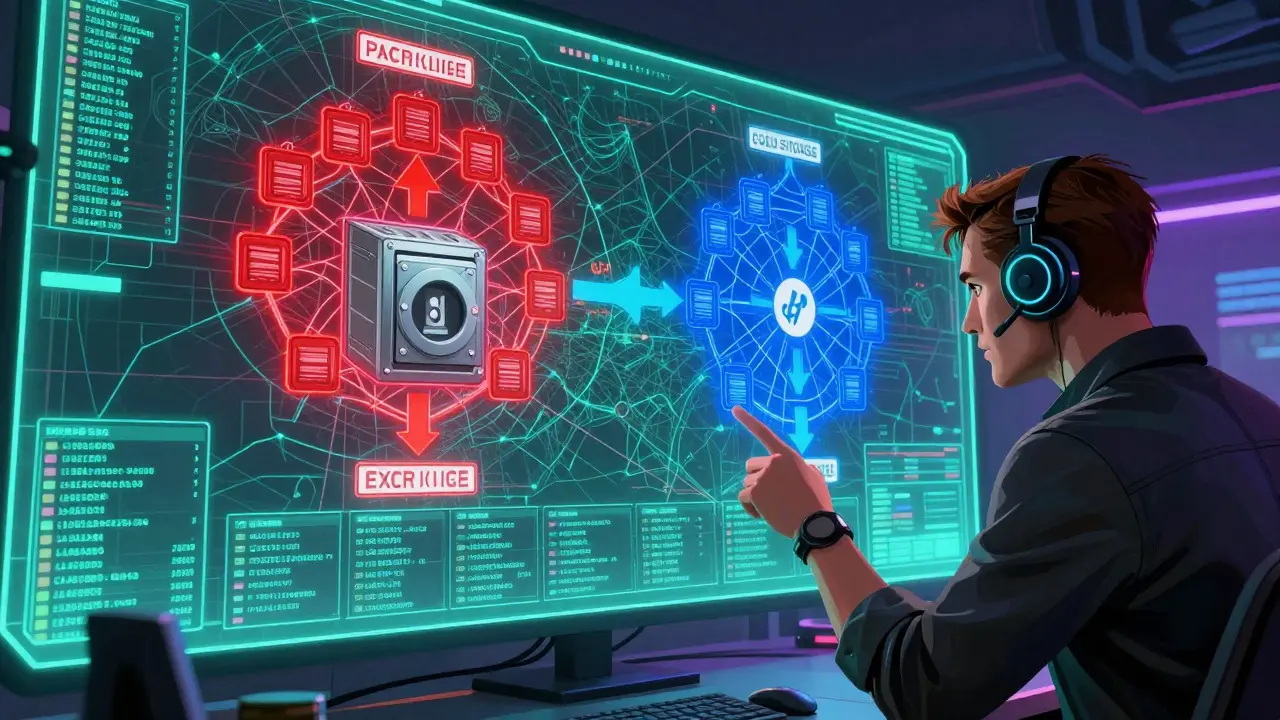
One of the most reliable signals is the net flow of assets into and out of exchanges. When a whale moves coins *to* an exchange (inflow), it usually means they are preparing to sell. More supply on the order book creates downward pressure. Conversely, when coins move *from* an exchange to a private wallet (outflow), it suggests accumulation. The holder is taking profit or securing assets for long-term holding, removing supply from the market. Nansen.ai’s data shows that high outflows correlate strongly with bullish sentiment. But be careful: not all inflows are sales. Sometimes whales move funds between their own wallets or to custodial services for operational reasons. That’s why looking at the destination address matters. If you see a massive Ethereum transfer to a known Binance hot wallet, that’s a red flag. If it goes to a Tornado Cash pool, it’s likely obfuscation, making the intent harder to read.
The Role of Stablecoins in Predicting Moves
Don’t ignore stablecoins like USDT or USDC. They act as dry powder. Research indicates that large stablecoin transfers onto exchanges often precede significant crypto purchases by 12-24 hours. If you see billions of dollars worth of USDT flowing into Binance, someone is getting ready to buy. This is a leading indicator of liquidity entering the market. By tracking stablecoin balances on major exchanges, you can gauge how much buying power is waiting in the wings. It’s a subtle but powerful signal that complements direct crypto movement tracking.
Avoiding Common Pitfalls and Manipulation
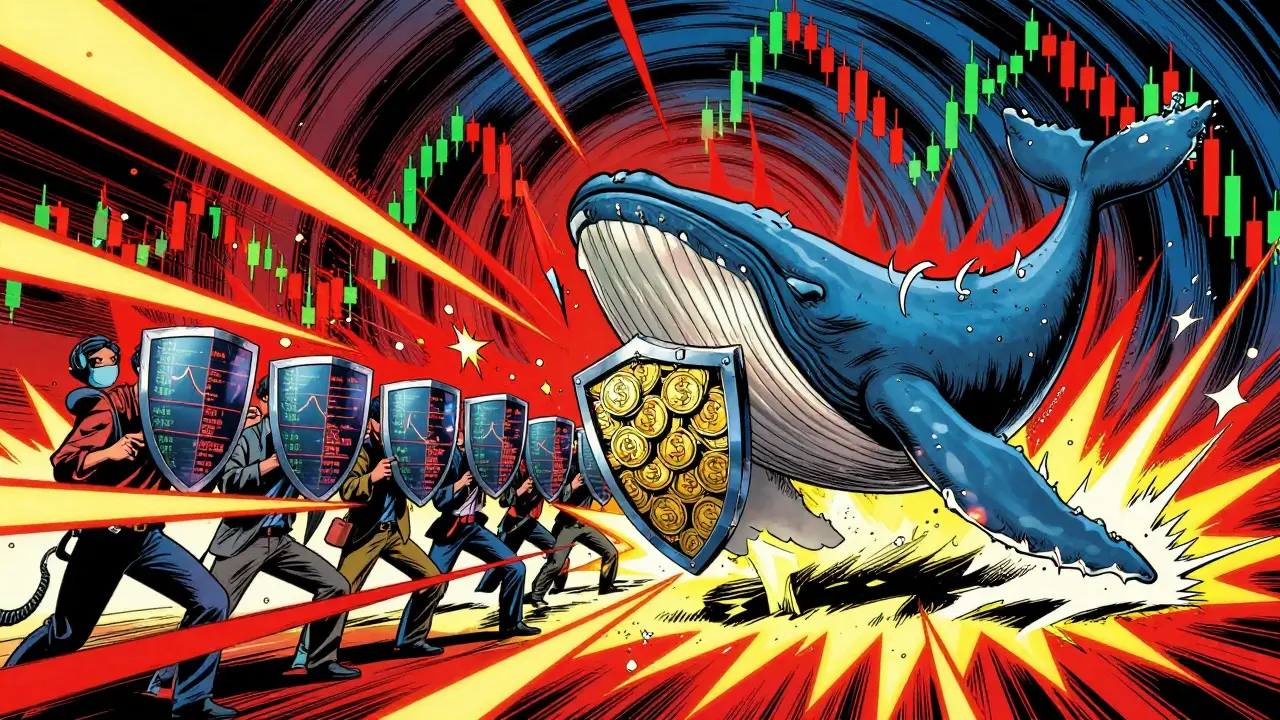
Whale tracking isn’t foolproof. Market makers use various tricks to mislead retail investors. One common tactic is "Whale Wall Spoofing," where large orders are placed and then canceled to create the illusion of heavy support or resistance. Another is wash trading, where the same entity buys and sells to inflate volume. To avoid being fooled, cross-reference on-chain data with other indicators. For example, if a whale deposit coincides with a drop in social media sentiment, it’s more likely a genuine sell signal than a trap. Also, remember that privacy coins like Monero and protocols like Tornado Cash make transactions untraceable. Currently, about 15-20% of ETH transactions are untraceable due to such privacy features. Always keep this blind spot in mind.
Building Your Own Tracking Routine
Start simple. Set up free alerts on Whale Alert for Bitcoin and Ethereum. Focus on transactions over 500 BTC or 5,000 ETH to reduce noise. Once you’re comfortable, upgrade to a paid tool like Nansen or Arkham to get labeled data. Keep a journal of the alerts you receive and what happened to the price afterward. Over time, you’ll start to see patterns. Did the price drop after the exchange inflow? Did it pump after the stablecoin influx? This personal backtesting is invaluable. As one trader noted, combining whale data with RSI divergence increased prediction accuracy from 52% to 68%. You don’t need to be a coder to do this, but you do need patience and discipline.
Frequently Asked Questions
Is whale tracking accurate?
It provides strong signals but isn't a crystal ball. Accuracy depends on context. Combining on-chain data with technical analysis improves reliability significantly. Studies show it explains about 18-23% of short-term volatility in major assets.
Which is better: Nansen or Whale Alert?
Whale Alert is best for beginners due to its simplicity and free access. Nansen is superior for serious traders who need to know *who* is moving the assets and require historical data analysis. Choose based on your budget and experience level.
Do whales always sell when they move to exchanges?
Not always. Some moves are for collateral, internal transfers, or preparation for OTC deals. However, statistically, large exchange inflows are more likely to result in selling pressure than outflows are to result in buying.
Can I track whales on DeFi protocols?
Yes. Advanced tools like Arkham Intelligence allow you to track interactions with specific smart contracts and DEX pools. This helps identify large swaps or liquidity additions/removals that impact token prices.
How much does it cost to track whales professionally?
Professional tiers range from $99/month (Nansen Basic) to $999/month (Nansen Pro) or $149/month (Arkham). Institutional licenses can be significantly higher. Free options exist but lack deep analytics.




Oh my gosh, this is exactly what we needed!!
I've been so confused by those random dips lately and now I finally feel like I have a map to follow. The part about stablecoins being 'dry powder' really clicked for me because I always ignored USDT movements thinking they were boring.
Thanks for breaking it down so nicely! 🙌
It is interesting to think that the ledger is public yet the intent remains hidden. We see the movement but not the mind behind it. This creates a strange paradox where transparency does not equal understanding. One must be patient to read between the lines of the blockchain data.
Honestly, this article reads like a brochure for Nansen.
Let's not pretend Whale Alert isn't just a toy for the retail masses who can't afford the 'real' intel.
If you're paying $999/month you are playing in the big leagues, everyone else is just guessing in the dark.
The elitism of on-chain analysis is real and you should embrace it or stay poor. 💎🙏
Sure, let's all pretend that watching a whale move coins is some kind of alpha signal rather than a lagging indicator of price action that has already happened.
By the time your tweet pops up, the market maker has already front-run you three times over.
Enjoy your $99 subscription to feeling smart while you lose money. 😂
You guys are both right in a way but also missing the bigger picture which is that no single tool works in isolation and that is why the routine section at the end is actually the most valuable part of the whole post because it emphasizes journaling and backtesting which is where the real edge comes from not just staring at alerts all day long without context.
I started doing this last month and honestly it changed how I view volatility completely because now I know if a dip is just noise or if it's a genuine supply shock and that peace of mind is worth more than any paid dashboard.
They don't want you to track them 🕵️♂️
The whales know we are watching. It's all a game. The Tornado Cash thing? That's where the real secrets are buried. Trust no one. Not even the block explorer. 👁️👁️
Respectfully, the learning curve for Arkham is a bit of an exaggeration, i find it quite manageable once you get used to the interface.
Also, for those in developing markets, the cost of entry is still high, so free tools like Whale Alert remain the only viable option for many of us.
Great post overall, very informative. 🇳🇬
"Institutional-grade analytics" sounds fancy until you realize you're just looking at the same data as everyone else, just with better labels.
But sure, keep telling yourself that $999 gets you the truth.
Meanwhile, I'm here sipping tea and watching the charts go up and down, wondering if any of this actually matters in the long run. ☕📉
Typical American arrogance.
Assuming the rest of the world has the bandwidth and dollars to play with these toys.
In Ireland, we look at fundamentals, not just on-chain noise.
But then again, when did you Irish ever understand crypto anyway? 🇮🇪🔥
One must consider the statistical significance of these claims.
While the article suggests a correlation, causation is rarely proven in such volatile markets.
However, the utility of stablecoin tracking is undeniable and should be adopted by serious analysts immediately.
Do not be fooled by the hype. 📊💸