
How Moroccans Use Crypto for International Payments Despite Restrictions
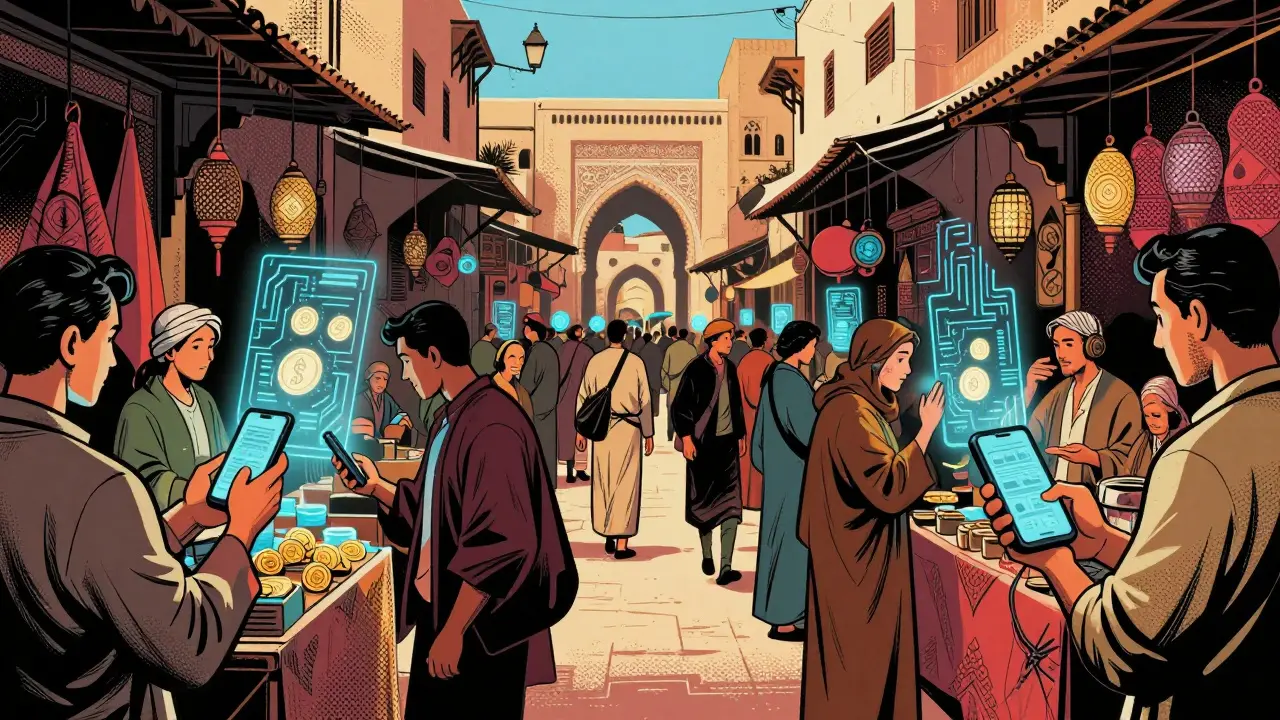
In the bustling markets of Casablanca and the quiet tech hubs of Rabat, a digital secret is quietly rewriting the rules of finance. Even though sending crypto across borders is officially forbidden here, millions of Moroccans continue to move money using blockchain technology. It sounds risky, even dangerous, but for many, it is the only way to send money to family abroad or pay for services on the global web. The numbers tell a clear story. By 2026, the underground crypto market is projected to reach nearly 292.4 million USD, proving that demand is outpacing regulation.
Cryptocurrency serves as a vital tool for individuals seeking freedom from traditional banking controls in Morocco. Unlike the centralized systems monitored by the government, decentralized currencies offer privacy. People often use Digital Assets or Virtual Money to bypass high fees and slow transfer times.The Paradox of the 2017 Prohibition
To understand the current landscape, you have to look back at November 2017. That was when the Ministry of Economy and Finance drew a hard line in the sand. They declared every single cryptocurrency transaction illegal. It wasn’t a suggestion; it was a full stop. Governor Abdellatif Jouahri of Bank Al-Maghrib has been very vocal about this stance for years. His team worries about consumer protection. Without a regulator to call when things go wrong, users face total loss if an exchange fails.
Volatility is another massive concern for the Central Bank. Imagine buying a house with Bitcoin one day, only to find its value drops 20% the next morning. For a national economy, that kind of chaos is unacceptable. There are also serious security issues regarding money laundering and terrorist financing. These are not small talk concerns; they are the backbone of why the ban exists. Yet, despite these warnings, people keep finding ways around them. Why? Because the alternatives are often too slow or too expensive.
Navigating the Underground Payment Channels
If the law prohibits it, how does the money actually move? It happens through peer-to-peer (P2P) networks. Think of this like a giant, decentralized barter system. Instead of going to a bank branch where officials can flag a suspicious transfer, two individuals agree on a price and swap directly. One person pays via cash deposit or mobile wallet, while the other releases crypto to their digital wallet.
- Telegram Groups: Dedicated communities form online where traders post ads offering rates. Trust is built through reputation scores within the group.
- OTC Desks: Some larger businesses operate off-exchange desks that handle big ticket items without public records.
- Family Chains: Often, the simplest method involves friends sending crypto to relatives who then withdraw funds in a different jurisdiction.
This ecosystem functions almost entirely outside the view of the authorities. A merchant might accept USDT (a stablecoin tied to the dollar) for an export payment to avoid the volatility of the Moroccan Dirham. The transaction settles in minutes, unlike the three days a wire transfer might take. This speed is addictive for businesses that live on cash flow. However, doing this carries weighty consequences.

Risks Hidden in the Grey Zone
Using unauthorized crypto for international payments isn’t without danger. Since the law considers this activity illegal, there is no safety net. If you trade on a platform that gets shut down, your assets vanish. There is no insurance fund to reimburse you. In a standard banking system, fraud protection exists; in the Moroccan crypto underground, you are on your own.
Then there is the matter of legal risk. While enforcement varies, possession of certain amounts could lead to asset seizure or fines. Government agencies monitor large transactions closely to catch tax evasion. The Central Bank regularly issues warnings reminding citizens that virtual currency offers no legal tender status. This means if someone cheats you in a transaction, the courts cannot help you recover your funds.
| Feature | Traditional Wire Transfer | Underground Crypto |
|---|---|---|
| Legal Status | Fully Regulated | Prohibited / Illegal |
| Speed | 1-3 Days | Minutes |
| Fees | High (1-5%) | Variable (Market Rate) |
| Consumer Protection | Guaranteed | None |
Shifting Horizons: The 2025 Legalization Draft
Things might change soon. On July 21, 2025, the Central Bank announced a game-changing development. They finalized a draft law that aims to legalize and regulate cryptocurrencies. This is a massive pivot from the total ban of 2017. It suggests that the government recognizes the reality of what’s happening. Rather than fighting a losing battle against underground adoption, they are choosing to bring it under a controlled roof.
This draft doesn’t just open the floodgates randomly. It focuses on creating a framework for legitimate use cases, like international payments. It distinguishes between reckless speculation and functional utility. If this law passes fully in 2026, Moroccans could finally use crypto openly without fearing police raids. It would mean registering with a licensed exchange and paying taxes, much like other business activities. Until then, we remain in a transition phase where the law lags behind the technology.

The Official Alternative: Central Bank Digital Currency
While the private sector experiments with Bitcoin, the state is building its own version. Bank Al-Maghrib is actively developing a Central Bank Digital Currency (CBDC). Unlike Bitcoin, which anyone can mine and hold anonymously, a CBDC is issued directly by the central bank. It looks like crypto on the surface but acts like cash under the hood.
Governor Jouahri has been working with the International Monetary Fund and the World Bank on this project. Their goal is specifically to fix cross-border payments. Morocco shares trade routes with several African nations. A digital coin allows instant settlement with partners like Egypt. They recently signed agreements to test these corridors. The plan is to combine the efficiency of blockchain with the stability of the government-backed currency. For regular citizens, this could eventually replace the need for black-market crypto swaps with official apps.
Global Standards and Regional Cooperation
You won’t find this alone. Cross-border finance requires talking to neighbors. Egypt is partnering with Morocco to test digital corridors. The World Bank facilitates these tests to ensure the infrastructure works. This isn't just about money; it’s about sovereignty. If countries rely on Western-led SWIFT systems, they can be cut off during sanctions. A regional CBDC system offers independence.
This cooperation highlights a bigger trend. Nations are realizing that controlling the currency flow means controlling economic destiny. For now, however, most Moroccans still rely on existing tools. Stablecoins like Tether (USDT) dominate the underground market because they don’t fluctuate wildly. Traders prefer holding dollars digitally rather than volatile coins like Bitcoin when moving funds. This preference stabilizes the market somewhat, keeping prices predictable for daily commerce.
Is owning crypto illegal in Morocco right now?
Yes, since the 2017 ban, ownership and trading of cryptocurrencies are technically prohibited. However, enforcement varies, and a new draft law from mid-2025 suggests a shift toward regulated legalization in the near future.
How do people transfer crypto without getting caught?
Most users utilize Peer-to-Peer (P2P) platforms or private networks. They match buyers and sellers who deal in cash locally, avoiding direct bank wires linked to crypto exchanges.
What is the difference between CBDC and Bitcoin?
A CBDC is centralized and issued by the Bank Al-Maghrib, ensuring stability and compliance. Bitcoin is decentralized, meaning no single authority controls it, leading to higher volatility and legal risks.
Will the July 2025 draft law be implemented by 2026?
While announced in July 2025, implementation typically takes time for parliamentary approval. Market projections suggest a hybrid model emerging by late 2026, allowing registered exchanges to operate legally.
Can businesses accept crypto for goods today?
Currently, accepting crypto is illegal due to the 2017 prohibition. Doing so exposes businesses to penalties and confiscation of funds, although some operate discreetly using P2P methods.






All this crypto talk is just noise because the government will shut it down eventually.
The resilience of Moroccan youth using technology is really inspiring to see across our continent.
We need to support these innovations instead of blocking progress for old reasons.
The situation in Morocco highlights a fundamental disconnect between state policy and citizen necessity. People do not wake up and choose to break the law simply for the thrill of it. They look at the alternatives available through traditional banking channels and find them insufficient. High fees eat away at remittances before the money even reaches the intended family members. Slow transfer times mean emergencies become critical failures of communication. Volatility is a concern for everyone involved in these underground transactions. Stablecoins like USDT provide a semblance of security against wild swings in value. Yet, operating in a grey zone means accepting zero consumer protection. If a counterparty disappears with your funds, you cannot call a bank to freeze the transaction. The legal framework exists to protect consumers from predatory schemes in most cases. Central banks claim to protect citizens from losing their life savings on speculative assets. However, the prohibition of utility-focused transfers harms small businesses disproportionately. Exporters who deal with global clients need faster settlement than wires allow. The 2025 draft law attempts to bridge this gap after years of stagnation. Implementation remains uncertain until parliament gives final approval to the new regulations. Until then, citizens remain stuck in a limbo between innovation and compliance.
The 2017 ban was enacted by Bank Al-Maghrib to prevent money laundering risks.
Cryptocurrency lacks intrinsic value and is highly volatile compared to fiat currency systems.
Everyone talks about risk but nobody mentions the profit margins on the black market exchange rates.
Using Telegram groups is kinda risky but also so cool 😎
Imagine bypassing the whole banking system easily 🚀💸
I am hopeful that the new regulations will bring clarity soon.
People deserve to move money without fear of legal trouble.
Hopeful much?
The state only cares about tracking every cent that moves through their CBDC pipeline.
Central Bank Digital Currencies offer a middle ground for digital payments.
Their integration with existing ledgers ensures stability during cross-border trade settlements.
Privacy concerns are mitigated through strict identity verification protocols implemented by national authorities.
Efficiency gains in settlement times could revolutionize regional commerce significantly.
This approach prioritizes macroeconomic security over individual financial anonymity requirements.
Governments just want to watch everything you buy forever.
They call it security but it is total surveillance capitalism.
We should try to understand both sides of the argument here.
Financial inclusion is important but safety nets matter just as much for regular families.
I feel so scared thinking about losing all my savings in a crash.
Why do people trust computers with their money instead of actual banks?
I thnk u are right about the risks involved there.
Safety is key even if it takes longer to send cash.
like i mean wht is the point of banning it when everyone is doing it anyway teh banks cant stop blockchain stuff and its crazy lol
Stop pretending this is freedom when it is just gambling with other people's savings.