

How Ethereum Hard Forks Upgrade the Network
When you hear "Ethereum hard fork," it might sound like something technical and distant-something only developers care about. But here’s the truth: every time Ethereum hard forks, it changes how you send money, how much you pay in fees, and even how green the network is. These aren’t minor tweaks. They’re full rebuilds of the rules that keep the whole system running.
What Exactly Is a Hard Fork?
A hard fork is when Ethereum’s core rules change in a way that older software can’t understand anymore. Think of it like upgrading your phone’s operating system-but if you don’t update, your phone stops working with the new apps. That’s what happens on Ethereum. Nodes (the computers running the network) must upgrade their software to stay on the main chain. If they don’t, they get left behind on an old version that no one else accepts. This is different from a soft fork, where new rules are still compatible with old ones. Hard forks break compatibility on purpose. They’re used when the change is too big to sneak in quietly. Maybe you’re switching from gasoline to electricity. Or maybe you’re fixing a hole in the foundation. Either way, you can’t do it without rebuilding part of the structure.Why Ethereum Needs Hard Forks
Ethereum wasn’t built perfect. It was built to evolve. And evolution sometimes means tearing down walls to build better ones. The biggest reason? Security. In 2016, a smart contract called The DAO got hacked. Someone stole $60 million worth of Ether. The community was split: should they let the theft stand because blockchains are supposed to be immutable? Or should they reverse it to protect users? They chose to reverse it. That was the first Ethereum hard fork. It created two chains: the new Ethereum (ETH), where the theft was undone, and Ethereum Classic (ETC), where the original chain lived on unchanged. That split still exists today. It showed that Ethereum’s community could make hard decisions-even when they went against blockchain dogma. Hard forks also fix performance problems. Before 2021, gas fees on Ethereum were a nightmare. You’d pay $50 to send a simple token because the network was congested. Sometimes you’d pay $100 and your transaction still wouldn’t go through. That wasn’t just annoying-it made everyday use impossible for most people.The London Hard Fork: Ending the Fee Chaos
In August 2021, the London Hard Fork changed everything. It introduced EIP-1559, a new fee system that replaced the old auction-style bidding. Here’s how it worked before: you guessed how much gas you needed, added a tip to get priority, and prayed your transaction didn’t get buried. It was like trying to get a taxi during rush hour by shouting your price louder than everyone else. After EIP-1559, Ethereum started burning part of every transaction fee. The network automatically sets a "base fee" based on how full the blocks are. If it’s busy, the fee goes up. If it’s quiet, it drops. You still add a tip if you want your transaction processed faster-but now, the base fee disappears into thin air instead of going to miners. This made fees predictable. It also made Ethereum deflationary. Since more ETH gets burned than is issued as rewards, the total supply can shrink over time. That’s why so many people now see Ethereum as digital scarcity, not just a payment system.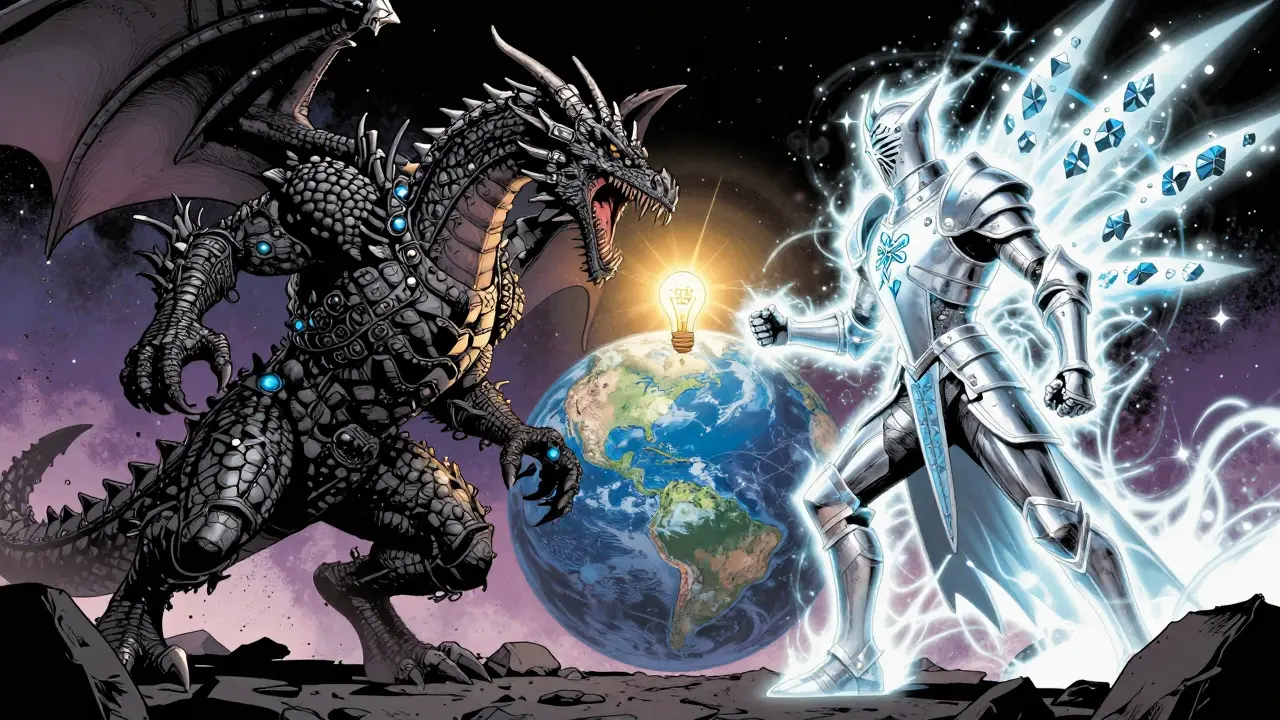
The Merge: Killing Proof of Work
The biggest hard fork in Ethereum’s history didn’t just tweak fees. It changed how the entire network reaches agreement. Before September 2022, Ethereum used Proof of Work-the same system Bitcoin uses. Miners competed to solve math puzzles using massive amounts of electricity. It was slow, expensive, and environmentally terrible. Ethereum used as much energy as a small country. The Merge replaced mining with Proof of Stake. Instead of powerful computers, validators lock up 32 ETH as collateral to propose and verify blocks. If they act honestly, they earn rewards. If they cheat, they lose their stake. No mining rigs. No power plants. No noise. The result? Ethereum cut its energy use by 99.9%. That’s not a marketing number. It’s real. Before the Merge, Ethereum used 45 terawatt-hours per year. After? Less than 0.1. That’s less than a single data center. This wasn’t just good for the planet. It made the network more secure. Proof of Stake makes attacks far more expensive. To take over Ethereum, you’d need to buy over 50% of all ETH in existence. That’s billions of dollars-and you’d destroy the value of your own investment.How Hard Forks Are Planned
You can’t just flip a switch on a global blockchain. Every hard fork goes through a strict process. First, someone writes an Ethereum Improvement Proposal (EIP). This is a technical document explaining the change, why it’s needed, and how it works. Hundreds of developers, researchers, and node operators review it. Then, it gets tested on testnets-practice versions of Ethereum where nothing real is at stake. If it works there, it moves to mainnet. A specific block number is chosen for activation. Everyone gets months of notice. Wallets, exchanges, and dApps prepare. On the day of the fork, nodes update their software. If you’re running a node and you don’t update, you’re on the old chain. Most people don’t run nodes-they use wallets or exchanges. But those services have to upgrade too. If they don’t, you can’t send or receive ETH after the fork. There’s always risk. One big danger is replay attacks. If you send ETH on the new chain, someone could copy that same transaction on the old chain and steal your coins again. That’s why wallets and exchanges added protections-like changing transaction formats after forks.Who Wins and Who Loses
Not everyone loves hard forks. Miners hated the Merge. They spent millions on hardware. When Proof of Work ended, their machines became worthless. Some switched to other chains like Bitcoin or Ravencoin. Others just walked away. EIP-1559 also hurt miners. Before, they got all transaction fees. After, most of it got burned. Their income dropped. Some argued it made mining unprofitable. But the truth? Mining on Ethereum was already dying. The Merge finished it. On the other side, users won. Fees became stable. Transactions were faster. The network became greener. Developers got better tools. Smart contracts could now read the base fee directly-something they couldn’t do before. The DAO fork split the community. But it also proved that Ethereum could respond to crises without collapsing. That trust matters. It’s why institutions now use Ethereum. Why governments study it. Why people feel safe storing value there.
What’s Next?
The Merge didn’t solve everything. Ethereum still can’t handle millions of transactions per second. That’s where future hard forks come in. The next big upgrade is called "Dencun," which will add data blobs to reduce the cost of Layer 2 rollups. That’s how Ethereum will scale without making the main chain heavier. After that? Sharding. Splitting the chain into 64 smaller pieces that work together. It’s complex. It needs a hard fork. And it’s already being tested. Ethereum’s roadmap is built on hard forks. They’re not optional. They’re the only way to keep growing without breaking.What This Means for You
If you use Ethereum-whether you’re sending ETH, trading NFTs, or using DeFi-you benefit from every hard fork. You don’t need to understand the code. You just need to know this: upgrades make the network better, cheaper, and safer. You don’t have to do anything. Your wallet will keep working. But if you ever hear "Ethereum is upgrading," don’t ignore it. That’s not just a tech update. That’s the network getting stronger.Frequently Asked Questions
What’s the difference between a hard fork and a soft fork?
A hard fork breaks compatibility with old software, forcing everyone to upgrade. A soft fork keeps old software working while adding new rules. Hard forks are used for major changes like switching consensus or fixing critical bugs. Soft forks are for smaller, backward-compatible improvements.
Do I need to do anything during an Ethereum hard fork?
If you hold ETH in a wallet or exchange, you don’t need to do anything. Your coins stay safe. But if you run your own node, you must update your software before the fork activates. Otherwise, you’ll be stuck on the old chain.
Why was the DAO fork controversial?
The DAO fork reversed a hack by changing the blockchain’s history. Critics said that broke the core promise of blockchains: immutability. Supporters said it protected users and showed Ethereum could respond to emergencies. The split created Ethereum Classic (ETC), which still exists today as a reminder of that debate.
Did EIP-1559 make Ethereum deflationary?
Yes. Since August 2021, more ETH has been burned than created in most periods. When network usage is high, the burn rate exceeds new issuance. That means the total supply of ETH can decrease over time, making it scarcer-similar to how gold becomes harder to mine.
Can Ethereum hard forks be reversed?
No. Once a hard fork is live and blocks are built on the new chain, there’s no going back. The old chain becomes obsolete unless a group chooses to keep running it separately-like Ethereum Classic did after the DAO fork. But the main Ethereum chain moves forward permanently.
What happens to my NFTs during a hard fork?
Your NFTs stay on the new chain. Smart contracts and token metadata are part of the blockchain’s state. When the network upgrades, everything moves with it. As long as your wallet supports the new version, your NFTs remain accessible and unchanged.
Why can’t Ethereum just update without hard forks?
Some changes can be made with soft forks, but others require breaking old rules. For example, switching from Proof of Work to Proof of Stake changes how blocks are validated at the deepest level. You can’t do that without rewriting the core protocol. Hard forks are the only way to make these foundational upgrades.


Honestly, I didn’t think I’d care about hard forks until I saw my gas fees drop. Now I just cheer when I see "upgrading" in my wallet app. 🙌
So let me get this straight... we killed mining not because it was bad, but because it was too *efficient* at making miners rich? 😏💰
This is why crypto is doomed!!! They keep changing the rules!!! What’s next? A fork to make ETH pink??? People don’t get it-blockchain is supposed to be UNTOUCHABLE!!!
I used to mine ETH on my garage rig. Now I’m just a guy who pays $0.02 to send a token and wonders if the universe is a simulation. Thanks, EIP-1559. You turned me into a zen crypto monk. 🧘♂️
Ugh. Another "Ethereum is greener now" article. Let me guess-you also think your reusable tote bag offsets your 3 AM NFT flipping habit? 🙄
The DAO fork was the moment Ethereum stopped being a blockchain and became a democracy. And democracies are messy. But hey, at least we didn’t let the hacker win. Some of us still believe in justice.
Hard forks? More like hard lies. If it’s immutable, why are they always changing it? I don’t trust this.
The technical clarity of this post is commendable. The evolution of Ethereum's consensus mechanism represents a rare instance of protocol-level adaptation without sacrificing decentralization. A thoughtful analysis.
I love how Ethereum listens. It’s not just code-it’s a community that actually grows together. Feels like we’re building something real. 🌱
EIP-1559’s deflationary mechanics are a textbook example of monetary policy applied to decentralized systems. The burn rate is now a key macroeconomic variable in ETH valuation models-this isn’t just UX, it’s asset theory.
Let’s be honest: the Merge was less a technological breakthrough and more a PR stunt to attract ESG funds. The energy savings are real, but the philosophical cost? We traded sovereignty for sustainability.
i just wanna say thank u to whoever made the merge happen!! my txns r so fast now and i dont cry when i send eth anymore 😭❤️ also pls dont make the next fork on a friday
The real win here isn’t the tech. It’s that thousands of people worked together for years to make this happen. No CEO. No VC. Just builders. That’s the future.
One must question the epistemological foundations of a system that permits revisionism under the guise of "progress." If the ledger is mutable, then trust is contingent upon governance, not cryptography. This is not innovation-it is institutionalization.
It’s funny how we treat blockchain like it’s a religion. But it’s just software. And software evolves. The real miracle isn’t the fork-it’s that we didn’t break it.
Ethereum's evolution demonstrates that decentralized systems can adapt responsibly. This is a model for other public infrastructures. Well done, community.