

Double-Spending Attack Methods: How Hackers Break Blockchain Security
You buy a coffee with Bitcoin. The merchant sees the transaction pending on their screen and hands over your latte. You walk out, then immediately broadcast a second transaction spending those same coins to an exchange. If you time it right, the merchant’s node might accept your first payment before seeing the second one. That is double-spending, the digital equivalent of paying for the same coffee twice with the same dollar bill.
In the physical world, handing someone a $20 bill means you no longer have that specific piece of paper. Digital money isn’t so straightforward. Data can be copied infinitely without losing quality. Without a strict system to verify who owns what at any given second, anyone could copy their digital wallet balance and spend it multiple times. This is why Bitcoin's core innovation wasn't just creating a new coin; it was solving the double-spending problem through decentralized consensus.
But the solution isn't magic. It relies on timing, network speed, and computational power. And where there are rules, there are ways to break them. Let's look at exactly how attackers try to cheat the system, from simple tricks to massive resource-heavy assaults.
Why Digital Money Is Vulnerable to Copying
To understand the attacks, you have to grasp the underlying flaw. Physical cash has a unique identifier-its physical existence. You can’t clone a gold coin instantly. But a file? A file is easy to duplicate. In early digital currency attempts, like e-gold, this problem was solved by trusting a central server to keep track of balances. If the server said you had 1 coin, you had 1 coin. If you tried to spend 2, the server rejected it.
This works, but it creates a single point of failure. If the server goes down, or if the company holding the server decides to freeze your account, you’re stuck. Cryptocurrencies wanted to remove that middleman. They needed a way for thousands of strangers to agree on who owns which coins without calling up a bank manager. This led to the blockchain, a public ledger where every transaction is recorded chronologically.
The vulnerability lies in the gap between when you send a transaction and when it gets permanently locked into a block. During this window, different nodes on the network might see things differently. Attackers exploit this latency.
The Race Attack: Speed vs. Consensus
The simplest method is the Race Attack. It exploits the time it takes for data to travel across the internet.
Here’s how it plays out:
- An attacker sends Transaction A (paying a merchant) and Transaction B (sending coins back to themselves or another address) simultaneously.
- Transaction A goes to the merchant’s node. Transaction B goes to other nodes in the network.
- The attacker hopes the merchant accepts Transaction A as valid before hearing about Transaction B.
- If successful, the merchant releases the goods. Then, the rest of the network confirms Transaction B, making Transaction A invalid because the coins were already spent.
This works best against merchants who don’t wait for confirmations. If a shopkeeper looks at "Pending" status and thinks it’s done, they’re vulnerable. For small purchases, this risk is often calculated into the price. For large amounts, waiting for six confirmations usually kills this attack, as the network quickly realizes the conflict and picks the winner.

The Finney Attack: Pre-Mining for Advantage
The Finney Attack is named after Hal Finney, a Bitcoin pioneer who described it in 2011. It’s more sophisticated than a race attack and requires the attacker to be a miner or have significant computing power.
The steps involve precise timing:
- The attacker mines a private block containing Transaction B (the conflicting transaction).
- They do not publish this block yet.
- They spend the same coins in Transaction A with a merchant, expecting the merchant to accept it quickly.
- Once the merchant ships the goods, the attacker publishes their private mined block.
Because the attacker’s block contains the valid spend (Transaction B), and it was mined legitimately, the network will likely accept it as the correct history. The merchant’s transaction (A) becomes orphaned. The attacker got the goods for free. This attack is harder to pull off today because mining difficulty adjusts, and most miners publish blocks almost instantly to earn rewards. Keeping a block secret risks losing the reward if someone else finds a block first.
The 51% Attack: Brute Force History Rewriting
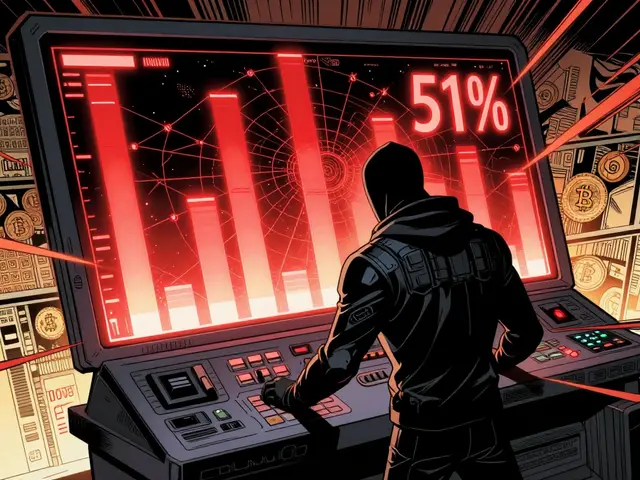
This is the big one. The 51% Attack occurs when a single entity controls more than half of the network's total hash rate.
With majority power, the attacker can rewrite recent transaction history. Here’s the scenario:
- The attacker buys goods with crypto and receives confirmation.
- They secretly mine a longer chain where they never made that purchase.
- They release their longer chain to the network.
- Nodes switch to the longest chain, reversing the original transaction.
The attacker keeps both the goods and the coins. While theoretically possible on Bitcoin, it’s prohibitively expensive. As of late 2024, controlling 51% of Bitcoin’s hash rate would require billions of dollars in hardware and electricity. However, smaller altcoins with lower hash rates are frequent victims. Networks like Ethereum Classic and Bitcoin Gold have suffered repeated 51% attacks, proving that decentralization matters more than brand name.
| Attack Type | Complexity | Resource Requirement | Best Target |
|---|---|---|---|
| Race Attack | Low | Standard Node | Merchants ignoring confirmations |
| Finney Attack | Medium | Mining Power + Timing | Fast-confirmation services |
| 51% Attack | High | >50% Network Hash Rate | Small-cap altcoins |

How Blockchains Defend Against These Threats
So, how does the system fight back? It uses a mix of cryptography and game theory. The primary defense is Proof-of-Work (PoW), which makes rewriting history computationally expensive.
Every block added to the chain requires energy. To reverse a transaction, you don’t just change the record; you have to re-mine all subsequent blocks faster than the rest of the network combined. This is why we talk about "confirmations." One confirmation means one block has been built on top of yours. Six confirmations mean six blocks have been built since. The probability of reversing the transaction drops exponentially with each block.
Another layer is the Byzantine Generals Problem. This theoretical model proves that distributed systems can reach agreement even if some participants are malicious. As long as honest nodes control the majority, the truth wins out. The network doesn’t need to trust individuals; it trusts the math and the majority rule.
Newer networks also use Proof-of-Stake (PoS) mechanisms. Instead of burning electricity, validators lock up capital. If they try to double-spend, they lose their stake. This economic penalty makes attacks financially ruinous for the attacker, adding a different kind of security layer.
Real-World Consequences and Prevention Tips
These aren't just academic exercises. In 2018, Bitcoin Gold suffered three 51% attacks in a few weeks. Exchanges froze withdrawals, prices crashed, and users lost confidence. Similar events hit Vertcoin and ZClassic.
For everyday users and merchants, prevention is practical:
- Wait for Confirmations: Never consider a transaction final until it has sufficient confirmations. For Bitcoin, 6 is the standard for high value. For stablecoins on fast chains, fewer may suffice, but check the network’s typical block time.
- Use Reputable Wallets: Good wallets warn you if a transaction is being replaced or if there’s a potential conflict.
- Avoid Small-Cap Coins for Large Payments: If you’re selling a car for a niche altcoin, ensure the network has enough hash rate to resist a 51% attack. Check sites like CryptoCompare or CoinWarz for current hash rate stats.
- Leverage Layer-2 Solutions Carefully: Networks like the Lightning Network enable instant payments but introduce different trust assumptions. Ensure your channel partner is reputable.
The threat of double-spending drives innovation. Developers constantly tweak protocols to close loopholes. Quantum computing poses a future risk to current cryptographic signatures, potentially allowing attackers to forge transactions easier, but post-quantum cryptography is already being tested.
Understanding these methods helps you appreciate why blockchain is secure-not because it’s perfect, but because breaking it is too expensive to be worth it for most attackers. Until quantum computers arrive or hash rates shift dramatically, the cost of cheating remains higher than the profit.
What is the difference between a race attack and a 51% attack?
A race attack exploits network latency by sending two conflicting transactions simultaneously, hoping one reaches the merchant first. It requires minimal resources. A 51% attack requires controlling over half the network's mining power to rewrite transaction history entirely. The former is a timing trick; the latter is a brute-force takeover.
Can double-spending happen on Bitcoin today?
Yes, but it is extremely difficult. A race attack is still possible if a merchant ignores confirmations. A 51% attack is theoretically possible but costs billions of dollars in hardware and electricity, making it economically unfeasible for most attackers unless they plan to crash the price afterward.
How many confirmations are safe?
For Bitcoin, 6 confirmations are generally considered secure for high-value transactions. This typically takes about an hour. For smaller amounts, 1-3 confirmations might be acceptable depending on your risk tolerance. Always check the specific blockchain's average block time.
Are Proof-of-Stake coins immune to double-spending?
No. PoS coins face similar threats, though the mechanism differs. An attacker needs to control a majority of the staked capital to rewrite history. If they do, they can double-spend, but they risk losing their entire stake if caught, acting as a strong financial deterrent.
Which cryptocurrencies have suffered double-spending attacks?
Smaller altcoins with low hash rates are most vulnerable. Notable examples include Ethereum Classic, Bitcoin Gold, Vertcoin, and ZClassic. These networks experienced successful 51% attacks where exchanges froze withdrawals and prices dropped sharply.







Yo listen up fam this whole blockchain security thing is a total myth for the little guy see its not about math its about power and who has the biggest wallet to burn it lol
People think they are safe because of some fancy cryptography but really its just a game of chicken with miners and if you blink you lose your lunch money its that simple dont let them fool you with their jargon its all smoke and mirrors baby
The author displays a profound misunderstanding of economic incentives by framing these attacks solely as technical exploits rather than rational market behaviors. A 51% attack on Bitcoin isn't merely "prohibitively expensive" due to hardware costs; it's deterred by the opportunity cost of destroying one's own asset value which the article completely fails to address.
Furthermore, comparing Proof-of-Work to Proof-of-Stake without acknowledging the nothing-at-stake problem in early PoS implementations shows a superficial grasp of consensus mechanisms. The Finney attack description ignores the stochastic nature of block discovery times making the "precise timing" argument misleading at best.
We need to stop romanticizing decentralization when in reality mining pools have already achieved oligarchic control over hash rates. The table provided is reductive and ignores the nuanced differences between orphaned blocks and actual chain reorganizations which carry different risk profiles for merchants.
Ultimately this piece reads like introductory undergraduate material dressed up in blog formatting lacking any rigorous analysis of game theoretic equilibria or historical data on attack profitability versus execution costs.
Love the energy here! It's awesome how we can break down complex tech stuff so clearly. Keep pushing those boundaries!
I am deeply moved by the elegance of this explanation...
It strikes me that we are witnessing the digital manifestation of trust itself. When I read about the race attack I felt a sense of wonder at how fragile our agreements truly are. We build these massive structures of value on top of thin ice made of code and electricity.
Is it not poetic that our financial safety depends on the speed of light and the cooperation of strangers? There is something profoundly beautiful about the Byzantine Generals Problem solved through mathematics rather than politics. I find myself pondering the philosophical implications of a world where truth is determined by majority computational effort rather than authority.
This post reminds me that technology is not just tools but extensions of human will. The vulnerability described is essentially the human condition mirrored in silicon - we fear betrayal and seek assurance. In the end perhaps the real innovation was not the blockchain but the realization that we could create trust from chaos.
I feel inspired to look deeper into the metaphysics of consensus mechanisms. Thank you for sharing this glimpse into the soul of the machine.
wait why does nobody talk about the social layer??
i mean sure the tech is cool but what happens when the community decides the attacker is right? thats the real double spend isnt it? the fork. the split. the drama. people forget that code is law only until humans decide otherwise. its always been about vibes and votes more than hashes. i feel like this article misses the point entirely by ignoring the governance wars. its kinda sad tbh. we are all just waiting for the next civil war while pretending the ledger is neutral. 🙄
Actually, the term 'double-spending' is technically misused in several contexts within modern L2 discussions. If you are referring to state channel closures, the dispute period mitigates this entirely. Also, Ethereum Classic suffered attacks primarily due to centralized exchange mining pools, not inherent protocol flaws. You should cite specific block heights for accuracy.
bro stop with the block heights nobody cares about the exact numbers its about the vibe of the loss man you are missing the forest for the trees again lol
Your dismissal of empirical data in favor of vague 'vibes' illustrates precisely why retail investors continue to suffer losses. Specificity matters when discussing financial security protocols. Without concrete examples, your argument lacks falsifiability.
This is such an important topic! 😊 We need to make sure everyone understands the risks before investing their hard-earned savings. Safety first always! ❤️
I appreciate the detailed breakdown. It helps clarify the differences between the attack vectors quite well. Thank you for taking the time to write this out respectfully.
The comparison table is particularly useful for quick reference. One might consider adding information regarding the impact of network congestion on confirmation times as an additional variable affecting security margins.
Great overview. Stay safe out there.