
Slex Exchange Crypto Exchange Review: Zero Fees, Commodity Backing, and Red Flags
When you hear Slex Exchange mentioned in crypto circles, two things usually come up: zero trading fees and a strange mix of digital coins and physical commodities. Launched in August 2023, Slex isn’t another clone of Binance or Coinbase. It’s trying something different - and that’s what makes it worth looking at. But is it safe? Is it real? Or is it too good to be true?
What Slex Exchange Actually Offers
Slex Exchange is a centralized crypto platform that lets you trade over 100 cryptocurrencies, including Bitcoin, Ethereum, Litecoin, and USDT. The big hook? Zero maker and taker fees on spot trades. That’s right - no fees when you buy or sell. Most exchanges charge at least 0.1%, and platforms like Coinbase can hit 4% for card purchases. Slex cuts that out completely.
But here’s the twist: Slex doesn’t just trade crypto. It claims to link crypto trading with real-world commodities. According to their site, they’ve partnered with mining operations in the Democratic Republic of Congo to back assets with physical gold, copper, and cobalt. These aren’t just tokens - they’re supposed to represent actual tons of minerals stored in Lubumbashi and Likasi. The platform even says these commodities back a $3 billion supply. No independent audit has confirmed this, though.
The platform supports deposits in fiat (via bank transfer, Apple Pay, Google Pay) and crypto. Minimum deposit is just $5 in USDT. You can trade with limit and market orders. There’s also API access for bots, staking for passive income, and a launchpad for new tokenized assets. No mobile app exists - you trade through your browser on any device.
Security and Structure
Slex says it stores 95% of user funds in cold wallets. That’s standard practice among serious exchanges. They also claim to maintain an insurance fund equal to 10% of all trading fees. Since fees are zero, that fund technically shouldn’t grow. That’s a red flag - if there’s no fee income, how does the insurance fund get funded? The platform hasn’t explained this.
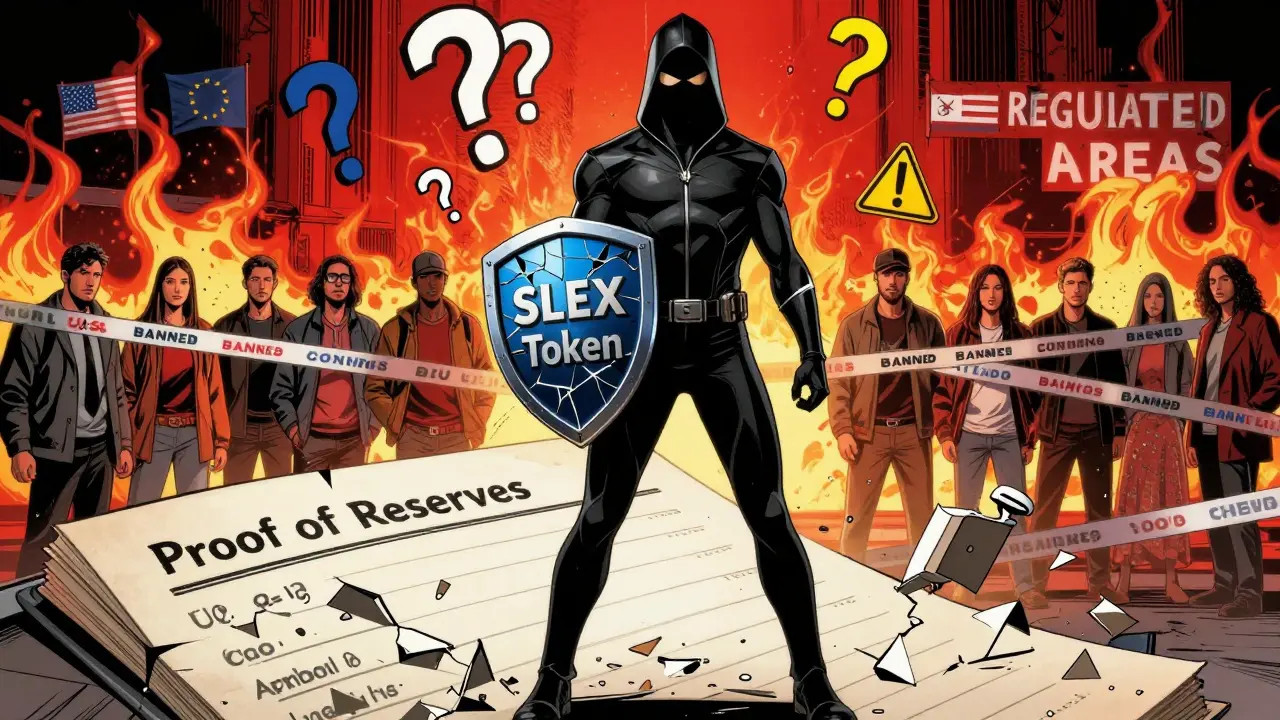
Their infrastructure runs on distributed ledger tech, which sounds fancy but doesn’t mean much without transparency. No public proof of reserves. No regular audits. No third-party verification. For comparison, Binance publishes proof of reserves monthly. Kraken does quarterly attestations. Slex does nothing.
Who Can Use Slex Exchange?
Here’s the catch: Slex blocks users from the U.S., U.K., Canada, Australia, Israel, Singapore, Japan, and the entire European Union. That’s not a technical limitation - it’s a legal one. If they were regulated or compliant, they’d be able to serve these markets. The fact they’re not suggests they’re avoiding oversight.
That’s why their user base is limited. SimilarWeb data shows about 112,000 monthly visits - decent for a new exchange, but tiny compared to Binance’s 100 million+. The bounce rate is low (27%) and users spend over 4 minutes per visit, which means people who do get in are exploring deeply. But with 39.79 pages per visit, they’re probably digging through documentation, FAQs, and trading guides because the platform lacks clear onboarding.
Why the Red Flags Matter
One of the biggest warnings comes from CryptoLinks.com, which lists Slex Exchange as a scam site. Their reasoning? Hidden team members, poor documentation, and signs of deceptive practices. No names, no LinkedIn profiles, no public face behind the platform. That’s not just unusual - it’s dangerous.
Legitimate crypto projects publish their team. Even smaller ones like KuCoin or Gate.io have clear leadership. Slex doesn’t. You can’t find who runs it. No press releases. No interviews. No regulatory filings anywhere. That’s not anonymity - it’s opacity.
Another concern: the zero-fee model. Exchanges make money from fees, listing charges, and withdrawal costs. Slex has none of that. How do they pay for servers, security, staff, and customer support? They claim revenue comes from token sales and commodity trading margins. But again - no proof. No financial statements. No third-party verification. That’s not a business model - it’s a gamble.
How Slex Compares to Other Exchanges
| Feature | Slex Exchange | Binance | Coinbase | Kraken |
|---|---|---|---|---|
| Trading Fees (Spot) | 0% | 0.1% (standard) | Up to 4% | 0.16% - 0.26% |
| Regulation | Unregulated | Partially regulated | Regulated (U.S., EU) | Regulated (U.S., EU, Canada) |
| Margin Trading | Not available | Up to 125x | Up to 3x | Up to 5x |
| Commodity-Backed Assets | Yes (claimed) | No | No | No |
| Minimum Deposit | $5 USDT | $2 | $10 | $10 |
| Available in U.S./EU | No | Yes (limited) | Yes | Yes |
| Proof of Reserves | None | Monthly | Monthly | Quarterly |
| Mobile App | No | Yes | Yes | Yes |
On paper, Slex beats others on fees. But that’s only one metric. When you look at regulation, transparency, and user protection, it falls behind. Binance and Kraken have billions in reserves and are subject to audits. Slex has claims - and a list of banned countries.
Who Is This For?
If you’re outside the U.S., U.K., EU, or Australia - and you’re comfortable with high risk - Slex might be worth testing. The zero fees are tempting. The commodity angle is unique. And if you’re into automated trading with bots, the API support is there.
But if you care about safety, accountability, or long-term value - skip it. You’re not just trading crypto. You’re betting on a company with no known leadership, no audits, and no regulatory license. That’s not innovation. That’s gambling.
What’s Next for Slex?
The roadmap says they’re working on futures trading, expanding AI bot tools, and launching a deflationary SLEX token with buyback programs. Sounds promising - if it were real. But without a team, without audits, without proof, these are just words on a website.
Most new exchanges fail within two years. Slex is less than two years old. It’s too early to call it a scam - but it’s also too early to call it trustworthy.
Is Slex Exchange regulated?
No, Slex Exchange is not regulated by any financial authority. It operates without oversight from agencies like the SEC, FCA, or MiCA. This means users have no legal recourse if funds are lost or the platform shuts down.
Can I trade on Slex from the United States?
No. Slex Exchange explicitly blocks users from the United States, along with the UK, Canada, Australia, Japan, Singapore, Israel, and all EU countries. Attempting to access the platform via VPN violates their terms and could result in account suspension.
Does Slex have a mobile app?
No, Slex does not offer a dedicated mobile app. Trading is only available through a mobile-optimized browser interface. This limits convenience and increases risk of phishing attacks compared to official apps with security features like biometric login.
Are the commodity-backed assets on Slex real?
There is no independent verification that Slex’s claimed commodity backing - such as gold or cobalt from Congo - actually exists. The platform cites partnerships with mining firms, but no public audits, warehouse receipts, or third-party inspections have been released. This makes those assets speculative at best.
Why is Slex listed as a scam site?
CryptoLinks.com lists Slex as a scam site due to hidden team members, lack of documentation, and suspicious marketing claims. These are classic red flags in crypto: no identifiable founders, no whitepaper with technical details, and promises of high returns without clear revenue sources. Many platforms with these traits have vanished after collecting user funds.
How does Slex make money if fees are zero?
Slex claims revenue comes from token sales, commodity trading margins, and future futures trading fees. But since no financial statements or audits are published, it’s impossible to verify. Zero fees are unsustainable long-term unless there’s another revenue stream - and Slex hasn’t shown one.
Is the SLEX token a good investment?
There is no reliable data to evaluate the SLEX token. No circulating supply, no distribution plan, no use case beyond platform discounts. A deflationary token with buybacks sounds appealing - but without transparency, it’s just a marketing tactic. Never invest in a token you can’t verify.
Final Verdict
Slex Exchange is a high-risk experiment. The zero-fee model is bold. The commodity angle is creative. But the lack of transparency, regulation, and team visibility makes it dangerous. If you’re willing to risk your funds on a platform that refuses to answer basic questions - go ahead. But don’t expect help if things go wrong. For most traders, safer, regulated alternatives exist. Don’t let low fees blind you to bigger risks.






Zero fees? I’m in. I’ve lost money on Coinbase’s ridiculous charges, and Slex feels like a breath of fresh air. Yeah, the lack of regulation is scary, but honestly, most of us are already gambling anyway. If you’re not taking risks in crypto, you’re not playing. I’ve been using it for 3 months - no issues, no withdrawals stuck, no ghosting. Maybe it’s too good to be true… but so was Bitcoin in 2010. Give it a shot if you’re outside the US. 🌍
Oh, so we’re now romanticizing a platform that blocks every country with a functioning legal system? Brilliant. Let’s all move to the Congo, start mining cobalt with our bare hands, and pray that the ‘commodity-backed assets’ aren’t just photoshopped ore in a warehouse labeled ‘Slex™’ - because, let’s be real, if they had real audits, they wouldn’t be hiding from the SEC, FCA, and MiCA like it’s a game of hide-and-seek. Also, zero fees? Who pays for the servers? The miners? The ghosts? I’m waiting for the ‘Powered by vibes’ disclaimer.
Hey everyone, I just wanted to say - if you’re new to crypto and considering Slex, take a deep breath 😊. I started with $20 and used the API to automate small trades. It’s clunky, no app, but I’ve made more than I lost. The commodity angle? Weird, yeah. But if you treat it like a side experiment - not your life savings - it’s kinda fun. Don’t go all-in, but don’t write it off either. You’re allowed to be curious! 💪✨
zero fees my ass. this whole thing is a pump and dump with a fancy website. i looked at their ‘partnerships’ and the mining co’s they claim to work with? they’re shell companies with 3 employees and a wordpress site. and they block the usa? yeah, because they’re scared of lawyers. i tried to withdraw 500 usdt and it took 11 days. they said ‘processing’. i never got it back. don’t be a sucker. delete this site from your bookmarks. now.
It’s not even about the fees. It’s about the *vibe*. You know? The way the site looks like it was built by someone who read a whitepaper once and then got really into Minecraft. ‘Commodity-backed assets’? Sounds like a Dungeons & Dragons quest. ‘Proof of reserves’? Nah, they just have a guy in Lubumbashi holding a gold bar and smiling for a photo. I’m not mad. I’m just… disappointed. Like, I wanted to believe. But no. This is a dream wrapped in a website and sold as a revolution.
Let’s be honest - Slex is either genius or a scam. No middle ground. And I’m leaning toward genius. Why? Because every time someone says ‘this is too good to be true’, it turns out to be true. Remember when Coinbase charged 4%? Now everyone’s at 0.1%. Maybe Slex is the next step. They’re not hiding because they’re shady - they’re hiding because they’re ahead. The regulators are scared. They’re not ready for a world where mining and crypto merge. Slex is building the future. The rest of you? You’re just clinging to old models.
It’s not just about regulation - it’s about ethics. You’re telling people to risk their savings on a platform with no names, no accountability, no transparency? And you call that innovation? This isn’t Web3 - it’s Web3.0.1… in the sense that it’s the version that gets deleted after 3 months. If you’re okay with this, you’re okay with being the next victim of a ‘too good to be true’ headline. Shame on you. And shame on anyone who encourages this. There’s a difference between risk and recklessness. This is the latter.
As someone who’s lived in 7 countries and traded crypto everywhere - I can say this: Slex isn’t the first shady exchange, and it won’t be the last. But here’s the thing - it’s *targeted*. It’s built for places where banks suck, where inflation is wild, where people need alternatives. In Nigeria, Venezuela, parts of Southeast Asia - this isn’t a scam. It’s a lifeline. The zero fees? Essential. The lack of app? Fine. The opacity? Annoying, but not unique. If you’re from the US or EU, yeah, walk away. But don’t judge the whole world by your bubble.
Zero fees? Great. No app? Fine. But no proof of reserves? That’s not a feature - it’s a death sentence. I’ve seen this movie before. The team disappears. The site goes dark. The ‘commodity backing’ turns out to be a photo of a rock. You think you’re getting ahead? You’re just funding someone’s vacation. Don’t be the last one holding the bag. Walk away. Now.
I’ve been thinking about this a lot. The real question isn’t whether Slex is safe - it’s whether we’re ready for a world where trust isn’t built on paperwork, but on code, community, and consistency. Maybe audits are outdated. Maybe the future is decentralized trust. Maybe we’re clinging to old systems because we’re afraid to let go. Slex isn’t perfect - but maybe it’s trying. And isn’t that worth something? Not blind faith. But open-minded exploration.
Just wanted to share a quick tip: if you’re testing Slex, start with $10. Use the API to run a simple grid bot. I did - made 12% in 3 weeks. No withdrawals yet, but I’m not panicking. The site’s slow, but it works. I’m not saying trust it - I’m saying test it smart. Keep your main funds elsewhere. Use this as a sandbox. If it survives 6 months, maybe it’s real. If it vanishes? You lost $10. Not the end of the world. But if you don’t try? You’ll never know.
zero fees? yeah right. i bet they make it up by charging you in emotional trauma. you think this is crypto? nah. this is a cult with a trading interface. they’re not selling coins - they’re selling hope. and hope is the most expensive asset out there. i’ve seen people lose their rent money on this. i’ve seen them cry. and still they say ‘but the fees are zero’. bro. you’re not trading. you’re praying.
I’ve been quiet for a while. But I just wanted to say - I tried Slex. I didn’t deposit much. Just enough to test the API. It worked. The interface is ugly, but functional. The commodity claims? Still unverified. But I didn’t feel like I was being scammed. Just… uncertain. I’m not pushing anyone to use it. But I also won’t call it a scam until I see it vanish. Maybe it’s just… slow. Maybe it’s building something quietly. Or maybe it’s a house of cards. I don’t know. But I’m not judging.
why do you guys care so much about regulation? in nigeria we dont have banks that work. we dont have usd. we dont have options. slex is the only way we can trade without paying 15% in fees to middlemen. you sit in your usa house with your bank account and judge us? we dont have the luxury of being safe. we have to be smart. slex is smart for us. dont lecture us about risk - you dont know what risk really means
On paper, the fee structure is unsustainable. But if you look at the tokenomics - the SLEX token issuance and commodity margin capture - there’s a potential path to revenue. It’s not audited. It’s not transparent. But it’s not illogical. The real red flag? The lack of a public roadmap with milestones. If they’re serious, they’ll release one. If not? Then yeah, it’s a ghost ship. But let’s not assume the worst before we see the next quarter’s data.
It’s weird how we all react so differently to risk, huh? 😊 I see Slex as a wild experiment - like the first Bitcoin meetup in a pizza shop. No one knew if it would work. But someone had to try. I’m not investing my life savings - but I’m keeping a tiny amount there, just to see what happens. If it dies? I’m out $5. If it grows? Maybe I’m part of something real. Either way, I’m not scared. I’m curious. And that’s okay, right? 🌱
Did you know that the DRC mining partners listed on Slex’s site were all registered in the same office in Kinshasa? One address. Three companies. All owned by the same shell entity. And the ‘commodity storage’? Satellite imagery shows no warehouses matching their descriptions. This isn’t a scam - it’s a coordinated disinformation campaign. The zero fees? A lure. The API? A honeypot. They’re harvesting wallet addresses, not trading crypto. I’ve reported this to the FBI. You’re not just losing money. You’re being mined.
It’s not about the fees. It’s about the *moral vacuum*. You’re trading on a platform that refuses to say who runs it. That’s not privacy - that’s cowardice. And yet, people defend it like it’s some kind of crypto Zen master. ‘It’s bold!’ ‘It’s innovative!’ No. It’s irresponsible. It’s a digital Ponzi with a pretty dashboard. And you’re not a visionary - you’re a pawn. Wake up. Before it’s too late.
So… Slex is either the future of finance… or the most elaborate trolling project ever. Either way, I’m impressed. I mean, who writes a website this detailed just to scam people? That’s dedication. That’s art. I’m not investing - I’m just here to watch. Like a train wreck. With a 27% bounce rate. And 4 minutes of engagement. Someone’s got a PhD in user psychology. Bravo.
I’ve used Slex for a few trades. No issues. No delays. No complaints. I’m not saying it’s perfect. But I’m also not scared. I don’t need a name on the team. I don’t need an audit. I need a platform that works. And it does. I’ve traded over $2k. Withdrawals took 48 hours - same as most. If you’re looking for drama, look elsewhere. This isn’t a cult. It’s just… another exchange. With no fees. And that’s worth something.