
Why Pakistan Ranks 3rd-4th in Global Crypto Adoption
Pakistan isn't just using cryptocurrency - it's leading the world in how people actually use it. While headlines often focus on Bitcoin price swings or Wall Street ETFs, the real story is happening in cities like Lahore, Karachi, and Faisalabad, where millions of ordinary Pakistanis are turning to digital assets not for speculation, but for survival. According to Chainalysis’ 2025 Global Adoption Index, Pakistan jumped to 3rd place globally, behind only India and the United States. Other reports still place it at 4th or 9th, depending on how they measure it. But one thing is clear: Pakistan is among the top three countries on Earth where crypto isn't a niche experiment - it's a daily tool.
How Did Pakistan Get Here?
Just a few years ago, the State Bank of Pakistan banned banks from dealing with crypto exchanges. In 2018, it was illegal to even talk about Bitcoin. Fast forward to 2025, and the country created the Pakistan Virtual Assets Regulatory Authority a government body established in July 2025 to license, monitor, and regulate all virtual asset services in Pakistan. Alongside it came the Pakistan Crypto Council a public-private advisory body led by CEO Bin Saqib, formed in early 2025 to bridge government policy and industry needs. This wasn’t a last-minute pivot - it was a full institutional overhaul.The change didn’t come from Wall Street or Silicon Valley. It came from people. When inflation hit 35% in 2023 and the Pakistani rupee lost nearly half its value against the dollar in two years, families started looking for ways to protect their savings. Crypto wasn’t about getting rich overnight. It was about not losing everything.
What Are People Actually Buying?
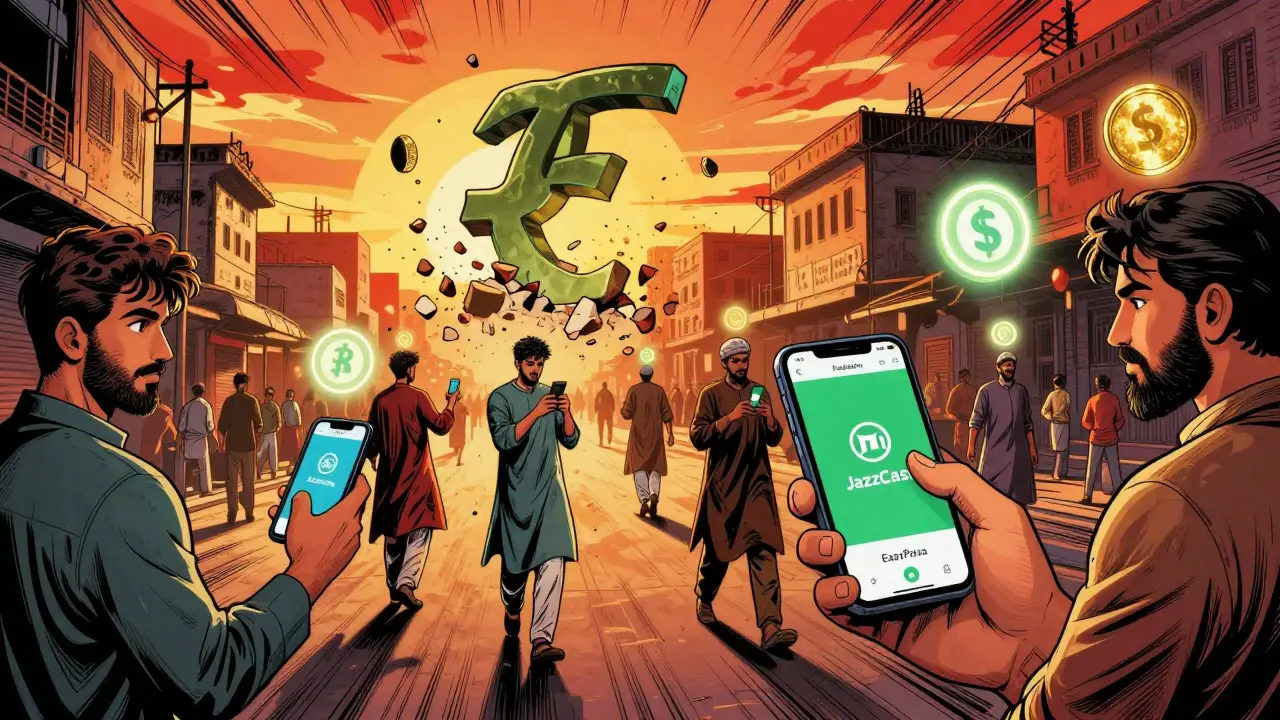
Most of the crypto flowing into Pakistan isn’t Bitcoin. It’s stablecoins - especially USDT (Tether) and USDC. These digital coins are pegged 1:1 to the U.S. dollar, so they don’t swing up and down like Bitcoin. For a parent sending money to a child studying abroad, or a small business owner paying suppliers overseas, stablecoins are faster, cheaper, and more reliable than banks.Chainalysis data shows Pakistan’s crypto inflows surged 210% between July 2024 and June 2025. The majority of that came from peer-to-peer (P2P) trading, not exchanges. People are buying crypto directly from each other using local payment apps like JazzCash and EasyPaisa. A typical transaction? A worker in Dubai sends 500 USDT to his sister in Multan. She cashes it out in rupees within minutes - no bank fees, no 7-day delays. That’s not investment. That’s life.
Over 20 million Pakistanis now hold digital assets, with total holdings estimated between $20 billion and $25 billion. That’s roughly 9% of the country’s population. For context, the global average is just under 7%. In some urban areas, adoption rates hit 15% - higher than in Germany or Japan.
Why Other Countries Don’t Rank This High
Nigeria used to be #2 in crypto adoption. Now it’s slipped to #6. Why? Because Nigeria’s government cracked down on P2P trading in 2024, making it harder for people to buy crypto. Vietnam and India are also top performers, but they have different drivers. India’s growth comes from retail investors and institutional participation. Vietnam’s is fueled by young tech-savvy users and gaming tokens. Pakistan’s story is different: it’s about financial necessity.Kim Grauer, chief economist at Chainalysis, put it simply: "Crypto adoption is mostly accelerating in mature markets with clearer rules and in emerging markets where stablecoins are transforming how people manage money." Pakistan is the textbook example of the second.
The Role of Regulation - And the Risks
The creation of the Pakistan Virtual Assets Regulatory Authority was a game-changer. Before, crypto was a gray zone. Now, exchanges must be licensed, KYC rules apply, and anti-money laundering checks are mandatory. This sounds bureaucratic, but it’s actually what gave people confidence. Banks started relaxing restrictions. Payment processors began integrating crypto withdrawals. Even utility companies now accept USDT for electricity bills in pilot zones.But there’s a shadow side. In August 2025, the Pakistan Crypto Council signed a deal with World Liberty Financial a U.S.-based blockchain firm co-founded by Zach Witkoff, linked to the Trump family’s financial network. The goal? To build a national blockchain infrastructure. The catch? The firm is privately funded, with no public oversight. Critics worry this could turn Pakistan’s crypto strategy into a profit-driven project for foreign investors rather than a public service.
Then there’s the political angle. In April 2025, Zach Witkoff met directly with Pakistan’s army chief and prime minister. These aren’t random meetings. They’re strategic. Some analysts say this is Pakistan trying to build political leverage with a potential future U.S. administration. Others see it as a dangerous dependency - letting a private U.S. company shape the backbone of the country’s financial future.
What’s Next? The Real Test
Pakistan’s crypto adoption isn’t just about numbers. It’s about sustainability. Can this momentum last? Can the government avoid turning crypto into a political tool? Can it keep regulation focused on protecting users, not just attracting foreign capital?Right now, the answer looks promising. Unlike in Venezuela or Argentina, where crypto is used because the system collapsed, Pakistan’s adoption is growing alongside institutional reform. The country isn’t replacing its banking system - it’s patching the holes in it.
By 2030, experts predict over a billion people will own Bitcoin. Pakistan, with its young population, growing digital infrastructure, and clear utility-driven demand, is positioned to be one of the biggest beneficiaries. But only if it stays focused on what got it here: real people needing real solutions.

How Pakistan Compares to Top Crypto Nations
| Country | Chainalysis Rank | Primary Driver | Stablecoin Usage | Regulatory Status |
|---|---|---|---|---|
| India | 1 | Retail investment, exchange trading | Low | Clear tax rules, licensed exchanges |
| United States | 2 | Institutional ETFs, corporate adoption | Moderate | Fragmented state-level rules |
| Pakistan | 3 | Remittances, inflation hedge | Very High | Centralized regulatory authority |
| Indonesia | 4 | Gaming tokens, P2P trading | Medium | Restricted but tolerated |
| Vietnam | 5 | Young users, DeFi gaming | Low | Unclear, evolving |
The table shows Pakistan isn’t just riding the wave - it’s defining a new category: utility-first adoption. While others chase hype, Pakistan built infrastructure around real needs.
Why does Pakistan rank higher than Nigeria in crypto adoption despite Nigeria’s larger population?
Nigeria’s population is bigger, but its crypto adoption has slowed because of government crackdowns on P2P trading and bank restrictions. Pakistan, by contrast, embraced crypto as a solution to inflation and remittance bottlenecks. It didn’t ban users - it regulated platforms. That shift gave people confidence to use crypto daily, not just as a speculative gamble.
Is crypto legal in Pakistan now?
Yes. Since July 2025, crypto is fully legal under the Pakistan Virtual Assets Regulatory Authority. Exchanges must be licensed, users must pass KYC checks, and all transactions are monitored. But owning or trading crypto is not a crime - and banks can no longer block crypto-related payments.
Why are stablecoins so popular in Pakistan?
Because they’re stable. The Pakistani rupee has lost over 40% of its value since 2022. People use USDT and USDC to protect their savings, pay for imports, or receive money from abroad without waiting weeks or paying 10% in fees. Stablecoins act like digital dollars - and in Pakistan, that’s more reliable than local currency.
How many Pakistanis use crypto?
Approximately 20 million people - about 9% of the population. That’s significantly higher than the global average of 6.9%. In cities like Karachi and Lahore, adoption rates exceed 15%. Most users are under 35 and use crypto for remittances, savings, or small business payments.
Could Pakistan’s crypto growth be derailed?
Yes - if politics overrides utility. The partnership with World Liberty Financial and private U.S. interests raises concerns about foreign control over critical financial infrastructure. If regulation becomes more about pleasing foreign investors than serving citizens, trust could erode. But as long as people continue using crypto to survive inflation and send money home, the momentum will hold.
What This Means for the Rest of the World
Pakistan’s story isn’t just about crypto. It’s about what happens when a country listens to its people instead of its regulators. When banks fail, when inflation bites, when remittance fees eat your paycheck - people find a way. Pakistan didn’t invent crypto. But it showed the world how to use it right: not for gambling, not for hype, but for real, everyday survival.Other developing nations are watching. Bangladesh, Egypt, and Kenya are already drafting similar regulatory frameworks. If Pakistan can keep its focus on utility - not politics - it won’t just stay in the top 3. It could become the model for how the rest of the world should adopt digital money.




So I’ve been thinking about this whole Pakistan crypto thing for a while now, and honestly it’s kind of beautiful in a weird way. You know how in the U.S. everyone’s chasing Bitcoin like it’s the next gold rush? Like, ‘Oh I bought 0.002 BTC at $68k and now I’m rich!’ No. Not even close. In Pakistan, people aren’t trying to get rich. They’re trying to not starve. A mom sending money to her daughter studying abroad doesn’t care about Hodl or Lambo. She cares that the $200 she sends doesn’t take a week to get there and doesn’t get eaten up by fees. USDT is just… faster money. And that’s it. No hype. No memes. Just survival. And honestly? That’s the purest form of adoption I’ve ever seen. We overcomplicate everything here. They just use what works. Simple. Clean. Real.
Oh please 🤦♀️ Pakistan’s ‘crypto revolution’ is just a glorified work-around for a failed economy. 🤡 Meanwhile, the U.S. is building real infrastructure - ETFs, custody solutions, institutional-grade compliance. Pakistan’s ‘regulation’ is just a PR stunt to look like they’re not completely broke. Stablecoins? Please. That’s not innovation - it’s economic desperation wearing a blockchain hoodie. And don’t even get me started on that ‘World Liberty Financial’ nonsense. Sounds like a crypto cult fronted by Trump’s cousin. 🤢
THIS ISN’T A STORY ABOUT CRYPTO - THIS IS A STORY ABOUT A NATION BEING FORCED INTO A DIGITAL REVOLUTION BECAUSE ITS GOVERNMENT FAILED ITS PEOPLE. 💥 I mean, come ON. The State Bank banned Bitcoin in 2018? And now? Now they’re handing over their financial sovereignty to a U.S.-based private firm co-founded by a guy linked to the Trumps? This isn’t innovation. This is colonialism with a blockchain logo. 🚨 People are using USDT because their own currency is in freefall. And now? Now they’re letting a private American company build the backbone of their financial future? That’s not progress. That’s surrender. And the fact that the army chief met with them? That’s not policy. That’s a coup by proxy. I’m not shocked. I’m horrified.
Pakistan ranks high because they have no choice. That’s not leadership. That’s collapse with a tech veneer. USDT isn’t a solution. It’s a Band-Aid on a hemorrhage. And the regulatory body? Just another bureaucratic shell game. No substance. No transparency. Just optics.
Interesting how this mirrors what we’ve seen in parts of Southeast Asia - but with a twist. The real innovation here isn’t the tech, it’s the institutional adaptation. Pakistan didn’t wait for permission. They created a regulatory sandbox that actually works for the people. P2P via JazzCash? That’s genius. It’s bottom-up fintech at its finest. The stablecoin dominance makes total sense - it’s not about speculation, it’s about functional equivalence to USD. Think of it as a parallel financial layer. And the fact that utility companies are accepting it? That’s not a pilot. That’s infrastructure being rebuilt from the ground up. We’re looking at the future of monetary resilience here.
I really appreciate how this post highlights the human side of crypto. Not the traders. Not the speculators. Just people trying to feed their families. I’ve talked to Pakistani friends who use USDT to send money home - they say it’s the only thing that doesn’t vanish in the banking system. And honestly? That’s more meaningful than any NFT or meme coin. We need more stories like this. Not about prices. Not about charts. About dignity. About keeping your savings alive when the system lets you down. That’s what matters.
Look I get it - Pakistan’s using crypto because they’re desperate. But let’s be real - this isn’t a triumph. It’s a tragedy wrapped in a whitepaper. The fact that people have to rely on a U.S.-based private company to stabilize their economy? That’s not innovation. That’s dependency. And don’t tell me about ‘utility’ - if your currency is so unstable that your entire population has to turn to digital dollars just to survive, then your government failed. Period. The army chief meeting with a Trump-linked firm? That’s not policy. That’s a hostage situation. And the fact that people are celebrating this? That’s the saddest part.
Chainalysis data is garbage. They’re funded by crypto exchanges. The ‘210% surge’? Probably just washed through P2P loops. And 20 million users? Out of 240 million? That’s less than 10%. Meanwhile, Nigeria’s crackdown was justified - P2P is a money laundering haven. Pakistan’s ‘regulation’ is a farce. KYC? On JazzCash? Please. This whole narrative is a PR campaign for Tether. And the ‘utility’ angle? Just marketing spin. People aren’t adopting crypto. They’re fleeing collapse.
As someone from India, I can say this - Pakistan’s story is deeply inspiring. We also have inflation, we also have remittance issues, but we haven’t built the same kind of grassroots infrastructure. The fact that they created a regulatory authority AND kept it focused on people? That’s leadership. I’ve seen how banks in Pakistan freeze accounts for ‘crypto-related activity’ - now? They’re accepting USDT for electricity bills. That’s not just innovation - that’s revolution. And the P2P model using JazzCash? Genius. It’s like mobile banking meets blockchain, but without the tech bros. This is what financial inclusion looks like. Not in Silicon Valley. Not in Wall Street. In Multan. In Faisalabad. In the homes of ordinary people who just want to survive. I’m inspired. And honestly? We should learn from them.
The regulatory framework in Pakistan is superficial at best. Licensing exchanges without transparent audit trails is meaningless. And the partnership with World Liberty Financial? A blatant overreach. Private foreign entities shaping national financial infrastructure? This is not governance - it’s privatized sovereignty. The army’s involvement raises serious constitutional concerns. This is not adoption. It is a strategic vulnerability. And the fact that the public celebrates it? That’s the most dangerous part. Complacency in the face of systemic capture.
Let’s be honest - this whole thing smells like a CIA-backed operation. The timing? Too perfect. Right after the army chief met Witkoff? Coincidence? Nah. The U.S. has been trying to destabilize Pakistan’s currency for decades. Now they’ve got them hooked on USDT - a Tether-controlled dollar proxy. Who owns Tether? Who controls the blockchain ledger? Who audits the reserves? No one. And now Pakistan’s entire financial future is tied to a private U.S. firm with zero accountability? This isn’t adoption. It’s a digital trap. They’re turning millions into unwitting nodes in a global financial surveillance network. And the best part? Everyone’s cheering like it’s freedom. It’s not. It’s a new kind of colonialism. With emojis.
I just want to say thank you for sharing this. 🙏 It’s easy to think of crypto as gambling or hype - but this? This is people fighting to protect their families. I cried reading about the sister in Multan getting USDT from her brother in Dubai. That’s love. That’s resilience. That’s what matters. 🌍❤️ Let’s stop calling it ‘adoption’ and start calling it dignity.
The real philosophical rupture here is ontological: crypto in Pakistan doesn’t function as a speculative asset class - it functions as an emergent monetary substrate. In other words, it’s not an alternative currency - it’s the *de facto* currency. The rupee has been epistemologically de-legitimized. Stablecoins are not replacing it - they’re *subsuming* its function. This isn’t adoption. It’s a metaphysical shift in value perception. The state no longer holds the monopoly on money - the network does. And that’s why the military is involved. Because sovereignty itself is being reconfigured. This isn’t finance. It’s postmodern statecraft.
Let’s be real - this is just another example of people being desperate enough to believe in magic. USDT isn’t money. It’s a promise. And promises made by offshore companies backed by Trump-linked billionaires? Yeah. That’s not a solution. That’s a waiting room for disaster.