
What is Gradient (GRAY) Crypto Coin? A Deep Dive into its Tech and Risks
Imagine trying to sell a rare collectible online, but the moment you list it, the market price drops by 20% just because of your own trade. In the world of decentralized finance (DeFi), this is called price impact, and it's a nightmare for anyone trading low-cap tokens. Gradient is a decentralized trading layer protocol designed to eliminate this problem by moving order matching off-chain before hitting the liquidity pools. Known by its ticker GRAY, the project aims to give traders a way to execute larger orders without the punishing slippage common on standard exchanges. If you're looking at Gradient GRAY crypto, you're likely wondering if its technical promises hold up in the real world. While the idea of "price-impact free trading" sounds like a holy grail for DeFi, the actual experience for users has been a bit of a rollercoaster. Here is a breakdown of how it works and whether it actually delivers.How the CORE Architecture Actually Works
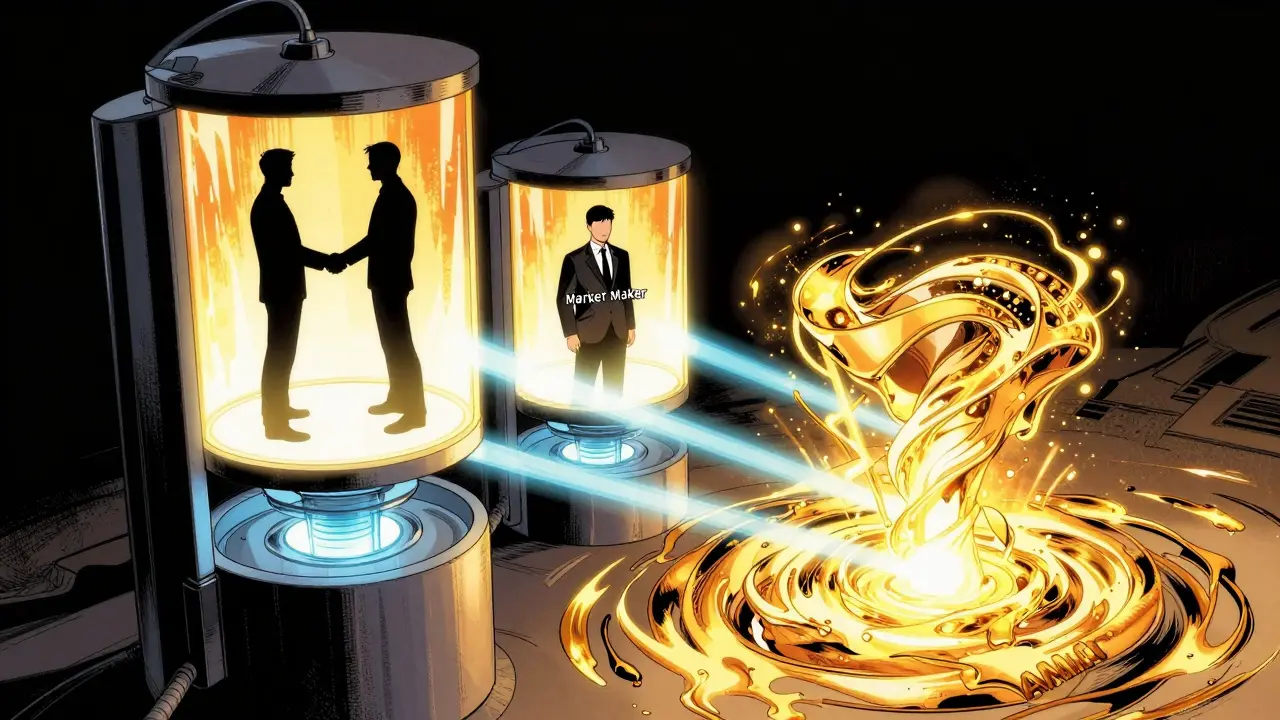
Most decentralized exchanges (DEXs) use an Automated Market Maker (AMM) system. If you've used Uniswap, you know the drill: the price moves based on a mathematical formula. If a pool is shallow, one big buy can spike the price. Gradient tries to bypass this using its Coordinated Order Routing Engine (or CORE) an off-chain matching system that pairs buyers and sellers directly before using a liquidity pool as a last resort . Think of it as a three-layer filter for your trade:- Peer-to-Peer Matching: The system looks for another human or bot wanting the opposite trade at your price. If it finds one, the trade happens without affecting any pool price.
- Market Maker Liquidity: If no peer is found, it taps into designated professional market makers.
- AMM Aggregation: Only if the first two fail does the trade hit the standard AMM pools.
The $GRAY Token: Utility and Tokenomics
At the center of this ecosystem is the GRAY token, an ERC-20 asset built on the Ethereum blockchain used for governance and protocol incentives . If you're checking Etherscan, you'll find it under the contract address 0xa776a95223c500e81cb0937b291140ff550ac3e4. One thing that catches the eye of analysts is the scarcity. The token has a fixed supply of 10 million-no more will ever be minted. In a vacuum, this is great for price potential. However, scarcity doesn't matter if there isn't enough demand for the token's utility. Currently, the token is mostly used for incentives, and critics argue that its long-term value depends entirely on whether the Gradient protocol actually gains users.| Feature | Traditional AMMs | Gradient (GRAY) |
|---|---|---|
| Price Impact | High (based on pool size) | Low (via CORE matching) |
| Execution Method | On-chain Formula | Off-chain Routing $\rightarrow$ On-chain |
| Liquidity Level | Very High | Relatively Low |
| Best Use Case | Major pairs (ETH/USDC) | Low-cap/Niche tokens |
The Reality Check: Does it Actually Work?
Here is where the theory meets the harsh reality of the crypto market. While the CORE architecture is clever, a trading protocol is only as good as its liquidity. If there aren't enough people using Gradient, the "Peer-to-Peer" and "Market Maker" layers are empty. This forces almost every trade into the third layer-the AMM aggregation-which is exactly where the slippage happens. We've seen reports from users on Reddit claiming they experienced 30% slippage on Uniswap while trying to trade GRAY, even though the protocol promises a price-impact free experience. This creates a paradox: the tool designed to fix slippage is currently suffering from it because it lacks the volume to function. From a market perspective, the data is fragmented. Some trackers show a market cap around $17 million, while others put it closer to $2.4 million. This kind of discrepancy usually happens with new or low-volume assets, making it hard for traders to find a stable "fair market value."Investment Outlook and Expert Warnings
If you're considering buying $GRAY, you should be aware that professional analysts are split, but mostly cautious. Quantitative teams, such as those at CoinCodex, have previously flagged the token as "Bearish," citing high volatility and resistance levels. Some analysts have even predicted the token could head toward zero if the ecosystem doesn't grow rapidly. On the other hand, some DeFi specialists believe that if Gradient can secure a strategic partnership to bring in at least $50 million in Total Value Locked (TVL), it could become a powerhouse for niche token trading. Without that liquidity injection, it's essentially a great engine with no fuel.
How to Get Started (and Common Pitfalls)
Using Gradient is relatively straightforward for anyone comfortable with Ethereum the leading smart-contract blockchain platform , but there are a few hurdles.- Wallet Setup: You'll need an Ethereum-compatible wallet (like MetaMask). Be warned: some users have reported connection bugs that require a few restarts of the browser or wallet app to fix.
- Connecting to the Interface: Link your wallet to the Gradient dApp. Ensure you have enough ETH to cover gas fees, as these can spike during high network congestion.
- Executing Trades: Enter the token you want to swap. If the trade is large, check the estimated slippage. If it looks too high, the CORE engine likely hasn't found a peer match.
The Path Forward: CORE 2.0
The project's survival likely hinges on the upcoming "CORE 2.0" upgrade. The roadmap promises better liquidity and cross-chain functionality, which would allow Gradient to move beyond just Ethereum. If they can successfully bridge to other networks and attract professional market makers, they might actually solve the slippage problem for the masses. Until then, Gradient remains a high-risk, high-reward experiment. It's a technically sound idea struggling in a market dominated by giants like 1inch and CowSwap. Whether it becomes a DeFi staple or a cautionary tale depends on its ability to turn technical innovation into actual user adoption.What makes Gradient different from Uniswap?
Unlike Uniswap, which relies solely on an AMM formula that causes price impact for large trades, Gradient uses the CORE engine to match traders peer-to-peer off-chain. This allows users to trade without shifting the price of the asset in a liquidity pool.
Is the GRAY token a good investment?
It is considered high-risk. While the fixed supply of 10 million tokens creates scarcity, the protocol currently suffers from low liquidity and adoption. Most analysts suggest extreme caution unless the project hits its liquidity milestones.
Why are some people reporting high slippage on a "price-impact free" platform?
The CORE engine requires a matching peer or a market maker to eliminate slippage. Because Gradient has relatively low trading volume, many trades fail to find a match and are routed to standard AMM pools, resulting in the same slippage the protocol aims to fix.
What is the contract address for GRAY?
The official ERC-20 contract address for the GRAY token on Ethereum is 0xa776a95223c500e81cb0937b291140ff550ac3e4.
What is CORE 2.0?
CORE 2.0 is a planned upgrade to the Gradient protocol intended to improve liquidity and introduce cross-chain capabilities, allowing the protocol to operate on multiple blockchains instead of just Ethereum.


The CORE architecture is basically trying to implement a Central Limit Order Book (CLOB) efficiency within a DeFi wrapper. It's a classic liquidity bootstrapping problem where the MEV-resistant nature of the off-chain matching only works if you have a massive order flow. Without that organic volume, you're just routing back to the same AMM slippage we all hate. Really hope CORE 2.0 brings some serious cross-chain interoperability to fix this!
How quaint that people actually believe "off-chain matching" is some revolutionary breakthrough in 2024. It is simply a centralized wrapper for a decentralized promise, which is an oxymoron at best and a scam at worst.
Off-chain matching? More like off-chain surveillance. They're just tracking your trades before they hit the chain so the whales can front-run you even harder. This is probably just another layer for the elites to drain the retail liquidity while pretending to "fix" slippage. Wake up people, the contract address is just a honeypot for the globalists!
The market cap discrepancy mentioned is due to the difference between circulating supply and fully diluted valuation. It's basic math.
So it's basically a ghost town right now...!!! Is there any way to see the actual order book for the peer-to-peer layer???
If you're trying to trade this, just be careful with your slippage settings in MetaMask. Since the volume is so low, I've seen people lose a chunk of their trade just because the AMM layer kicked in unexpectedly. Definitely keep it under $100 until CORE 2.0 drops.
it's kind of a poetic tragedy lol. like building a super highway but nobody has cars yet. the tech is sound but crypto is all about the network effect... if no one uses the peer matching, the whole thing is just a fancy way to use Uniswap with extra steps. just hope they dont rug before the update
I totally agree with the need for more TVL. Maybe the team could look into liquidity mining to attract more market makers? That usually helps bridge the gap for new protocols struggling with volume.
Keep trying guys! Just take it slow.
Technical elegance cannot replace human trust. The protocol is a mirror of the current DeFi struggle: over-engineering solutions for problems that are actually just liquidity voids.
Omg the drama of a 30% slippage is just sending me! Like, imagine thinking you're getting a deal and then BOOM, your money is just gone. Absolutely iconic failure!
Only a fool would think these US-based protocols can compete with the grit of Indian devs. Our ecosystem will dwarf this small-time GRAY project soon because we understand the real flow of money unlike these pretenders
the fundamental failure here is the assumption that retail traders care about the mechanism as much as the price action which is a classic mistake in these types of whitepapers because at the end of the day if the chart is dumping no one cares if the routing is peer to peer or not and the lack of a sustainable incentive model for the market makers means the core engine is basically a decorative ornament on a sinking ship
It's so heartbreaking to see such a beautiful vision struggle against the cold reality of the market! It feels like a dance where one partner is missing, and we're all just watching this lonely protocol wait for someone to join in. There is something deeply philosophical about the gap between what we can build and what the world is actually ready to use. I truly hope the creators find the strength to push through to CORE 2.0 because the world needs more innovation that dares to challenge the status quo, even if the path is littered with slippage and broken dreams! We must remain hopeful for the dreamers in the blockchain space!
I believe we can all learn a great deal from this project's journey. While the risks are evident, the ambition to reduce price impact is commendable and provides a wonderful learning opportunity for new DeFi enthusiasts.