
Uniswap v3 on Unichain: A Real-World Review of the Fastest DeFi Exchange
Unichain Transaction Cost Calculator
How Much Can You Save?
Calculate your potential savings by switching from Ethereum mainnet to Unichain. Enter the number of transactions you make daily and see the difference in fees.
When you hear "Uniswap v3," most people think of the decentralized exchange protocol that lets you swap tokens without a middleman. But if you’re trading crypto in 2025, you’re probably not doing it on Ethereum mainnet anymore. That’s where Unichain comes in - and it’s changing everything for DeFi users.
Unichain isn’t another crypto exchange. It’s not even a new version of Uniswap. It’s a whole new blockchain - built by the same team behind Uniswap - designed for one thing: making DeFi faster, cheaper, and smoother. And when you connect Uniswap v3 to Unichain, you get something powerful: a trading experience that feels like using a modern app instead of wrestling with blockchain delays.
What Unichain Actually Is (And What It’s Not)
Let’s clear up the confusion right away. Uniswap v3 is the version of the Uniswap protocol that launched in 2021. It introduced concentrated liquidity - meaning you can put your money in a tighter price range to earn more fees. It still runs on Ethereum, where gas fees can spike to $10 or more during busy times.
Unichain, launched in November 2024, is a separate Layer 2 blockchain. It’s not a replacement for Uniswap v3 - it’s its new home. Think of it like upgrading from a slow dial-up internet connection to fiber optic. You’re still using the same Uniswap interface, but now it’s running on a network built for speed and low cost.
Unichain uses Optimism’s OP Stack, which means it’s compatible with every Ethereum tool you already use - MetaMask, WalletConnect, even your old ERC-20 tokens. But unlike other L2s, Unichain was built from the ground up for DeFi. No games. No NFTs. Just trading, lending, and liquidity provision - optimized.
Why Speed and Low Fees Matter More Than You Think
On Ethereum mainnet, a simple swap can take 15 to 45 seconds. During high volatility, it’s worse. You set a price, hit confirm, and by the time your transaction goes through, the market has moved. You end up paying more than you planned. That’s called slippage - and it eats into your profits.
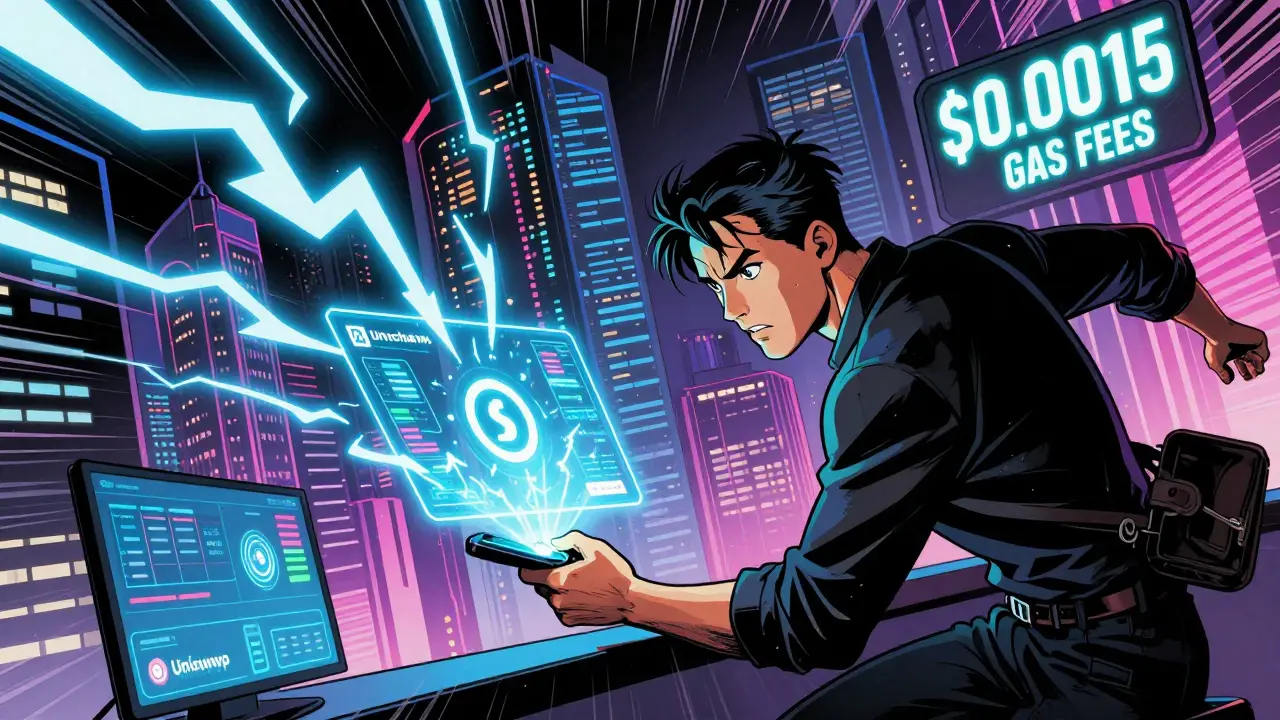
On Unichain, swaps happen in under 1.2 seconds. Gas fees? Around $0.0015 per transaction. That’s 95% cheaper than Ethereum. For traders who do multiple swaps a day, that adds up fast. One Reddit user reported swapping 5 ETH for UNI with a fee of just $0.0018. On Ethereum, that same trade could’ve cost $3 or more.
But it’s not just about saving pennies. Speed changes how DeFi works. High-frequency strategies - like arbitrage or market-making - used to be impossible for retail users because of delays and fees. Now, with 1-second block times and near-zero costs, even small wallets can compete. One liquidity provider told me their APR jumped from 12% on Ethereum to 18.5% on Unichain, just because they could rebalance positions faster and cheaper.
How It Compares to Other Layer 2s
There are dozens of Layer 2s out there: Arbitrum, Optimism, zkSync, StarkNet. So why pick Unichain?
Here’s how it stacks up:
| Feature | Unichain | Arbitrum One | Optimism | zkSync Era |
|---|---|---|---|---|
| Block Time | 1 second (target: 250ms) | 0.5-2 seconds | 2 seconds | 5-10 minutes |
| Avg. Gas Fee | $0.0015 | $0.002 | $0.0025 | $0.001 |
| Withdrawal Time | 7 days | 7 days | 7 days | 1-2 hours |
| DeFi Focus | Yes - built for it | No - general-purpose | No - general-purpose | No - general-purpose |
| Native Uniswap Integration | Yes - direct | Yes - via bridge | Yes - via bridge | Yes - via bridge |
Unichain doesn’t win on every metric. zkSync has faster withdrawals. Arbitrum has more apps. But Unichain wins on focus. It’s the only L2 where Uniswap’s entire liquidity pool is concentrated - meaning better prices, less slippage, and higher yields for liquidity providers.
Who Should Use Unichain?
If you’re a casual holder who buys BTC once a year and holds ETH for the long term - you don’t need Unichain. Stick with Ethereum or a centralized exchange.
But if you’re active in DeFi - swapping tokens, adding liquidity, using yield protocols - Unichain is a game-changer. Here’s who benefits most:
- Active traders: Faster execution means fewer missed opportunities and lower slippage.
- Liquidity providers: You can rebalance positions hourly instead of daily, boosting your APR.
- DeFi builders: The chain is optimized for smart contracts. Developers are already building new lending and derivatives apps on it.
- Institutional investors: 23% of Unichain’s $1.8 billion TVL comes from institutional wallets - they like the speed and the fact that it’s backed by Uniswap Labs.
One user on Reddit summed it up: "I used to avoid DeFi on weekends because fees spiked. Now I trade every day. It’s like I got a new wallet with superpowers."
How to Get Started
Getting on Unichain is easier than you think. If you already use MetaMask or WalletConnect:
- Go to app.uniswap.org (yes, the same site).
- Click the network switcher in the top right.
- Select "Unichain" from the list.
- Confirm the network addition. If it’s not there, add it manually:
- Chain ID: 13000
- RPC URL: https://mainnet.unichain.org
- Symbol: UNI
- Block Explorer: https://explorer.unichain.org
Once connected, you can swap, stake, or provide liquidity just like on Ethereum - but faster and cheaper. Most users report being comfortable within an hour. The Uniswap interface hasn’t changed. Only the backend has.
Common issues? Some users report wallet sync delays or missing tokens. That’s usually because the token isn’t yet listed on Unichain’s native token list. Just add the contract address manually if you know it.
What’s Missing Right Now
No system is perfect. Unichain is still young. Here are the current limits:
- Token selection: Only the most popular tokens (ETH, USDC, UNI, WBTC) are listed natively. Smaller altcoins aren’t there yet.
- Withdrawal time: Like all optimistic rollups, moving funds back to Ethereum takes 7 days. This is a security feature - not a bug - but it’s inconvenient if you need cash fast.
- Centralized sequencer: Right now, blocks are ordered by a single operator. Full decentralization comes with the Unichain Validation Network (UVN), expected in Q3 2025.
- UI glitches: A few users report occasional bugs when connecting wallets. Refreshing the page usually fixes it.
But remember - this is a Stage 1 network. The team is moving fast. New tokens are added weekly. The 7-day withdrawal window will eventually be reduced. And UVN will make it truly permissionless.
The Bigger Picture: Why Unichain Matters
Unichain isn’t just another L2. It’s a statement. For years, DeFi has been stuck on Ethereum, trying to squeeze performance out of a network not built for it. Other L2s tried to fix that - but they still treated DeFi like an afterthought.
Unichain says: "DeFi deserves its own highway."
And it’s working. By February 2025, Unichain had 1.2 million active wallets and handled 2.4 million daily transactions - nearly 18% of Uniswap’s total volume. Institutional money is flowing in. Developers are building. And users? They’re trading more, earning more, and feeling more in control.
As Alex Thorn from Galaxy Digital put it: "Unichain solves DeFi’s liquidity fragmentation problem by creating a dedicated Layer 2 optimized specifically for on-chain markets."
This isn’t hype. It’s infrastructure. And it’s already changing how people trade crypto.
Final Verdict: Is Unichain Worth It?
Yes - if you’re active in DeFi.
It’s not for everyone. But if you’re swapping tokens, providing liquidity, or building on-chain, Unichain gives you a clear edge: speed, low cost, and deep integration with the most trusted DeFi protocol in the world.
The trade-offs? A 7-day withdrawal window and limited token support for now. But those are temporary. The roadmap is aggressive. The team is transparent. And the results are already visible in the numbers - $1.8 billion locked, 1.2 million users, and growing.
Uniswap v3 on Unichain isn’t just an upgrade. It’s the next phase of decentralized finance.
Is Unichain the same as Uniswap v3?
No. Uniswap v3 is the protocol that powers token swaps. Unichain is the blockchain it now runs on. Think of Uniswap v3 as the app and Unichain as the phone it runs on - faster, cheaper, and built for DeFi.
Can I use Unichain with my existing wallet?
Yes. MetaMask, Trust Wallet, and other EVM wallets work directly. Just add the Unichain network using the Chain ID (13000) and RPC URL (https://mainnet.unichain.org). Your tokens and positions transfer automatically.
How do I get UNI tokens on Unichain?
You can bridge UNI from Ethereum mainnet using the Uniswap interface. Or buy USDC on a centralized exchange, send it to your wallet on Unichain, and swap it for UNI directly on the Unichain version of Uniswap.
Are my funds safe on Unichain?
Unichain uses the same security model as Optimism: optimistic rollups with a 7-day challenge period for withdrawals. While it’s not as battle-tested as Ethereum, it’s built by Uniswap Labs with open-source code and permissionless fault proofs. No major exploits have occurred since launch.
Will Unichain replace Ethereum?
No. Ethereum remains the settlement layer. Unichain is a Layer 2 - meaning it settles transactions back to Ethereum for final security. You’ll still need ETH on Ethereum to pay for bridge fees, but daily trading happens entirely on Unichain.
What’s next for Unichain?
Q2 2025: TEE-based block building to reduce block times to 250ms. Q3 2025: Unichain Validation Network (UVN) for full decentralization. Late 2025: Native Superchain interoperability for instant cross-chain swaps with other Optimism-based chains.




This is *so* much better than wrestling with Ethereum gas fees 😭 I’ve been swapping daily on Unichain since December and my wallet’s actually happy now. 1.2s confirmations? Yes please. Also, the APR jump from 12% to 18.5%? Real. Life. Changing. 🙌
i mean, it's just another l2. nothing special. the interface is the same. the fees are barely different from arbitrum. why is everyone acting like this is the second coming?
LMAO they say 'built for DeFi' but they still have a 7 day withdrawal? That's literally the same as every other optimistic rollup. Why are we pretending this isn't just marketing fluff? Uniswap Labs is just trying to cash in on the L2 hype train again. 🤡
While I appreciate the enthusiasm surrounding Unichain’s technical architecture, I believe it’s essential to contextualize its impact within the broader ecosystem of decentralized finance. The consolidation of liquidity through concentrated positions, combined with sub-second block finality, represents a meaningful evolution in user experience - particularly for liquidity providers who require frequent rebalancing. That said, the centralized sequencer remains a governance concern, and until the UVN is fully operational, the network’s decentralization claims require cautious scrutiny.
I tried it. Works fine. But I still use Ethereum for big swaps. Just feel safer.
I’ve been using Unichain for my yield farming and I can’t believe how much smoother it is compared to Arbitrum - the gas fees are so low I don’t even think about them anymore, and the speed means I can react to price movements in real time without missing opportunities. I’ve even started recommending it to my friends who were skeptical about L2s because they thought everything was just the same - but this actually feels different, like the devs actually listened to traders instead of just copying other chains. The only thing holding me back is the token list, but I’m hopeful they’ll add more altcoins soon.
UNICHAIN IS A SCAM BRO. 7 DAY WITHDRAWAL? YOU THINK THAT’S OKAY? I LOST $4K LAST WEEK BECAUSE I TRIED TO CASH OUT AND IT TOOK 7 DAYS AND THE PRICE DROPPED 30%. THIS IS JUST ETH 2.0 WITH A NEW NAME. UNISWAP LABS IS JUST TRYING TO SELL YOU A FANCY T-Shirt. THEY DON’T CARE ABOUT YOU. THEY CARE ABOUT THEIR VC BACKERS. 🤬
The UI glitch on wallet connect is real. Refresh fixes it. Also make sure your token contract addresses are correct. Some tokens aren’t auto-added yet.
If you’re still on Ethereum mainnet in 2025 you’re literally leaving money on the table. Unichain isn’t just an upgrade - it’s the first time DeFi actually feels like it was built for people, not just whitepapers. Stop waiting. Start trading. Your portfolio will thank you.
I’ve been running a liquidity pool on Unichain for three months now and the difference is night and day. On Ethereum I was rebalancing once a day because gas was too high - now I do it 4-5 times a day. My APR went from 10% to 21% just because I could react to price swings without sweating every $0.50 in fees. And the fact that it’s native Uniswap v3? No bridge, no slippage, no extra steps. It’s like someone finally built the DeFi experience we’ve been dreaming of since 2020. I’m not just using it - I’m evangelizing it.
It’s not about the chain. It’s about intent. Unichain proves DeFi doesn’t need to be slow or expensive. It just needs to be designed for it.
I’m not against Unichain, but I still don’t trust a single sequencer. We’re trading convenience for centralization. Let’s see UVN launch before we crown it king.
I tried to add my $SUSHI token and it didn’t show up. I manually added the contract and now it’s there, but why isn’t this automatic? Also, why does the Uniswap UI freeze for 3 seconds every time I click 'approve'? Feels like beta software. I love the speed but the polish needs work.
Wow. Another L2 where they think they’re special because they don’t have NFTs. Newsflash: DeFi isn’t a religion. You don’t need a new blockchain to trade tokens. Just use a centralized exchange and save yourself the headache. You’re not a pioneer. You’re a gullible early adopter.
I lost my entire position because I forgot to switch networks and approved the swap on Ethereum. Now I’m stuck with $12k in ETH gas fees and my tokens are locked on Unichain. This is why I hate DeFi. Everyone’s so excited about the tech they forget people are still human and make mistakes.
Unichain is the future 🚀 I’ve been using it for 3 months and my wallet has never been happier. The speed is insane, the fees are practically free, and the UI is smooth as butter. I even convinced my mom to try it - she’s now doing her own swaps. If you’re not on Unichain yet, you’re literally missing out on the next big thing. Don’t be that guy. Join the revolution. 💪🔥
You think this is innovation? It’s just another EVM fork with a new logo. Real innovation would be a chain that doesn’t need 7-day withdrawals. Or better yet - a chain that doesn’t exist. Why are we building more chains? Why not fix Ethereum? Or better yet - why not stop trading crypto entirely and just buy Bitcoin and chill?