
Uniswap (USWAP) Crypto Exchange Review: Is It Safe for Beginners in 2026?
Have you ever typed "USWAP" into a search bar and wondered if you found the right platform? You likely meant Uniswap, which is the leading decentralized exchange protocol that allows users to swap cryptocurrencies without a central authority. Often misspelled as USWAP, this platform has become the backbone of decentralized finance (DeFi). But here is the real question: is it actually safe and easy enough for you to use today?
If you are used to traditional exchanges like Coinbase or Binance, Uniswap feels different. There are no login screens, no customer support chatbots, and no company holding your money. Instead, you connect your own digital wallet and trade directly with smart contracts on the blockchain. This guide breaks down exactly how Uniswap works, what it costs, and whether it fits your trading style in 2026.
What Is Uniswap and How Does It Work?
To understand Uniswap, you first need to drop the idea of a traditional order book. In a regular stock market or centralized crypto exchange, buyers and sellers match orders based on price. Uniswap uses an Automated Market Maker (AMM), which is a system that uses mathematical formulas and liquidity pools instead of human buyers and sellers to determine prices.
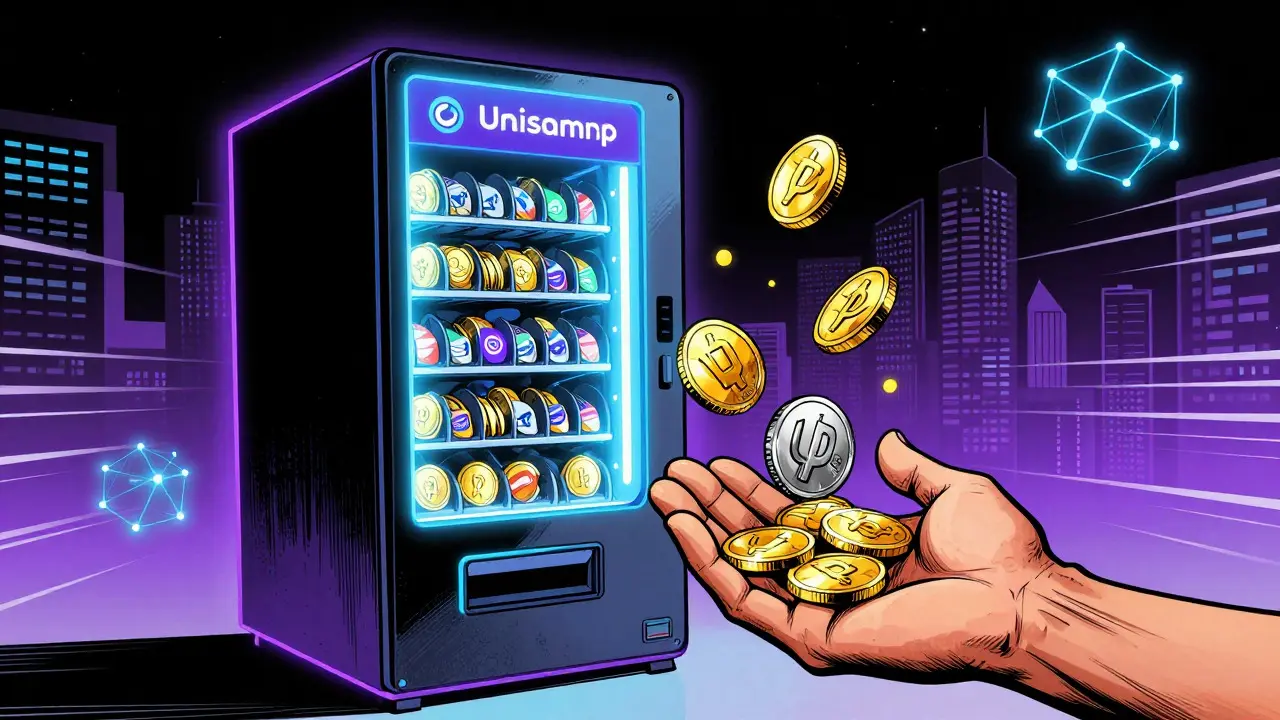
Think of it like a vending machine. You don't negotiate with anyone. You put in ETH, and the machine gives you USDC based on the ratio of assets currently in the pool. These pools are funded by everyday people called liquidity providers who deposit their crypto to earn a share of the trading fees. This model means trading never stops and anyone can access it globally, provided they have an internet connection and a compatible wallet.
Founded by Hayden Adams in 2018, Uniswap has evolved through several versions. The current standard, Uniswap V3, introduced concentrated liquidity. This feature lets providers place their capital within specific price ranges, making their money work up to 4,000 times more efficiently than before. For you as a trader, this means tighter spreads and better prices for major tokens like Ethereum and stablecoins.
Fees and Costs: What Will You Actually Pay?
Costs are where many beginners get tripped up. Uniswap charges a fee for every swap, but unlike centralized exchanges, these fees go directly to the liquidity providers, not to a corporate headquarters. The fee structure depends on the type of tokens you are swapping:
- Stablecoin pairs (e.g., USDC/USDT): 0.01% fee
- Semi-stable pairs (e.g., ETH/stablecoin): 0.05% fee
- Standard pairs (most ERC-20 tokens): 0.3% fee
- Exotic or volatile tokens: 1% fee
A 0.3% fee sounds low compared to some centralized platforms charging 0.6% or more. However, there is a hidden cost: Gas Fees, which are network transaction costs paid to validators to process your transaction on the blockchain.
If you trade on the Ethereum mainnet, gas fees can range from $1.50 to over $50 during busy periods. This makes small trades unprofitable. That is why most savvy users now use Layer 2 networks or alternative chains. For example, swapping on Polygon might cost you just $0.02 in gas, while Arbitrum and Optimism offer similar savings. Always check which network you are connected to before confirming a swap.
| Feature | Uniswap (DEX) | Coinbase Advanced (CEX) | PancakeSwap (DEX) |
|---|---|---|---|
| Standard Swap Fee | 0.3% | 0.6% (for low volume) | 0.25% |
| Network Gas Fee (Ethereum) | $1.50 - $50+ | $0 (included in spread) | N/A (BNB Chain) |
| Network Gas Fee (Layer 2/Polygon) | $0.02 - $0.50 | N/A | $0.05 - $0.20 |
| KYC Required? | No | Yes | No |
| Fiat On-Ramp | No (use third-party) | Yes | Limited |
Security: Who Holds Your Keys?
The biggest advantage of Uniswap is security through non-custodial design. When you use a centralized exchange, you are trusting that company not to hack, fail, or freeze your account. With Uniswap, your funds stay in your personal wallet until the exact moment of the swap. If the website goes down, your money is still safe in your wallet.
This eliminates the risk of exchange insolvency, a problem that caused billions in losses for users of centralized platforms like FTX and Celsius in recent years. Uniswap's smart contracts have been audited by top firms like OpenZeppelin and Trail of Bits. As of late 2025, there have been no major exploits of the core V3 protocol since its launch.
However, "not your keys, not your coins" also means "you are responsible for everything." If you send tokens to the wrong address, there is no customer support team to call. If you click a phishing link and approve a malicious contract, your funds can be drained instantly. Security on Uniswap relies entirely on your vigilance. Always verify URLs, use hardware wallets like Ledger for large amounts, and double-check slippage settings.
User Experience: Is It Beginner Friendly?
Let's be honest: Uniswap is not designed for total novices. If you expect a simple "Buy Bitcoin" button linked to your bank account, you will be frustrated. The interface requires you to understand concepts like slippage tolerance, gas limits, and network selection.
Data from user surveys in 2025 shows that 78% of experienced DeFi users rate Uniswap highly, while only 42% of beginners feel satisfied after their first week. The learning curve is steep. You need to set up a wallet like MetaMask or Trust Wallet, fund it with ETH or MATIC for gas, and then connect it to the app.uniswap.org site.
That said, the interface itself is clean and intuitive once you grasp the basics. You select the token you want to give, choose the token you want to receive, and hit swap. The platform supports over 50 wallet providers, making integration seamless for those already in the ecosystem. For absolute beginners, spending five hours learning about wallet security and gas fees is a wise investment before putting any real money at risk.
Uniswap vs Competitors: Where Does It Stand?
In 2026, Uniswap remains the dominant force in decentralized trading, processing over $1.2 billion in daily volume across 11 blockchains. It holds roughly 58% of the total DEX market share. But competition is heating up.
PancakeSwap, which is a popular decentralized exchange built primarily on the BNB Chain known for lower fees and yield farming opportunities, offers cheaper transactions on its native chain but lacks the deep liquidity of Ethereum-based pairs. Newer entrants like Aster are introducing features like MEV-aware routing and hidden orders, which protect traders from front-running bots-a common issue on Uniswap.
Despite these rivals, Uniswap's depth of liquidity is unmatched. If you are swapping large amounts of ETH or USDC, Uniswap typically offers the best price with minimal slippage. For obscure meme tokens or new launches, other DEXs might have more initial liquidity, but for established assets, Uniswap is the gold standard.

How to Start Trading on Uniswap: A Step-by-Step Guide
Ready to try it? Here is the safest path to your first swap:
- Get a Wallet: Download MetaMask or Trust Wallet. Secure your seed phrase offline.
- Fund Your Wallet: Buy ETH on a centralized exchange and send it to your wallet. Alternatively, buy MATIC or ARB if you plan to trade on Layer 2s.
- Connect to Uniswap: Go to app.uniswap.org (verify the URL carefully!). Click "Connect Wallet" and approve the connection.
- Select Networks: Switch your wallet network to Polygon or Arbitrum to save on gas fees.
- Execute the Swap: Choose your input and output tokens. Adjust slippage tolerance if needed (usually 0.5% for stable pairs, higher for volatile ones).
- Confirm: Review the details in your wallet pop-up and confirm the transaction.
Remember, your first swap might take a few minutes to learn. Do not rush. Start with a small amount to test the waters.
Future Outlook: What Comes Next?
Uniswap is not standing still. Version 4 (V4) is scheduled for release in early 2026. This update will introduce "hooks," allowing developers to customize pool behavior with greater precision. This could lead to specialized pools for specific strategies, further enhancing efficiency.
Regulatory clarity is also improving. After settling with the SEC in 2025 regarding governance tokens, the protocol operates in a clearer legal space, though it remains non-custodial. Institutional adoption is growing, with nearly 17% of volume now coming from larger players. If you are looking for a secure, transparent, and powerful way to trade crypto without handing over control, Uniswap remains the top choice in 2026.
Is USWAP the same as Uniswap?
Yes, "USWAP" is a common misspelling of Uniswap. There is no major exchange officially named USWAP. Always ensure you are visiting app.uniswap.org to avoid scams.
Do I need to pay KYC to use Uniswap?
No. Uniswap is a decentralized protocol that does not require Know Your Customer (KYC) verification. You only need a cryptocurrency wallet to trade.
Why are my gas fees so high on Uniswap?
If you are trading on the Ethereum mainnet, gas fees depend on network congestion. To reduce costs, switch to Layer 2 networks like Arbitrum, Optimism, or Base, or use Polygon, where fees are significantly lower.
Can I lose all my money on Uniswap?
While the protocol itself is secure, you can lose money through user error (sending to wrong addresses), interacting with scam tokens, or falling for phishing sites. Always verify URLs and use reputable wallets.
Does Uniswap support buying crypto with a credit card?
Not directly. Uniswap is a peer-to-peer exchange. To buy crypto with fiat, you must use a centralized exchange or a third-party on-ramp service integrated into your wallet, then transfer those funds to Uniswap.

Look, everyone is so obsessed with the 'decentralized' buzzword that they forget the actual mechanics of how these things work. You think you're trading directly on-chain without a middleman? Please. The liquidity providers are effectively the market makers, and they charge you a spread that is often wider than what you'd get on a CEX if you look at the real slippage during volatile hours. I've been doing this since 2018, and let me tell you, the narrative that Uniswap is the holy grail of freedom is mostly marketing fluff designed to keep retail users away from institutional-grade platforms where the real volume happens. It's not about safety; it's about who gets to set the price discovery mechanism, and right now, it's a bunch of anonymous whales manipulating concentrated liquidity ranges to front-run your trades.
i totally agree with nick! i tried using uniswap last week and it was such a mess. the gas fees were insane even on layer 2s sometimes. why do we need all this complexity just to swap tokens? centralized exchanges are so much easier for normal people like me who just want to buy some eth without reading a whitepaper first :)
While Nick raises valid points regarding liquidity depth in certain edge cases, dismissing the entire non-custodial model as 'marketing fluff' ignores the fundamental shift in ownership that DeFi represents. For those willing to learn, the ability to hold your own keys provides a level of security against exchange insolvency that no centralized entity can match. Remember FTX? That wasn't a glitch; it was a feature of custodial risk. Uniswap allows you to bypass that entirely. The learning curve is steep, yes, but the reward is true financial sovereignty. Start small, use Layer 2 networks like Arbitrum to minimize costs, and gradually build your understanding of slippage and gas dynamics. It is an empowering journey once you grasp the basics.
hmm interesting discussion :) i am from india and here most people still prefer binance or coinbase because its simple. but i heard about uniswap and it sounds cool that no one controls your money. maybe i will try it when i have more crypto to spare. the gas fees scare me though :(
The very notion of 'safety' in decentralized finance is a paradox wrapped in an enigma. You seek refuge from the tyrannical grip of centralized authorities, yet you fear the chaotic abyss of self-custody. Is it truly safe if you must become your own bank, your own auditor, and your own savior? Uniswap offers a mirror to your own incompetence; if you lose your seed phrase, the blockchain does not care. It is a philosophical test of human fallibility against immutable code. Most fail. They cling to their comfortable cages because the freedom of the open ledger is too terrifying for the average mind.
Hey guys! 👋 Just wanted to chime in. I’ve been using Uniswap on Polygon for months and it’s super smooth! 🚀 The fees are basically nothing compared to Ethereum mainnet. If you’re worried about cost, definitely switch to a Layer 2. It’s like night and day. Keep exploring! ✨💸
Indeed; the transition to Layer 2 solutions is imperative for the mass adoption of decentralized exchanges. The economic inefficiency of Ethereum mainnet gas fees has long been a barrier to entry for the average investor. However, one must remain vigilant. While the fees are lower, the security assumptions of these bridged networks are not identical to the base layer. Proceed with caution, verify your connections, and always double-check the contract addresses before interacting. Knowledge is power, and diligence is the shield.
We live in an age where convenience is worshipped above all else. People hand over their digital souls to corporations because they are afraid of a little responsibility. Uniswap demands respect for the technology. It demands you read the fine print. It demands you understand that there is no customer service hotline to save you from your own stupidity. This is not a flaw; it is a moral imperative. To use it is to accept the burden of truth. Are you ready to bear that weight?
the paradigm shift is undeniable. we are moving from trust-based systems to verification-based systems. the cognitive load required to navigate DEXs is high but necessary for true autonomy. most users are sleepwalking into custodial risks. wake up. the protocol doesn't lie.
Don't be fooled by the 'open source' fairy tale. The core contracts may be audited, but the frontend is a honeypot for phishing attacks. The SEC settlement didn't clear the air; it just gave them a license to operate in the shadows while MEV bots extract value from every single transaction you make. You are not the customer; you are the product being mined by sophisticated arbitrage algorithms. The decentralization is a facade maintained to prevent regulatory crackdowns while the insiders profit from your ignorance.
boring. too many words. just say if its safe or not.
Safe is relative. If you click the right link, yes. If you don't, no. It's like asking if a car is safe. Depends on if you know how to drive. Most people here talk like experts but probably lost money to a rug pull last year. Simple truth: you hold the keys, you hold the risk. Stop whining and learn or stay on Coinbase.
I actually found the interface quite intuitive once I watched a few tutorials. The step-by-step guide in the article was helpful, especially the part about checking the URL. It’s scary at first thinking about losing funds forever, but setting up a hardware wallet gives me peace of mind. I started with tiny amounts on Arbitrum just to see how it felt, and now I feel pretty confident swapping stablecoins. It’s a bit of a hurdle, but I think it’s worth it for the control.
You call it control I call it liability. Why should I deal with gas fees and seed phrases when I can just log in with email? The whole ethos is pretentious. Real life isn't about 'sovereignty' it's about getting things done. Uniswap is a toy for nerds who hate efficiency.
Oh, Candice, you sweet summer child. Efficiency is the opiate of the masses, blinding you to the glorious chaos of the decentralized frontier! To surrender your keys is to surrender your soul to the corporate overlords who watch your every move. Yes, it is difficult. Yes, it is tedious. But oh, the ecstasy of knowing that no government, no CEO, no bank manager can freeze your assets with a snap of their fingers! Embrace the struggle, my friend. It is the fire that forges true wealth and independence. Dance in the flames of volatility!
Hey folks! :) Don't let the negativity get you down. If you're new, start slow. Use MetaMask, connect to Polygon, and try swapping $5 worth of tokens. It’s a great way to learn without risking much. And hey, check out Revoke.cash after you’re done to keep your wallet clean. Happy swapping! :D
LISTEN UP!!! If you are going to use Uniswap, DO IT RIGHT! Get a Ledger NOW! Do not leave your private keys on your computer! You think you are safe? YOU ARE NOT! The hackers are waiting! Verify every single transaction! Check the slippage! Check the network! If you are lazy, go back to Binance and cry about fees! But if you want real power, you put in the work! No excuses! GO!
Phil makes a strong point about vigilance. While the tone is intense, the advice is sound. Hardware wallets are non-negotiable for significant holdings. It is better to be paranoid than poor in this space. Keep learning and stay safe everyone.