
Quantum-Safe Blockchain Projects: What’s Real, What’s Coming, and Who’s Leading the Charge
Imagine a future where your digital assets - your Bitcoin, your NFTs, your smart contracts - are no longer secure. Not because someone hacked your wallet, but because a quantum computer cracked the math that protects them. This isn’t science fiction. It’s a real, looming threat. And while most people still think of blockchain as just a ledger for crypto, a growing number of projects are building something far more urgent: quantum-safe blockchain systems that can survive the next computing revolution.
Right now, nearly every blockchain in use relies on public-key cryptography - algorithms like ECDSA and RSA. These are the same ones that keep your bank login safe, your emails encrypted, and your digital signatures valid. But quantum computers, when they reach full power, can break them in minutes. Not years. Minutes. And since blockchains store data forever, anything signed today with vulnerable crypto could be stolen decades from now. That’s why quantum-safe blockchain projects aren’t just futuristic ideas - they’re critical infrastructure projects happening right now.
What Does "Quantum-Safe" Actually Mean?
"Quantum-safe" doesn’t mean "immune to all future tech." It means using cryptographic algorithms that even quantum computers can’t crack - at least not with any known method. These are called post-quantum cryptography (PQC) algorithms. The big shift came in July 2022, when NIST, the U.S. standards body, picked its first set of PQC standards: CRYSTALS-Kyber for encrypting data and CRYSTALS-Dilithium for digital signatures. These aren’t theoretical. They’re the new global baseline.
Before this, projects used different math - like hash-based signatures (XMSS) or code-based systems. Now, most serious players are building around Kyber and Dilithium. Why? Because they’re standardized, tested, and backed by governments and tech giants. If you’re building a blockchain today and you’re not using these, you’re already behind.
Project Zond: Making Ethereum Quantum-Safe Without Rewriting Everything
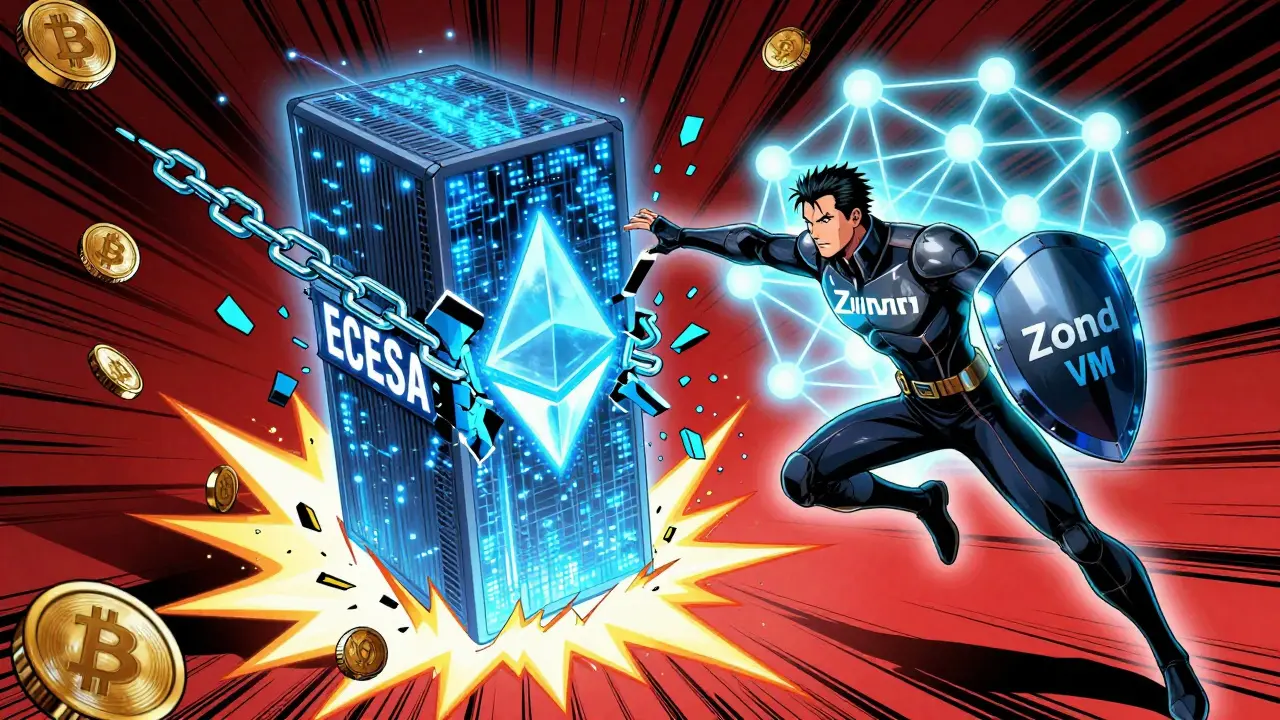
One of the most clever approaches came from Project Zond, unveiled at ETHDenver in March 2025. Ethereum has over 100,000 smart contracts and millions of users. Rewriting all of it for quantum resistance? Impossible. So Zond did something smarter: it built a new virtual machine - the Zond Virtual Machine (ZVM) - that works almost identically to Ethereum’s EVM.
Developers don’t need to learn new languages. They don’t need to refactor their code. They just deploy their existing Solidity smart contracts to the ZVM - and suddenly, they’re protected by Dilithium signatures. The ZVM handles the heavy crypto work under the hood. This isn’t just a technical win. It’s a practical one. It means Ethereum’s entire ecosystem - DeFi apps, NFT marketplaces, DAOs - can upgrade to quantum safety without breaking anything. It’s like swapping out the engine of a car while it’s still driving.
Quantum Resistant Ledger (QRL): The First Pure Quantum-Proof Crypto
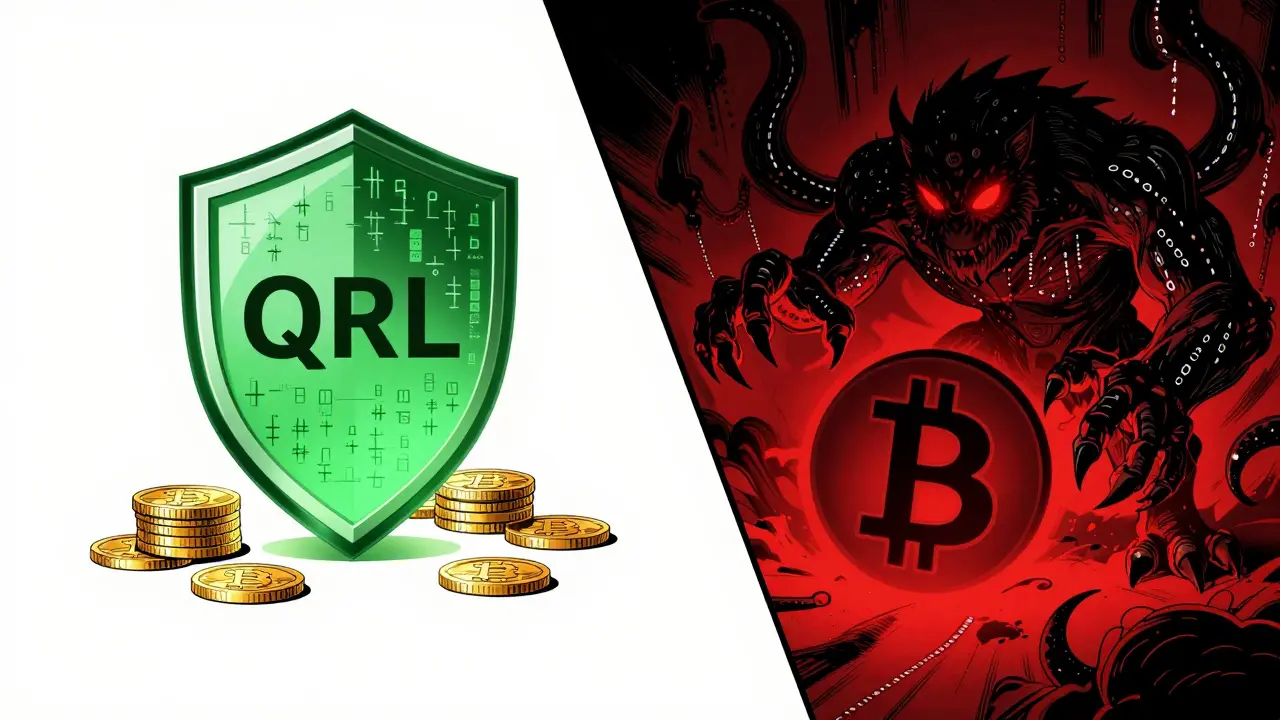
If Project Zond is about retrofitting, then Quantum Resistant Ledger (QRL) is about starting from scratch. Launched in 2018, QRL was one of the first blockchains designed from the ground up to be quantum-resistant. It uses XMSS, a hash-based signature scheme that NIST later endorsed for PQC. Unlike lattice-based algorithms like Dilithium, XMSS signatures are smaller and simpler - around 400 bytes, compared to Dilithium’s 2-5 kilobytes. That means less storage, lower fees, and faster transactions.
But there’s a trade-off. XMSS is great for signatures, but it doesn’t handle encryption well. So QRL focuses on securing transactions and wallet addresses - the most critical part. It doesn’t try to do everything. It does one thing exceptionally well: make sure your coins can’t be stolen by a quantum computer, today or in 2040. The QRL community is small but active, with developers regularly contributing to its open-source codebase. It’s not flashy. But it’s one of the few blockchains you can say with confidence: "This won’t break when quantum computers arrive."
Diamante: Enterprise-Grade Quantum Security for Institutions
While QRL and Zond target public blockchains, Diamante is built for banks, governments, and corporations. It’s not a public chain. It’s a hybrid - part permissioned, part trustless. Think of it as a private blockchain with public blockchain security. Its entire base layer runs on NIST-standardized Kyber and Dilithium. No retrofitting. No compromises.
Why does this matter? Because enterprises don’t just care about security - they care about compliance, audit trails, and data privacy. Diamante gives them all of that, wrapped in quantum-safe crypto. It’s not for casual users. But for a hospital storing patient records or a government agency managing land titles, this is the only way forward. The catch? Larger signature sizes mean higher transaction costs and slower processing. Diamante mitigates this with optimized consensus and off-chain data handling, but it’s still a trade-off: more security, more overhead.
Bitcoin and Ethereum: The Giants Are Watching
Bitcoin doesn’t have a quantum-safe blockchain - yet. But it’s not ignoring the threat. Researchers have been studying how to replace ECDSA with Schnorr signatures (already partially adopted in Taproot) and eventually move to PQC algorithms. The problem? Bitcoin’s governance is slow. Changing its core crypto requires near-universal consensus. That’s hard. But experts agree: if Bitcoin doesn’t act before 2030, it risks becoming obsolete.
Ethereum is further along. Beyond Project Zond, its roadmap includes "crypto-agility" - the ability to swap out algorithms without a hard fork. This is huge. It means Ethereum won’t be stuck with one crypto standard forever. If a better PQC algorithm emerges in 2030, Ethereum can adopt it. Bitcoin can’t do that. Ethereum’s flexibility gives it a long-term edge.
Why This Matters More Than You Think
You might think, "I don’t hold crypto. Why should I care?" Here’s the truth: blockchain isn’t just about Bitcoin. It’s about digital identity, supply chains, voting systems, and legal contracts. If the foundation of digital trust collapses because of quantum computing, everything built on it collapses too.
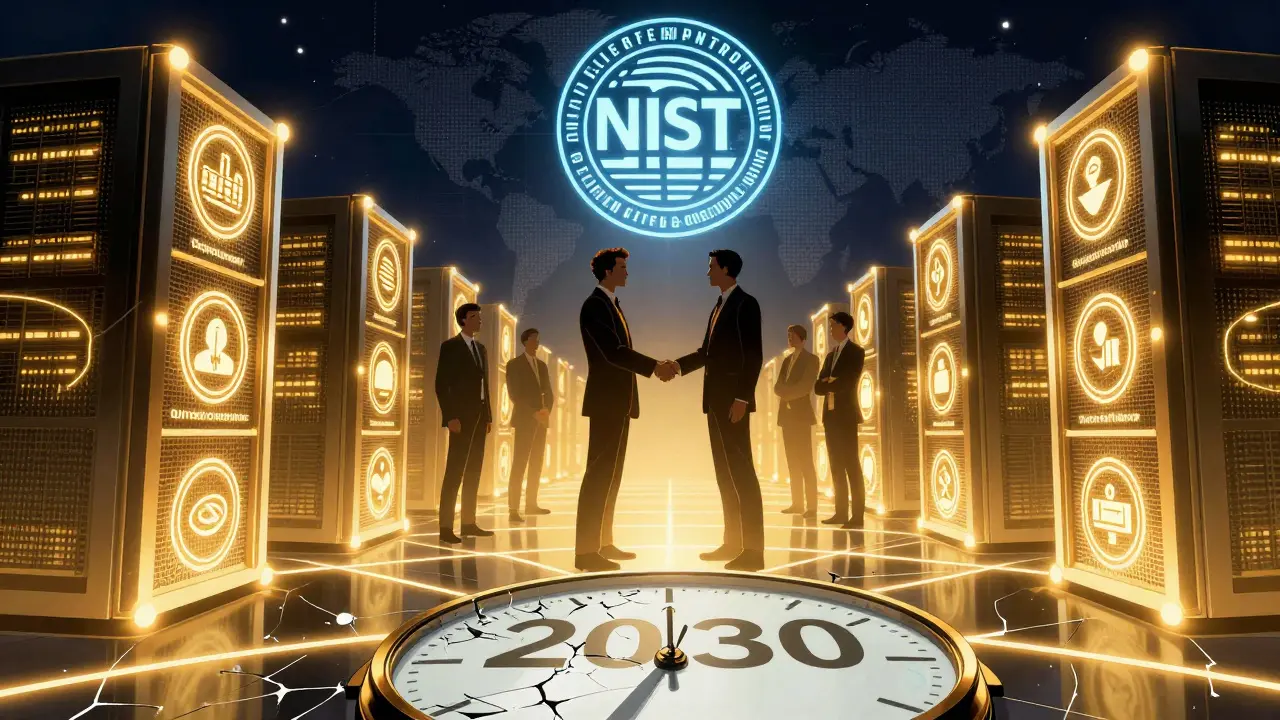
Microsoft’s security team says we have until 2033 to fully transition to quantum-safe systems. That’s not a deadline - it’s a warning. Why? Because it takes years to update software, reissue certificates, and train developers. If you wait until 2032, it’s too late. The same applies to blockchain. Projects that started building quantum-safe systems in 2023 are already ahead. Those waiting until 2027 will be scrambling.
And it’s not just about tech. Regulators are watching. The European Union’s ETSI/IQC conference in June 2025 brought together governments, banks, and tech firms to align on standards. This isn’t a niche topic anymore. It’s a global priority.
The Hidden Costs of Quantum Resistance
There’s no free lunch. Quantum-safe crypto comes with trade-offs:
- Larger keys and signatures: Dilithium signatures are 20-50 times bigger than ECDSA. That means more data stored on-chain, slower syncing, higher fees.
- Higher compute load: Verifying a PQC signature uses 2-10x more processing power than classical crypto. This strains node performance.
- Wallet and exchange support: Most wallets don’t yet support PQC. If your exchange doesn’t upgrade, you can’t send or receive quantum-safe coins.
- Backward compatibility: Can your new quantum-safe blockchain talk to old systems? Most can’t - yet.
That’s why Project Zond’s approach is so smart. It hides the complexity from users. It’s like Wi-Fi 6 - you don’t need to know how it works. You just get faster speeds.
What Should You Do Right Now?
Here’s the practical checklist:
- If you’re a developer: Start learning about Kyber and Dilithium. Use the Open Quantum Safe (OQS) library. Test your smart contracts with Zond’s testnet.
- If you’re an investor: Look at QRL and Diamante. They’re not speculative tokens - they’re infrastructure projects. Check their GitHub activity, community size, and whether they use NIST standards.
- If you’re an enterprise: Ask your blockchain vendor: "Is your system built on NIST PQC? Can you upgrade without a fork?" If they say "we’ll look into it," walk away.
- If you’re a regular user: Don’t panic. But don’t ignore it. If you hold crypto long-term, prioritize projects with clear quantum-safe roadmaps.
The clock is ticking. Quantum computers won’t arrive overnight. But the damage they can do is irreversible. The blockchain projects that survive the next decade won’t be the ones with the flashiest apps. They’ll be the ones that built their foundation on math that even quantum machines can’t break.
Are any blockchains already quantum-safe?
Yes. Quantum Resistant Ledger (QRL) is one of the few cryptocurrencies built from scratch using quantum-resistant cryptography (XMSS). Diamante’s hybrid blockchain uses NIST-standardized Kyber and Dilithium algorithms at its core. Project Zond offers Ethereum-compatible quantum resistance via its Zond Virtual Machine. These are live, operational systems - not prototypes.
Is Bitcoin quantum-safe?
No, not yet. Bitcoin still uses ECDSA for digital signatures, which is vulnerable to quantum attacks. While there are research efforts to upgrade to Schnorr signatures or eventually integrate PQC, no concrete upgrade path has been adopted. Experts warn that if Bitcoin doesn’t act before 2030, its long-term security could be at risk.
Why not just wait until quantum computers are here?
Because attackers can already steal and store encrypted data today - and decrypt it later when quantum computers arrive. This is called "harvest now, decrypt later." If you’re using a vulnerable blockchain now, your data is already at risk. Waiting means accepting that your assets could be stolen years from now - even if you didn’t do anything wrong today.
Do I need to switch my crypto wallets?
Not immediately. But if you hold crypto long-term, you should track which wallets and exchanges support quantum-resistant algorithms. Most current wallets don’t. Projects like QRL and Diamante offer their own wallets with PQC support. Ethereum users may soon be able to use Zond-compatible wallets without changing their addresses. Plan ahead - don’t wait for a crisis.
Is this just hype, or is it real?
It’s real. NIST has standardized the algorithms. Microsoft, IBM, and the Linux Foundation are actively integrating them into enterprise systems. The Open Quantum Safe project has over 1,200 GitHub stars and active contributions. Governments are holding conferences. This isn’t speculation - it’s a global infrastructure upgrade already underway.
Quantum-safe blockchain isn’t about the next big coin. It’s about preserving what we’ve built. The future of digital trust depends on it.





Let me get this straight - we’re all just gonna sit around waiting for quantum computers to wipe out Bitcoin like it’s some kind of DOS game? 😂 We’ve been warned for YEARS and still nobody moves. America’s got Zond, Europe’s got Diamante, and we’re still stuck on ECDSA like it’s 2012. This isn’t tech evolution - it’s national suicide. If we don’t act now, China and Russia will own the next digital economy while we’re still arguing about gas fees.
so like… if quantum computers break crypto… does that mean my nft of a cat in a spacesuit is just… gone? like… poof? no more digital cat? 😭 i just spent 3 eth on that
It is truly astonishing how Western tech communities treat existential threats as optional feature requests. Quantum resistance is not a "nice to have" - it is the bedrock of digital sovereignty. Yet here we are, debating whether to upgrade wallets while China’s state-backed blockchain initiatives have already implemented NIST PQC standards across their digital yuan infrastructure. The gap between awareness and action is not merely technical - it is moral.
yo i just checked my wallet and its still using ECDSA lmao guess i’m just gonna keep my 12 btc until the q-comps show up and steal em 😎 maybe i’ll get a new nft of a robot crying
so i read this whole thing and i think i get it but honestly i dont know what kyber or dilithium even sound like. like is it a band? a phone? i just know if my crypto goes poof because i didnt upgrade i’ll be mad. also can someone explain why my exchange still says "coming soon" for quantum safe? is that a joke?
Team, this is a pivotal moment in digital infrastructure evolution! We’re not just upgrading crypto - we’re future-proofing the foundation of trust itself. Project Zond’s ZVM is a masterclass in backward-compatible innovation - leveraging NIST-standardized Dilithium without disrupting the ecosystem. This is how you scale resilience. Developers: dive into Open Quantum Safe. Investors: prioritize QRL and Diamante for infrastructure-grade exposure. Enterprises: demand PQC compliance - no compromises. The time to act is NOW - not tomorrow, not next quarter. The quantum clock is ticking, and we’re building the shield while the storm gathers.
QRL’s XMSS is quiet but deadly. Small sigs. Low fees. Zero fluff. It’s the Swiss Army knife of quantum resistance. No drama. No hype. Just math that works. Meanwhile, everyone’s chasing Zond like it’s the next DeFi summer. Real innovation doesn’t need a hype train.
i just wanna say thank you for writing this. i’m not a dev or investor, just someone who holds a few coins and i had no idea any of this was happening. i’m gonna check if my wallet supports PQC now. also i’m kinda scared but also hopeful? like… we can fix this right? we have to?
so like… if quantum computers break crypto… does that mean i can finally stop pretending i understand blockchain? i mean, i just bought some eth because my friend said it was going to the moon… now you’re telling me it’s gonna be stolen by a robot from the future? 😭 i just wanted to meme
QRL for life 🙌 i’ve been holding since 2020 and no one else even knew what it was. now everyone’s like "ohhh quantum safe" like they just discovered fire. my bag’s still small but at least i didn’t gamble on ethereum’s "maybe someday" plan. also 👍 for Zond - that’s smart as hell
Let’s be clear: if you’re still using ECDSA on a public blockchain, you’re not a crypto holder - you’re a data donor. The NIST standards aren’t suggestions. They’re the new baseline. Anyone building on non-compliant systems is either ignorant or willfully negligent. Project Zond’s approach is elegant, but it’s still a patch. True resilience requires native implementation - not retrofitting legacy systems with quantum lipstick. The future belongs to architectures born in the post-quantum era, not those desperately clinging to classical foundations.
While the technical merits of quantum-resistant cryptography are indisputable, the sociopolitical implications warrant deeper scrutiny. The centralization of NIST standards - while necessary for interoperability - risks creating a de facto global cryptographic monoculture. Sovereign nations must retain the capacity for cryptographic autonomy. A universal reliance on Kyber and Dilithium, while expedient, may inadvertently cede strategic control to a single regulatory authority. A balanced approach - multilateral standardization with cryptographic diversity - remains imperative for long-term resilience.
oh wow quantum safe blockchain. next you’ll tell me we need to start using paper wallets made of dragon scales. 🤡
so like… i read the whole thing and i’m still not sure if i should care or just keep scrolling. 🤷♀️
i think about this a lot. not just the tech - but what it means for human trust. we built blockchains because we stopped trusting banks, governments, systems. now we’re told we must trust math even more - math that even we don’t fully understand. is that progress? or just another layer of abstraction between us and reality? maybe the real quantum threat isn’t the computer… it’s the loss of meaning.
you people are panicking over a hypothetical while your crypto is sitting in a hot wallet with a 2017 seed phrase. 🤦♂️ if you can’t even secure your own keys, why should anyone trust you to upgrade to quantum-safe? go fix your shit first. then come back.
I’ve been waiting for someone to say this - and finally, someone did! This isn’t just about blockchain. It’s about the collapse of digital civilization as we know it. Every smart contract, every digital identity, every automated payment system - they’re all built on the same fragile math. And we’re not just ignoring it - we’re laughing at it. I’ve spent 17 hours researching this. I’ve contacted six wallet providers. Two replied. One actually has a roadmap. The rest? Silence. I’m not angry. I’m heartbroken. We built this world on trust - and now we’re letting it die because it’s inconvenient. What happens when your child’s medical record, stored on a blockchain, is stolen in 2042 - because we didn’t act in 2025? Who do you think will be blamed? Not the quantum computer. Not the hacker. Us. We let it happen.
This article is overly complex. Quantum computing is not real. It is a Western narrative designed to sell expensive consulting services. In India, we use UPI. It works. Why complicate? Also, why use English? Why not Hindi? This is not a problem. This is a scam.