
Phoswap Crypto Exchange Review: Is This BSC DEX Safe in 2026?
Have you ever wondered why a crypto exchange with zero circulating supply on CoinMarketCap is still being traded? That’s the confusing reality of Phoswap, a decentralized exchange (DEX) operating on the Binance Smart Chain (BSC). If you are looking for the next big yield farming opportunity or just want to swap tokens cheaply, Phoswap might have popped up in your search results. But before you connect your wallet and risk your funds, we need to look past the marketing hype. In a market where only 38% of new DEX projects survive beyond 18 months, understanding what Phoswap actually offers-and what it hides-is crucial for your financial safety.
This review cuts through the noise. We will examine Phoswap’s technical architecture, its native PHO tokenomics, and how it stacks up against giants like PancakeSwap. You’ll learn whether this platform is a viable tool for your DeFi strategy or if you should stick to more established protocols.
What Exactly Is Phoswap?
At its core, Phoswap is an Automated Market Maker (AMM) protocol. Unlike traditional exchanges where you buy from another person, here you trade against a pool of liquidity provided by other users. It operates exclusively on the Binance Smart Chaina blockchain network known for low fees and fast transactions. This means you don’t create an account with email and password. Instead, you connect a Web3 wallet like MetaMask or TrustWallet. Your funds never leave your control until you execute a transaction directly with Phoswap’s smart contracts.
The platform launched without much fanfare regarding its founding team. There is no public information about who built it, which is common in anonymous DeFi projects but adds a layer of risk. The main contract address is documented as 0xb978...714368. Because it uses EVM-compatible smart contracts, it feels familiar if you’ve used Ethereum-based tools, but the underlying infrastructure is entirely different.
Understanding the PHO Token and Supply Issues
Every DEX needs a utility token to govern the ecosystem and reward users. For Phoswap, that token is PHOthe native utility token of the Phoswap exchange. Here is where things get tricky. According to data from November 2025, the maximum supply of PHO is capped at 10,000,000 tokens. However, CoinMarketCap listed the circulating supply as zero. This is clearly a reporting error because PHO is actively traded on centralized exchanges like Bitget and KuCoin.
Why does this matter? When you see "zero" circulating supply, it often indicates poor data integration or a lack of transparency in how tokens are distributed. Without clear vesting schedules or allocation details, you can’t know if the team holds a massive portion of those 10 million tokens. If they decide to dump them, the price could crash instantly. Always verify token distributions on blockchain explorers rather than trusting aggregated data sites blindly.
How Phoswap Makes Money (And How You Do)
Phoswap isn’t just for swapping tokens. It’s designed as a yield-generating machine. The platform offers four main functionalities:
- Swap Pool: Trade one token for another. Fees are typically lower than Ethereum but higher than some newer chains.
- Liquidity Pool: Deposit pairs of tokens (like BNB/USDT) to earn a cut of the trading fees. This is where most passive income comes from, but it carries the risk of impermanent loss.
- Farming Pool: Stake your liquidity provider tokens to earn extra PHO rewards. This boosts your APY but increases your exposure to the PHO token’s volatility.
- Staking Pool: Lock up PHO tokens to earn more rewards. Simple, but again, dependent on the health of the PHO price.
Additionally, Phoswap has experimented with Airdrops, Voting mechanisms, and Lottery programs. These features aim to keep users engaged, but they also complicate the user experience. For a beginner, navigating between farming, staking, and voting can be overwhelming. For an expert, these are standard DeFi utilities, though not unique enough to justify switching from larger platforms.
Phoswap vs. The Giants: PancakeSwap and Uniswap
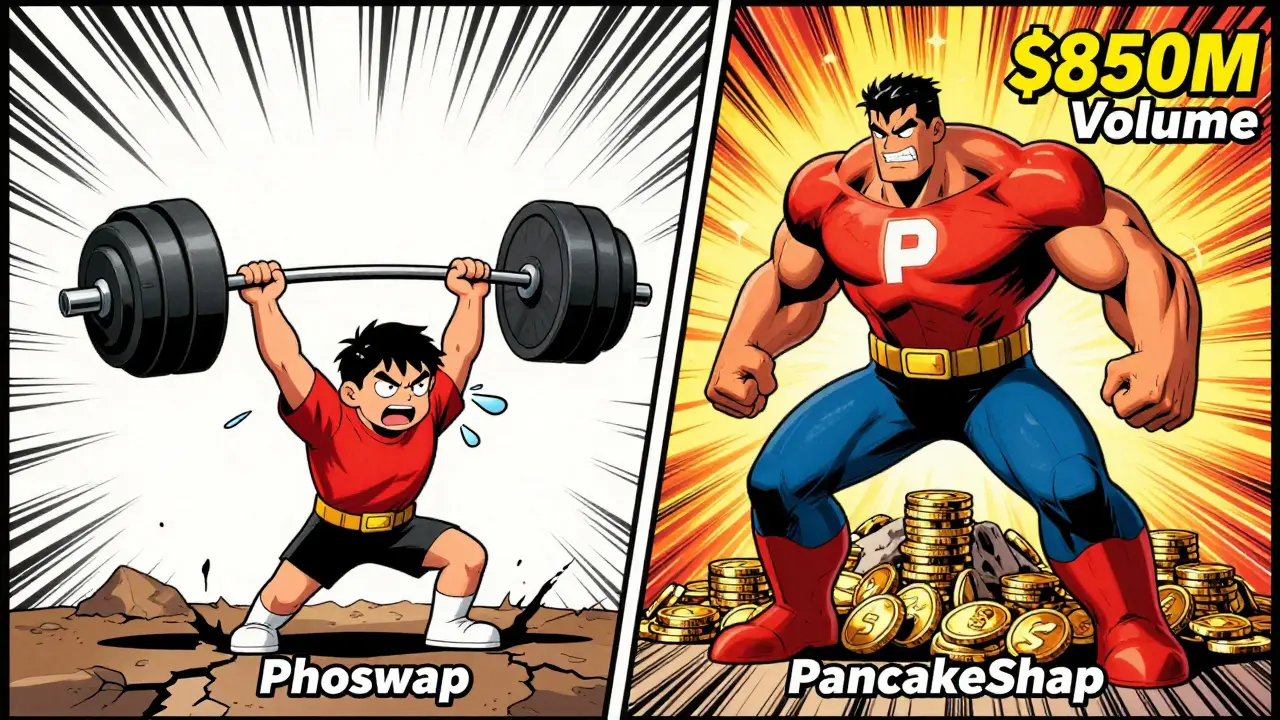
To understand Phoswap’s position, you have to compare it to the leaders. As of late 2025, PancakeSwap dominates the BSC ecosystem with roughly 65% of the market share. Let’s break down the differences.
| Feature | Phoswap | PancakeSwap | Uniswap (Multi-chain) |
|---|---|---|---|
| Network | Binance Smart Chain | Binance Smart Chain | Ethereum, Polygon, Arbitrum, etc. |
| 24h Volume (Nov 2025) | Low / Undisclosed | $850 Million | $1.2 Billion |
| Liquidity Depth | Shallow (High Slippage Risk) | Deep (Low Slippage) | Very Deep |
| Advanced Features | Basic Swap/Farm/Stake | Perpetuals, NFTs, Launchpad | Concentrated Liquidity (v3) |
| Team Transparency | Anonymous | Public | Public (Vitalik Buterin et al.) |
The gap is significant. PancakeSwap processes hundreds of millions in daily volume, meaning you can trade large amounts without moving the price drastically. On Phoswap, with lower liquidity, a $1,000 trade might result in high slippage, meaning you get fewer tokens than expected. Furthermore, PancakeSwap has evolved into a full ecosystem with NFT markets and perpetual futures. Phoswap remains a basic swap-and-farm protocol. Unless you are specifically targeting a rare token pair only available on Phoswap, there is little reason to prefer it over the competition.
Security Risks: What You Need to Watch Out For
Since Phoswap is a decentralized exchange, it doesn’t hold your funds in a central bank account. This protects you from hacks like the ones that cost centralized exchanges billions in 2025. However, it introduces different risks. The primary threat is smart contract vulnerability. In 2025, 17 major DeFi protocols were hacked for a total of $450 million, often due to outdated multi-sig setups or complex code errors.
Has Phoswap been audited? The available research does not highlight any recent, reputable security audits from firms like CertiK or Hacken. Without a verified audit report, you are essentially trusting the code as-is. If there is a bug in the PHO distribution mechanism or the liquidity pool logic, exploiters could drain the funds before anyone notices. Always check the latest audit status on the project’s official documentation before depositing significant capital.
Another risk is rug pulls. Since the team is anonymous, there is no accountability if they abandon the project. While the code is open-source, the governance structure may allow insiders to manipulate parameters. Look for community-led governance where token holders vote on changes, rather than a single admin key controlling everything.
User Experience and Technical Barriers
Using Phoswap requires a moderate level of crypto literacy. You cannot just sign up and buy. Here is the step-by-step reality:
- Get a Wallet: Install MetaMask or TrustWallet on your browser or phone.
- Acquire BNB: You need BNB (Binance Coin) to pay for gas fees on the Binance Smart Chain. As of late 2025, fees average around $0.07 per transaction, which is cheap compared to Ethereum but still a cost.
- Connect to Phoswap: Visit the official site (verify the URL carefully to avoid phishing scams) and connect your wallet.
- Approve Tokens: Before swapping, you must approve the smart contract to spend your tokens. This step is irreversible and requires careful attention.
- Execute Swap: Set your slippage tolerance. On low-liquidity pools like Phoswap, you may need to set this higher (e.g., 1-3%) to ensure the trade goes through.
There is no customer support chat. If something goes wrong, you are on your own. Community support via Telegram or Discord is likely, but responses can be slow. This makes Phoswap unsuitable for beginners who expect hand-holding. It is a tool for those comfortable reading transaction confirmations and understanding blockchain states.
Is Phoswap Worth Using in 2026?
So, should you use Phoswap? For the average investor, probably not. The combination of low liquidity, anonymous team, and lack of distinctive features makes it a risky choice when superior alternatives exist. PancakeSwap offers better liquidity, more features, and a proven track record on the same network. Uniswap provides cross-chain flexibility and deeper institutional trust.
However, Phoswap might have a niche appeal. If you are hunting for very early-stage tokens that haven’t listed on major exchanges yet, Phoswap might host them. Yield farmers seeking higher APYs might also find temporary opportunities in new farming pools, but remember: high yields always come with high risks. The PHO token’s uncertain distribution and the platform’s minor market share suggest limited long-term growth potential. With only 38% of new DEXs surviving past 18 months, Phoswap is fighting an uphill battle to stay relevant.
If you decide to proceed, start small. Treat any initial deposits as experimental. Never invest money you can’t afford to lose, and always double-check contract addresses. In the world of DeFi, caution is your best asset.
Is Phoswap a safe exchange to use?
Safety in DeFi is relative. Phoswap is non-custodial, meaning you control your keys, which reduces the risk of exchange hacks. However, it lacks prominent security audits and has an anonymous team. Smart contract vulnerabilities remain a significant risk. Use it with extreme caution and only with small amounts you can afford to lose.
Why does CoinMarketCap show 0 circulating supply for PHO?
This is likely a data reporting error. PHO is actively traded on exchanges like Bitget and KuCoin, proving it has circulation. Aggregated data sites sometimes fail to update or scrape accurate on-chain supply data for smaller tokens. Always verify on-chain data using blockchain explorers like BscScan.
How do I withdraw my funds from Phoswap?
You don't "withdraw" in the traditional sense. Since your funds are in your connected Web3 wallet, you simply interact with the smart contract to remove liquidity or swap tokens back to BNB or USDT. Then, you can transfer those assets from your wallet to a centralized exchange or another wallet.
What are the fees for trading on Phoswap?
Phoswap charges a standard swap fee, typically around 0.3%, which is split among liquidity providers. Additionally, you must pay gas fees in BNB to process transactions on the Binance Smart Chain. As of late 2025, these gas fees average $0.05-$0.10 per transaction.
Can I use Phoswap on mobile devices?
Yes, Phoswap’s website is responsive and works on mobile browsers. However, you will need a mobile-compatible Web3 wallet like TrustWallet or MetaMask Mobile to connect and authorize transactions. Ensure you are accessing the correct URL to avoid phishing sites.
Who founded Phoswap?
The founding team of Phoswap is anonymous. There is no publicly available information about the individuals or entities behind the project. This anonymity is common in early DeFi projects but increases the risk for users as there is no accountable leadership.




Look, I get the hype around new DEXs. It’s exciting to find something fresh before it blows up. But honestly? This looks like a trap waiting to happen. The zero circulating supply thing is just bad data hygiene, or worse, intentional obfuscation. You can’t trust a project that doesn’t even have their basic metrics straight on CoinMarketCap. It’s not about being closed-minded; it’s about protecting your own skin in a space full of sharks. If they wanted transparency, they would have fixed it by now.
I’ve seen too many ‘next big things’ turn into dust because the team ran off with the liquidity. Why risk it when PancakeSwap exists? Just stick to the proven giants until this one shows some real, verifiable traction. Don’t let FOMO drive your wallet.
Hey everyone, just dropping in to share my two cents since I’ve been looking at Phoswap lately.
The article makes a good point about the liquidity depth. I tried swapping a decent amount and the slippage was wild. Like, really high. It’s cool that they offer farming pools for higher APY, but if you’re losing money on entry/exit fees due to slippage, what’s the point?
Also, for anyone new here: make sure you double-check the contract address. There are so many copycat sites out there trying to phish wallets. Always use BscScan to verify. It’s a small step that saves a lot of headaches later. Stay safe out there!
You guys are all missing the bigger picture here. Of course the team is anonymous. That’s how it’s supposed to be in true DeFi! No central authority, no CEO to sue, just code. The fact that CoinMarketCap shows zero supply isn’t an error-it’s a statement. They don’t want to be tracked. They don’t want to be regulated.
PancakeSwap? Please. That’s corporate crypto. Big tech surveillance wrapped in blockchain. Phoswap is the resistance. Sure, the UI is clunky and the audits are ‘missing,’ but that’s because they haven’t sold out to CertiK yet. Once they do, they’ll be compromised. Keep your funds in self-custody and stop trusting these mainstream narratives. The smart money is already moving to the dark pools.
Let’s be brutally honest here. This platform is fundamentally flawed from a tokenomics perspective. A max supply of 10 million tokens with no clear vesting schedule is a red flag the size of a billboard. Who holds the majority? The dev wallet? The marketing fund? We don’t know. And that ignorance is dangerous.
Furthermore, the lack of a reputable audit is not a feature; it is a critical vulnerability. In 2025, we saw $450 million drained from protocols with *some* security measures. To suggest using Phoswap without a verified audit from a firm like Hacken is financial negligence. Do not deposit capital into unverified smart contracts. The impermanent loss risk combined with potential rug-pull mechanics makes this a non-starter for any serious investor. Stop chasing yield and start managing risk.
Wake up people! This is exactly the kind of energy we need in crypto! Yes, it’s risky! Yes, it’s unknown! That’s where the 100x gains are! While you’re all sitting on stablecoins watching inflation eat your savings, someone is going to catch this wave early.
I’m putting money in. I’m farming those PHO rewards. If it rugs, I lose a little bit and laugh it off. If it pumps, I retire. You can stay safe and poor, or take a calculated risk and get rich. Life is short. Go big or go home! Don’t let fear keep you from freedom. Connect your wallet and see what happens!
I cannot believe people are still falling for this. It’s 2026. We have established ecosystems. We have institutional-grade security. Why would anyone voluntarily choose a platform with an anonymous team and shallow liquidity? It’s not ‘early adoption,’ it’s gambling. And not even skilled gambling-just throwing money into a black hole.
If you care about your finances, stick to Uniswap or PancakeSwap. They have volume, they have history, and they have accountability. Phoswap is a relic of the wild west days that should have died out years ago. Using it suggests a fundamental misunderstanding of how value accrues in decentralized finance. Educate yourself before you transact.
I appreciate the detailed breakdown in the original post, as it highlights several important considerations for users who might be unfamiliar with the nuances of decentralized exchanges operating on the Binance Smart Chain. It is quite concerning to note the discrepancy regarding the circulating supply of the PHO token, especially given that aggregated data platforms like CoinMarketCap often serve as the primary source of information for retail investors. When such fundamental data points are inaccurate or entirely absent, it creates a significant barrier to trust and makes it extremely difficult to assess the true market dynamics of the asset. Furthermore, the anonymity of the founding team, while perhaps common in earlier iterations of DeFi projects, raises valid questions about long-term sustainability and accountability, particularly when compared to more transparent competitors like PancakeSwap which have public leadership teams. Users must weigh these risks carefully against the potential benefits of higher yields, keeping in mind that high returns are almost always correlated with elevated levels of risk, including the possibility of total loss of principal investment.
It’s interesting to think about the philosophy behind anonymous development. On one hand, it promotes the idea of ‘code is law.’ On the other, it removes the human element of trust. I guess it depends on whether you trust the math or the person. Personally, I prefer knowing who I’m dealing with. But hey, maybe I’m just old school. The slippage issue mentioned in the article is definitely a dealbreaker for me though. I hate paying extra for nothing.
Sigh. Another generic review of another generic fork. Honestly, reading through this feels like watching paint dry. The analysis is superficial at best. Anyone with actual on-chain experience knows that ‘low liquidity’ isn’t just a minor inconvenience; it’s a structural failure for a DEX aiming to compete. The comparison table is cute, but it ignores the reality of MEV bots and sandwich attacks that plague low-volume pools. This platform is essentially a honeypot for inexperienced traders. Save your time and your gas fees. There is nothing ‘new’ here, just repackaged mediocrity.
Yo! Just checked the site out. Looks kinda basic, I gotta say. But hey, sometimes simple is better right? 😎 I tried swapping a tiny bit of BNB and it went through fine. Gas was cheap too! Not gonna lie, the UI could use a glow-up, but if it works, it works. Maybe I’ll try farming later if I have spare cash. WAGMI! 🚀
i dont get why evryone is so mad abt it. its free to use basically. gas fees are low. i like it.
This brings up an interesting question about the evolution of DeFi governance. We started with anonymous founders because it was the only way to build quickly without legal overhead. Now, as the industry matures, does anonymity become a liability? I wonder if Phoswap will ever transition to a DAO structure to mitigate the ‘key man’ risk. Until then, the lack of audits is a hard pass for me. Curious to hear if anyone has dug into their GitHub activity?
Typical weak-minded behavior. You people whine about ‘risk’ and ‘anonymity’ while sitting on centralized exchanges that freeze your assets whenever they feel like it. Phoswap is American-made code running on BSC. It’s efficient. It’s fast. It doesn’t ask for permission. The fact that you’re scared of a slight slippage fee means you don’t understand the market. Real traders adapt. Weak hands fold. Get over it.