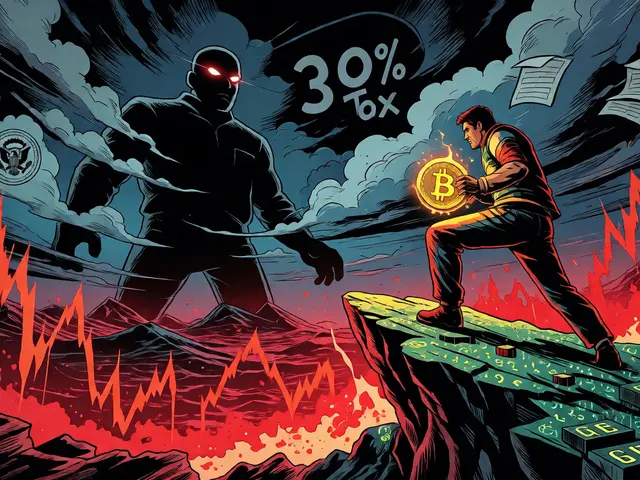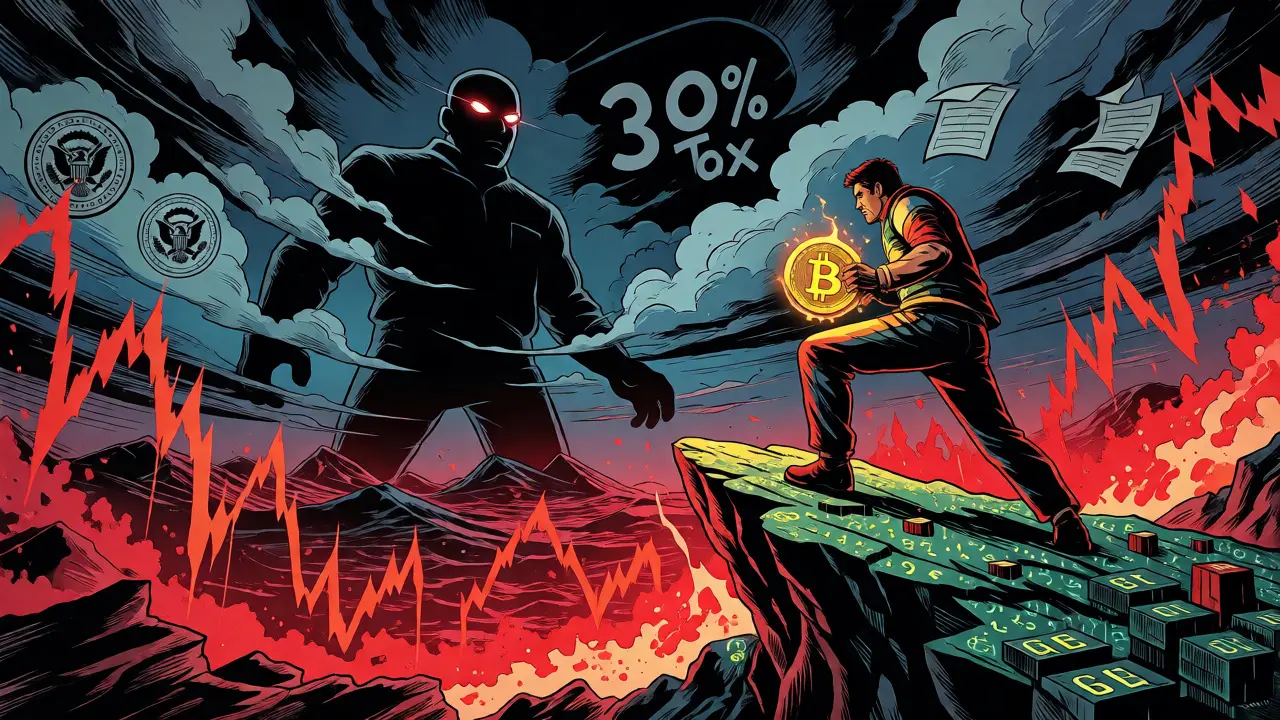
India's 30% Crypto Tax: A Bitcoin Trader's Survival Guide
Imagine this: You spend a year trading Bitcoin. You lose ₹50,000 on Ethereum and make ₹50,000 on Bitcoin. Your net profit? Zero. Your bank account? Unchanged. But when you file your taxes, the Indian government wants a cut of that ₹50,000 gain. This isn't a hypothetical nightmare; it’s the reality for every Bitcoin trader in India operating under the current tax regime. Since April 2022, the landscape has shifted from a gray area to a rigid, high-cost environment where the rules are strict, the rates are steep, and the loopholes are virtually non-existent.
If you’re active in the Indian crypto market, understanding the mechanics of the 30% flat tax is no longer optional-it’s essential for survival. This guide breaks down exactly how Section 115BBH of the Income Tax Act impacts your wallet, why loss offsetting doesn’t work the way you think it does, and what the recent GST changes mean for your bottom line. We’ll skip the legal jargon and focus on what actually hits your bank account.
The Core Rule: 30% Flat Rate, No Exceptions
Let’s start with the headline number. India imposes a flat 30% tax rate on all income arising from the transfer of Virtual Digital Assets (VDAs). This includes Bitcoin, Ethereum, NFTs, and stablecoins. Unlike traditional stocks or mutual funds, where holding period matters (short-term vs. long-term), crypto gains in India are taxed uniformly. Whether you hold Bitcoin for one day or ten years, the rate remains 30%. Plus, there’s a 4% health and education cess, pushing the effective rate to roughly 31.2% for most individuals.
This approach treats crypto as speculative income rather than an investment asset. The logic is simple from the government’s perspective: if you made money, pay up. There are no progressive slabs here. Even if you fall into the 5% or 10% income tax bracket for your salary, your crypto profits are still hit with the full 30% charge. This creates a significant drag on returns, especially for small traders who might otherwise benefit from lower tax brackets.
The Loss Offset Trap: Why You Might Pay Tax on a Net Loss
Here is the part that trips up most new traders. In most countries, if you lose money on one trade, you can use that loss to reduce the tax bill on another winning trade. Not in India. Under the current rules, losses from one VDA cannot be set off against gains from another VDA. Furthermore, these losses cannot be carried forward to future financial years.
Consider this real-world scenario:
- You buy Bitcoin at ₹10 lakhs and sell it at ₹12 lakhs. Gain: ₹2 lakhs.
- You buy Ethereum at ₹5 lakhs and sell it at ₹3 lakhs. Loss: ₹2 lakhs.
- Your net portfolio performance is zero.
However, for tax purposes, the government sees only the ₹2 lakh gain on Bitcoin. They ignore the ₹2 lakh loss on Ethereum entirely. You owe 30% tax on the ₹2 lakh gain (₹60,000 + cess), even though you didn’t make any actual money. This rule effectively penalizes diversification and punishes active traders who manage risk by hedging positions.
TDS: The 1% Deduction That Complicates Everything
Starting July 1, 2022, a 1% Tax Deducted at Source (TDS) applies to crypto transfers exceeding ₹50,000 in a financial year (or ₹10,000 for certain non-residents). This deduction happens automatically on many Indian exchanges when you sell or swap assets.
Why does this matter? Because TDS is not a final tax payment; it’s just an advance collection. If your total taxable income puts you in a higher bracket, or if you have other deductions, you might owe more. Conversely, if your gains are low, you might have paid too much TDS and need to claim a refund during filing. The biggest headache arises with P2P transactions or international exchanges. Many offshore platforms don’t deduct TDS, leaving the burden on you to calculate and deposit it manually via Challan ITNS 281. Miss this, and you face interest penalties.
| Feature | India | USA | Germany |
|---|---|---|---|
| Tax Rate | 30% Flat (+ Cess) | 0-20% (Long Term) | 0% (if held > 1 year) |
| Loss Offset | No (VDA to VDA) | Yes (against gains) | Yes |
| Holding Period Impact | None | Significant (STCG vs LTCG) | Significant |
| TDS Requirement | 1% | None | None |

The New Layer: 18% GST on Platform Services
As of July 2025, the taxation landscape got even more complex with the introduction of 18% Goods and Services Tax (GST) on crypto platform services. This isn’t a tax on your profits; it’s a tax on the fees you pay to exchanges like CoinDCX, WazirX, or Binance India. If an exchange charges you a 0.1% trading fee, they now add 18% GST on top of that fee.
For high-frequency traders, this adds up quickly. It also raises questions about whether swapping one cryptocurrency for another constitutes a "supply" of goods or services. While the primary intent is to tax the service providers, the cost is ultimately passed down to you, the user. When calculating your break-even points, remember that your transaction costs are now higher due to this additional levy.
How to Calculate Your Actual Liability
Calculating your tax bill requires meticulous record-keeping. The formula is straightforward but unforgiving:
(Selling Price - Purchase Price) × 30% = Tax Liability
Crucially, "Purchase Price" means the original acquisition cost. You cannot deduct trading fees, network gas fees, or storage costs from this base price. Only the raw amount paid to acquire the asset counts. This makes it vital to track every single transaction, including swaps. If you swap Bitcoin for Ethereum, that swap is treated as a sale of Bitcoin (taxable event) followed by a purchase of Ethereum.
To stay compliant, you must file Schedule VDA in your Income Tax Return (ITR). This schedule requires you to list details of each VDA transaction, including the date, type of transaction, and consideration received. Failing to disclose VDAs can lead to penalties, even if you didn’t make a profit.

Strategies for Surviving the High-Tax Environment
Given the harsh conditions, what can traders do? Traditional strategies like tax-loss harvesting don’t work across different coins. However, some tactics remain relevant:
- Hold Longer: While the rate doesn’t change, fewer transactions mean less administrative burden and potentially lower cumulative TDS complications.
- Consolidate Exchanges: Using fewer platforms simplifies tracking cost basis and ensures TDS is handled correctly without manual intervention.
- Avoid Frequent Swaps: Every swap is a taxable event. Moving between altcoins frequently triggers multiple tax liabilities, even if your overall portfolio value hasn’t increased.
- Keep Impeccable Records: Use tools like Koinly or ClearTax that integrate with Indian exchanges. Manual spreadsheets often fail when dealing with hundreds of micro-transactions.
It’s worth noting that many Indian traders have migrated to international exchanges or P2P markets to avoid immediate TDS deductions. However, this is a double-edged sword. While you keep more cash upfront, you take on the responsibility of self-assessing and paying the tax later. If you underestimate your liability, you’ll face interest charges on delayed payments.
Final Thoughts: Is It Worth It?
India’s crypto tax regime is undeniably one of the toughest globally. The combination of a flat 30% rate, no loss offsetting, and mandatory TDS creates a high barrier to entry for retail investors. For Bitcoin traders, the key takeaway is simplicity: minimize taxable events, track every rupee, and never assume a net loss means no tax bill.
While the government argues this framework brings legitimacy and revenue, the practical impact has been a contraction in trading volumes and a shift toward long-term holding over active trading. Until regulations evolve to allow loss offsetting or introduce tiered rates, success in the Indian crypto market depends less on picking the right coin and more on managing your tax exposure efficiently.
Can I offset Bitcoin losses against Ethereum gains in India?
No. Under Section 115BBH, losses from the transfer of one Virtual Digital Asset (VDA) cannot be set off against income from the transfer of any other VDA. Each asset is treated independently for tax calculation purposes.
Do I have to pay tax if I hold Bitcoin for more than 3 years?
Yes. Unlike stocks or property, there is no distinction between short-term and long-term capital gains for cryptocurrencies in India. All gains are taxed at a flat 30% regardless of the holding period.
What happens if my crypto gains are below ₹50,000?
You still owe 30% tax on those gains. The ₹50,000 threshold applies to the TDS deduction requirement, not the taxability itself. If you sell assets worth less than ₹50,000 in a year, TDS may not be deducted automatically, but you must still report the gains and pay the tax when filing your return.
Are mining rewards taxed in India?
Yes. Mining rewards are generally treated as business income or "income from other sources" depending on the scale and nature of the activity. Once mined, if you sell the reward, the subsequent sale is subject to the 30% VDA tax on the gain from the acquisition value (which is typically the fair market value at the time of receipt).
Does the 1% TDS apply to buying Bitcoin?
Generally, TDS is deducted on the transfer (sale) of VDAs. However, if you are purchasing from a resident seller and the aggregate value exceeds the threshold, the buyer is responsible for deducting TDS. On most Indian exchanges, TDS is applied when you sell or convert crypto to INR.