

How to Fill Out Form 8949 for Crypto Trading: A Step-by-Step Guide
You bought Bitcoin in 2021. You swapped some Ethereum for Solana last year. Maybe you even used a small amount of Dogecoin to buy coffee or paid for a service with stablecoins. If you did any of this, you owe the IRS money-or at least you need to tell them what happened. The document that captures all these messy, complex, and often confusing transactions is Form 8949, officially titled Sales and Other Dispositions of Capital Assets. It’s not just a form; it’s the IRS’s primary tool for verifying your crypto tax liability.
Many traders think they’re safe if they didn’t sell for cash. That’s a dangerous myth. Under IRS rules established in 2014, cryptocurrency is property, not currency. This means every time you trade, spend, or swap crypto, you trigger a taxable event. Form 8949 is where you report each individual transaction. Without it, your tax return is incomplete, and the IRS has become very good at finding people who skip this step.
Why Form 8949 Matters More Than Ever
The IRS isn’t guessing anymore. In recent years, enforcement has shifted from random audits to data matching. Exchanges like Coinbase and Binance now send Form 1099-B reports directly to the IRS. These forms show how much money you received when you sold or traded assets. But here’s the catch: exchanges often don’t know your exact cost basis (what you originally paid). They might report zero cost basis, making it look like you made 100% profit on every trade.
If you file without Form 8949, the IRS sees the income from the 1099-B but no corresponding gain calculation. This triggers a red flag. According to IRS data from 2023, cryptocurrency-related enforcement actions jumped by over 300% between 2020 and 2022. The agency matched thousands of 1099-K and 1099-B statements against tax returns to find underreporting. Form 8949 is your defense. It allows you to correct the exchange’s data by providing the accurate cost basis and calculating the true capital gain or loss.
Understanding the Structure of Form 8949
Form 8949 looks intimidating because it’s long and repetitive. But logically, it’s simple. It’s divided into two main parts based on how long you held the asset:
- Part I: Short-term capital gains and losses. This covers assets held for one year or less. These are taxed at your ordinary income tax rates, which can range from 10% to 37% depending on your total income.
- Part II: Long-term capital gains and losses. This covers assets held for more than one year. These enjoy preferential tax rates of 0%, 15%, or 20%, which is significantly lower for most taxpayers.
Within each part, you’ll see three boxes: A, B, and C. You need to pick the right box for each transaction based on whether the exchange reported the basis to the IRS.
| Box | Description | When to Use |
|---|---|---|
| A | Basis was reported to the IRS | Use this if your exchange sent a 1099-B with cost basis info (common for large centralized exchanges). |
| B | Basis was NOT reported to the IRS | Use this if your exchange sent a 1099-B but only showed proceeds, not cost basis. |
| C | No statement received | Use this for trades on smaller exchanges, DeFi protocols, or personal wallet transfers where no 1099 was issued. |
What Data You Need for Each Transaction
For every single line on Form 8949, you must provide seven specific pieces of information. Missing even one can cause errors. Here is exactly what goes in each column:
- Description of Property: Be specific. Don’t just write “Bitcoin.” Write “0.5 BTC” or “1 ETH.”
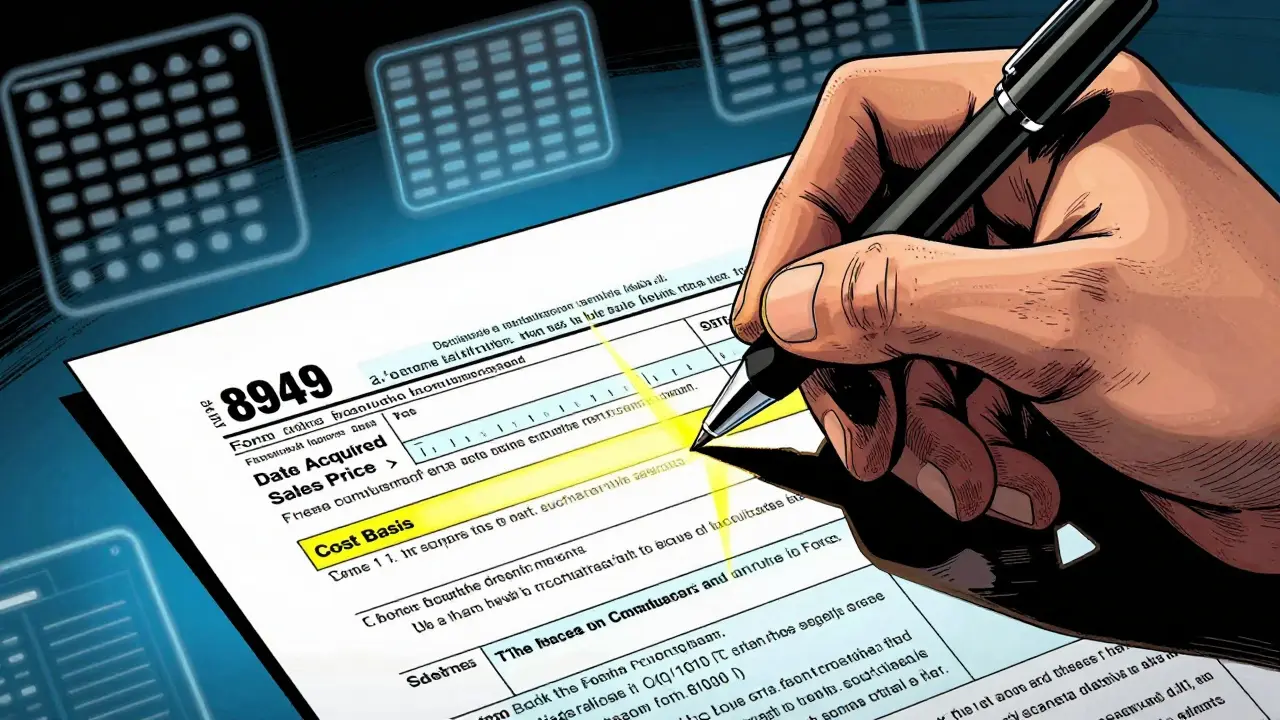
- Date Acquired: The date you bought or received the crypto. For example, 05/15/2023.
- Date Sold or Disposed: The date you sold, traded, or spent the crypto. For example, 08/20/2023.
- Sales Price: The fair market value of what you received when you disposed of the asset. If you swapped ETH for USDT, this is the USD value of the USDT at the time of the swap.
- Cost Basis: What you paid for the asset, including buying fees. This is crucial. If you bought BTC for $20,000 plus $50 in fees, your cost basis is $20,050.
- Code: If there are adjustments to the gain or loss (like wash sales or different cost basis methods), you enter a code here (e.g., Code D for FIFO vs. Specific ID).
- Gain or Loss: Calculated automatically by subtracting Cost Basis from Sales Price. Positive numbers are gains; negative numbers are losses.
The IRS explicitly states that you must report all transactions, even those with a $0 gain or loss. Skipping “small” trades is a common mistake that leads to penalties. Penalties for underreporting can reach 20% of the unpaid tax, and up to 75% if fraud is suspected.
The Cost Basis Challenge
The hardest part of Form 8949 isn’t the form itself-it’s figuring out your cost basis. When you sell 1 Bitcoin, which Bitcoin are you selling? The one you bought in January? The one you mined in March? Or the one you received as payment in June?
The IRS allows several methods for determining cost basis:
- FIFO (First-In, First-Out): Assumes you sell the oldest coins first. This is the default method for many software programs and is easy to track, but it often results in higher taxes because older coins usually have a lower cost basis (meaning higher gains).
- LIFO (Last-In, First-Out): Assumes you sell the newest coins first. This can sometimes reduce taxes if prices have been rising, but it’s less commonly used.
- Specific Identification: You choose exactly which coin you sold. This offers the most control over your tax bill but requires meticulous record-keeping. You must be able to prove which specific units were sold.
According to a 2024 survey by the American Institute of CPAs, 68% of tax professionals recommend Specific Identification for active traders to maximize tax efficiency. However, if you use this method, you must document it clearly. If your records don’t match, the IRS will likely assume FIFO.
Manual Entry vs. Tax Software
If you have five trades a year, you can probably fill out Form 8949 manually. But if you have hundreds, manual entry is a recipe for disaster. A 2024 study found that traders with over 500 transactions spend an average of 15-20 hours completing the form by hand. Errors are inevitable. One wrong date or decimal point can throw off your entire return.
This is why 78% of crypto traders with high volumes now use specialized tax software. Tools like Koinly, CoinLedger, or CoinTracker connect to your exchanges and wallets via API. They pull all your transaction history, calculate the cost basis using your chosen method (FIFO, LIFO, etc.), and generate a pre-filled Form 8949 CSV file that you can import into TurboTax or other tax software.
User reviews highlight the time savings. On Reddit, users frequently note that software cuts preparation time from days to minutes. However, beware of inaccuracies. Some users report issues with DeFi transactions or cross-chain swaps where software fails to track the movement of assets correctly. Always review the generated data before filing.

Common Mistakes to Avoid
Even experienced traders make mistakes on Form 8949. Here are the most frequent pitfalls:
- Ignoring Non-Cash Trades: Swapping Bitcoin for Ethereum is a taxable event. Many people forget to report this because no dollars changed hands. It still counts as a sale.
- Mixing Personal and Business Income: If you’re mining crypto as a hobby, it’s income. If you’re trading actively as a business, it might be ordinary income, not capital gains. Form 8949 is for capital assets. Business income goes on Schedule C.
- Forgetting Wallet Transfers: Moving crypto from one personal wallet to another isn’t taxable. But moving it to an exchange to sell is. Make sure you only report disposals, not internal transfers.
- Incorrect Date Formatting: The IRS requires MM/DD/YYYY format. Using DD/MM/YYYY can lead to processing delays or rejections.
Future Changes: The 1099-DA
The landscape is changing. Starting with tax year 2025 (filed in 2026), the IRS will introduce Form 1099-DA. This new form will require brokers and exchanges to report both gross proceeds AND cost basis information. This means the IRS will already know your gain or loss before you file.
While this sounds like it makes Form 8949 obsolete, it actually makes accuracy more critical. If your calculated gain doesn’t match the 1099-DA, the IRS will question the discrepancy immediately. For now, you still need to file Form 8949, but the burden of proof is shifting toward the exchanges. Keep your records clean, verify your cost basis method, and never underestimate the importance of this form.
Do I need to file Form 8949 if I only have losses?
Yes. Even if you lost money on your crypto trades, you must report them on Form 8949. Reporting losses allows you to offset capital gains from other investments. If your losses exceed your gains, you can deduct up to $3,000 of net capital losses against your ordinary income per year, with the remainder carried forward to future years.
What if I traded crypto on a decentralized exchange (DEX)?
You still need to report these transactions. Since DEXs do not issue 1099 forms, you will use Box C on Form 8949. You are responsible for tracking the acquisition date, disposal date, and fair market value of both assets at the time of the swap. This is why maintaining a detailed ledger is essential for DeFi users.
Can I use Form 8949 for NFTs?
Yes. NFTs are treated as collectibles or capital assets. If you sell or trade an NFT, you report it on Form 8949. Note that if you hold an NFT for more than one year, it may be subject to a higher maximum capital gains rate (28%) compared to standard long-term rates (20%), depending on its classification.
What happens if I lose my transaction records?
This is risky. Try to reconstruct your ledger using blockchain explorers (like Etherscan or Blockchain.com) and bank statements. If you cannot determine the exact cost basis, the IRS may disallow your claimed basis, resulting in higher taxes. Consider consulting a crypto tax specialist to help rebuild your records.
Is staking income reported on Form 8949?
No. Staking rewards are considered ordinary income at the time you receive them, not capital gains. You report staking income on Form 1040, Schedule 1. However, when you eventually sell or dispose of the staked coins, the difference between the fair market value at receipt and the sale price is reported on Form 8949.






Man, this guide is a lifesaver 🌟 I spent three weekends last year trying to figure out why my tax software was flagging me for 'missing dispositions' on my DeFi swaps. It turns out I was treating wallet-to-wallet transfers as sales because I didn't understand the nuance of Box C vs Box A. If you're using Uniswap or PancakeSwap, just remember that no 1099 means you have to be your own accountant. Keep screenshots of every swap! 📸💸
The distinction between hobby mining and business trading is so often overlooked. People think if they aren't day-trading like a wolf of wall street, it's all capital gains. But if you're running a mining rig in your garage and selling daily, the IRS sees ordinary income. It’s a philosophical shift from asset holding to active commerce. Stay sharp.
I have to say that when I first started looking into this whole process of filling out the forms and understanding the intricacies of the tax code regarding digital assets, I felt completely overwhelmed by the sheer volume of information and the potential pitfalls that lay ahead for someone who had never dealt with anything remotely similar before in their entire life up until that point where I decided to dive headfirst into the research phase which took weeks but ultimately paid off big time when I realized how much money I could save by properly categorizing my long term holdings versus short term flips and making sure I wasn't accidentally triggering wash sale rules without even knowing what those were exactly at the time.
Hey guys, just wanted to chime in because I feel your pain. I lost my exchange records from 2017 when the platform shut down. I had to use blockchain explorers to reconstruct everything. It was a nightmare but doable. Don't panic if you don't have perfect receipts. Just do your best to estimate fair market value at the time of acquisition. The IRS understands these things happen.
This article is painfully obvious to anyone who has actually filed taxes before. You really need to stop acting like crypto users are too stupid to read a form. Form 8949 has existed since 2005. It’s not rocket science. If you can’t track your cost basis, you’re doing it wrong. Stop blaming the IRS for your own lack of record keeping. It’s embarrassing.
I appreciate the clarity on Box B vs Box C. I always get confused about whether my small DEX trades count as 'reported' since I never get a 1099. So just to confirm, if I trade on a decentralized protocol where I hold the keys, I always use Box C? That makes sense. Thanks for breaking it down so simply!
It is imperative that we recognize the sovereign obligation of the citizenry to adhere to the fiscal mandates established by the federal apparatus. The utilization of cryptographic ledgers does not absolve one of the statutory requirement to declare capital dispositions pursuant to Internal Revenue Code Section 6045. Furthermore, the notion that decentralized exchanges operate outside the purview of regulatory oversight is a fallacious premise propagated by libertarian ideologues who fail to comprehend the intricate web of jurisdictional authority that governs financial transactions within the United States. One must submit to the bureaucratic machinery without hesitation.
stop overthinking it just buy the software already cointracker or koinly will do the math for you in seconds why are you still manually entering data in excel sheets in 2024 get it together people time is money 💸
i mean honestly if you cant keep track of your own coins then maybe you dont deserve them lol i used specific id method and saved thousands compared to fifo which is basically paying extra taxes because you're lazy about tracking which coin you sold. most people here are probably going to get audited and cry about it later. typical.
the jargon around cost basis methods is unnecessarily complex for what is essentially a simple accounting exercise. fifo lifo specific id its all just semantics until you see the tax bill drop significantly by choosing the right one. sarcastic alert: yes i know the irs prefers fifo but if you have the records for specific id why wouldnt you use it to minimize liability? its not illegal its strategy. 🙄
Just reading through this quietly. Good info. I usually stick to FIFO because I'm bad at record keeping so it saves me the headache of proving which specific bitcoin I sold. Not everyone wants to play accountant. Simple is better for me.
does this apply to nfts minted for free? i minted some pfp projects and never sold them but they are worth something now. do i owe taxes on the air drop value or only when i sell? kinda confusing tbh
You need to be very careful with staking rewards. Many people report them as capital gains when they are actually ordinary income upon receipt. Then when you sell the staked coins, your cost basis is the FMV at the time you received them, not zero. This is a huge mistake I see constantly. Fix your ledger now.
Oh wow, talk about a bureaucratic maze! 🌀 I remember swapping ETH for USDT thinking it was just moving money around, like shifting cash from left pocket to right pocket. Turns out the IRS sees that as selling ETH and buying USDT simultaneously. It’s wild how every single interaction on-chain is a taxable event. I feel like I’m living in a surveillance state just by using a wallet. 😅
Typical American obsession with maximizing every penny while ignoring the moral decay of speculative gambling disguised as investment. The fact that you need a 20-page guide to fill out a form shows how broken the system is. We should be taxing the rich banks, not penalizing retail traders for participating in a global financial evolution. Disgraceful.
Thanks for sharing this. I was really stressed about the 1099-DA coming next year. Knowing that I need to keep my records clean now will help me sleep better. Friendly reminder to everyone: back up your API keys and export your CSVs regularly. Don't wait until April.
oh my gosh i made so many mistakes last year i thought swapping doge for shiba wasnt taxable because no dollars changed hands. im gonna have to pay penalties i guess. thanks for the heads up though. hope nobody else gets burned like i did :(
Let's get this straight! If you are trading actively, you might qualify for trader status and deduct expenses. But don't come crying to me if you try to claim it without meeting the strict IRS criteria. Be aggressive in your planning but compliant in your filing. I love seeing people take control of their finances instead of letting the government dictate their losses. Go forth and optimize!
hey man i totally get the confusion with the boxes. box a b c stuff. i used coinledger and it auto filled most of it but i still had to double check the dates. mm/dd/yyyy format is tricky if u r used to dd/mm/yyyy like in europe. easy fix tho. just be careful with the decimals. good luck everyone!