
How Blockchain Blocks Store Transaction Data: A Technical Guide
You might think a blockchain is just a giant spreadsheet that everyone shares. It’s not. If you try to shove your entire photo library onto Bitcoin, you’ll go broke before the first upload finishes. The magic of Blockchain isn’t that it stores everything; it’s that it stores just enough information to prove that something happened, and nothing else. When you send money or execute a smart contract, the network doesn’t copy your file into every computer in the world. Instead, it packs specific, compact details into a digital box called a block. Understanding how these boxes are built explains why crypto transactions are secure, transparent, and surprisingly efficient at storing only what matters.
| Component | Function | Data Size (Bitcoin Example) |
|---|---|---|
| Block Header | Links to previous block, contains timestamp and hash | 80 bytes |
| Transaction Counter | Counts the number of transactions in the block | Varies (Compact Integer) |
| Merkle Root | Cryptographic fingerprint of all transactions | 32 bytes |
| Transaction List | The actual payment or contract data | Variable (1-4 MB limit) |
The Anatomy of a Block
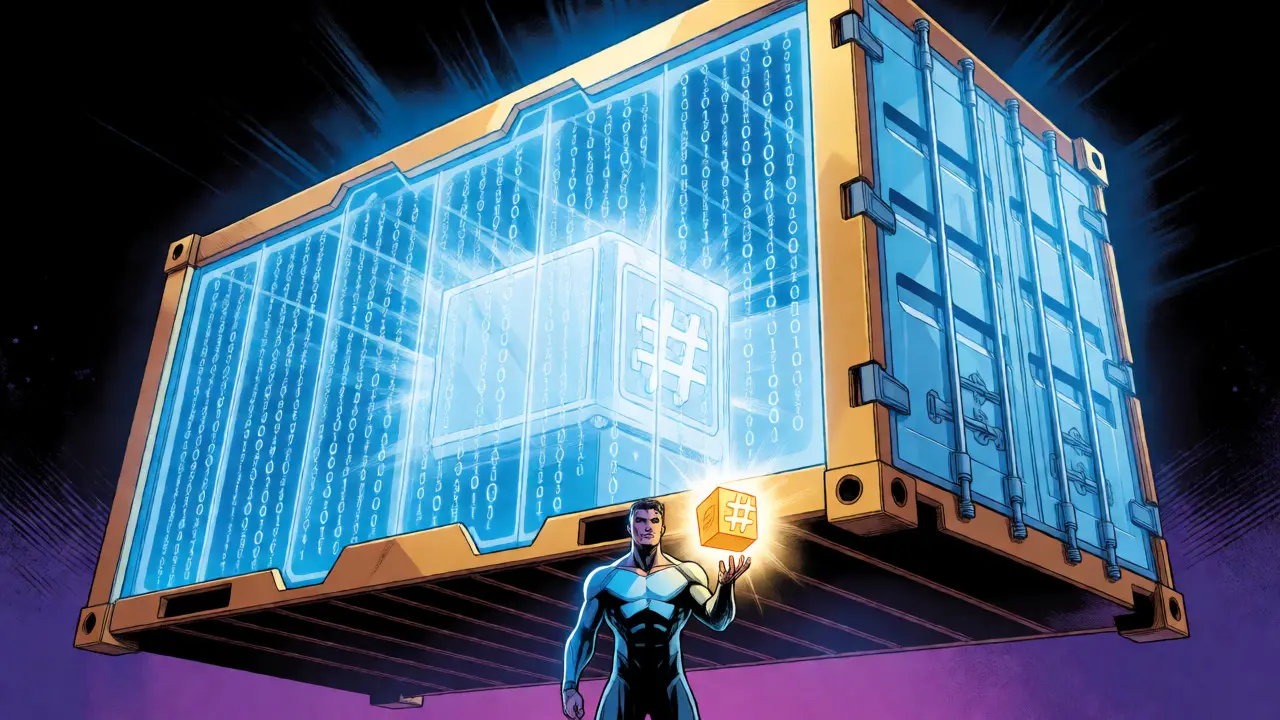
Think of a blockchain block like a sealed shipping container. You don’t need to know what’s inside every single crate to trust the container hasn’t been tampered with, provided you have the right seal. That seal is the Block Header. This small chunk of data-only 80 bytes for Bitcoin-is the most critical part of the structure. It contains the cryptographic hash of the previous block, which creates the chain link. If someone tries to change a transaction in an old block, the hash changes, breaking the link to every subsequent block. The header also includes a timestamp, a nonce (a random number used in mining), and the version number.
But where does the actual transaction data live? It sits below the header in the body of the block. This section holds the list of transactions included by the miner. For Bitcoin, this data is structured specifically to save space. Each transaction record includes the sender’s address, the recipient’s address, the amount sent, and a digital signature proving ownership. Unlike a database row that might include extra metadata or comments, blockchain transactions are stripped down to their mathematical essentials. This minimalism is why you can verify a transaction’s validity without needing to download the entire history of the internet.
Merkle Trees: Compressing Proof
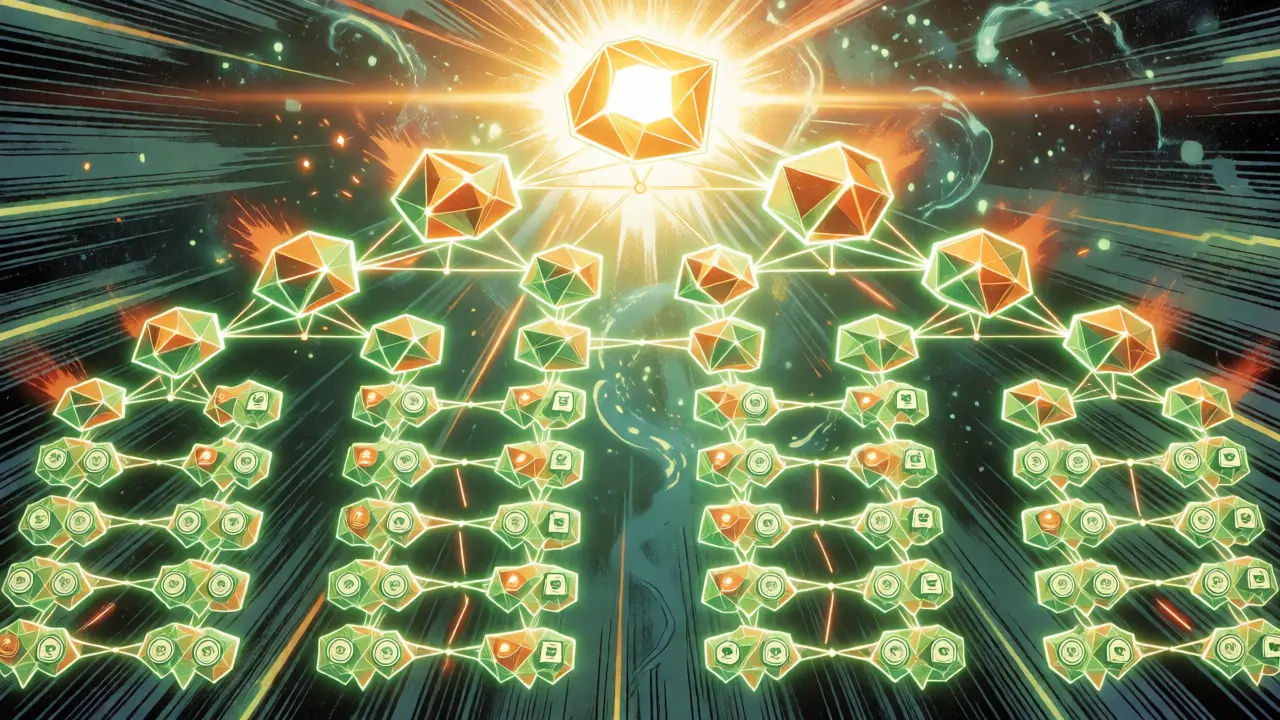
If a block contains thousands of transactions, how do we verify one without checking them all? Enter the Merkle Tree, invented by Ralph Merkle in 1979. Imagine a tournament bracket. You pair up two transactions and hash them together to create a parent hash. Then you pair those parents and hash them again. You keep going until you reach a single hash at the top: the Merkle Root.
This root hash is stored in the block header. Here’s why this matters: if you want to prove that a specific transaction was included in a block, you don’t need the whole block. You only need the transaction itself and a few sibling hashes along the path to the root. This process, called a Merkle proof, allows light clients (like mobile wallets) to verify transactions instantly without downloading gigabytes of data. It turns a massive list of data into a single, verifiable fingerprint.
On-Chain vs. Off-Chain Storage
Here is the hard truth about blockchain storage: it is expensive. Storing data directly on the chain, known as On-Chain Storage, means every node in the network must store a copy. On Ethereum, writing 1KB of data can cost around $10 depending on gas prices. Because of this, developers rarely store large files like images or videos directly on the mainnet.
Instead, they use a hybrid approach. They store the heavy data off-chain on systems like IPFS (InterPlanetary File System) or centralized servers. Then, they take a cryptographic hash of that file and store only that 32-byte string on the blockchain. If the file changes even slightly, its hash changes. Since the original hash is locked in the immutable blockchain, any mismatch proves the file has been altered. This method gives you the security of the blockchain with the scalability of traditional storage.

How Different Chains Handle Data
Not all blockchains store data the same way. Bitcoin is designed primarily for value transfer, so its blocks are optimized for simple payment records. With SegWit (Segregated Witness), Bitcoin increased its effective capacity to 4MB per block, but the core data structure remains focused on inputs and outputs. In contrast, Ethereum needs to store more than just payments. It must store the state of smart contracts-think of this as the current balance of every account plus the code execution status. This makes Ethereum blocks heavier and more complex, often exceeding 1TB in total chain size compared to Bitcoin’s ~500GB.
Newer chains like Solana attempt to solve this by increasing block frequency and size, allowing for higher throughput. However, this comes at the cost of hardware requirements. Running a full node on Solana requires high-end specs to keep up with the data flow. Meanwhile, private blockchains like Hyperledger Fabric allow for permissioned access, meaning not every participant sees every transaction. This partitioning reduces the storage burden on individual nodes, making it viable for enterprise supply chains where privacy is key.
The Immutability Trade-Off
Once data is written to a block, it is there forever. You cannot edit a typo or delete a bad transaction without rewriting every block after it. This immutability is a feature, not a bug, for audit trails. The Estonian government, for example, uses blockchain to secure health records because no doctor or administrator can secretly alter a patient’s history. But this permanence is a double-edged sword. If you accidentally store sensitive personal data on a public blockchain, you can’t erase it under GDPR rules. Developers must be meticulous about what goes into a block, ensuring that only necessary verification data-not raw personal info-is stored on-chain.
Why can't I store my photos directly on the blockchain?
Storing large files like photos directly on-chain is prohibitively expensive and slow. Every node in the network would need to store a copy of your image. Instead, developers store the image on IPFS or a server and record only its unique hash on the blockchain. This proves the image existed at a certain time and hasn't changed, without clogging the network.
What happens if a block gets corrupted?
If a block's data is corrupted, its cryptographic hash will no longer match the expected value. Since each block contains the hash of the previous block, this breaks the chain. Nodes will reject the corrupted block and any subsequent blocks, forcing the network to re-sync from a valid point. This self-healing mechanism ensures data integrity across the decentralized network.
Do all transactions in a block get verified individually?
Yes, miners or validators check the signatures and validity of each transaction before including it in a block. However, once the block is mined and added to the chain, verifying a specific transaction later doesn't require re-checking every other transaction in that block. Using a Merkle proof, you can verify a single transaction's inclusion using only a fraction of the block's data.
How much data does a typical Bitcoin block hold?
A standard Bitcoin block is limited to 1MB of data, though SegWit updates effectively allow up to 4MB. This space is filled with transaction records, each containing sender/receiver addresses, amounts, and signatures. The exact number of transactions varies based on their complexity, but a full block typically contains between 2,000 and 3,000 transactions.
Is blockchain storage cheaper than cloud storage?
No, on-chain storage is significantly more expensive. Cloud storage costs fractions of a cent per megabyte, while storing 1KB on Ethereum can cost several dollars. Blockchain is better suited for storing small, critical pieces of data like hashes or financial records, rather than bulk data like videos or documents.






Oh wow... this is so... deep? 🤯 I mean, the way you explained the Merkle Tree made me feel like my brain was actually working for once!! 😭 But then again, who even cares about block headers when we could just be storing memes?? 🖼️💸 It’s all so complicated and yet so simple at the same time... I’m crying happy tears right now. 😢🙏 Please tell me I’m not alone in feeling overwhelmed by the sheer weight of cryptographic hashes?! 🌊⛓️
Hey man, great read! Really cleared up why my wallet syncs so slow sometimes lol. The bit about off-chain storage on IPFS is super useful info for anyone trying to build dApps without going broke on gas fees. Keep it up!
It is absolutely tragic how many people still misunderstand the fundamental nature of distributed ledgers. We are standing on the precipice of a new era, yet most treat blockchain as merely a speculative asset class rather than an immutable truth machine. This article correctly identifies that the true value lies not in speculation but in the mathematical certainty of the state transition function. To ignore this distinction is to do a disservice to the entire community.
Thank you for providing such a clear and structured explanation. The distinction between on-chain and off-chain storage is particularly important for those of us managing data governance issues. I appreciate the professional tone and the accurate technical details regarding Ethereum's state storage requirements.
As someone who has spent years navigating the intersection of traditional enterprise systems and decentralized architectures, I must commend this breakdown. The comparison between Bitcoin's UTXO model and Ethereum's account-based model is often glossed over, but here it is handled with appropriate nuance. However, one must consider the implications of Solana's hardware requirements for decentralization; while throughput increases, the barrier to entry for node operators rises significantly, potentially leading to centralization vectors that private chains like Hyperledger attempt to mitigate through permissioning. It is a delicate balance between scalability and security.
LISTEN TO ME!!! 🗣️ You need to understand that this isn't just tech, it's FREEDOM!!! 🔥 When you store your data on-chain, you own it!!! 💪 No more middlemen telling you what to do!!! 🚫💰 If you aren't building on this, you are literally choosing to be a slave to Web2!!! 👑 Go out there and hash everything!!! 🌐✨ Don't let them keep your data in silos!!! 🧱💥
The article fails to address the energy consumption per transaction adequately.
i cant believe people still dont get this its so obvious if you just look at the math the merkle root proves everything its beautiful its terrifying its absolute truth and we are all just ants crawling on top of a giant digital ledger and nobody appreciates the elegance of the nonce finding process anymore its sad really very sad i am crying into my keyboard right now because the world does not see the beauty in 80 bytes of header data
I find the philosophical underpinnings of immutability quite fascinating. It raises questions about the nature of truth itself. If history is written in code, can it ever be wrong? Or is it only our interpretation that changes? A thoughtful piece indeed.
lol "stripped down to their mathematical essentials" bro thats just fancy talk for 'we deleted the comments section' 😂 also nice job pretending that storing 1kb for $10 isnt basically stealing from users. good luck explaining that to ur grandma when she tries to send 5 bucks. 🙄💸
This was so helpful!! 🥰 I finally understand why my NFT metadata doesn't live on the chain itself. It makes so much sense now! Thanks for breaking it down so simply ❤️🙌
What a vibrant tapestry of technical wisdom! 🎨 The way you wove together the structural integrity of blocks with the practical realities of gas fees creates a narrative that is both educational and empowering. It feels less like reading documentation and more like having a chat with a wise old mentor over coffee. ☕✨ Truly inspiring for those of us trying to navigate these complex waters.
Obviously, this is basic stuff for anyone who actually reads whitepapers, but I suppose it helps the casuals. Still, the omission of Layer 2 rollups as a primary solution for the storage cost issue is glaring. Are we ignoring optimistic and zk-rollups entirely? Typical oversight. 🙄📉
Nice write-up mate. 👍 The bit about GDPR vs immutability is spot on though. Been thinking about that a lot lately. How do devs handle the right to be forgotten when the chain never forgets? 🤔🇬🇧
i wonder if the merkle tree structure could be applied to other types of databases outside of crypto seems like such a clever way to verify data integrity without sharing the whole file wouldnt that save so much bandwidth in regular web apps too maybe im missing something but it feels like a universal solution kinda thing
Actually, the term "blockchain" is often misused in this context. What we are discussing is specifically a replicated state machine with cryptographic commitments. Calling it a "database" is reductive. Furthermore, the assertion that light clients verify transactions "instantly" ignores the latency involved in network propagation and consensus finality. Precision matters.
Agreed. The section on privacy in private blockchains was interesting. Not sure how that applies to public networks though.
To add to the discussion on storage costs: one must remember that the cost of storage is inversely proportional to the scarcity of block space. As demand for block space increases, so does the price of storing data. Therefore, the incentive structure encourages minimalism. This is not a bug, but a feature designed to prevent spam and ensure network health. It forces developers to think critically about what data truly requires global consensus versus what can be stored locally or off-chain. 🧠⚖️
I have been reflecting deeply on the concept of the Merkle Root as a form of collective memory compression. By reducing thousands of individual interactions into a single hash, we are essentially creating a cryptographic abstraction of reality. This allows for trustless verification without the burden of total recall. It is a profound shift in how we conceptualize proof and evidence in a digital age, moving away from the accumulation of raw data toward the validation of state transitions. The elegance lies in the fact that the integrity of the whole is preserved by the integrity of the parts, linked hierarchically. It is a beautiful metaphor for society itself, where individual actions contribute to a larger, verifiable narrative without requiring every observer to witness every detail directly. 🌌🔗