DLT vs Blockchain: Understanding the Key Differences in 2026
You’ve probably heard the terms blockchain and Distributed Ledger Technology (DLT) used interchangeably. It’s an easy mistake to make. After all, they both deal with decentralized databases, digital trust, and getting rid of middlemen. But if you are building a system or trying to understand where your data lives, treating them as synonyms is like calling every vehicle a Ferrari. Some vehicles are Ferraris, sure, but others are trucks, buses, or bicycles.
The reality is that Distributed Ledger Technology is the broad category, while blockchain is just one specific type within it. By 2026, this distinction matters more than ever. As enterprises move past the hype cycle and into actual implementation, choosing the wrong architecture can mean the difference between a system that handles thousands of transactions per second and one that chokes under basic load.
The Umbrella Concept: What is DLT?
At its core, Distributed Ledger Technology is a shared database spread across multiple locations, institutions, or geographies. Think of it as a super-secure, collaborative spreadsheet. Every participant has a copy. When someone makes a change, everyone else’s copy updates automatically. There is no central server holding the master record. This removes the single point of failure that plagues traditional centralized databases.
The key feature here is distribution. The ledger isn’t stored on one computer; it’s replicated across a network of nodes. For a basic DLT system to function securely, you typically need at least three nodes to prevent tampering. If one node goes offline or gets corrupted, the others maintain the integrity of the data. This setup allows for what experts call "trustless" systems-environments where participants don’t need to trust each other or a central authority to verify transactions.
DLT doesn’t dictate how the data is structured inside that distributed network. It simply ensures that the data is synchronized and immutable across all copies. This flexibility is why DLT is becoming the preferred choice for many enterprise applications that need high speed and privacy without the rigid constraints of a chain structure.
The Specific Implementation: What is Blockchain?
Blockchain, created by Satoshi Nakamoto in 2008 for Bitcoin, is a specific way of organizing data within a DLT framework. Instead of a free-form database, blockchain structures information into blocks. These blocks are linked together in a chronological sequence using cryptographic hashes. Each block contains a timestamp, transaction data, and a unique code (hash) from the previous block. This creates an unbreakable chain.
This chaining mechanism is what gives blockchain its name and its primary strength: immutability. Once a block is added to the chain, changing any data inside it would require changing the hash of that block and every subsequent block in the entire network. That’s computationally nearly impossible on large networks. This makes blockchain ideal for public, permissionless environments like cryptocurrencies, where strangers need to agree on the state of the ledger without knowing who they are dealing with.
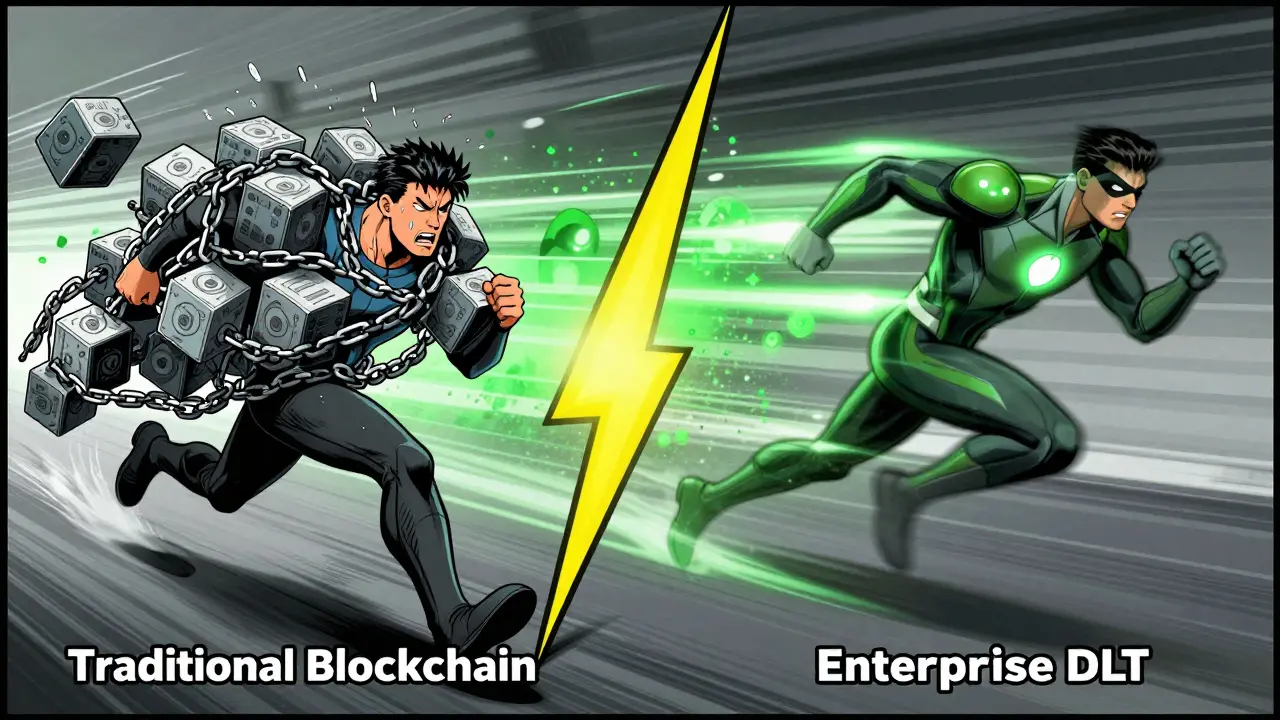
However, this structure comes with trade-offs. Because every node must process and store every block in the chain, scalability becomes a bottleneck. Bitcoin processes about 7 transactions per second (TPS). Ethereum, even after its upgrades, hovers around 30 TPS on the base layer. In contrast, non-blockchain DLTs can handle significantly higher volumes because they aren’t bound by the linear chain structure.
Key Differences: Structure, Speed, and Consensus
To really see the difference, you have to look under the hood at how these systems operate. Here is a breakdown of the critical distinctions:
| Feature | Distributed Ledger Technology (General) | Blockchain (Specific Type) |
|---|---|---|
| Data Structure | Flexible (Graphs, Tangles, Ledgers) | Sequential Blocks chained via hashes |
| Consensus Mechanism | Varied (PBFT, Raft, Voting) | Proof-of-Work, Proof-of-Stake, etc. |
| Transaction Speed (TPS) | High (1,000 - 10,000+ TPS) | Low to Medium (7 - 30 TPS base) |
| Energy Consumption | Low (Enterprise-grade efficiency) | Variable (PoW is high, PoS is low) |
| Privacy Model | Often Permissioned (Private) | Often Permissionless (Public) |
| Token Requirement | Not required | Often required (Gas fees) |
One major difference lies in consensus. Public blockchains often use energy-intensive mechanisms like Proof-of-Work (PoW) or resource-heavy Proof-of-Stake (PoS) to secure the network among anonymous users. Enterprise DLT solutions, like R3 Corda or Hyperledger Fabric, use Practical Byzantine Fault Tolerance (PBFT) or similar voting mechanisms. Since the participants are known and vetted, they don’t need expensive cryptographic puzzles to agree on the truth. This makes enterprise DLT up to 60% more scalable and 99% less energy-intensive than traditional PoW blockchains.
Another distinction is the token model. Most public blockchains require a native cryptocurrency to pay for transaction fees (gas). This incentivizes validators to keep the network running. Many DLT platforms, however, operate without tokens entirely. Companies can run a DLT network for internal supply chain tracking or financial settlements without creating or managing a digital currency. This simplifies regulatory compliance and reduces operational complexity.
Performance and Scalability: Why Speed Matters
If you are running a global payment system, 7 transactions per second won’t cut it. Visa processes thousands of transactions per second; blockchain struggles to match that baseline. This is where alternative DLT architectures shine. Technologies like Hashgraph (used by Hedera) or IOTA’s Tangle do not use blocks or chains. Instead, they use directed acyclic graphs (DAGs) or gossip-about-gossip protocols.
In a Hashgraph network, nodes share information directly with each other in a peer-to-peer manner. This allows for near-instant finality. While Bitcoin might take 10 to 60 minutes for a transaction to be considered fully irreversible, Hashgraph can achieve finality in seconds. Independent benchmarks from the Journal of Blockchain Technology (March 2023) showed Hedera Hashgraph achieving over 10,000 TPS. This performance gap is why banks and large enterprises are increasingly looking beyond blockchain for their infrastructure needs.
Consider the case of JPMorgan’s Quorum team. In a 2022 post-mortem, they documented that transaction finality delays of 15 seconds created operational bottlenecks in high-frequency trading scenarios. Sub-second settlement is required in those markets. A standard blockchain couldn’t deliver that. They had to pivot toward more efficient consensus models found in broader DLT frameworks to meet real-world demands.

Use Cases: When to Choose Which
So, which one should you pick? It depends entirely on your problem.
Choose Blockchain if:
- You need a public, transparent ledger where anyone can verify transactions (e.g., Bitcoin, Ethereum).
- You are building a decentralized application (dApp) that requires smart contracts executed by anonymous validators.
- You want to issue a token or cryptocurrency that needs broad market accessibility.
- Trust among participants is zero, and you need cryptographic proof to establish validity.
Choose Alternative DLT if:
- You are building an enterprise solution requiring high throughput (>1,000 TPS).
- Privacy is paramount, and you only want authorized parties to see specific data (e.g., Hyperledger Fabric).
- You want to avoid the complexity and cost of managing cryptocurrency tokens.
- You need sub-second transaction finality for financial settlements or IoT device coordination.
For example, Maersk’s TradeLens shipping consortium uses a permissioned DLT approach. With 98 participating enterprises, they needed a system where competitors could share logistics data without revealing sensitive commercial secrets to each other. A public blockchain would have exposed too much data, while a traditional centralized database lacked the trust factor. A private DLT struck the perfect balance.
The Future: Convergence and Hybrid Models
The lines between DLT and blockchain are blurring. We are seeing a convergence in 2026. Ethereum’s transition to Proof-of-Stake reduced its energy consumption by 99.95%, addressing one of the biggest criticisms of blockchain. Meanwhile, DLT platforms like R3 Corda are adding blockchain-like features, such as cryptographic chaining, for specific use cases that require extra audit trails.
Gartner’s 2023 Hype Cycle places DLT at the "Plateau of Productivity," indicating it’s ready for widespread business use. Pure blockchain implementations are still navigating the "Slope of Enlightenment." The trend is moving toward hybrid models. According to 451 Research, 63% of new DLT implementations in 2023 incorporated elements from both worlds. They use the security and transparency principles of blockchain but leverage the scalable, flexible architecture of general DLT.
By 2027, the World Economic Forum predicts that 10% of global GDP will be stored on these platforms. Whether it’s called blockchain or DLT will matter less than the underlying capability to create trust, ensure data integrity, and facilitate seamless exchange of value. For now, understanding the difference helps you ask the right questions when selecting your technology stack.
Is Bitcoin a DLT or a blockchain?
Bitcoin is both. It is built on blockchain technology, which is a specific type of Distributed Ledger Technology (DLT). All blockchains are DLTs, but not all DLTs are blockchains.
Why do enterprises prefer DLT over blockchain?
Enterprises often prefer DLT because it offers higher transaction speeds, better privacy controls, and lower energy consumption. Unlike public blockchains, many DLT solutions allow for permissioned access, meaning only verified participants can join the network, which is crucial for corporate data security.
Can DLT work without cryptocurrency?
Yes. Many DLT platforms, such as Hyperledger Fabric and R3 Corda, do not require a native cryptocurrency or token to operate. Transactions are validated through consensus mechanisms among known participants rather than incentivized miners or stakers.
What is the main disadvantage of blockchain compared to other DLTs?
The main disadvantage is scalability. Because every node must store and validate every block in the chain, blockchain networks struggle to handle high volumes of transactions quickly. This results in lower throughput (TPS) and slower finality times compared to DAG-based or graph-based DLTs.
Which is more secure: Blockchain or DLT?
Both can be highly secure, but they offer different types of security. Blockchain provides strong security against external attacks in public, trustless environments due to its cryptographic chaining. DLT provides robust security in private, permissioned environments through strict access controls and efficient consensus algorithms. The "more secure" option depends on whether you need protection from anonymous actors or insider threats.