

Crypto Exchanges to Avoid if You Are Russian: Risks, Scams, and Legal Dangers
If you're in Russia and thinking about using a crypto exchange, you need to know which ones could get you in serious trouble-financially, legally, or even physically. It's not just about losing money. It's about crypto exchanges that are actively being targeted by Russian authorities and U.S. sanctions, and using them could land you in court, with your bank accounts frozen, or worse. The landscape changed dramatically in 2024 and 2025. What used to feel like a loophole is now a legal minefield.
Why Some Crypto Exchanges Are Dangerous for Russians
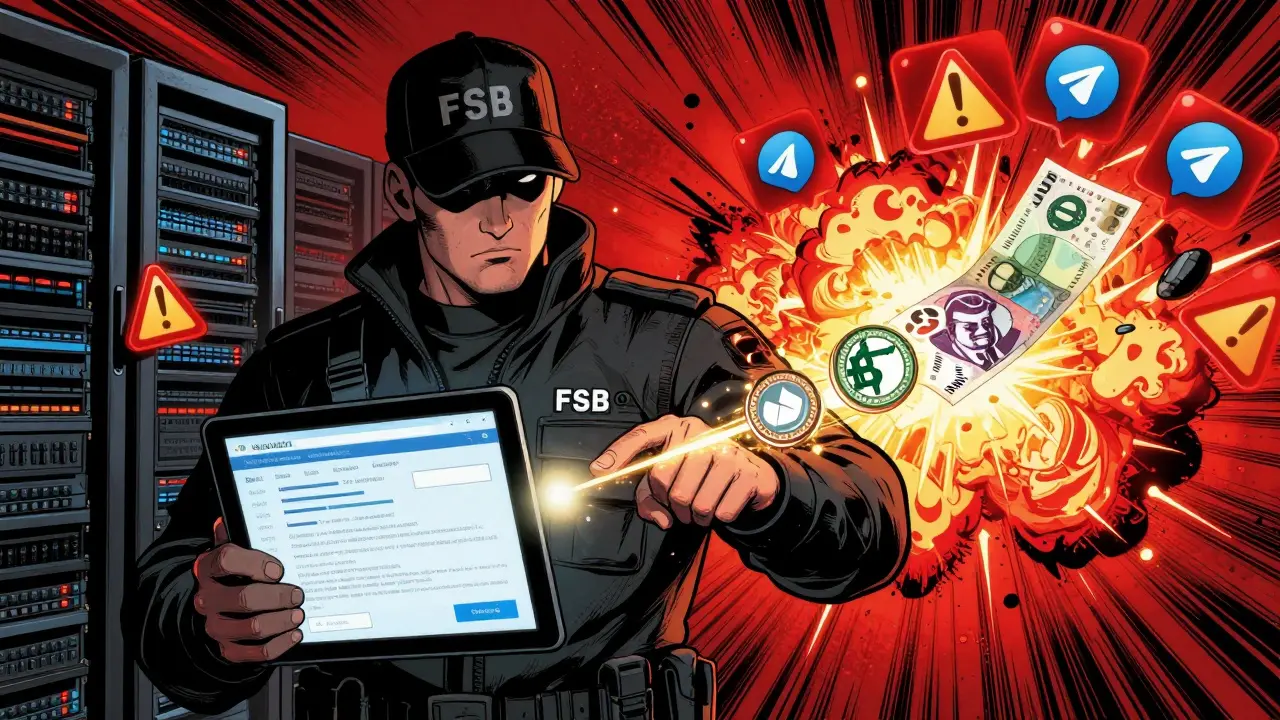
Russia doesn’t ban owning cryptocurrency. You can hold Bitcoin, Ethereum, or USDT without breaking the law. But using crypto to pay for goods or services inside Russia? That’s illegal. The Bank of Russia made this clear in 2021, and they’ve doubled down since. What’s worse is that some exchanges aren’t just ignoring these rules-they’re helping people break them. These dangerous platforms operate like digital money laundromats. Russian users deposit rubles, often through local banks like Alfa-Bank. The exchange converts that money into USDT or another stablecoin, then sends it overseas. The goal? To move money out of Russia without triggering financial monitoring. This is exactly what Russian authorities call a "cryptolaundromat." And they’ve been raiding these operations since late 2024. In October 2024, Russian security services seized over $10 million, 100 million rubles, and 200,000 euros from exchange operators. In March 2025, they took down Garantex and its successor, Grinex. These weren’t small-time operations. They were handling hundreds of millions in illicit transactions.The Top 3 Exchanges to Avoid Right Now
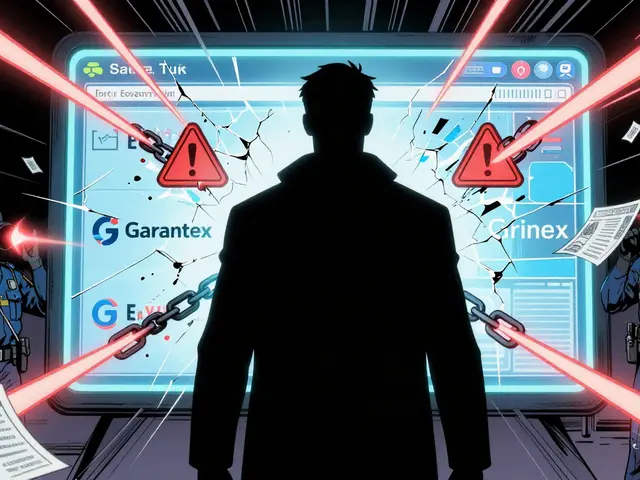
You don’t need to guess which ones are risky. The evidence is public. Here are the three exchanges you should never touch if you’re in Russia:- Garantex - Once Russia’s largest domestic exchange, Garantex was officially sanctioned by the U.S. Treasury’s OFAC in April 2022 for helping ransomware gangs like Hive. By 2025, Chainalysis found 68% of its transactions linked to crime: darknet markets, stolen funds, and fraud. It was shut down in March 2025 after Russian police raided its servers. Thousands of users lost access to their funds overnight.
- Exved - This platform wasn’t even called Exved at first. It was created by the same team behind Garantex, including Sergey Mendeleev, who ran a Moscow-based payment processor disguised as a "trade facilitator." Exved processed over 2 billion rubles per month through Alfa-Bank accounts, routing money out of Russia without reporting it. Russian prosecutors now classify Exved as a criminal enterprise. Over 278 users have reported losing funds, with average losses of 850,000 rubles each.
- Grinex - The "successor" to Garantex, Grinex promised "faster transfers" and "no paperwork." It used Telegram bots to onboard users with just a phone number. Transparency International Russia found that 90% of Grinex users were regular people, not businesses. By September 2025, 63% of users reported sudden account freezes. No explanations. No customer service. Just silence.
These aren’t just "bad" exchanges. They’re legally designated threats. The U.S. State Department is offering up to $5 million for information leading to the arrest of Garantex’s top executives. Russian police have begun tracking users based on bank transaction patterns. If you sent money through one of these platforms, you’re not just risking your crypto-you’re risking your freedom.
How These Exchanges Trick Users
They don’t look dangerous. That’s the trick. You open the app. You enter your phone number. You upload a photo of your passport. In five minutes, you’re trading. They promise "no KYC," "no delays," and "sanction-proof transfers." Some even have slick websites with fake "verified" badges and testimonials from early 2024, before the crackdown. But here’s what they don’t tell you:- They don’t report transactions to Rosfinmonitoring (Russia’s financial monitoring agency).
- They route money through shell companies in Hong Kong, Georgia, or Thailand.
- They use Telegram bots because they can’t be shut down by Russian courts.
- They have no legal team, no customer support, and no accountability.
A user on Dvach (2ch.hk) posted in April 2025: "I deposited 1.2 million rubles. Two days later, my account vanished. I sent 27 messages. No reply. My bank says they have no record of the transfer-because the exchange never told them anything. Now I’m being asked to explain where the money went. I didn’t steal it. I just used the app everyone said was safe." That’s the reality. These platforms operate on trust, not law. And when the law comes knocking, you’re on your own.
The Legal Consequences Are Real
You might think, "I’m just trading crypto. What’s the big deal?" The big deal is Article 193.1 of the Russian Criminal Code. It targets illegal currency transactions-especially those meant to evade capital controls. If you transfer more than 6 million rubles ($70,000) through one of these exchanges, you could face up to 7 years in prison. Even smaller transfers-like 50,000 rubles-have triggered investigations. Russian police now cross-reference bank data with blockchain analytics. If your account shows regular transfers to a known sanctioned exchange, you’re flagged. In October 2025, Interfax reported that Russian authorities seized 37 server clusters in Moscow alone, targeting platforms that helped import dual-use goods (like semiconductors and medical equipment) using crypto. This wasn’t about gambling. It was about bypassing sanctions. And here’s the worst part: you have no legal recourse. The Russian Ministry of Finance confirmed in September 2025 that users of unlicensed exchanges have zero right to sue, demand refunds, or file complaints. Your money is gone. And if you’re investigated, you’ll have to prove you didn’t know it was illegal. Good luck with that.What Happens When You Use Them
Real stories from Russian users paint a clear picture:- One man from Rostov deposited 3 million rubles into Grinex. His account vanished. His bank froze his personal account for "suspicious activity." He now faces a tax audit for "unreported income."
- A student in Kazan sent 450,000 rubles to Exved to pay for a course abroad. The exchange disappeared. He was summoned to the local FSB office for questioning. He wasn’t charged-but his passport was flagged.
- A small business owner in St. Petersburg used Garantex to pay suppliers in Turkey. He lost 1.8 million rubles. Then he got a letter from the tax office: "Explain the source of 1.8 million rubles received in 2024."
These aren’t outliers. Trustpilot reviews for Grinex average 1.2 out of 5. Reddit’s r/RussianCrypto had 1,243 users surveyed in October 2025. 87% said they’d never use an unlicensed exchange again.
What Should You Do Instead?
There are legal ways to trade crypto in Russia-but they’re not for everyone. The only exchanges allowed to operate legally under Russia’s "experimental regime" require you to be an "especially qualified investor"-meaning you need at least 6 million rubles in assets. These platforms report everything to Rosfinmonitoring. They’re slow. They’re bureaucratic. But they’re safe. Most Russians using crypto now are either:- Businesses trading internationally under the 2024 legal loophole (using licensed platforms), or
- Individuals holding crypto long-term, with no intention to move money out.
If you’re trying to send money abroad, crypto isn’t the answer. It’s a trap. The Bank of Russia has made it clear: any transaction that bypasses the banking system is under scrutiny. Even if you think you’re "just holding," if you use an unlicensed exchange, you’re part of the problem-and you’re at risk.
What’s Coming Next?
The crackdown isn’t over. In September 2025, the State Duma introduced draft bill No. 45876-8, which would make using sanctioned exchanges a criminal offense-even for first-time users. Fines could reach 1 million rubles ($11,000). Jail time is possible. Analysts at Sberbank predict 70-80% of these high-risk platforms will vanish by 2027. But until then, the risk remains high. Even if a platform seems "quiet," it could be under investigation. If it’s not on Russia’s official list of licensed exchanges (which you can find on the Bank of Russia’s website), it’s not safe.Bottom Line
Don’t be fooled by fast transfers or Telegram bots. Don’t trust testimonials from 2024. The rules changed. The enforcement changed. The consequences changed. Garantex, Exved, Grinex-these names are now synonymous with loss, legal trouble, and personal risk. If you’ve used them before, stop. If you’re thinking about using them, don’t. There are no safe shortcuts. There’s no workaround. And the Russian government isn’t asking for permission anymore-they’re taking names.Your crypto isn’t worth your freedom.
Is it illegal to own cryptocurrency in Russia?
No, owning cryptocurrency is not illegal in Russia. Federal Law No. 114-FZ allows citizens to hold Bitcoin, Ethereum, and other digital assets. However, using crypto to pay for goods or services inside Russia is banned. You can own it, but you can’t spend it domestically.
Can I get arrested for using Garantex or Exved?
Yes. Russian authorities have begun prosecuting individuals who use sanctioned exchanges to move money out of the country. Under Article 193.1 of the Criminal Code, you can face up to 7 years in prison for large-scale transactions. Even smaller transfers have triggered investigations. Police now track users through bank transaction data linked to known illicit platforms.
What happens if my funds are frozen on Grinex or Exved?
If your funds are frozen, you won’t get them back. These platforms have no legal obligation to respond. The Russian Ministry of Finance confirmed in September 2025 that users of unlicensed exchanges have no legal recourse. You can’t sue, file a complaint, or force a refund. Your money is gone, and you may still face scrutiny from tax or law enforcement agencies.
Are there any legal crypto exchanges in Russia?
Yes, but only a few. Russia has an "experimental legal regime" that allows licensed exchanges to operate under strict conditions. These platforms must report all transactions to Rosfinmonitoring and require users to be "especially qualified investors" with at least 6 million rubles in assets. They’re slow, regulated, and designed for corporate trade-not personal use.
Can I use a foreign exchange like Binance or Coinbase?
Technically, yes-but it’s risky. Foreign exchanges aren’t banned, but if you transfer rubles to them using Russian banks, your transaction may be flagged. Russian banks are required to report suspicious transfers, and if you’re sending large sums to an unregulated foreign platform, you could be investigated. The safest path is to avoid crypto transfers entirely if you’re trying to move money out of Russia.
Why did Russia ban crypto payments but allow crypto trading?
Russia wants to control capital outflows. Allowing crypto trading lets people hold digital assets without destabilizing the ruble. But letting crypto be used for payments would let people bypass the banking system entirely. The government fears this could weaken its control over the economy and enable sanctions evasion. So they permit ownership, but block use-especially for cross-border transfers.
What’s the difference between Garantex and Grinex?
Garantex was the original exchange, shut down in March 2025 after being linked to ransomware and darknet markets. Grinex was created by the same team to replace it, using the same infrastructure and methods. It operated through Telegram bots, had minimal verification, and targeted regular users. Both were sanctioned by the U.S. and raided by Russian authorities. Grinex didn’t fix the problem-it just changed its name.
Can I avoid trouble by only holding crypto and never withdrawing?
If you only hold crypto and never transfer it to or from an unlicensed exchange, you’re unlikely to face legal issues. But if you bought it through Garantex, Exved, or Grinex-even if you never moved it-your purchase history could still be flagged. Russian authorities now analyze blockchain data to trace origins. If your wallet was ever connected to a sanctioned platform, you could be investigated.



Just to clarify something important: owning crypto in Russia isn't illegal, but using unlicensed exchanges to move money out absolutely is. The Bank of Russia's 2021 ruling was clear, and enforcement has only tightened since. If you're using Garantex, Exved, or Grinex, you're not just risking your funds-you're creating a paper trail that links directly to sanctioned entities. The FSB doesn't need to prove intent; they just need to prove transaction patterns. Once flagged, your bank accounts, property, even your passport could be frozen without warning. This isn't speculation-it's documented policy.
I used Exved for 6 months and lost 1.2M rubles no reply no refund no nothing
The sheer audacity of these platforms is staggering. They prey on desperation. People think they're finding a loophole, but they're walking into a trap designed by criminals and exploited by state actors. The fact that users are now being investigated for simply having a wallet that once interacted with a sanctioned exchange? That’s not justice-that’s digital surveillance masquerading as financial regulation. And the Ministry of Finance’s official stance that users have zero legal recourse? That’s not policy. That’s abandonment.
lol Russians think they're smart using crypto to bypass sanctions. You're not a hacker you're a sucker. These exchanges are bait. The moment you send rubles in, you're already on a list. And now the FSB has your bank logs, your IP, your phone number. You think you're outsmarting the system? You're just handing them your life on a silver platter.
Let’s be real-the entire crypto experiment in Russia was a Western-backed destabilization tactic. These 'exchanges' weren’t just laundering money-they were funding regime change operations under the guise of DeFi. The U.S. Treasury sanctioned Garantex not because it was criminal, but because it was effective. And now they’re blaming the victims? Classic. The real crime is that ordinary Russians were used as pawns in a geopolitical game. The exchanges didn’t betray them-they were tools. The system betrayed them. And now? Now we’re told to ‘just use licensed platforms.’ As if a state-controlled financial monolith is any less dangerous than a black-market one.
wait so if i bought btc on garantex in 2023 and never touched it again am i still in trouble?? i just held it like a dumbass
While the legal risks are undeniable, it is also imperative to recognize the structural pressures that led to this situation. The Russian financial system has long been inaccessible to ordinary citizens seeking international liquidity. The restrictions on foreign currency transactions, combined with the devaluation of the ruble, created an unavoidable vacuum. These exchanges filled it-not out of malice, but out of necessity. To condemn users without addressing the systemic failures that forced them into these choices is not just unjust-it is intellectually dishonest. The state did not offer alternatives; it offered silence. And silence, in financial terms, is often a death sentence.
They knew. They all knew. The devs, the admins, the Telegram bots. They were never here to help you. They were here to harvest your data, your ID, your bank login. Then vanish. And the FSB? They were waiting. This wasn’t a scam. It was a sting operation with Russian citizens as bait.
I get it. You’re scared. You saw friends lose everything. You saw accounts vanish overnight. But let’s not turn this into a witch hunt. The real issue isn’t that people used these platforms-it’s that no one told them the truth. No government, no bank, no media gave clear, accessible guidance. Instead, we got headlines and fear. If you’re reading this and you used one of these exchanges, don’t panic. Don’t delete your wallet. Don’t assume the worst. Reach out to legal aid groups that specialize in crypto cases. There are still options. You’re not alone. And you’re not guilty just because you were desperate. The system failed you. Now we have to fix it-together.
My heart is breaking for everyone who lost everything. I know what it’s like to trust a platform because it looked legit. I sent 800,000 rubles to Grinex because the website had a green checkmark and a ‘verified’ badge. I thought I was being smart. I thought I was being cautious. And then-poof. Gone. No emails. No replies. No one to call. I cried for three days. I lost not just money, but my sense of safety. I used to believe in technology. Now I just believe in silence. And I’m not alone. There are thousands of us. And no one cares. Not the banks. Not the government. Not even the media. We’re just… collateral damage. And it hurts. It hurts so much.
It is evident that the regulatory framework in Russia is both overly rigid and fundamentally disconnected from the lived realities of its citizens. While the state has enacted punitive measures against unlicensed exchanges, it has simultaneously failed to provide viable, accessible alternatives for the average individual. The requirement of 6 million rubles in assets to access legal platforms is not merely exclusionary-it is elitist. The notion that only the wealthy deserve financial sovereignty is not governance. It is oppression. The blame lies not with the users, but with a system that offers no path forward, then punishes those who attempt to forge one.
Look, let’s cut through the noise. Garantex, Exved, Grinex-they weren’t just bad actors. They were engineered failures. Every feature, every UI choice, every ‘no KYC’ promise was designed to maximize user exposure while minimizing legal accountability. They didn’t just ignore sanctions-they weaponized them. They knew the FSB was watching. They knew the U.S. was tracking. And they didn’t care. Because their business model wasn’t about making money. It was about harvesting data, laundering identities, and creating plausible deniability for foreign actors. The users? They were the cannon fodder. The real victims aren’t just the ones who lost money. They’re the ones who lost trust-in technology, in institutions, in the idea that systems can be fair. And that loss? That’s the real cost. It’s not in rubles. It’s in sleepless nights, in paranoia, in never feeling safe again. And that’s something no regulation can fix.