

Advantages and Disadvantages of Public Blockchains Explained
Public blockchains are the backbone of Bitcoin and Ethereum, but they’re not magic. They give you freedom, transparency, and security - but at a cost. If you’ve ever waited 20 minutes for a transaction to go through, or paid $50 in fees to send $100 worth of crypto, you’ve felt the downside. This isn’t theory. It’s real. And it matters.
What Makes a Blockchain Public?
A public blockchain is open to anyone. No permission needed. You don’t need to apply, get approved, or pay a fee to join. Anyone can download the software, run a node, verify transactions, or send crypto. Every transaction ever made is visible to everyone. That’s it. No central bank. No company controlling it. Just code, cryptography, and thousands of computers around the world agreeing on what’s true.
Bitcoin started this in 2009. Ethereum expanded it in 2015 with smart contracts. Today, over 100 million unique wallet addresses exist across major public chains. The Bitcoin network processes 300,000 to 400,000 transactions daily. Ethereum handles over a million. These aren’t small numbers. But they’re also nowhere near Visa’s 1,700 transactions per second.
Advantage 1: Decentralization Means No Single Point of Failure
Centralized systems - like banks or PayPal - have one boss. If that boss gets hacked, shuts down, or changes the rules, you lose. Public blockchains don’t have a boss. They’re run by a network of strangers. Thousands of nodes spread across continents. Even if half of them go offline, the network keeps running.
This isn’t just a tech detail. It’s political. It’s economic. It means governments can’t freeze your wallet. Corporations can’t delete your transaction. Censorship becomes nearly impossible. That’s why activists, journalists, and people in countries with capital controls use Bitcoin and Ethereum. It’s not about speculation. It’s about survival.
Advantage 2: Transparency Builds Trust Without Intermediaries
On a public blockchain, you can look up any transaction. Ever. Go to blockchair.com/bitcoin right now. Type in any Bitcoin address. You’ll see every coin it ever received or sent. No hiding. No secrets.
This level of openness removes the need for auditors, lawyers, or middlemen. If you’re paying a contractor in crypto, you don’t need to trust them. You can verify the payment was sent. You don’t need a bank statement. The blockchain is the statement. This transparency is why supply chain companies are testing public blockchains to track food or medicines. If a box of medicine moves from factory to pharmacy, you can see every step - publicly.
Advantage 3: Immutability Keeps Data Permanent
Once a transaction is confirmed on a public blockchain, it’s nearly impossible to change. Not hard. Nearly impossible. To alter a single block, you’d need to control more than half the network’s computing power - and do it faster than everyone else updates the chain. That’s called a 51% attack. It’s been attempted. It’s failed. On Bitcoin, it’s practically unthinkable.
This permanence is why public blockchains are used for digital identity, land registries, and voting systems. If your diploma is stored on-chain, no university can erase it. If your vote is recorded on a public ledger, no official can delete it. That’s powerful. But it’s also scary. Mistakes can’t be undone. Send crypto to the wrong address? Too bad. No customer service. No refund.
Advantage 4: User Empowerment and Permissionless Innovation
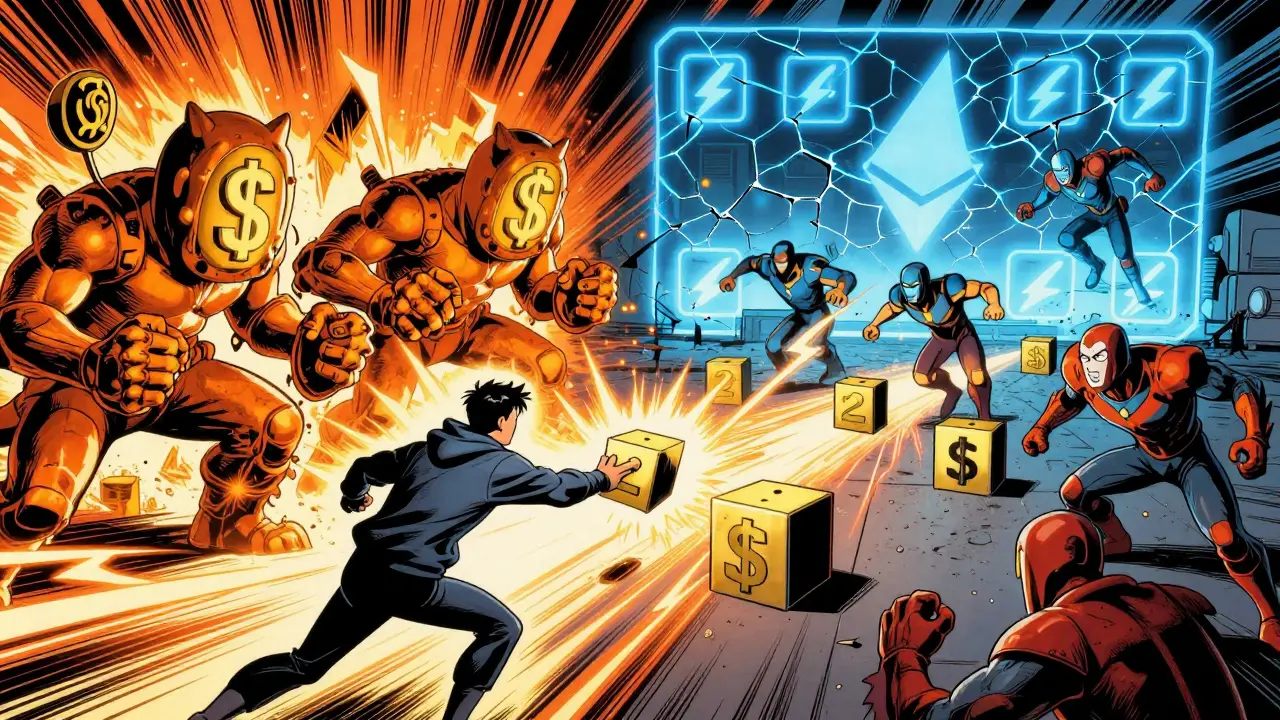
Anyone can build on a public blockchain. No approval. No pitch deck. No venture capital. If you have code, you can launch a token, a marketplace, or a lending app. That’s how DeFi exploded. In 2020, a handful of developers built protocols like Uniswap and Aave on Ethereum - no company backing them. Today, those platforms manage over $10 billion in assets.
That’s the beauty of permissionless innovation. You don’t need permission to create value. But that freedom comes with risk. Most DeFi apps fail. Many are scams. But the ones that work? They change finance forever.
Disadvantage 1: Slow and Expensive Transactions
Bitcoin can only handle 7 transactions per second. Ethereum does 15-30. Compare that to Visa’s 24,000. When demand spikes - during an NFT drop, a DeFi surge, or a meme coin frenzy - the network clogs. Transactions sit in a backlog. Miners prioritize those with the highest fees. So you pay more. Or you wait hours.
In 2021, Ethereum gas fees hit $700 for a single trade. In 2023, during a major NFT launch, users paid $200 just to mint a digital image. That’s not just inconvenient. It’s exclusionary. If you’re trying to send $10 to a friend in Nigeria, paying $50 in fees doesn’t make sense. Public blockchains work best for large-value transfers, not small daily payments.
Disadvantage 2: High Energy Use (Even After Ethereum’s Shift)
Bitcoin still runs on Proof of Work. That means miners compete to solve math puzzles using massive amounts of electricity. One Bitcoin transaction uses as much power as an average U.S. household does in two days. That’s not sustainable.
Ethereum fixed this in 2022 by switching to Proof of Stake. Energy use dropped by 99.95%. Now, it uses less than a household lightbulb per transaction. But Bitcoin hasn’t changed. And many newer public chains still rely on energy-heavy models. If climate concerns matter to you, not all public blockchains are equal.
Disadvantage 3: Governance Is Messy and Slow
Who decides what changes happen on a public blockchain? No one. That’s the point. But that also means decisions get stuck. In 2017, Bitcoin developers argued over block size. Some wanted bigger blocks to handle more transactions. Others feared centralization. The split led to Bitcoin Cash - a new chain that copied Bitcoin but changed the rules.
Ethereum had a similar moment in 2016 after the DAO hack. $60 million was stolen. The community voted to reverse the transaction - a move against blockchain immutability. That created Ethereum Classic. Two chains. One original. One changed. Governance debates like this happen constantly. They’re messy. They take months. And they create uncertainty. Enterprises hate that.

Disadvantage 4: Privacy Is a Myth
Just because you’re anonymous doesn’t mean you’re private. On a public blockchain, your wallet address is visible. Every transaction you make is public. If someone links your address to your real identity - through an exchange, a social media post, or a public donation - your entire financial history is exposed.
That’s why you can’t use Bitcoin to store medical records or payroll data. You can’t use Ethereum to track confidential contracts. Even if you use a privacy coin like Monero, most exchanges don’t support it. Public blockchains are transparent by design. Privacy requires extra tools - and even then, it’s not foolproof.
Disadvantage 5: Hard to Use for Businesses
Most companies don’t use public blockchains for core operations. Why? Because they need reliability. Predictability. Speed. Public chains don’t deliver that. Gas fees spike unpredictably. Transactions take minutes. Nodes can go offline. You can’t guarantee uptime.
That’s why Walmart, Maersk, and Deutsche Bank use private or consortium blockchains. They control who joins. They set the rules. They get speed and privacy. Public chains are great for open finance and digital ownership. But for supply chain logs, HR records, or internal accounting? Not yet.
Who Should Use Public Blockchains?
Public blockchains aren’t for everyone. But they’re perfect for specific cases:
- Cryptocurrency holders who want censorship-resistant money
- DeFi users who want to lend, borrow, or trade without banks
- Developers building open apps with global access
- Activists or citizens in repressive regimes needing financial freedom
- Artists and creators minting NFTs with verifiable ownership
If you need speed, privacy, or enterprise-grade reliability? Look at private blockchains or centralized systems. Public chains aren’t better. They’re just different.
The Future: Layer 2s and Hybrid Models
People aren’t giving up on public blockchains. They’re fixing them. Layer 2 solutions like the Lightning Network (for Bitcoin) and Arbitrum, Optimism (for Ethereum) are scaling transactions off-chain, then settling them on the main chain. Total value locked in Layer 2s crossed $10 billion in 2024.
Hybrid models are also rising. Think of a company using a public blockchain to verify a product’s origin - but storing sensitive data on a private server. The public chain proves authenticity. The private system keeps details confidential.
Public blockchains won’t replace banks. But they’re changing how we think about trust. They’re proving you don’t need a central authority to make value transfer work. That’s revolutionary. Even with all their flaws.
Are public blockchains safe?
Yes, but not in the way you might think. The network itself is extremely secure because of its decentralized design - it’s nearly impossible to hack the blockchain ledger. But your wallet? Your private keys? Those are your responsibility. If you lose them, or if you click a phishing link, you can lose everything. The blockchain won’t help you recover it.
Can I use public blockchains for everyday payments?
Not really - not yet. Fees and speed make it impractical for buying coffee or paying rent. Layer 2 solutions are improving this, but most people still use credit cards or bank apps for daily spending. Public blockchains are better suited for larger transfers, savings, or decentralized finance.
Why do gas fees go so high?
Gas fees rise when too many people try to send transactions at once. Miners prioritize transactions with higher fees. During NFT launches or DeFi spikes, demand surges, and fees spike. It’s basic supply and demand. Ethereum’s move to Proof of Stake helped, but congestion still happens. Layer 2 networks are the real solution.
Is Bitcoin the only public blockchain?
No. Bitcoin was the first, but Ethereum, Solana, Litecoin, and many others are public blockchains too. Each has different rules, speeds, and uses. Ethereum supports smart contracts, so it’s used for apps. Bitcoin is mostly for value storage. Solana is faster but less decentralized. They’re not the same.
Do public blockchains use a lot of electricity?
Bitcoin does - a lot. But Ethereum switched to Proof of Stake in 2022 and now uses 99.95% less energy. Other chains like Solana and Cardano also use low-energy consensus methods. So it depends on the chain. Don’t assume all public blockchains are energy hogs.
Can governments shut down public blockchains?
No. Not really. Governments can ban exchanges, restrict access, or fine users - but they can’t shut down the blockchain itself. It runs on thousands of computers worldwide. Even if one country blocks it, others keep it alive. That’s why it’s called censorship-resistant.






Public blockchains are wild. I love the idea but I swear my wallet has cost me more in gas than I’ve ever made. I just send when I absolutely have to now. No more impulse buys.
Bro in India we pay 50 rupees for a UPI transfer. Now you telling me I gotta pay $20 to send $50? That’s not innovation, that’s a scam. Why even call it finance?
they say decentralization is freedom but honestly its just chaos with extra steps. i tried to send eth once and lost it because i typed the wrong address. no one helped. no customer service. just silence. this isnt liberation its digital russian roulette
Let me get this straight - we built a global financial system that can’t process a $10 payment without charging a month’s rent in gas fees? And people call this progress? I’ve seen more reliable service from a 2008 AOL dial-up connection.
Don’t give up on it. Layer 2s are getting better. I’ve been using Arbitrum for weeks now - fees are pennies. It’s not perfect, but it’s moving in the right direction.
Anyone else notice how the article talks about transparency like it’s a superpower, but ignores how that transparency destroys privacy? My aunt got doxxed because she donated to a political cause on-chain. Now her employer knows. That’s not freedom. That’s vulnerability dressed up as innovation.
While the technical merits of public blockchains are well-documented, their practical adoption remains limited by usability, scalability, and regulatory ambiguity. Enterprises require SLAs, audit trails, and recourse mechanisms - none of which are inherent to permissionless systems. Until these gaps are bridged, hybrid architectures will dominate institutional use cases.
Oh my goodness, this piece is absolutely brilliant! The way it captures the tension between decentralization and real-world practicality is nothing short of poetic. I’m currently building a blockchain-based agricultural supply chain in Lagos, and the transparency has transformed how smallholder farmers negotiate prices - no more middlemen skimming 40%! But oh, the gas fees? Still a nightmare. We’re using BSC for now. Not ideal, but it works. Keep writing like this - the world needs more clarity!
Y’all are acting like blockchain is supposed to be easy 😭 I mean yeah gas fees suck but think about it - we’re living in a world where you can send money across the globe without a bank and no one can stop you. That’s not normal. That’s magic. And magic ain’t cheap. Just wait till L2s scale. We’re in the iPhone 1 era. The future’s bright.
They don’t want you to know this but public blockchains are a government psyop to track your every move. They let you think you’re free but every transaction is logged and fed into a global surveillance matrix. The energy waste? A distraction. The ‘decentralization’? A lie. Wake up. They’re building the digital panopticon and calling it revolution
Love how you said ‘public blockchains aren’t better - they’re just different.’ That’s the whole damn truth right there. I use crypto for savings, not coffee. Let the banks handle my latte. I’m cool with slow and secure.
Honestly I think the real win here is the permissionless innovation. I built a simple token for my local art collective last year - no VC, no pitch deck, just code. People are using it now to tip each other. It’s tiny, but it’s real. That’s the future right there.
Who even needs blockchains when you can just use PayPal or Venmo? This whole thing is overhyped nonsense. All that energy wasted for what? So some tech bros can flex their wallet addresses? Get a life
That’s actually what I’ve been doing too. Used to send everything on mainnet. Now I just batch everything on Arbitrum. It’s like night and day. And I don’t even notice the delay. It’s seamless.