
Why Iceland Is Restricting Crypto Mining: Energy Allocation Crisis Explained
For over a decade, Iceland was the golden ticket for cryptocurrency miners. You had cheap, clean geothermal and hydroelectric power, a cold climate that cut cooling costs, and a stable government that didn’t seem to care much about what you were hashing. But by mid-2024, the party started winding down. The Icelandic government, led by Prime Minister Katrín Jakobsdóttir, made it clear: the era of unlimited growth for crypto mining in Iceland is over.
If you’re looking to expand your mining operation into Reykjavik or its surroundings, you need to understand why. It’s not just about politics; it’s physics. Iceland has hit a hard ceiling on how much electricity it can generate, and the country is now deciding who gets to use that limited resource. This shift affects every miner, from small solo operators to massive industrial farms like those run by Genesis Mining or Verne Global.
The Renewable Energy Paradox
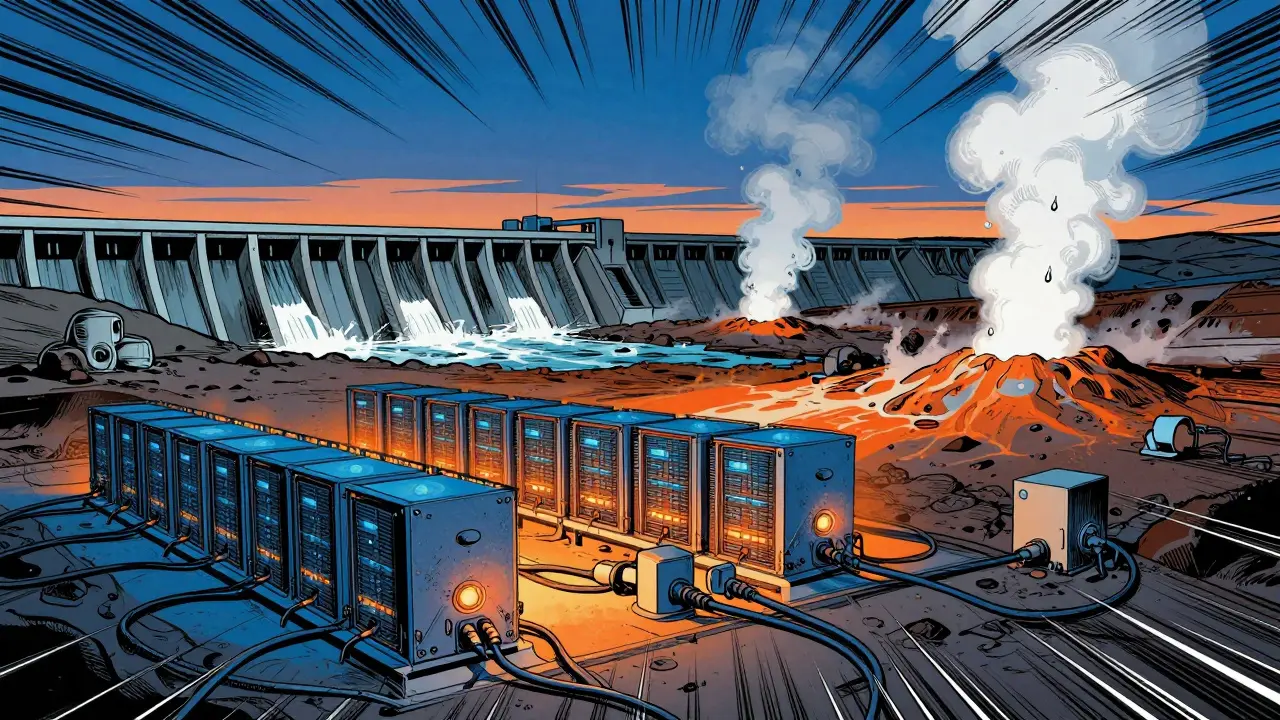
Iceland sits on top of one of the most abundant sources of renewable energy on Earth. Roughly 75% of its electricity comes from hydroelectric dams, and the remaining 25% is generated by geothermal plants tapping into volcanic activity. For years, this meant surplus power. Waterfalls flowed freely, and steam vented from the ground, often unused. Miners stepped in to buy this "stranded" energy at wholesale rates, turning waste into Bitcoin.
But here’s the problem: that surplus is gone. According to data from the National Energy Authority of Iceland, cryptocurrency mining consumed approximately 8% of the nation’s total energy consumption in 2023. That might sound small compared to the US or China, but in a country with a population of only 380,000 people, it’s massive. The grid is operating near maximum capacity. Both hydro and geothermal facilities are running at their physical limits. There is no easy switch to flip to create more power.
Is Iceland's electricity truly 100% renewable?
Yes. Iceland generates nearly all of its electricity from domestic renewable resources, specifically hydropower (approx. 75%) and geothermal energy (approx. 25%). This makes it unique globally for industrial applications.
Who Gets Priority? The Zero-Sum Game
When supply is fixed and demand rises, someone loses out. In Iceland, that someone is increasingly the crypto mining sector. The government faces a difficult choice: allocate scarce megawatts to Bitcoin miners, or save them for other industries? Currently, the scale is tipping away from mining.
The primary competitor for Iceland’s energy is the aluminum smelting industry. Aluminum production is energy-intensive, yes, but it provides stable, long-term employment and predictable tax revenue. Crypto mining, by contrast, creates very few direct jobs and offers volatile returns based on market prices. When officials look at the economic impact, they see that mining contributed an estimated 2% to Iceland’s GDP in 2024. While significant, policymakers argue that same energy could support tourism infrastructure, data centers for AI development, or even hydrogen production for export.
This isn't just theoretical. We’ve seen similar moves elsewhere. Quebec raised tariffs for miners when residential needs grew. Inner Mongolia cracked down during droughts that affected hydro output. Iceland is following suit, but with a different nuance: they aren’t banning mining outright yet. They are simply refusing to give new miners access to the grid.
| Industry | Energy Demand | Economic Stability | Job Creation | Government Priority |
|---|---|---|---|---|
| Aluminum Smelting | Very High | High (Long-term contracts) | High (Stable employment) | High |
| Crypto Mining | High (8% of national total) | Low (Volatile market) | Low (Automated) | Declining |
| Data Centers / AI | Moderate to High | Medium (Growing sector) | Medium (Tech jobs) | Rising |
| Residential Use | Moderate | N/A | N/A | Highest |

The Policy Shift: From Welcome Mat to Closed Door
In March 2024, Prime Minister Katrín Jakobsdóttir publicly stated her desire to reduce cryptocurrency mining activities in the country. This wasn’t a subtle hint. It was a signal to investors that the regulatory environment was changing. The government wants to pivot from supporting energy-heavy mining to fostering broader blockchain innovation-think decentralized finance apps, NFT platforms, or Central Bank Digital Currency (CBDC) research. These sectors use negligible amounts of electricity compared to Proof-of-Work mining.
So, what does this mean for existing miners? If you have a Power Purchase Agreement (PPA) signed before 2017, you’re likely safe for now. Companies like Advania Data Centers and Verne Global secured their spots early. They benefit from grandfathered rates and guaranteed grid connections. But if you’re trying to enter the market today, good luck. New entrants face extremely limited options. Grid connection requests are stuck in indefinite delays because there is simply no spare capacity.
Tariff hikes are also becoming a tool for management. While Iceland hasn’t implemented the steep punitive taxes seen in some Asian jurisdictions, the cost of securing new industrial power is rising. The era of dirt-cheap, wholesale-rate electricity for new miners is effectively dead.
Technical Realities: The Hashrate Ceiling
Let’s talk numbers. As of 2024, Iceland’s Bitcoin mining operations generated well above 1% of the global hashrate. That sounds impressive, but it’s capped at approximately 120 megawatts of allocated power. Modern ASIC miners, such as the Antminer S19 XP or Whatsminer M50S, are incredibly efficient, consuming around 28 joules per terahash. However, efficiency doesn’t matter if you don’t have the plug.
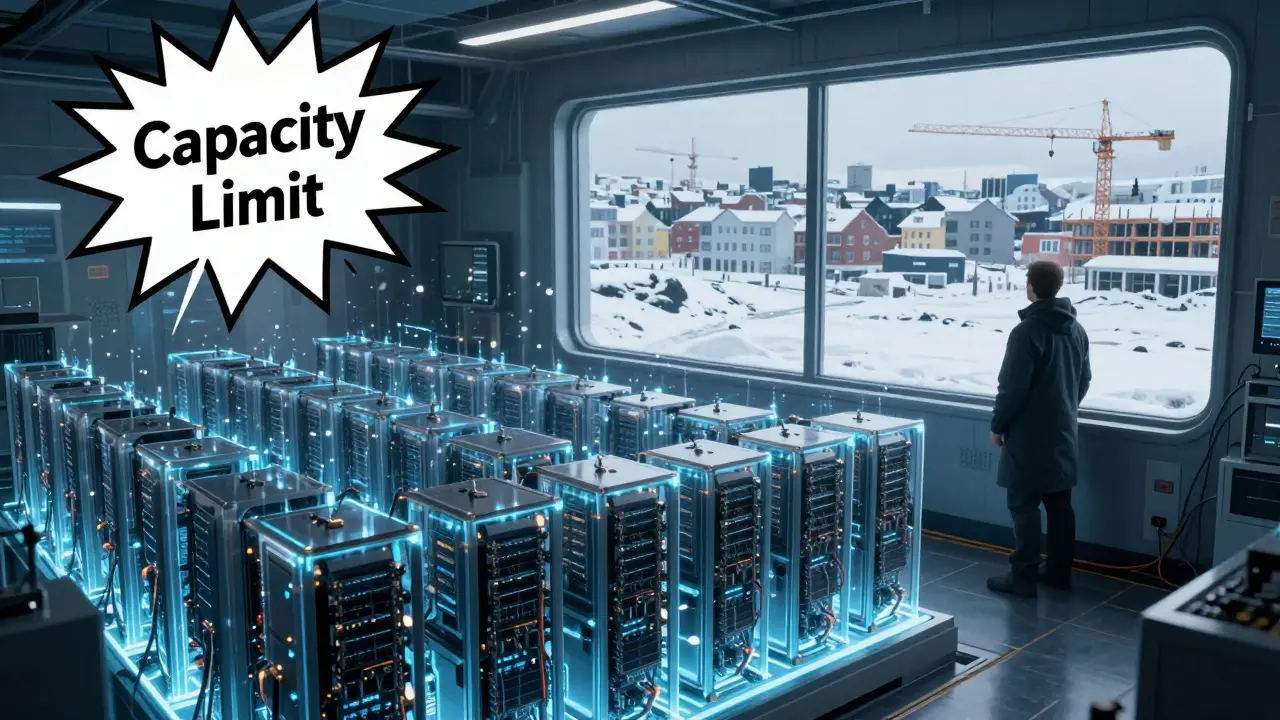
You can have the best hardware in the world, but if the local transformer can’t handle another 500 kilowatts, you’re stuck. Infrastructure limitations are the insurmountable barrier here. Building new hydro dams takes decades and faces environmental scrutiny. Drilling new geothermal wells is expensive and technically risky. Until significant new generation capacity comes online-which analysts say is unlikely before 2030-the pie isn’t getting bigger.
This creates a strange dynamic. Iceland remains one of the most premium locations for *existing* miners due to political stability and green credentials. But it is a growth-limited jurisdiction. You won’t find the rapid scaling opportunities you might see in Texas or Kazakhstan, where vast fossil-fuel-based grids can absorb sudden spikes in demand.
What Should Miners Do Now?
If you are currently mining in Iceland, hold tight. Your operational costs remain low, and the risk of sudden shutdown is minimal compared to countries with authoritarian regimes. Focus on optimizing efficiency within your current power allowance. Don’t plan for expansion unless you can secure a secondary location.
If you are planning to start mining, reconsider Iceland as your primary hub. Look at regions with expanding grid infrastructure. The US Midwest, parts of Canada, or even Eastern Europe may offer better scalability despite higher carbon footprints or less political stability. Remember, in 2026, accessibility to power is more valuable than the source of that power.
For those interested in the broader blockchain space, Iceland is still a great place to be. The government wants developers, not hashers. If your business model relies on software rather than silicon, the door is still open.
Future Outlook: A Stable Stagnation
The future of crypto mining in Iceland looks like stagnation. Industry experts predict the sector will remain stable at current levels. Existing players will continue to profit from their advantageous positions, but new competition will be locked out. The government’s focus on CBDCs and non-mining blockchain applications suggests that any future energy investments will bypass the mining industry entirely.
This is a classic case of resource constraints forcing economic evolution. Iceland proved that you can mine Bitcoin sustainably, but it also proved that sustainability has limits. As the global energy landscape tightens, Iceland’s experience serves as a warning to other renewable-rich nations: green energy is finite, and prioritization is inevitable.
Can I get a new power contract for crypto mining in Iceland in 2026?
It is highly unlikely. The Icelandic government has paused new allocations for crypto mining due to grid capacity constraints. Existing contracts from pre-2017 are generally honored, but new entrants face indefinite waiting lists and rejection.
Why is the Icelandic government against crypto mining?
The government is concerned about opportunity costs. They believe limited renewable energy should be reserved for industries that create more stable jobs (like aluminum) or innovative tech sectors (like AI data centers) rather than volatile crypto mining.
How much energy do crypto miners use in Iceland?
In 2023, cryptocurrency mining accounted for approximately 8% of Iceland's total national energy consumption. This represents a significant portion of the country's fixed electricity generation capacity.
Is crypto mining banned in Iceland?
No, it is not banned. However, the government is actively discouraging growth by restricting new power allocations and shifting policy support toward less energy-intensive blockchain technologies.
Which companies are major crypto miners in Iceland?
Major players include Genesis Mining, Advania Data Centers, and Verne Global. These companies established their presence early and hold secure power purchase agreements.



oh great, another country realizing that mining bitcoin is basically just burning money for no reason lol. they had cheap power and still cant make it work? sounds like a disaster waiting to happen. i bet the locals are tired of seeing their electricity go to some server farm in a basement somewhere.
The decision by the Icelandic government is both prudent and necessary for long-term economic stability. It is crucial to understand that renewable energy resources, while abundant, are not infinite. The allocation of such resources must prioritize industries that provide tangible societal benefits, such as employment and infrastructure development, over speculative ventures like cryptocurrency mining. This shift demonstrates a mature approach to resource management and aligns with global trends towards sustainable industrial practices.
It makes sense from an economic standpoint. Aluminum smelting provides stable jobs and consistent tax revenue, whereas crypto mining is volatile and creates very few direct positions. The grid capacity is finite, so prioritizing established industries seems logical.
Wait, but what about the hash rate efficiency? If you have the best ASICs like the S19 XP, you get more terahashes per joule. Shouldnt that matter more than job creation? I mean, if the tech is better, why not use it? Also, does this mean all new miners are completely out of luck or just delayed?
Efficiency matters, but only if there is power available to plug into. The article clearly states that the grid is at maximum capacity. You can have the most efficient hardware in the world, but without megawatts, you cannot mine. The issue is not the technology; it is the physical limitation of hydroelectric and geothermal generation.
This is typical government overreach disguised as environmentalism. They are just trying to control the narrative and squeeze out independent operators who don't fit their little plan. Who cares about aluminum smelting when Bitcoin is the future? These politicians have no idea what they are talking about and are ruining innovation for profit.
I suspect this is part of a larger agenda to centralize financial control under the guise of green energy initiatives. By restricting crypto mining, they limit the decentralization efforts of the people. It is a coordinated effort to maintain the status quo of traditional banking systems while pretending to care about sustainability. We must remain vigilant against these subtle forms of oppression.
Oh my goodness, can we just appreciate how beautiful Iceland is though? Like, imagine living next to waterfalls and volcanoes! But seriously, this is such a sad turn of events for the crypto community. It feels like the golden age is really coming to an end everywhere. I hope the existing miners can keep going because it was such a cool concept!
So basically, if you didn't sign a contract before 2017, you're screwed? That's harsh. I guess the early birds got the worm, or in this case, the cheap electricity. Poor latecomers having to deal with indefinite delays. What a mess.
i think its pretty fair tho. like, why should everyone else pay for the lights if the miners are using up all the juice? its not right to hog the resources. plus, the gov needs money for other stuff too. maybe they should focus on ai instead since thats gonna be big soon.
lol u guys are so naive 🤡 thinking the gov cares about jobs? nah, they just want to control the flow of capital. crypto is too free for them. they hate freedom. also ur spelling is bad lmao 😂
Clearly, the uneducated masses do not understand the geopolitical implications of energy allocation. It is amusing to watch simpletons argue about 'fairness' when the reality is complex economic strategy. Only those with superior intellect can grasp the nuances of grid management versus speculative asset mining. You are all missing the bigger picture entirely.
In the grand scheme of things, this reflects a universal truth: resources are limited, and choices must be made. The transition from one era to another is inevitable. Perhaps we should reflect on what value truly means in a digital age. Is it the coin mined, or the society sustained? 🤔
hi friends! just wanted to say that this info is really helpful. thanks for sharing the details about the power contracts. it seems like a tough situation for new miners but understandable for the country. hope everyone stays safe and keeps learning!