Understanding Governance Token Value: Why It Matters and How to Assess It
You buy a governance token because you want a say in how a protocol runs. You expect that holding these tokens gives you real power and, hopefully, some financial upside. But here is the uncomfortable truth: most governance tokens trade at prices completely disconnected from their actual utility. If you are trying to figure out if a token is worth buying or holding, you need to look past the hype and understand where the value actually comes from.
Governance tokens are not just digital ballots. They represent a claim on influence within a Decentralized Autonomous Organization (DAO). Unlike traditional stocks, they rarely pay dividends directly. Instead, their value fluctuates based on speculation about future protocol success, community sentiment, and the perceived importance of the decisions being made. This article breaks down exactly how to assess that value, what drives price swings, and why your vote might matter less than you think unless you know how the system works.
What Exactly Are You Buying?
At its core, a governance token grants you voting rights proportional to your holdings. That is it. There is no legal contract guaranteeing you a share of profits. When you hold MKR, for example, you can vote on risk parameters for the DAI stablecoin. You can decide how much collateral is required for loans or which assets are accepted. These decisions impact the protocol’s stability and revenue, but they do not automatically put money in your pocket.
This distinction is critical. In traditional finance, equity represents ownership and cash flow rights. In crypto, governance tokens represent influence. The value proposition shifts from "how much money will I make?" to "how much control do I have over an asset that might become valuable?" This second-order effect is where most confusion lies. If the protocol succeeds, the token might appreciate because more people want influence over a successful system. If the protocol fails, the token becomes worthless because nobody cares who controls a dead project.
Smart contracts execute these votes automatically once thresholds are met. This removes human error and potential tampering, but it also means that if the community makes a bad decision, there is no board of directors to blame. You voted for it. Or rather, the whales voted for it, and your small stake was drowned out by their voting power.
The Whale Problem and Voting Power Dynamics
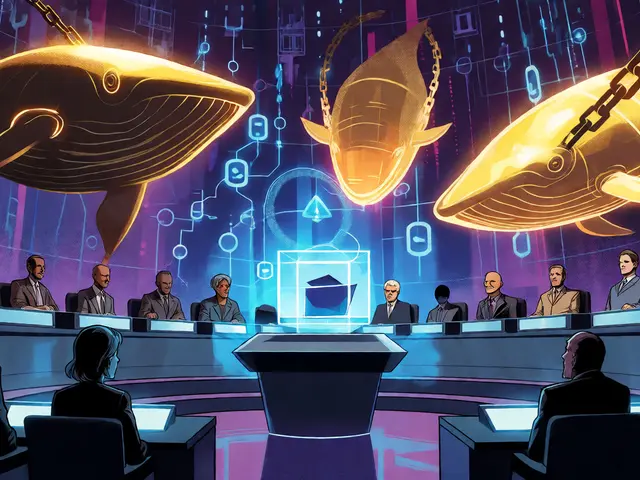
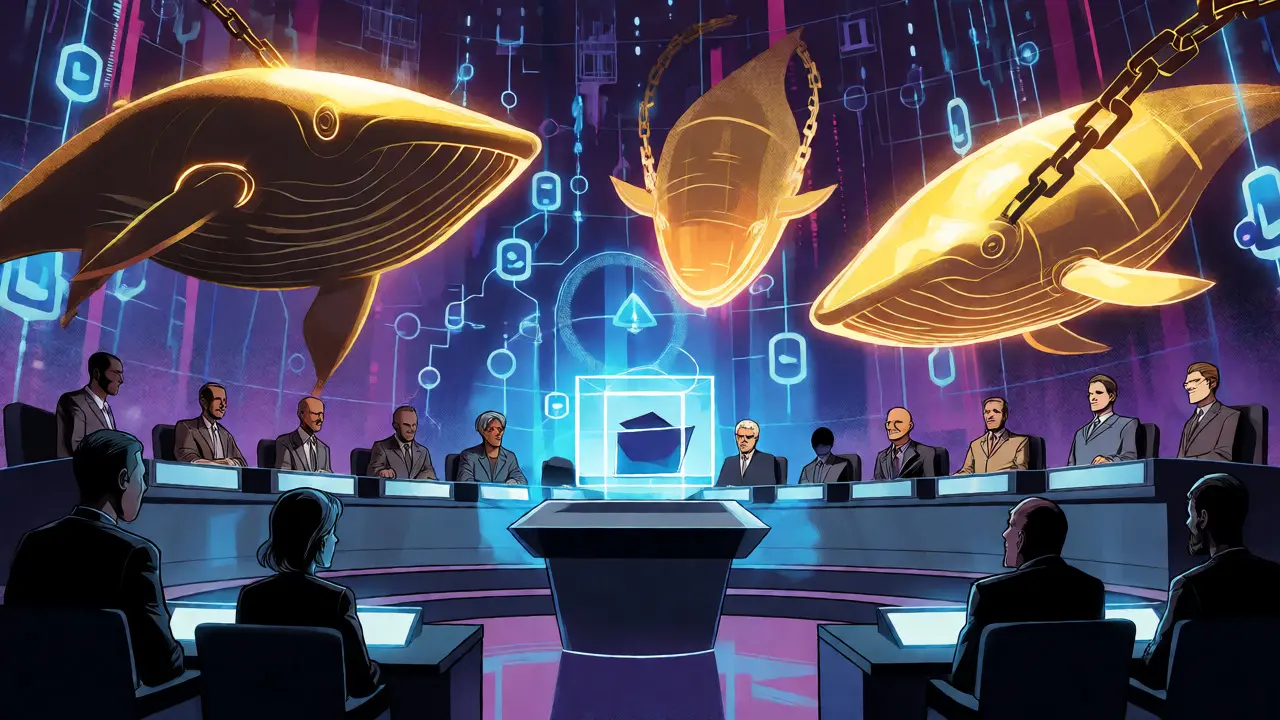
Here is a scenario that plays out daily in major DAOs: A proposal is submitted to change transaction fees. A large holder, often called a whale, owns 15% of the supply. Small holders own the rest but only 5% of them bother to vote. The whale votes "Yes." The proposal passes with overwhelming support relative to those who voted. Did the community approve it? Technically, yes. Did the majority of token holders approve it? No. Most didn't care enough to log in.
This concentration of power undermines the democratic ideal. While quadratic voting attempts to mitigate this by giving smaller holders more weight per token, most protocols still use linear voting. Your one million tokens count as one million votes. One token counts as one vote. If institutional investors or early team members hold the bulk of the supply, they effectively control the protocol's direction. This creates a misalignment between the token price and the average user's experience. You might be paying a premium for a token that gives you negligible influence against entrenched interests.
Where Does the Price Actually Come From?
If governance tokens don't pay dividends, why do they have a market cap in the billions? The answer is speculation and network effects. Traders buy these tokens expecting others to buy them later at a higher price. They bet on the growth of the underlying protocol. For instance, when Uniswap launched its UNI token, traders speculated that having a say in fee structures would lead to better outcomes for liquidity providers, driving more volume and thus more demand for the token.
However, this valuation model is fragile. It relies entirely on the belief that governance matters. If users realize that their votes have little impact on their returns, demand drops. Recent trends show a shift toward revenue-sharing models, where protocols like GMX distribute fees directly to stakers. This creates intrinsic value. Tokens without this mechanism struggle to justify high valuations during bear markets because there is no yield to cushion the fall.
| Valuation Driver | Description | Risk Level | Example Protocol |
|---|---|---|---|
| Speculative Growth | Price rises due to expectations of future adoption and protocol success. | High | Early-stage DeFi protocols |
| Fee Sharing/Staking | Direct cash flow or token emissions distributed to holders/stakers. | Medium | GMX, Synthetix |
| Influence Premium | Value derived from controlling key protocol parameters (e.g., interest rates). | Variable | MakerDAO (MKR) |
| Network Effects | Token gains value as more users join the ecosystem, increasing demand for governance. | Low-Medium | Ethereum (ETH - quasi-governance) |
Why Voter Apathy Kills Value
You might think low participation is good for whales because they win every vote. But for the token's long-term value, apathy is toxic. When only 5-10% of the supply participates in voting, the legitimacy of decisions erodes. Users lose trust in the process. If a protocol changes its economic model and the community feels ignored, they leave. Liquidity dries up. Revenue falls. The token price crashes.
Successful DAOs fight this fatigue by simplifying proposals and using delegation. Platforms allow you to delegate your voting power to trusted experts or communities. This doesn't mean you give up your tokens; you keep them, but someone else casts the vote. This increases participation rates and ensures decisions reflect broader community sentiment. If a protocol lacks robust delegation mechanisms, its governance token is likely overvalued relative to its actual operational health.
How to Assess a Governance Token Before Buying
Don't just look at the chart. Dig into the governance activity. Here is a practical checklist:
- Voter Participation Rate: Check recent votes. If less than 10% of circulating supply voted, the token's governance utility is weak. High participation suggests engaged users who care about the outcome.
- Proposal Impact: Look at passed proposals. Do they significantly change the protocol's economics? If most votes are cosmetic (like changing logo colors), the token has little functional value.
- Revenue Mechanisms: Does the protocol generate real revenue? Is any of it returned to token holders? If not, the token is purely speculative.
- Whale Concentration: Use blockchain explorers to check top holder percentages. If the top 10 wallets hold 80% of the supply, your individual vote is statistically irrelevant.
- Team Alignment: Did the founding team vest their tokens? If insiders dumped their holdings early, their incentives are no longer aligned with long-term protocol health.
The Future: Beyond Simple Voting
The next generation of governance tokens is moving away from pure voting rights. We are seeing hybrid models where tokens combine governance with staking rewards, insurance coverage, or access to exclusive features. For example, some protocols require holding a governance token to participate in high-yield pools. This ties utility directly to holding, creating a floor for the price.
Regulatory scrutiny is also reshaping value. If authorities classify certain governance tokens as securities, they must offer clear profit expectations. This could force protocols to adopt formal dividend policies, making token valuation more akin to traditional equities. Conversely, if they remain classified as utilities, their value will continue to depend on network effects and speculative demand.
Ultimately, understanding governance token value requires separating signal from noise. The token itself is just code. Its value is a collective agreement on the importance of the organization it governs. If you can identify protocols with active communities, real revenue, and fair voting mechanisms, you are looking at assets with sustainable value. If you see low participation, whale dominance, and no revenue sharing, you are buying hope, not utility.
Do governance tokens pay dividends?
Traditionally, no. Most governance tokens do not pay direct dividends. However, newer protocols are introducing revenue-sharing models where fees generated by the platform are distributed to token holders who stake or lock their tokens. Always check the specific tokenomics of the protocol to see if yield is available.
Can I lose my governance tokens if I vote incorrectly?
No, you do not lose your tokens for voting. Your tokens remain in your wallet regardless of how you vote. However, if the community passes a proposal that negatively impacts the protocol's value, the market price of your tokens may drop. Some advanced systems use "slashing" mechanisms for delegates who consistently vote poorly, but this is rare for regular holders.
What is quadratic voting?
Quadratic voting is a mechanism designed to reduce the influence of wealthy whales. Instead of one token equaling one vote, the cost of additional votes increases quadratically. For example, casting 10 votes might cost 100 tokens instead of 10. This allows smaller holders to have a more significant relative impact on outcomes compared to linear voting systems.
Is governance token value tied to the protocol's total value locked (TVL)?
Often, yes, but not always directly. Higher TVL usually indicates greater usage and potential revenue, which can drive demand for the governance token. However, correlation does not equal causation. A protocol can have high TVL but poor governance participation, leading to stagnant token prices. Always look at both metrics together.
What happens if I sell all my governance tokens?
You lose your voting rights. Once you sell your tokens, you no longer have a voice in the DAO's decisions. You can still use the protocol as a regular user, but you cannot propose changes or vote on existing proposals unless you buy back into the token.