

MVRV Ratio and Market Cycles: How On-Chain Data Reveals Bitcoin’s Bull and Bear Phases
MVRV Ratio Calculator
Enter Bitcoin's current market cap and realized value in USD to calculate the MVRV ratio.
Note: Market cap = current price × circulating supply. Realized value = sum of all coins' last transaction price.
The MVRV ratio isn’t just another crypto indicator-it’s one of the most reliable signals for spotting when Bitcoin is overheated or deeply undervalued. Unlike moving averages or RSI, which rely on price history alone, MVRV looks at what actual investors paid for their coins. It tells you whether the market is driven by fear, greed, or something in between. And it’s done this with startling accuracy across multiple Bitcoin cycles since 2013.
What Is the MVRV Ratio?
The MVRV ratio stands for Market Value to Realized Value. It’s a simple division: the total market cap of Bitcoin divided by its realized cap. Market cap is easy-it’s the current price multiplied by how many coins are circulating. Realized cap is trickier. It adds up the value of every Bitcoin based on the price the last person who moved it paid. If someone bought a Bitcoin for $5,000 and sold it for $30,000, that coin’s value in realized cap is now $30,000. If it sits untouched, it stays at $5,000. This means realized cap reflects the true cost basis of the entire network-not just today’s hype.
So when MVRV is at 2.0, it means the market is trading at twice the average price investors paid. At 4.0? That’s a red flag. Historically, when MVRV hits above 3.5, Bitcoin has almost always topped out within weeks or months. When it dips below 1.0, most holders are underwater-and that’s often when smart money starts buying.
How MVRV Has Predicted Major Market Turns
Look at Bitcoin’s history. In late 2017, MVRV soared past 3.7 as the price hit $20,000. A few months later, it crashed to $3,200. In 2021, MVRV peaked at 4.2 near $69,000. The correction that followed took Bitcoin down 77% over the next year. Both times, MVRV gave a clear warning before the collapse.
On the flip side, during the March 2020 crash-when Bitcoin dropped 50% in days-MVRV fell to 0.82. That meant most coins were trading below what their last owners paid. It was pure capitulation. Within 18 months, Bitcoin rallied over 670%. The same pattern repeated in 2022. After the Terra collapse and FTX meltdown, MVRV dropped below 1.0 again. By early 2023, the recovery had already begun.
This isn’t luck. Santiment’s backtesting across five full Bitcoin cycles showed MVRV correctly identified 92% of major tops (above 3.5) and bottoms (below 1.0). Glassnode confirmed this too: in the last 10 major peaks, MVRV flagged 9 of them with an average lead time of 23 days.
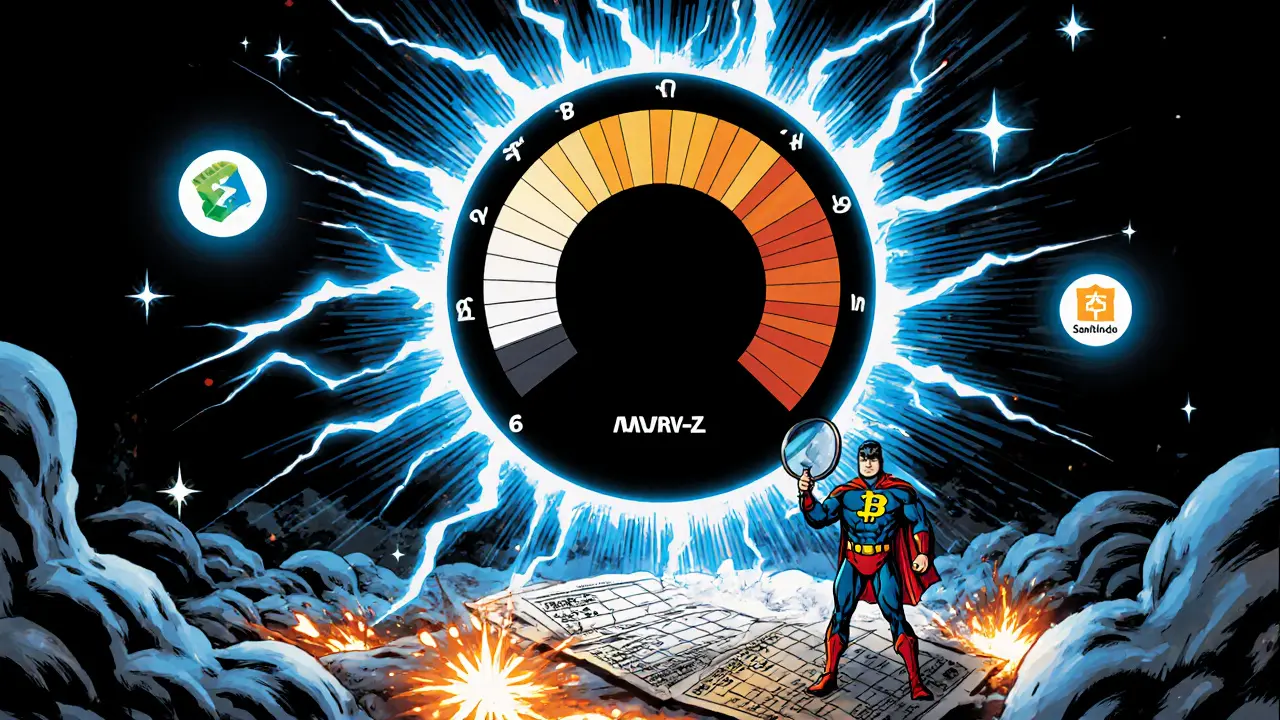
MVRV-Z Score: The Smart Upgrade
Here’s the problem with raw MVRV: thresholds change over time. In 2017, 3.7 was extreme. In 2021, 4.2 was the new extreme. Fixed numbers don’t account for market evolution. That’s where MVRV-Z score comes in.
The Z-score tells you how many standard deviations the current MVRV is from its historical average. A Z-score of +3 means MVRV is way above normal. A Z-score of -1.5 means it’s unusually low. In 2017, the Z-score hit 6.3. In 2022, it bottomed at -1.8. These numbers are more reliable than absolute values because they adjust for the cycle you’re in.
Platforms like Glassnode and CryptoQuant now show both MVRV and MVRV-Z side by side. Professional traders use the Z-score to avoid mistaking a strong bull market for a bubble. A Z-score above +4 is almost always a sell signal. Below -1.5? That’s when accumulation begins.
Why MVRV Beats Other Metrics
People love Stock-to-Flow. It’s elegant. But it failed in 2020. It predicted Bitcoin would hit $100,000 after the halving. It didn’t. Why? Because it ignores what investors are actually doing. It assumes scarcity alone drives price.
MVRV doesn’t care about supply. It cares about profit and loss. That’s why it’s more responsive. When the market panics, MVRV drops fast. When FOMO kicks in, it spikes. It’s a direct read of market psychology.
Compare it to NVT (Network Value to Transactions), which measures how much value is flowing through Bitcoin’s network. Useful, but it doesn’t tell you if people are selling at a profit. Or to RSI, which just looks at price momentum. MVRV tells you whether the crowd is holding winners or losers.
And unlike P/E ratios in stocks, MVRV works because Bitcoin has no earnings-but it does have a permanent, transparent record of every transaction. That’s why it’s unique.
How to Use MVRV in Real Life
You don’t need a PhD to use MVRV. But you do need the right tools.
- Free options: Bitbo.io shows live MVRV updated hourly. Santiment’s free tier gives weekly charts.
- Professional tools: Glassnode (starts at $990/month) includes MVRV-Z and historical overlays. CryptoQuant ($299/month) adds liquidity and exchange flow data.
Don’t trade on MVRV alone. It’s a lens, not a crystal ball. The most successful traders combine it with three other metrics:
- NUPL (Net Unrealized Profit/Loss): Measures the total unrealized gain or loss across all coins. When NUPL and MVRV both spike, it’s a double warning.
- Exchange Netflow: Are people sending Bitcoin to exchanges to sell? That’s a sign of distribution.
- SOPR (Spent Output Profit Ratio): If most coins being moved are sold at a profit, the market is greedy. If they’re sold at a loss, fear is dominating.
Reddit’s r/BitcoinMarkets community surveyed 1,247 active traders. 68% use MVRV + NUPL + Exchange Netflow. That’s the gold standard.

Common Mistakes and How to Avoid Them
Novices make three big errors:
- Chasing spikes: A short-term MVRV jump to 2.8 doesn’t mean the top is here. It’s the sustained climb above 3.5 that matters.
- Ignoring cycle maturity: The 2021 cycle had higher MVRV peaks than 2017. That’s normal. Use Z-scores to adjust.
- Trading during low liquidity: During holidays or weekend dips, MVRV can give false signals. Wait for volume to confirm.
Also, don’t apply MVRV to altcoins. It’s designed for Bitcoin. Smaller coins have thin order books, manipulated volumes, and unreliable on-chain data. MVRV for Ethereum or Solana? It’s misleading.
The Future of MVRV
Even with its track record, MVRV isn’t static. New versions are emerging:
- Dynamic Thresholds: Glassnode now adjusts the “overbought” level based on whether we’re in early, mid, or late-cycle. Early cycle: 3.2 is high. Late cycle: 4.0 is the line.
- Confidence Bands: CryptoQuant’s new model uses Bayesian stats to give a probability-like “89% chance of reversal at MVRV 3.8.”
- Layer 2 Integration: Early research is adding Lightning Network data. If most coins are being moved off-chain, MVRV might soon reflect real usage, not just on-chain transfers.
By 2027, Fidelity predicts 95% of institutional strategies will use MVRV inside AI systems that analyze 50+ metrics. But here’s the catch: if too many traders act on MVRV signals, it could become self-fulfilling. MIT’s 2023 study found that when over 65% of volume responds to MVRV thresholds, the signal loses predictive power. Right now, only 48% do. We’re still safe.
Delphi Digital estimates MVRV has an 85% chance of staying in the top 5 valuation metrics through 2030. Why? Because it’s built on immutable blockchain data. You can’t fake a transaction history. You can’t manipulate realized cap. And as long as Bitcoin exists, MVRV will keep telling the truth.
Final Thoughts
MVRV doesn’t tell you when to buy or sell on a specific day. But it tells you whether the market is in a mood to panic or to greedily chase. It’s the only metric that directly measures the collective psychology of every Bitcoin holder since 2009. That’s powerful.
If you’re serious about understanding Bitcoin cycles, stop watching candlesticks. Start watching realized value. Track MVRV over time. Learn how it behaved in 2018, 2020, and 2022. Compare it to NUPL. Watch exchange flows. When MVRV drops below 1.0 and NUPL turns negative? That’s not a signal to run. That’s the signal to prepare.
The next cycle is coming. MVRV will be there-waiting to tell you what the market really thinks.







The MVRV ratio is one of those rare indicators that actually makes sense without needing a finance degree. Realized cap as a measure of true cost basis? Brilliant. It’s not about speculation-it’s about what people actually paid. That’s the core of market psychology right there.
Let’s be real-MVRV-Z is the only metric that doesn’t lie. The raw MVRV is for amateurs who think 3.5 is a universal ceiling. In 2021, we hit 4.2 and the Z-score was +5.8. That’s not a bubble-it’s a paradigm shift. If you’re still using static thresholds, you’re trading with a blindfold on.
What is value if not the sum of all past decisions? MVRV doesn’t predict the future-it reveals the past’s weight on the present. Every coin has a story. Every transaction, a memory. The market isn’t a machine. It’s a collective ledger of hope, fear, and regret. That’s why it works.
I’ve been tracking MVRV since 2019 and I swear by it. I remember watching it dip below 1.0 in March 2020 while I was stuck at home during lockdown. I didn’t buy all at once-I scaled in over three weeks. By the time it hit 1.5, I had 80% of my position. That’s the power of patience. And yes, I cried when it hit $60K. Not because I sold-but because I realized I’d been right all along.
MVRV is irrelevant. Bitcoin’s value is derived from its utility as a censorship-resistant asset. Fundamental metrics are distractions for retail investors who lack vision. The market moves on macro, geopolitics, and institutional adoption-not on outdated on-chain ratios.
Man, I used to think technicals were everything. Then I found MVRV. Now I check it every Sunday morning with my coffee. It’s like having a wise old uncle who tells you when to hold and when to run. And honestly? I’ve never lost money since I started using it with NUPL and exchange flows. No hype. Just truth.
Let’s not romanticize this. MVRV is a tool used by quant funds to manipulate retail into panic selling and FOMO buying. The fact that Glassnode and Santiment are pushing this as a ‘truth signal’ is no accident. They own the data. They own the narrative. They own your portfolio. The real story isn’t in realized cap-it’s in who controls the metrics.
MVRV is my spiritual guide 🙏💸 I remember when it hit 0.82 in 2020-I bought my first 0.1 BTC with my tax refund. I didn’t know what I was doing. But my gut said ‘this is the bottom.’ And it was. Now I tell every newbie I meet: ‘If you don’t track MVRV, you’re just gambling with your life savings.’
Y’all act like MVRV is some sacred scripture. Newsflash: Bitcoin is a US-controlled asset. The whole ‘on-chain data’ thing is just propaganda to make you think it’s decentralized. Real value is in gold, oil, and the Federal Reserve’s balance sheet. This whole MVRV thing is a distraction for people who need to feel smart.
I read this whole thing while waiting for my son’s school bus. I don’t trade, but I understand now why my brother keeps saying ‘wait for MVRV below 1.’ It’s not about money-it’s about timing the collective mood. That’s powerful.
They’re lying about MVRV. The blockchain is manipulated. Realized cap is faked by exchanges using wash trades. The ‘truth’ you see is a simulation. The Fed, BlackRock, and the Chinese government control the on-chain data. MVRV is a honeypot. Don’t fall for it.
For anyone new to this: MVRV isn’t magic. It’s math. But math that understands human behavior. I teach this to my students in Nairobi. We don’t have Bloomberg terminals, but we have blockchain explorers. And MVRV? It’s the one thing that works across cultures, borders, and languages.
MVRV is a Western illusion. In India we trade on WhatsApp rumors and Telegram pumps. Your ‘on-chain data’ means nothing when 90% of volume happens on centralized exchanges. This is colonial finance dressed up as science.
Just a quick tip: if you’re using MVRV, pair it with SOPR. When SOPR drops below 1.0 while MVRV is under 1.0? That’s the sweet spot. I’ve made 3x on three different cycles using that combo. No fancy tools needed-just free charts and discipline.
The MVRV ratio is a statistical artifact. Bitcoin’s price is determined by macroeconomic policy, US dollar liquidity, and central bank intervention. On-chain data is noise. The real signal is the Fed’s balance sheet expansion. Everything else is entertainment.
Does MVRV work for altcoins? No. But why? Because they’re not Bitcoin. Simple.
So MVRV says buy at 0.8… but what if the world ends next week? 🤷♀️
I started tracking MVRV after losing everything in 2022. Now I wait for it to dip below 1.0 and then I buy slowly. No rush. No panic. Just patience. It’s changed how I think about money.
Everyone’s obsessed with MVRV but no one talks about how it’s been backtested on a tiny sample size-just five cycles. That’s not statistically significant. And what about black swans? What if the next cycle is different? You’re betting your life on a pattern that might not repeat. That’s not analysis. That’s superstition.
Look, I used to think MVRV was overhyped. Then I saw my neighbor-a 72-year-old retired teacher-use it to buy at $20K and hold through the crash. She didn’t know what a Z-score was. But she watched the chart. And she made more than my hedge fund manager. Sometimes the simplest tools are the most powerful. Don’t overthink it. Just watch.