

History of Proof of Work: From Anti-Spam to Bitcoin's Backbone
Imagine a world where sending an email costs you nothing. Sounds great, right? Until someone sends you ten million spam messages in a single minute, crashing your inbox and wasting your time. That was the problem cryptographers were trying to solve in the early 1990s, long before Bitcoin existed or anyone heard the word "blockchain."
The solution they came up with is called Proof of Work. Today, it’s famous for securing Bitcoin and consuming as much electricity as some countries. But its origins are humble. It started as a simple trick to stop junk mail. Understanding this journey-from anti-spam tool to the backbone of digital money-helps us see why Proof of Work (PoW) is both revered and hated.
The Birth of Proof of Work: Fighting Spam
In 1993, two American cryptographers, Cynthia Dwork and Moni Naor, published a paper titled "Pricing via Processing or Combatting Junk Mail." Their idea was simple: make it slightly annoying to send emails by requiring the sender to do a small amount of computer work first. This computational cost would be negligible for one person sending one email but prohibitively expensive for a spammer trying to send millions.
This concept evolved into Hashcash, a system introduced by British scientist Adam Back in 1997. Hashcash required users to find a specific hash value-a unique digital fingerprint-for their email headers. Finding this hash took a fraction of a second on a standard computer, but doing it millions of times slowed spammers down significantly. In 1999, Markus Jakobsson and Ari Juels formally coined the term "Proof of Work" in their paper "Proofs of Work and Bread Pudding Protocols," cementing the terminology we use today.
At this stage, PoW was purely a defensive measure. It wasn’t about creating money; it was about protecting resources. The "work" proved that the sender had invested something real (computational power) into the transaction, making abuse economically unviable.
From Spam Protection to Digital Cash
The leap from stopping spam to creating secure digital currency happened in stages. In 2004, cryptographic activist Hal Finney created Reusable Proof of Work (RPOW). He realized that if you could sign these proofs of work with RSA encryption, they could be transferred like tokens. This was an early attempt to solve the "double-spending" problem-the risk that someone could copy-digital-money and spend it twice without a central bank checking the ledger.
However, RPOW still relied on a centralized server to verify transactions. The missing piece was decentralization. Enter Satoshi Nakamoto.
In October 2008, Satoshi published the Bitcoin whitepaper, "Bitcoin: A Peer-to-Peer Electronic Cash System." Satoshi adapted the Proof of Work concept from Hashcash but applied it to an entire network. Instead of just validating an email, miners now used PoW to validate blocks of transactions and add them to a public ledger (the blockchain). This ensured that no single entity controlled the network and that changing past records would require redoing all the work that came after-a task so computationally heavy it’s practically impossible.
When Bitcoin launched on January 3, 2009, with the mining of the genesis block, PoW became the engine of the first decentralized cryptocurrency. It replaced trust in banks with trust in mathematics and energy.

The Hardware Arms Race: CPUs to ASICs
In the early days of Bitcoin (2009-2010), anyone with a standard laptop could mine blocks using their CPU (Central Processing Unit). The difficulty was low, and rewards were plentiful. But as more people joined, the network adjusted its difficulty every 2,016 blocks (roughly every two weeks) to keep block times at 10 minutes.
This triggered a hardware arms race:
- 2010-2012: GPU Mining. Miners switched to Graphics Processing Units (GPUs), originally designed for gaming, because they could perform parallel calculations much faster than CPUs.
- 2013: The Rise of ASICs. Specialized Application-Specific Integrated Circuits (ASICs) entered the market. Bitmain’s Antminer S1, released in 2013, could process 180 gigahashes per second (GH/s), rendering GPUs obsolete for Bitcoin mining. By 2022, the Antminer S19 XP achieved 25.1 terahashes per second (TH/s)-139 million times faster than early CPUs.
This shift changed the nature of mining. It moved from hobbyists in basements to industrial operations in warehouses. The barrier to entry skyrocketed, leading to concerns about centralization. As of late 2023, three major mining pools (Antpool, F2Pool, and Viabtc) controlled over 56% of Bitcoin’s hash rate, raising questions about whether the network remained truly decentralized.
Energy Consumption: The Elephant in the Room
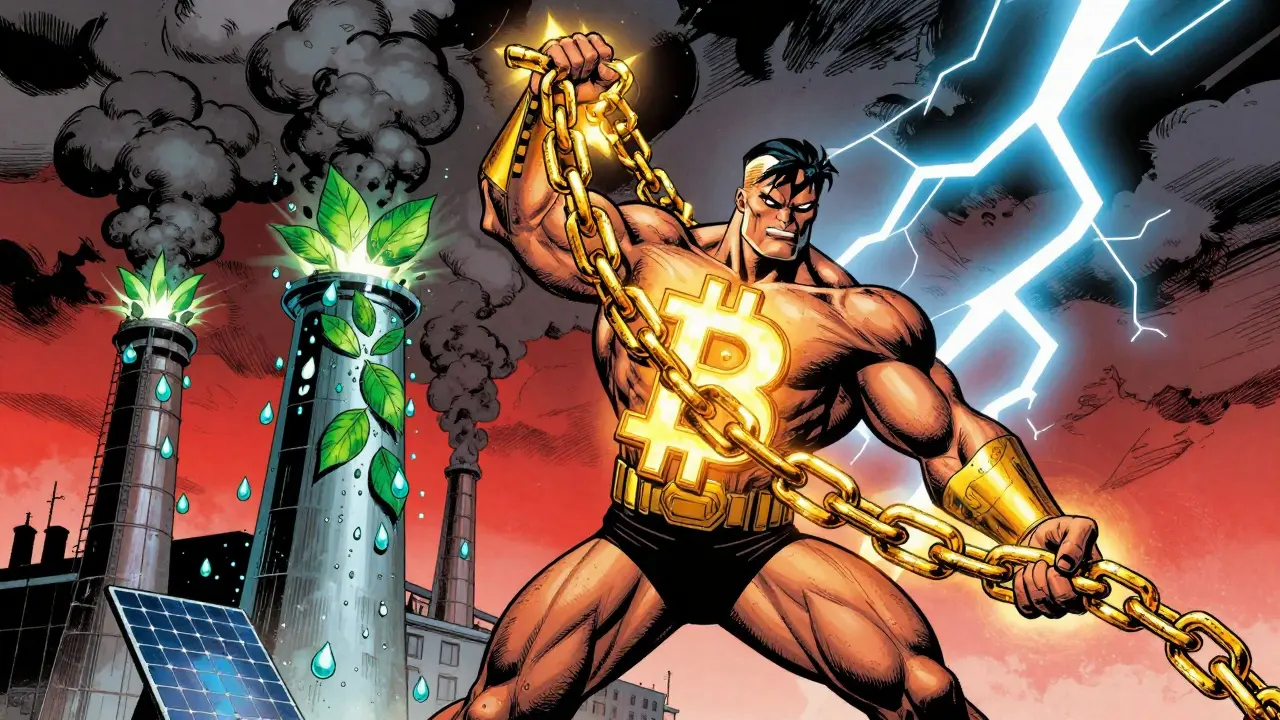
The most controversial aspect of Proof of Work is its energy usage. Because miners compete to solve puzzles, they run powerful machines 24/7, drawing massive amounts of electricity. According to the Cambridge Bitcoin Electricity Consumption Index, Bitcoin’s annual consumption reached 121.72 TWh in 2023, comparable to Norway’s national electricity use.
Critics argue this is unsustainable. Vitalik Buterin, co-founder of Ethereum, cited environmental concerns as the primary reason for Ethereum’s transition to Proof of Stake (PoS) in September 2022. This switch reduced Ethereum’s energy consumption by 99.95%. However, proponents like Nic Carter of Castle Island Ventures counter that 67.3% of Bitcoin mining uses renewable energy, including stranded hydroelectric power and flared natural gas that would otherwise be wasted.
The debate isn’t just about carbon footprints; it’s about security economics. Adam Back, inventor of Hashcash, argues that the energy cost is a feature, not a bug. It creates a "security budget" proportional to the value secured. With Bitcoin holding over $1 trillion in market cap, the high cost of attacking the network (requiring 51% of hash power) deters hackers. A cheaper consensus mechanism might leave such valuable assets vulnerable.
PoW vs. PoS: The Great Divide
As blockchain technology matured, alternatives emerged. Proof of Stake (PoS) requires validators to lock up coins as collateral rather than burning electricity. Here’s how they compare:
| Feature | Proof of Work (PoW) | Proof of Stake (PoS) |
|---|---|---|
| Security Basis | Computational Power & Energy Cost | Economic Collateral (Staked Coins) |
| Energy Efficiency | Low (High Consumption) | High (99.95% Less Energy) |
| Decentralization Risk | Hardware Centralization (ASICs) | Wealth Centralization (Rich Validators) |
| Transaction Speed | Slower (e.g., Bitcoin: 7 TPS) | Faster (e.g., Ethereum: 30+ TPS) |
| Battle-Tested History | Yes (Since 2009) | No (Ethereum only since 2022) |
While PoS offers efficiency, PoW remains the gold standard for security. Bitcoin has never been successfully hacked despite holding trillions in value. Its uptime is 99.98% since 2009. For many, this track record outweighs the environmental cost. Meanwhile, networks like Litecoin and Ethereum Classic have stuck with PoW, though they face scalability challenges compared to PoS chains.
The Future of Proof of Work
Is Proof of Work dying? Not exactly. While its share of new blockchain projects has dropped from 92% in 2017 to 31% in 2023, it remains dominant in store-of-value applications. Bitcoin controls over 50% of the total crypto market cap, proving that users still value its security model.
Future developments focus on sustainability. The Bitcoin Mining Council reports a 58.4% increase in renewable energy usage among members since 2021. New mining facilities are increasingly locating near flared gas sites or hydroelectric plants to utilize stranded energy. Regulatory frameworks like the EU’s MiCA (effective December 2024) will require PoW networks to demonstrate sustainable practices, pushing the industry toward greener solutions.
For developers and investors, understanding PoW’s history provides context for its current role. It’s not just a technical detail; it’s a philosophical choice between energy-backed security and capital-backed efficiency. As long as there’s demand for censorship-resistant, decentralized money, Proof of Work will likely remain a critical part of the financial landscape.
Who invented Proof of Work?
The concept was first proposed by Cynthia Dwork and Moni Naor in 1993. Adam Back later implemented it as Hashcash in 1997, and the term "Proof of Work" was coined by Markus Jakobsson and Ari Juels in 1999.
Why does Bitcoin use Proof of Work instead of Proof of Stake?
Bitcoin uses PoW because it provides the highest level of proven security and decentralization. The energy cost acts as a deterrent against attacks, ensuring that compromising the network is economically irrational. Changing to PoS would alter Bitcoin’s fundamental security model, which most developers oppose.
Can I mine Bitcoin with my home computer?
No. Since 2013, Bitcoin mining requires specialized ASIC hardware. Home computers (CPUs/GPUs) are too slow to compete with industrial mining farms. Solo mining is effectively impossible for individuals due to the high difficulty and competition.
How much electricity does Bitcoin consume?
As of 2023, Bitcoin consumes approximately 121.72 TWh annually, similar to the electricity usage of Norway. However, a significant portion (67.3%) comes from renewable sources like hydro and solar power.
What is a 51% attack?
A 51% attack occurs when a single entity controls more than half of the network’s computational power. This allows them to double-spend coins or reverse transactions. For Bitcoin, this would require billions of dollars in hardware and energy costs, making it highly impractical.





This is such a fantastic read! I really enjoyed learning about the history of Proof of Work... It’s amazing how something so simple can become so complex!! Thank you for sharing this!! 🌟
A well-researched article. The transition from anti-spam measures to digital currency security is indeed a significant evolution in cryptographic history.
The author oversimplifies the consensus mechanism dynamics. PoW isn't just 'energy cost'; it's a thermodynamic security model that ensures Byzantine fault tolerance in a trustless environment. Ignoring the economic game theory behind hash rate distribution is negligent.
pretty cool stuff. never thought about email spam being related to bitcoin mining before. makes sense now i guess.
Oh, please. Another article praising the environmental destruction caused by crypto? 🙄 Bitcoin is basically a pyramid scheme wrapped in greenwashing lies. The 'renewable energy' stats are fabricated by the industry itself! 😡🔥
You think Satoshi was one person? Wake up! This is all part of a central bank psyop to track our spending habits while we burn coal for their amusement. The 'decentralization' is a myth sold to keep us compliant. They want you thinking you're free while they watch every transaction. 👁️🗨️
It is truly fascinating to observe how different cultures and communities have adapted to these technological shifts. While some focus on the environmental impact, others see the potential for financial inclusion in developing regions. We must remain open to diverse perspectives and understand that what may seem inefficient to one group might be essential for another’s autonomy and security.
Good summary. The history is interesting. People should know where things come from.
Why does everyone ignore the fact that ASICs have completely killed decentralization? The article mentions it but doesn't emphasize enough that we are no longer peer-to-peer; we are pool-to-pool. This is a critical failure of the original vision!
Boring. Just another tech bro fantasy. Real life is harder than mining blocks. Stop obsessing over numbers.
Ah, the irony of using electricity to secure money while arguing about the value of energy itself. 🤷♂️ It’s like paying rent with coins you found in the couch cushions. Philosophically rich, practically absurd. But hey, at least it’s decentralized chaos!
Let me tell you something about your 'security'. You think 51% attacks are rare because they're hard? No, they're rare because the cartels control the hash rate. Your privacy is already gone. They see everything. Don't let them fool you into thinking you're safe. 🚫👀
The comprehensive analysis provided herein elucidates the intricate relationship between computational effort and network integrity. It is imperative to recognize that the historical context serves not merely as a narrative device but as a foundational element for understanding the current paradigm of digital asset verification mechanisms which have evolved significantly since their inception.
Look, the math works. That's all that matters. Whether you like the energy use or not, the system hasn't been hacked. End of story.
Honestly, only those who understand the nuances of cryptographic proof systems will appreciate this article. The rest of you are just consuming content without comprehension. PoW is superior because it ties security to physical reality, unlike the speculative collateral of PoS which is vulnerable to nothing-at-stake problems. :(
I feel so much anxiety reading about how centralized the mining pools are! It’s terrifying to think that three entities control more than half the network. How can we trust anything when the power is so concentrated? This needs to be addressed immediately! 😱📉