
Deri Protocol (DERI) Explained: Decentralized Derivatives and Trading Guide
Imagine trading high-leverage contracts on Bitcoin or Ethereum without needing to trust a centralized exchange with your funds. That is the core promise of Deri Protocol is a decentralized derivatives trading platform that lets users hedge, speculate, and arbitrage on-chain using an Automated Market Maker (AMM) model. It removes the middleman, giving you direct control over your assets while providing professional-grade tools for complex trading strategies.
If you have used a standard exchange, you know the risk of "exchange hacks" or frozen accounts. Deri Protocol solves this by being non-custodial. This means you keep your keys and only interact with the smart contracts. Whether you are looking to bet on a price surge or protect your portfolio from a crash, this platform provides the infrastructure to do so across multiple blockchains.
| Attribute | Value |
|---|---|
| Native Token | DERI |
| Supported Chains | BSC, Ethereum, Polygon, Arbitrum, zkSync Era |
| Primary Assets | BTC, ETH |
| Core Mechanism | Dynamic Proactive Market Making (DPMM) |
| Funding Model | Shared Funding Pool |
How the Deri Ecosystem Actually Works
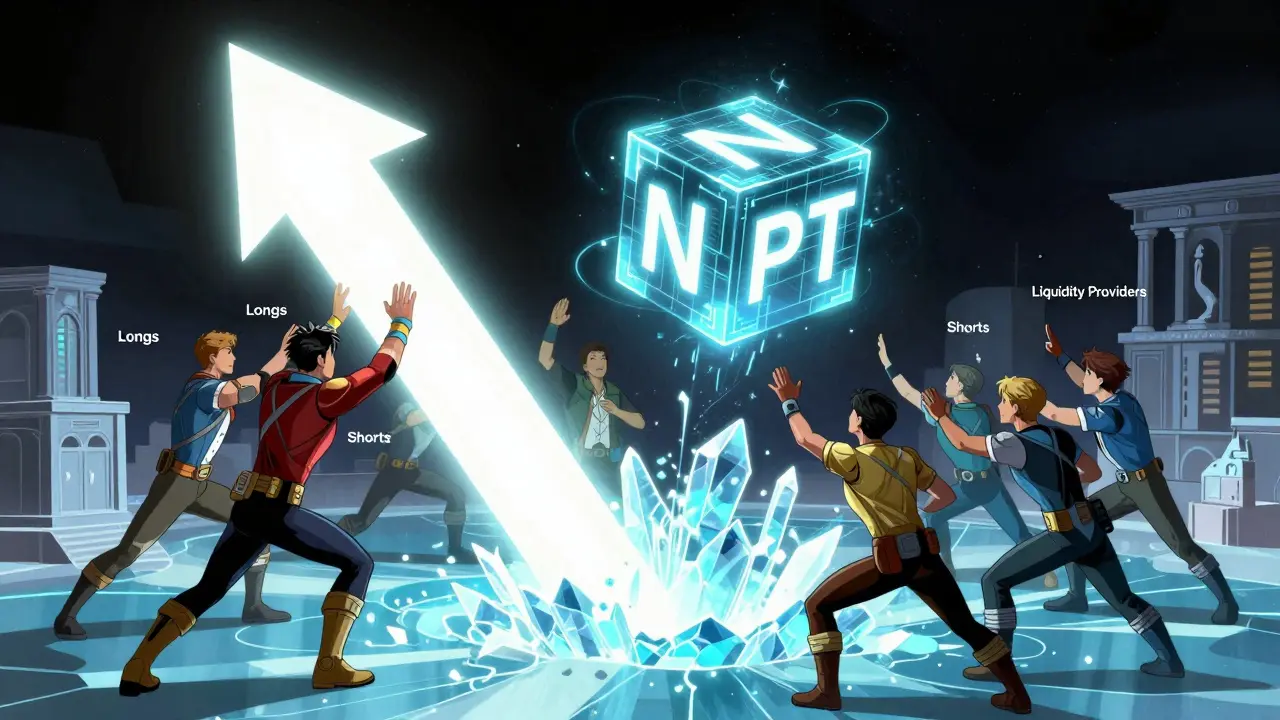
Most people are used to order books where a buyer meets a seller. Deri is different. It uses a shared funding pool. In this setup, there are three main players: the longs (betting the price goes up), the shorts (betting the price goes down), and the Liquidity Providers (LPs) who provide the capital that makes the trades possible.
When you open a position, you aren't trading against another person in real-time; you are interacting with the pool. The protocol uses an oracle to fetch real-time prices, ensuring the trade is fair. To keep the system balanced, a funding fee is charged. If too many people are going long, the long positions pay the shorts, which encourages traders to take the opposite side and keeps the price pegged to the actual market value.
One of the coolest parts about Deri is that your trades are tokenized as NFTs. This isn't for digital art; it is for composability. Because your position is an NFT, it can theoretically be used or integrated with other DeFi projects, making your trading capital more flexible than a locked balance on a centralized site.
The Trading Toolkit: From Perpetuals to Power Perpetuals
Deri doesn't just offer basic trading. It has a variety of specialized products for different risk appetites. Let's break down what you can actually do on the platform:
- Perpetual Futures: These are the standard. You speculate on the future price of BTC or ETH without an expiry date.
- Everlasting Options: Deri was a pioneer here. Unlike traditional options that expire, these are "everlasting." You pay a funding fee to keep the position open, giving you more control over your exit strategy.
- Power Perpetuals: This is for the advanced crowd. Instead of tracking the price of Bitcoin, it tracks the square of the price. This amplifies volatility and allows for much more aggressive (and risky) trading strategies.
- Gamma Swap: Currently in beta, this product targets the volatility of the underlying asset, allowing traders to profit from how much the price moves, regardless of the direction.
For the Everlasting Options, the protocol uses a system called DPMM (Dynamic Proactive Market Making). It blends the famous Black-Scholes model with an algorithm that adjusts prices based on how much liquidity is in the pool. This prevents the price from slipping too far when a large trade happens.
Understanding the DERI Token and Its Value
The DERI token is the fuel for the entire system. It isn't just a speculative asset; it has real utility within the network. DERI crypto holders can participate in governance, meaning they vote on how the treasury spends its money and which new features get developed.
The tokenomics are designed to fight inflation. The team takes 20% of the transaction fees and uses them to buy back DERI tokens from the open market and burn them. Since June 2022, millions of tokens have been sent to deadlock addresses. This reduces the total supply over time, which theoretically supports the price if demand stays steady.
If you aren't trading, you can still earn. By staking your tokens, you help secure the network and earn rewards. This creates a cycle where users are incentivized to hold the token rather than flipping it immediately.
Multi-Chain Accessibility and Security
Trading is useless if you can't get your money in and out easily. Deri Protocol is deployed on a massive variety of networks. Whether you prefer the low fees of Polygon, the speed of Arbitrum, or the new tech of zkSync Era, the protocol is there. They've even built their own cross-chain bridge, so you can move your DERI tokens between these chains without jumping through a dozen hoops.
Security is handled through a mix of decentralized wallets. The platform integrates with hardware wallets and specific secure environments like Mixin Kernel. Because it's on the blockchain, every transaction is transparent. You don't have to "trust" a CEO; you can verify the smart contract code.

Is it Right for You?
Deri Protocol is a professional tool. If you are a beginner who just wants to buy some Bitcoin and hold it for five years, this is likely overkill. However, if you are an active trader who wants to use leverage, hedge a portfolio, or experiment with non-linear derivatives (like Power Perpetuals), it's a powerful option.
The main trade-off is the learning curve. Understanding how a shared funding pool differs from an order book takes a bit of reading. But once you get it, the capital efficiency-the ability to get more "bang for your buck" with your margin-is a huge advantage over traditional platforms.
What makes Deri Protocol different from Binance or Coinbase?
The biggest difference is custody. Binance and Coinbase are centralized (CEX); they hold your money. Deri is decentralized (DEX) and non-custodial. You interact directly with smart contracts, meaning you never give up control of your private keys.
What are "Power Perpetuals"?
Power Perpetuals are a specialized derivative where the index price is the square of the asset's price (e.g., BTC price^2). This creates a non-linear payoff, allowing traders to gain more exposure to price movements than standard futures would allow.
How does the DERI token burn work?
The protocol takes 20% of the trading fees generated by the platform. Instead of keeping this as profit, the DAO uses these funds to buy DERI tokens from the secondary market and send them to a deadlock address, permanently removing them from circulation to reduce supply.
Which blockchains support Deri Protocol?
It is highly flexible and operates on Binance Smart Chain (BSC), Ethereum, Polygon, Arbitrum, Huobi Ecological Chain, and the zkSync Era mainnet.
Can I earn passive income with DERI?
Yes, you can earn rewards through staking your tokens or by becoming a Liquidity Provider (LP). LPs provide the capital for the trading pools and earn a share of the fees, though they do take on the net position risk of the pool.
Next Steps for Getting Started
If you're ready to try Deri, start by setting up a compatible wallet like MetaMask or a hardware wallet for extra security. Since the protocol is multi-chain, decide which network you want to use based on your preference for gas fees (Polygon and Arbitrum are generally much cheaper than Ethereum).
For those new to derivatives, a good rule of thumb is to start with a very small amount of margin. Because these products allow for high leverage, a sudden price swing in the opposite direction of your bet can lead to liquidation quickly. Test the interface with a small "paper trade" or a low-risk long/short position before moving into complex products like Everlasting Options.



basically just a glorified AMM with a funding rate it is not that deep
The structural asymmetry of the Power Perpetuals is an interesting exercise in convex payoffs, yet the systemic risk inherent in the DPMM's liquidity provision often leads to suboptimal equilibrium during periods of extreme volatility. One must consider the gamma exposure of the LPs as a primary failure point in this architecture. The tokenomic burn mechanism is a quaint attempt to induce scarcity, but without a significant increase in organic transactional velocity, the deflationary pressure is merely cosmetic. We are seeing a repetitive pattern of pseudo-innovation in the derivatives space where the complexity is scaled to mask the fragility of the underlying oracle dependency. It is essentially a sophisticated game of musical chairs played with synthetic assets and non-linear pricing models that the average retail participant cannot possibly quantify. The composability promised by the NFT-based positions is a theoretical benefit that has yet to find a meaningful integration in a broader DeFi primitive. Until we see genuine cross-protocol utility for these position tokens, it remains a vanity feature designed to attract venture capital rather than actual utility. The multi-chain approach is a standard necessity in the current fragmented ecosystem, offering no real competitive advantage. The reliance on a shared funding pool creates a precarious balance that can be easily disrupted by a single high-net-worth actor. Most of these "innovations" are just rebranded versions of legacy financial instruments tailored for a crowd that values buzzwords over balance sheets. The risk of oracle latency during a flash crash remains the elephant in the room for any non-custodial derivatives platform. Ultimately, the protocol's success depends on a level of liquidity depth that is rarely sustainable without aggressive incentive farming. The entire setup is a house of cards waiting for a volatility event to reveal its true solvency.
Typical crypto nonsense. We're just gambling with fancier names now. "Power Perpetuals" just sounds like a way to lose money faster while pretending it's a high-IQ move.
It does seem a bit intimidating for some, but the non-custodial part is really the most important bit here. Stay safe everyone! :)
Get US coins or get out 🇺🇸 This tech is just for gamblers! 🚩🤡
The "burn" is just a scam to keep us trapped in their ecosystem!!! They probably have a back door to all the funds anyway... wake up people!!!! Total shadow play by the globalists to control our assets!!!!!
this sounds rly cool for hedging! i might try it with a tiny bit of money just to see how it works
I agree that starting small is the best way to learn. The guide is very clear about the risks!
This entire platform is a waste of time. It is an insult to real trading and a pathetic attempt to automate what should be handled by actual professionals in a proper financial center.