
Cross-Chain Bridge Technology: How It Works, Risks, and Future Outlook
Imagine trying to send a letter from New York to London, but the postal systems in both cities use completely different languages, paper sizes, and sorting rules. You can’t just drop it in the mailbox. That is exactly what happens when you try to move assets between blockchains like Bitcoin and Ethereum. They are isolated islands. This is where cross-chain bridge technology comes in. It acts as the digital ferry, allowing data and value to travel between these separate networks.
If you are deep into decentralized finance (DeFi) or Web3, you have likely used a bridge without even realizing it. Whether you are moving Bitcoin to an Ethereum-based lending protocol or shifting tokens from Polygon to Arbitrum to save on gas fees, bridges are the invisible infrastructure making your life easier. But they are also the most dangerous part of the crypto ecosystem. In 2022 alone, bridges were the target of nearly 70% of all major hacks, losing billions of dollars. Understanding how they work is no longer optional-it is essential for keeping your funds safe.
What is a cross-chain bridge?
A cross-chain bridge is a protocol that enables the transfer of assets or data between two distinct blockchain networks that do not natively communicate with each other.
The Core Problem: Blockchain Silos
To understand why bridges exist, you first need to understand why blockchains don’t talk to each other. Every blockchain has its own set of rules, consensus mechanisms, and programming languages. Bitcoin uses Proof-of-Work and a simple scripting language. Ethereum uses Proof-of-Stake and Solidity. Solana uses Rust and a unique parallel processing engine.
Because of these differences, a token created on Ethereum cannot simply "move" to Solana. The Solana network doesn’t recognize Ethereum’s code. Without a bridge, your assets are stuck forever on the chain where you bought them. This fragmentation creates liquidity issues. If you want to use a specific DeFi app that only exists on Avalanche, but your money is on Ethereum, you are out of luck unless a bridge connects the two.
Bridges solve this by creating a standardized way to represent assets across chains. They allow the multi-chain vision of Web3 to become a reality, rather than just a theoretical concept.
How Bridges Actually Work: Three Main Models
Not all bridges are built the same way. There are three primary technical models used today, each with different trade-offs regarding speed, cost, and security.
- Lock and Mint: This is the most common model. When you want to move Bitcoin to Ethereum, you lock your actual Bitcoin in a smart contract on the Bitcoin network. A separate smart contract on Ethereum then "mints" a wrapped version of that Bitcoin (like wBTC). You now hold wBTC on Ethereum. To get your real Bitcoin back, you burn the wBTC on Ethereum, which unlocks your original Bitcoin on the source chain. The Avalanche Bridge uses this model, processing over 1.2 million transactions monthly.
- Lock and Unlock: Instead of minting new tokens, this model uses liquidity pools. You lock your tokens on Chain A. Then, you claim equivalent native tokens from a pre-funded pool on Chain B. THORChain operates this way. It requires large amounts of idle capital to maintain those pools, which makes it less capital-efficient but allows for true native asset transfers.
- Burn and Mint: In this variant, the original tokens are permanently destroyed (burned) on the source chain, and new tokens are created on the destination chain. This eliminates the risk of locked funds being stolen from a vault, but if something goes wrong, your assets are gone forever. This was the mechanism behind some of the worst hacks in history, such as the Harmony Horizon Bridge incident.
Trusted vs. Trust-Minimized Bridges
The biggest debate in bridge technology isn’t about the mechanics; it’s about trust. Who holds the keys? This divides bridges into two categories: Trusted (Federated) and Trust-Minimized (Decentralized).
| Feature | Trusted / Federated | Trust-Minimized / Decentralized |
|---|---|---|
| Control | Small group of validators (e.g., 5-20 nodes) | Distributed network or cryptographic proofs |
| Speed | Fast (minutes) | Slower (hours to days, depending on finality) |
| Security Risk | High (single point of failure, collusion risk) | Lower (relies on underlying chain security) |
| Examples | Polygon PoS Bridge, Multichain | THORChain, Chainlink CCIP |
| User Preference | Convenience-focused users | Security-focused power users |
Trusted Bridges rely on a small committee of validators to sign off on transactions. For example, the Polygon PoS Bridge uses a set of validators controlled largely by Polygon Labs. This makes transactions fast and cheap. However, if those validators collude or get hacked, your funds are gone. In fact, 67% of existing bridges use fewer than 15 validators, creating massive single points of failure.
Trust-Minimized Bridges, on the other hand, use cryptography and decentralized oracle networks to verify state changes. They don’t rely on a central group of people. Chainlink’s Cross-Chain Interoperability Protocol (CCIP) is a prime example. It uses a proof-of-reserves mechanism to cryptographically verify that assets exist before transferring them. While slower and more expensive to build, these bridges are considered much safer because they inherit the security of the underlying blockchains rather than introducing new attack surfaces.
The Security Nightmare: Why Bridges Get Hacked
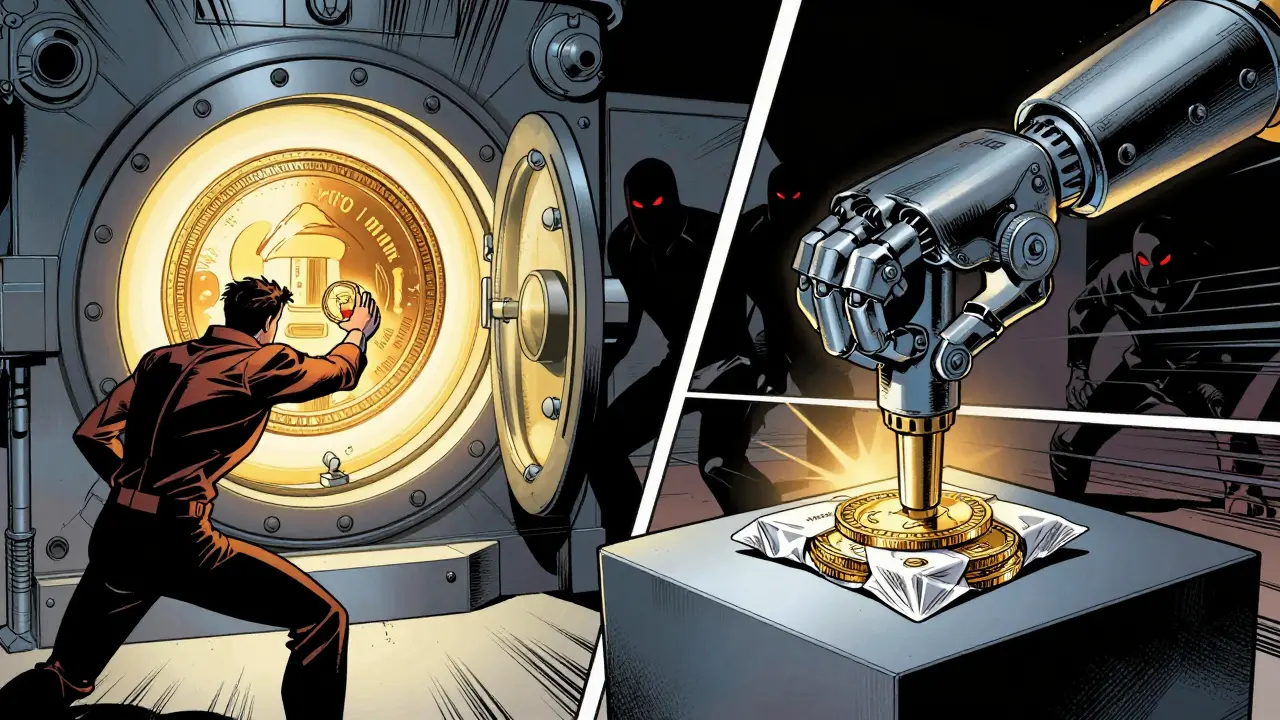
You cannot talk about cross-chain bridges without addressing the elephant in the room: security. According to Chainalysis, bridges accounted for $2.4 billion in losses in 2022 alone. Why are they so vulnerable?
The main issue is complexity. Building a bridge requires expertise in multiple smart contract languages (Solidity, Rust, Go), different consensus mechanisms, and advanced cryptography. One mistake in any layer can break the whole system. Most hacks happen due to:
- Validator Collusion: If a trusted bridge has only 10 validators, and 6 of them decide to steal the funds, they can. There is often no recourse for users.
- Signature Verification Flaws: In the Nomad Bridge hack ($190 million lost), attackers exploited a flaw in how signatures were verified, allowing them to mint unlimited funds.
- Smart Contract Bugs: Standard coding errors in the locking or minting contracts can lead to drained liquidity pools.
Dr. Ari Juels, Chief Scientist at Chainlink Labs, argues that the fundamental security model of most traditional bridges is flawed because they create new attack surfaces without inheriting the robust security of the underlying chains. This is why the industry is slowly shifting toward trust-minimized solutions like CCIP, which aims to reduce trust assumptions by 83% compared to older models.
The Future: Programmable Bridges and Consolidation
We are currently in the early stages of bridge evolution. Today, most bridges only move tokens. Tomorrow, they will move complex instructions. This is called programmable interoperability. Imagine triggering a loan on Ethereum based on collateral held on Solana. Or executing a trade on Uniswap using data from a private enterprise blockchain.
Chainlink’s CCIP and LayerZero Labs are leading this charge. LayerZero raised $120 million to build a "universal bridge" protocol that could connect any blockchain without needing specialized connectors for each pair. This would simplify the user experience dramatically.
However, consolidation is coming. Messari predicts that 60% of current bridge protocols will be obsolete by 2026. The market is too fragmented, and security standards are rising. Only bridges integrated directly into Layer-1 protocols or those with proven, audited, trust-minimized architectures will survive. Standalone bridges with weak security budgets-currently averaging just 12% of revenue-are likely to fail.

Practical Tips for Using Bridges Safely
Until the technology becomes perfectly secure, you need to protect yourself. Here is how experienced DeFi users navigate bridges:
- Check the Validator Set: Avoid bridges controlled by a single company or a tiny group of unknown entities. Look for decentralized validator networks.
- Use Established Protocols: Stick to bridges with high Total Value Locked (TVL) and long track records, like the official Polygon Bridge or THORChain. Avoid new, unaudited bridges offering "free" transfers.
- Transfer Small Amounts First: Never bridge your entire portfolio in one go. Test with a small amount to ensure the process works and the funds arrive correctly.
- Understand Wrapped Assets: Remember that wBTC is not BTC. It is a promise backed by BTC. If the bridge fails, you lose the promise, not necessarily the underlying asset (though recovery is rare).
- Monitor Gas Fees: Bridging involves transactions on two chains. Ensure you have enough ETH for Ethereum gas and MATIC for Polygon gas, etc., to avoid stuck transactions.
Conclusion: Necessary Evil or Evolutionary Step?
Cross-chain bridges are controversial. Some argue they should never have been built, citing the massive security risks. Others, like Sunny Aggarwal of Osmosis, see them as necessary evolutionary infrastructure. The truth is somewhere in the middle. Bridges are essential for a multi-chain future, but the current implementations are immature.
As we move through 2026, the focus is shifting from "how do we connect chains" to "how do we connect them securely." With advancements in cryptographic verification and decentralized oracle networks, the next generation of bridges promises to be faster, cheaper, and significantly safer. Until then, proceed with caution, do your research, and never trust blindly.
Are cross-chain bridges safe?
No bridge is 100% safe. Trusted bridges carry high counterparty risk, while trust-minimized bridges are safer but still experimental. Always use established protocols and transfer small amounts first.
What is the difference between a bridge and a swap?
A swap exchanges one token for another on the same chain. A bridge moves assets from one blockchain to a different blockchain, often wrapping them in the process.
Why did the Nomad Bridge get hacked?
The Nomad Bridge exploit occurred due to a signature verification flaw that allowed attackers to forge messages and mint unlimited funds without holding the underlying assets.
What is Chainlink CCIP?
Chainlink CCIP is a cross-chain interoperability protocol that uses decentralized oracles and cryptographic proofs to enable secure messaging and asset transfers between blockchains.
Can I recover my funds if a bridge fails?
Recovery is extremely difficult. If funds are stolen via a hack, they are usually lost forever. If a transaction gets stuck, you may need to contact support or wait for the timeout period, depending on the bridge type.