
Central Bank of Kuwait Crypto Prohibition: Understanding the Total Ban
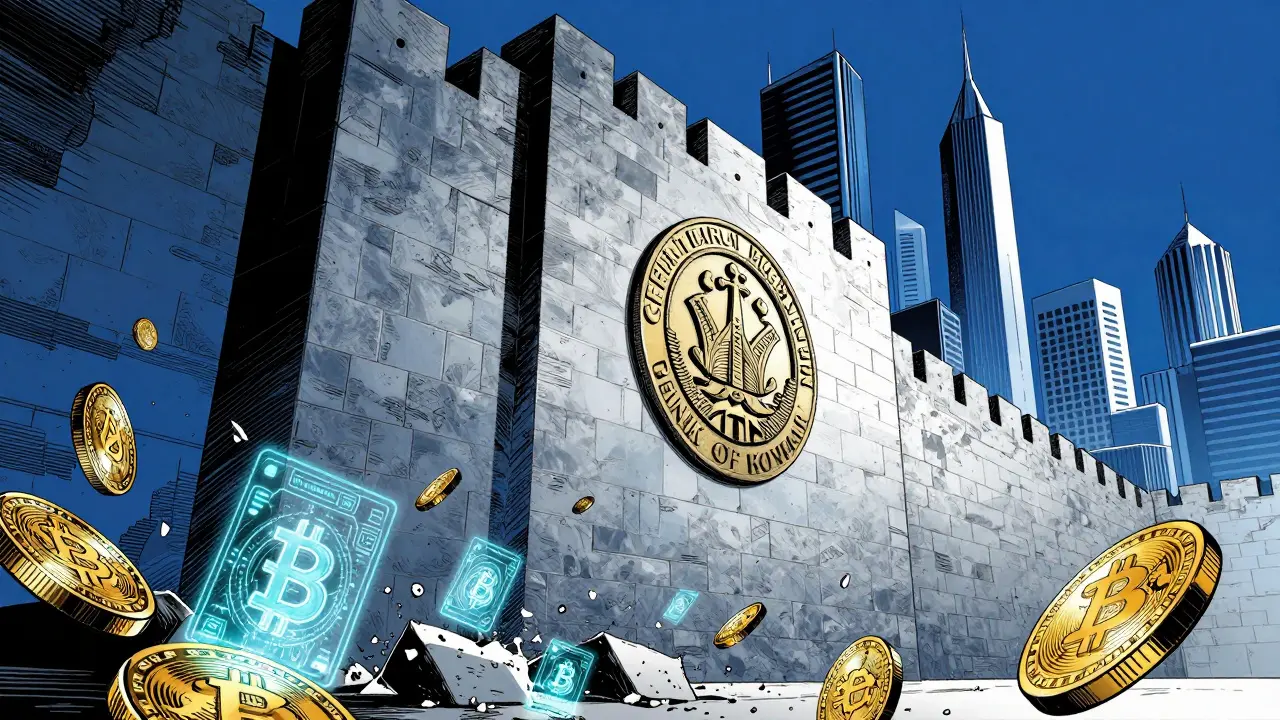
Imagine waking up to find that almost every single way you could interact with digital assets-buying, selling, mining, or even using them for a coffee-is strictly illegal. That is the reality for anyone in Kuwait. While much of the world is arguing over how to tax or regulate Bitcoin, the Central Bank of Kuwait is the primary monetary authority of Kuwait, responsible for maintaining price stability and supervising the banking sector taking a much harder line. They haven't just added some red tape; they've essentially built a regulatory wall around the country's financial system.
This isn't just a suggestion or a guideline. Kuwait has implemented an "absolute prohibition" on virtual currency activities. If you're wondering why a country in the heart of the Gulf Cooperation Council (GCC) is acting so differently from its neighbors, the answer lies in a mix of financial security, energy concerns, and a deep-seated commitment to traditional banking. To understand the scale of this, we need to look at how this ban actually works on the ground.
The Four Pillars of the Crypto Ban
The Central Bank of Kuwait (CBK) didn't act alone. To make sure there were no loopholes, they coordinated with three other major governmental bodies. This created a web of restrictions that covers every possible angle of the digital asset ecosystem.
- Payment Systems: You cannot use virtual assets as a way to pay for goods or services. The government does not recognize them as decentralized currency.
- Investment Activities: Dealing with virtual assets as investment vehicles is forbidden. This means you can't legally offer crypto-related investment services to customers.
- Licensing Restrictions: The government simply will not issue licenses to any person or company wanting to provide virtual asset services. In fact, they've clarified that no such licenses have ever been granted.
- Mining Operations: This is the most aggressively enforced part of the ban. All cryptocurrency mining-the process of using powerful hardware to secure a network and earn coins-is completely prohibited.
By attacking the issue from these four angles, Kuwait has ensured that there is no "gray area." Whether you are a retail investor or a large-scale hardware operator, the legal risk is the same: total prohibition.
Why Kuwait is Saying No to Digital Assets
You might ask, "Why go this far?" For the CBK, the primary drivers are stability and security. Specifically, the ban is designed to align Kuwait with the Financial Action Task Force (FATF), an international body that sets standards for Anti-Money Laundering and Combating the Financing of Terrorism (AML/CFT). By removing the anonymity and volatility of crypto, Kuwait believes it can better protect its financial borders from illicit flows.
Beyond the legalities, there is a massive infrastructure problem. Kuwait has some of the cheapest electricity in the world due to heavy government subsidies. This made it a paradise for miners. In 2022, mining one Bitcoin in Kuwait cost roughly $1,400, while the same process in Texas cost over $18,000. This price gap attracted thousands of illegal mining rigs.
The result? A nightmare for the power grid. The Ministry of Electricity, Water and Renewable Energy found that these operations were draining the grid, leading to potential power outages that could threaten public safety. When you consider that Bitcoin mining globally consumes more energy than entire nations like Malaysia, Kuwait decided that the risk to its electrical stability far outweighed any potential economic gain from blockchain technology.
| Country | Regulatory Stance | Digital Asset Status | CBDC Progress |
|---|---|---|---|
| Kuwait | Absolute Prohibition | Illegal | Feasibility Studies Only |
| UAE | Permissive/Regulated | Legal (Regulated) | Active Pilots |
| Bahrain | Open/Supportive | Legal (Regulated) | Active Pilots |
| Qatar | Transitioning | Moving toward Legal Framework | Exploring |
The Crackdown: Enforcement in Action
If you think a circular from a bank is just a piece of paper, the events of April 2025 prove otherwise. The Ministry of Interior launched a massive sweep, identifying over 1,000 illegal mining sites across the country. They didn't just cite banking rules; they used a combination of laws to trap violators, including the Industry Law of 1996 and the Penal Code of 1960.
This coordinated effort involved the Communications and Information Technology Regulatory Authority (CITRA) and the Kuwait Municipality. The government is now actively monitoring power consumption patterns to spot the "fingerprint" of a mining rig. If you're running a farm in a basement, the likelihood of the Ministry of Electricity noticing a massive, unexplained spike in power usage is very high.
Is there any hope for digital innovation in Kuwait?
While the door is slammed shut for private cryptocurrencies like Bitcoin or Ethereum, the government isn't totally opposed to the cryptocurrency prohibition's underlying technology if it is controlled. There are ongoing feasibility studies for a Central Bank Digital Currency (CBDC). A CBDC is essentially a digital version of the Kuwaiti Dinar, issued and backed by the CBK. This would give them the efficiency of digital payments without the chaos of decentralized assets.
Additionally, Kuwait is doubling down on traditional and Islamic finance. The enactment of the Sukuk Law (Islamic bonds) and the Financing & Liquidity Law-which allows the government to issue up to KWD 30 billion in public debt-shows that Kuwait prefers stability and state-backed instruments over the volatility of the crypto market. They are betting on a future where the state controls the ledger, not a distributed network of anonymous miners.
What this means for residents and businesses
For the average person in Kuwait, the message is clear: stay away from virtual assets. The Ministry of Finance does not recognize these assets for commercial transactions. If you use crypto for a business deal, you have zero legal recourse if the other party cheats you, because the contract itself is based on an illegal activity.
Businesses should be particularly careful with their payment gateways. The CBK has explicitly forbidden banks and exchange companies from mediating crypto transactions or accepting them in e-payments. Any company attempting to integrate a crypto-payment processor is risking its banking license and potentially facing criminal charges under the Penal Code.
Is it illegal to own Bitcoin in Kuwait?
While owning a digital asset in a private wallet is a complex legal area, the act of trading, using it for payments, or providing services related to it is strictly prohibited. The government views virtual assets as not being legal tender, and any active engagement with them violates several regulatory circulars and national laws.
What happens if I am caught mining cryptocurrency in Kuwait?
You could face severe legal consequences. Mining is prohibited under the Industry Law, the Penal Code, and regulations from CITRA and the Kuwait Municipality. The Ministry of Interior refers violators to investigative authorities, and you may face fines or imprisonment, especially if your operation is deemed a threat to the national power grid.
Does the ban apply to foreign companies operating in Kuwait?
Yes. Any entity operating within Kuwait's jurisdiction must comply with the Central Bank of Kuwait's mandates. Offering crypto-related services to Kuwaiti customers or using virtual assets for local business operations is a violation of the regulatory framework.
Will Kuwait ever allow cryptocurrencies?
Currently, there is no sign of the ban being lifted. Kuwait has maintained its strict stance even as neighbors like the UAE and Bahrain have opened up. The only potential "digital" shift is the possible introduction of a government-controlled Central Bank Digital Currency (CBDC).
Why is the CBK so concerned about electricity?
Crypto mining requires immense amounts of power. Because Kuwait subsidizes electricity, mining became artificially cheap and highly attractive. This led to over 1,000 illegal sites that put an unsustainable load on the electrical grid, risking widespread power outages and compromising public safety.
Next Steps and Troubleshooting
If you are a business owner or a resident currently involved in the digital asset space in Kuwait, here is how to handle the situation:
- For Mining Operators: Stop all operations immediately. The Ministry of Interior and Ministry of Electricity are actively using power-grid analytics to find rigs. Rectifying your activity now is better than waiting for a police raid.
- For Business Owners: Audit your payment gateways. Ensure that no virtual asset payment options (including stablecoins) are available to your customers. Remove any references to "crypto-investments" from your marketing materials to avoid attracting the attention of the Capital Markets Authority.
- For Investors: Be aware that you have no legal protection for crypto-based contracts in Kuwait. If you are looking for digital innovation, keep an eye on the official announcements regarding the potential CBDC or the new Sukuk and Financing laws.






Oh look, another government pretending they care about the 'grid' while just being terrified of losing control over the money. Groundbreaking. 🙄
It makes sense from a regulatory standpoint. Many countries struggle with the energy load of mining, especially when subsidies make it too cheap. It's probably for the best that they are prioritizing the power grid for the general public.
Wow, imagine actually believing that a 'CBDC' is the digital innovation they're promising. It's just a fancy way to say 'we want to track every single cent you spend.' Real revolutionary stuff there.
Man, 1000 mining sites?! That's wild! 😱 I bet some of those basements were absolutely roasting lol. Imagine the heat in a Kuwaiti summer with those rigs running!! 🥵🔥
This is exactly what happens when greed meets government subsidy. People were basically stealing electricity from the state to make fake internet money, and now they act like victims because they got caught. It's morally bankrupt to drain a national grid for a speculative asset that provides zero actual value to the local community. If you're mining in a country where the power is subsidized, you're not an 'innovator,' you're a parasite feeding off the public purse. The government isn't just protecting the grid; they're cleaning up a mess created by people who think they're smarter than everyone else. Honestly, the total ban is the only ethical response to that kind of systemic abuse. I'm exhausted just thinking about the audacity of these people to risk public safety for a few satoshis. It's honestly disgusting how some people justify this behavior as 'decentralization' when it's really just theft of resources. There is no moral high ground here for the crypto crowd. Absolutely none.
Maybe there's a way to find some synergy here!!! 🌟 If they can pivot toward sustainable blockchain infrastructure, it could be a total game-changer for their fintech ecosystem!!! Let's keep the vibes positive and hope for a more holistic regulatory framework soon!!! ✨
I didn't know the power grid could be monitored that closely. That's actually pretty interesting.
From a technical perspective, monitoring power consumption signatures is a very effective way to find miners. Mining rigs have a very specific, constant load profile that differs wildly from normal household appliances. It's basically a beacon for the electricity company if they're actually looking for it.
It's quite a fascinating reflection of how different cultures perceive the balance between individual financial sovereignty and the collective stability of the state 🌏. While we might see a total ban as a harsh measure, perhaps it's an expression of a deeper societal desire for harmony and a rejection of the volatility that often defines the digital asset space 🌿. It reminds me of how some communities prioritize the common good over the disruptive nature of new technology, ensuring that the foundation of their society remains unshaken by the whims of a global market 🕊️. I wonder if this strictness will eventually lead to a more curated, stable form of digital evolution that actually benefits the average citizen rather than just the wealthy few who can afford the hardware 💫.
It sounds really scary for the people who just wanted to try it out and didn't know it was this serious. I hope everyone stays safe and follows the rules so they don't get in trouble.
good call on the power grid stuff. if anyone is looking for alternatives just look into traditional index funds or the sukuk mentioned here. they are way safer for long term growth anyway